 Skip to content

In the Second Court of Appeals, the appellate record is assembled under Texas Rule of Appellate Procedure 34, and every brief must conform to Rules 9 and 38 plus the Second Court's local rules. The standard briefing deadline is 30 days after the later of the clerk's record or reporter's record is filed, shortened to 20 days in an accelerated appeal, as stated in the Texas Rules of Appellate Procedure.
You may be in Fort Worth with a notice of appeal already filed, a divorce or custody order you believe is wrong, and a trial record that feels impossible to organize. The Second Court of Appeals in Fort Worth won't retry the case or consider every document you wish had been admitted. It reviews the record properly brought forward and the arguments properly presented in the brief.
That sounds formal, but the system has a practical structure. Your appeal depends on three connected pieces: the appellate record, the brief, and the briefing schedule. If one piece is incomplete, even a serious complaint can become difficult or impossible for the court to review.
Table of Contents
- What the Second Court of Appeals Expects From You
- The Appellate Record Under Texas Rule 34
- Clerk's Record and Reporter's Record Side by Side
- Second Court of Appeals Local Rules That Catch Appellants Off Guard
- Required Contents of an Appellant's Brief
- Briefing Deadlines From Notice of Appeal to Reply
- E-Filing, Service, and Briefing Schedule Conventions
- Why Preservation and Citation Discipline Decide Most Appeals
- Practical Checklist for Family-Law Appellants in Tarrant County
- Questions Family-Law Appellants Ask After Reading This Guide
What the Second Court of Appeals Expects From You
Consider a Tarrant County parent who has just appealed a property-division order after a divorce. The notice of appeal starts the process, but it doesn't tell the Second Court why the trial court allegedly erred. The court expects the appellant to identify the materials from the trial court, obtain the appropriate record, and present each complaint through a compliant brief.
The three pillars of an appeal
The record contains the documents, testimony, and admitted evidence that the appellate court may review. You must make sure the clerk's record and reporter's record contain the material tied to your complaints.
The brief explains what happened, identifies the alleged errors, cites the legal authorities, and directs the court to the exact places in the record that support the argument. A persuasive story without record citations isn't enough.
The briefing schedule controls when the brief may be due. The Second Court's local rules matter because the court generally sets the briefing schedule, and later briefs that weren't requested by the court generally require leave to file. The court's local rules for practice before the Second Court also address covers, letter briefs, motions, and record-related filings.
Practical rule: Don't draft your calendar from memory or from a generic Texas appellate checklist. Watch for the Second Court's scheduling order and follow the order together with the statewide rules.
The court's expectations are mechanical, which is reassuring. You don't need to guess what a panel wants to see. You need to preserve the complaint, assemble the right record, cite that record precisely, and comply with both statewide and local filing requirements.
For a Fort Worth family-law appeal, the work begins in the trial record. A complaint about a custody finding, enforcement ruling, or property division must connect to something the trial court considered and to an error preserved for review. The earlier you map those connections, the less likely a preventable procedural problem will control the appeal.
The Appellate Record Under Texas Rule 34
Texas Rule of Appellate Procedure 34 treats the appellate record as the materials transferred from the trial court for review. In practical terms, it has two principal parts: the clerk's record, which contains filed documents, and the reporter's record, which contains the oral proceedings and admitted exhibits.
The record isn't a general file cabinet for everything related to the family dispute. It reflects what was filed, offered, admitted, recorded, designated, and properly brought forward. The Second Court generally cannot consider a document, recording, or exhibit just because a party believes it would help.
What normally belongs in the record
Unless the parties designate otherwise by agreement, Rule 34 identifies core materials such as the pleadings on which the trial was held, the docket sheet, the judgment or appealed order, requests for findings of fact and conclusions of law, post-judgment motions and rulings, the notice of appeal, formal bills of exception, and requests for the clerk's and reporter's records. The Texas appellate procedure text describing Rule 34 provides the governing framework.
That doesn't eliminate the need to review the record. A family-law appellant may need particular exhibits, hearing transcripts, proposed findings, objections, or rulings that are essential to a specific issue. If those materials aren't included, the brief may point to evidence the court cannot see.
Why the trial court still controls the appeal
The appellate court reviews the trial court's work. It doesn't receive a new evidentiary presentation through the opening brief. If newly discovered evidence matters, the proper response may involve a trial-court procedure, such as a motion for new trial, rather than attempting to insert the evidence into the appellate record later.
Rule 34 is therefore a gatekeeper. It tells you what the record is, how its components are created, and why designation decisions matter. It also works with the Second Court's local procedure for videos, audio recordings, and physical exhibits that weren't already included in the reporter's record.
The key question isn't, “What evidence do I wish the appellate judges would see?” It's, “What did the trial court consider, what complaint did I preserve, and where is the supporting material in the record?”
Clerk's Record and Reporter's Record Side by Side
The clerk's record and reporter's record are separate products created through different channels. The district or county clerk assembles the documentary record. The court reporter prepares the transcript of testimony and proceedings and handles admitted exhibits that are part of the reporter's record.
For a Tarrant County family-law appeal, you should treat them as separate assignments. Requesting one doesn't automatically request the other. A notice of appeal also doesn't guarantee that every useful transcript or exhibit will appear without a specific designation.
| Feature | Clerk's Record | Reporter's Record |
|---|---|---|
| What it contains | Pleadings, motions, orders, judgment, docket materials, findings requests, and other filed documents | Hearing or trial transcript and admitted exhibits handled through the court reporter |
| Who assembles it | The trial-court clerk | The court reporter |
| What you must do | Designate documents that are necessary to your issues and verify the assembled record | Request the relevant proceedings and identify the hearings or portions needed |
| Payment | Fees or arrangements are handled with the clerk for the clerk's record | Fees or arrangements are handled separately with the court reporter for the reporter's record |
| Main risk | Missing an order, motion, finding, or filing tied to preservation | Omitting testimony, objections, rulings, or admitted exhibits supporting the issue |
The court rules don't provide a universal Tarrant County price for every clerk's record or reporter's record. Costs depend on the materials requested, the length of the proceedings, applicable fee arrangements, and whether a party qualifies for a waiver or other relief. Confirm payment instructions directly with the Tarrant County District Clerk and the court reporter instead of relying on a fee estimate from an unrelated case.
Design the record around the issues
If your appeal challenges a property division, the record may need the order, relevant pleadings, evidence concerning the disputed assets or debts, objections, findings, and the portions of the hearing addressing the issue. A custody appeal may require testimony, exhibits, temporary orders, final orders, and rulings that show what the trial court considered and how the complaint was preserved.
A common fixable mistake is requesting a transcript but failing to request the right proceeding, or designating documents without checking whether the order and preservation materials are present. Another is assuming that a photograph, recording, or physical item will be available merely because it was discussed in court.
That assumption is especially dangerous in family cases. Recordings of custody exchanges, CPS interviews, enforcement events, or communications may require additional action if they weren't designated for the reporter's record.
Second Court of Appeals Local Rules That Catch Appellants Off Guard
The Second Court of Appeals combines statewide briefing rules with local procedures. Its posted local rules require civil and criminal briefs to conform to Texas Rules of Appellate Procedure 9 and 38, and they impose additional requirements concerning covers, letter briefs, motions for leave, and record-related materials.
Wait for the briefing schedule
A frequent mistake is treating the filing of the appellate record as permission to file a brief immediately. The Second Court's local practice generally requires most briefs to be filed after the court sets the briefing schedule. A later brief that the court didn't request generally requires a motion for leave.
That matters in a family-law appeal because a strong brief can still create a filing problem if counsel or a self-represented party assumes the deadline without checking the court's order. The appellant should monitor the docket and read the scheduling order carefully. Don't confuse a record-filing notice with the order that establishes the briefing sequence.
The court also requires the front cover to identify the Court of Appeals for the Second District of Texas and identify the trial court and presiding judge. Letter briefs must be addressed to the clerk and state the case style and number, with the format required by the local rules. Review the Second Court's posted local rules before preparing a filing.
Handle recordings and physical exhibits separately
If an issue depends on a video, audio recording, or physical exhibit that wasn't already designated for the reporter's record, the party must file a motion to supplement the appellate record when filing the brief. The court's local-rule amendments describe this specific procedure.
This is a real trap for custody and enforcement appeals. A parent may believe that a recording proves what happened during an exchange, or that photographs establish the condition of property, but the appellate court won't necessarily review that material unless it is properly part of the record.
Don't rely on generic guidance about appellate records. The Second Court's local requirements can affect whether the clerk accepts and dockets a filing, even when the brief otherwise follows statewide rules.
Required Contents of an Appellant's Brief
A family-law appeal can fail before the court reaches the merits if the brief omits a required part or presents an issue without record support. Rule 38.1 gives the appellant's brief a fixed structure. The Texas Rules of Appellate Procedure require the brief to identify the case, state the issues, explain the relevant facts, develop the legal argument, request specific relief, and include an appendix with at least the challenged judgment or order.
Begin with the cover and case information. Follow the Second Court's cover and formatting requirements, then include the required tables and sections:
| Brief section | Rule 38.1 reference | What it must accomplish |
|---|---|---|
| Case and contents information | Rules 38.1(a) and related formatting provisions | Identifies the appeal and helps the court find each part of the brief |
| Statement of the case | Rule 38.1(d) | Summarizes the case, procedural history, and trial-court disposition |
| Issues presented | Rule 38.1(f) | States the precise complaints the court must decide |
| Statement of facts | Rule 38.1(g) | Presents relevant facts supported by record citations |
| Summary of argument | Rule 38.1(h) | Gives the court a concise explanation of your position |
| Argument | Rule 38.1(i) | Shows the legal error using authority and record citations |
| Prayer and signature materials | Rule 38.1(j) and filing requirements | States the relief requested and identifies the filer |
| Appendix | Rule 38.1(k) | Includes at least the appealed judgment or order and other permitted materials |
Build preservation into every issue
The issue statement must include record citations showing where you preserved the complaint for appellate review. Your statement of facts and argument also need accurate references to the clerk's record and reporter's record. A citation-free claim leaves the court to search for support and gives the appellee an easy adequacy challenge.
Before drafting, prepare a preservation map for each issue:
- Identify the complaint: Specify the ruling, finding, or legal error you challenge.
- Locate the trial-court action: Find the objection, motion, request, offer of proof, and ruling.
- Record the page: Use the correct clerk's-record or reporter's-record citation.
- Connect the authority: Explain which rule, statute, or case supports reversal or other relief.
- State the remedy: Ask for relief the court has authority to grant.
Write the argument around the preserved complaint, the governing standard of review, and the harm caused by the ruling. In a custody or enforcement appeal, separate factual disputes from legal errors and identify the exact order or finding at issue. Paraphrasing testimony without pinpoint citations weakens credibility and may leave the issue inadequately briefed. A clear, concise argument still needs authority and record support.
Briefing Deadlines From Notice of Appeal to Reply
A notice of appeal starts the case, but it does not start the ordinary brief deadline. In most Texas appeals, the appellant's brief is due 30 days after the later filing of the clerk's record or reporter's record. An accelerated appeal generally uses a 20-day deadline, as provided by the Texas appellate rules.
That record-based calculation catches family-law appellants off guard. If the two records arrive on different dates, use the later filing date unless the governing rule or the Second Court's order sets a different schedule. Do not calculate from the notice-of-appeal date alone.
Track each brief and court order separately
The appellee's brief is generally due 30 days after the appellant's brief, or 20 days in an accelerated appeal. The reply brief is generally due 20 days after the appellee's brief, consistent with the Second Court opinion discussing briefing requirements and deadlines.
Termination-of-parental-rights cases, certain child-custody proceedings, and some CPS appeals may be accelerated. Confirm the classification under the applicable rule and the court's order. Do not assume a family-law appeal follows the ordinary schedule.
The Second Court may require a motion addressing the briefing schedule. File that motion when the local procedure calls for it, and follow the resulting order rather than relying on a generic deadline chart. If video, audio, or physical exhibits are needed, address them through the required motion to supplement the record. A brief cannot substitute for a properly supplemented record.
A missed deadline can require an extension request, create an abatement issue, or affect the court's consideration of the filing. Keep a written calendar with the clerk's-record date, reporter's-record date, briefing-order date, each brief deadline, and any motion deadline. This Second Court of Appeals family-law appeal filing deadline resource provides a useful checklist for Fort Worth appellants.
E-Filing, Service, and Briefing Schedule Conventions
Most filers submit appellate documents electronically through File & ServeTexas, the statewide e-filing system. Before submitting a brief, confirm the document follows the applicable statewide rules and the Second Court's local requirements. Then identify every party who must receive service and verify the filing envelope before submission.
Electronic service through the filing system usually creates the service record, but the certificate of service still needs to be accurate and formatted properly. Paper service or another method may be required in particular circumstances, so don't assume electronic service covers every party or every filing.

Confirm acceptance, not just submission
A submission receipt doesn't necessarily mean the clerk accepted the document as filed. Check the filing status, acceptance notification, docket entry, and any deficiency notice. Save those records with the final version of the document and the service confirmation.
The Second Court's briefing-schedule order is also different from a simple e-filing notification. Wait for the court's scheduling direction where the local rules require it. A person who files too early may have to address a procedural defect even though the brief is otherwise complete.
Family-law filings often contain sensitive information. Review applicable sealing or confidentiality requirements before uploading exhibits or appendices. Confirm the system's current file-size and format requirements, and ask the clerk about an exemption or paper-filing procedure if a record cannot reasonably be converted for electronic filing.
This Tarrant County family-case e-filing guidance may help with the trial-court filing side, but appellate filers still need to follow the Second Court's own requirements.
The video below provides a general filing-process reference, but it doesn't replace the current Texas rules or the Second Court's local rules.
Before clicking submit, check the case number, court designation, document type, party names, attachments, service list, and certificate of service. Preserve courtesy copies if the court requests them, especially for voluminous materials, and monitor docket email alerts after filing.
Why Preservation and Citation Discipline Decide Most Appeals
A custody appellant may have a persuasive factual story and still lose review of the complaint. A mother challenging a modification order might argue that the trial court misapplied the Holley factors, yet fail to cite where she objected to the challenged finding, summarize testimony without pinpoint citations, or include relevant temporary orders in the appendix.
The court needs two things: a preserved complaint and a supported argument. Rule 38.1(i) requires appropriate citations to authorities and the record, along with an explanation of why the alleged error warrants relief. A strong factual narrative cannot fill those gaps.
Map the complaint before drafting
Start with the trial record. Did the party make a timely complaint, obtain a ruling, or satisfy another applicable preservation requirement? Then examine the brief. Does it identify where preservation occurred and provide the legal and factual support needed to evaluate the issue?
The Texas Supreme Court's opinion in In re B.L.D. is part of the preservation framework family-law appellants must understand. A brief that omits the preservation location gives the court a basis to treat the issue as unpreserved or inadequately presented.
Build each argument around precise citations under Rule 9.4. Quote testimony accurately, identify the speaker and proceeding when useful, cite the exact page, and distinguish the clerk's record from the reporter's record. If a video, audio recording, or physical exhibit supports the complaint, confirm that it is properly included in the appellate record and address any required motion to supplement. An appendix can help the panel find an important order, but it does not replace record citations or supply missing legal analysis.
The appellate brief should function like a map. Every important conclusion needs a legal destination and a precise record route.
Preservation starts at trial through objections, offers of proof, requested findings, and clear rulings. The brief must then show where those steps occurred and connect them to the requested relief. For Fort Worth family-law appeals, citation discipline makes the complaint reviewable. Without it, a potentially valid issue may never reach the merits.
Practical Checklist for Family-Law Appellants in Tarrant County
Use this sequence after filing a notice of appeal. Adjust it to the governing rule and the Second Court's scheduling order.
First 30 days after the notice of appeal
- Record the filing date: Keep the notice of appeal and calculate the next procedural deadlines.
- Designate the clerk's record: Identify the pleadings, orders, judgment, findings requests, post-judgment motions, and other documents tied to each issue.
- Request the reporter's record: Tell the court reporter which hearings and proceedings are necessary.
- Address payment promptly: Confirm separate payment or waiver procedures with the Tarrant County District Clerk and court reporter.
- Protect restricted materials: File the appropriate Rule 34.6(b) designation or request for sealed or restricted records when applicable.
Record assembly and review
- Inspect the clerk's record: Verify that the appealed order and preservation materials are present.
- Check the transcript: Confirm that objections, offers of proof, testimony, and rulings supporting each issue appear.
- Identify omitted exhibits: If a video, audio recording, or physical exhibit matters and wasn't designated for the reporter's record, prepare the required motion to supplement when filing the brief.
- Raise record problems quickly: Follow the applicable procedure for objections, corrections, or supplementation rather than waiting until the argument is complete.
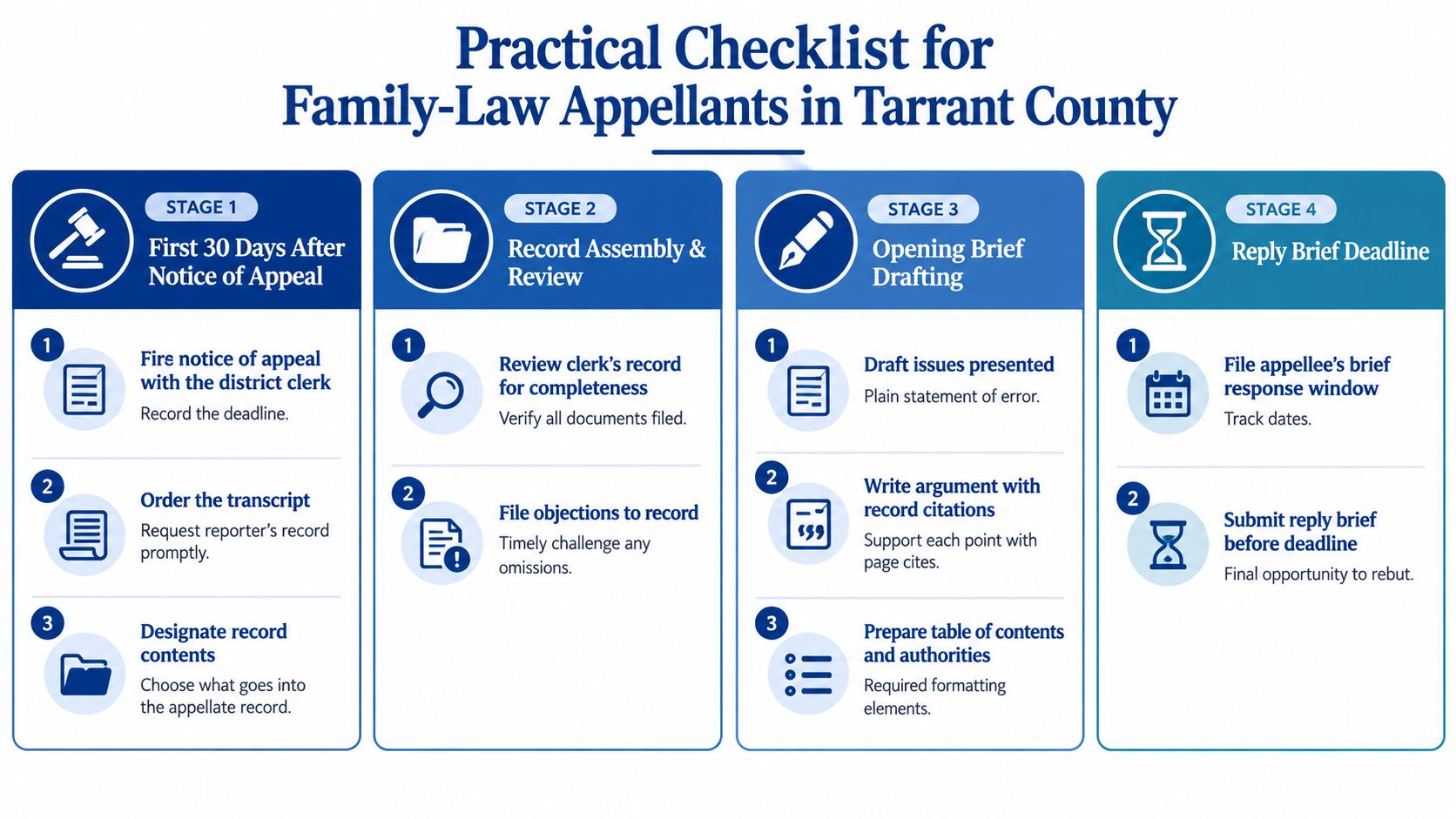
Opening brief drafting
- Create a preservation chart: Match every issue to the trial objection, request, ruling, and record citation.
- Draft precise issues: State the alleged error plainly and include the required preservation citation.
- Follow Rule 9.4: Check formatting, citation form, service materials, and required components.
- Build the argument from the record: Support each material factual assertion with a citation and each legal proposition with authority.
- Assemble the appendix: Include at least the challenged judgment or order and other permitted materials that help the court understand the issue.
After the opening brief
- Calendar the appellee's deadline: Use the briefing order and governing accelerated or ordinary schedule.
- Analyze the response: Separate new arguments from points that require direct rebuttal.
- Limit the reply: Use it to answer the appellee's positions, not to introduce an entirely new appeal.
- Confirm filing logistics: Verify the reply deadline, service list, certificate of service, and acceptance notice.
The Second Court's coverage for Fort Worth and surrounding counties can help you confirm whether your trial-court appeal is routed to this court.
Questions Family-Law Appellants Ask After Reading This Guide
What can't the Second Court do?
The Second Court generally can't consider evidence that wasn't part of the trial record. An appellant can't use the brief as a vehicle for new testimony, new documents, or a recording that was never properly included. If newly discovered evidence matters, a motion for new trial or another trial-court procedure may be the proper vehicle, depending on the circumstances.
The court also doesn't retry credibility disputes just because one parent views the evidence differently. Your brief must identify a reviewable legal error, explain preservation, and direct the panel to the supporting record.
How long does a family-law appeal take?
The schedule varies with the record, motions, briefing, submission, and whether the court requests oral argument. A realistic expectation is that many family-law appeals in the Second District take roughly twelve to eighteen months, but that estimate isn't a guaranteed deadline or outcome.
When should you consult an appellate attorney?
Professional appellate guidance is especially important for a complex property division, a custody modification involving disputed evidence, or an appeal raising constitutional or statutory interpretation issues. An attorney can evaluate preservation, identify the correct standard of review, organize the record, and determine whether the complaint is properly presented.
The strongest time to address preservation is during trial, through timely objections, offers of proof, and requested findings. After judgment, the practical question is whether those actions, the record, and the brief work together. In Fort Worth and Tarrant County family cases, careful record management can give a legitimate appellate issue a fair chance to be reviewed, but no attorney can guarantee that the court will reverse.
If you need help evaluating a Fort Worth or Tarrant County family-law appeal, the Law Office of Bryan Fagan PLLC can help you understand the record, briefing requirements, preservation issues, and available next steps. Visit the firm's resource to learn more about preparing for an appellate consultation and organizing the materials an attorney will need.
