 Skip to content

You've just left a Tarrant County courtroom with a final divorce decree, custody order, or other family-law judgment in hand. You may know you want appellate review, but the urgent question is simple: how many days do you have to file the notice of appeal?
For most ordinary Texas family-law appeals, the answer is 30 days after the trial court signs the judgment. A qualifying, timely post-judgment filing can extend that period to 90 days. Certain accelerated appeals, including termination-of-parental-rights matters, generally allow only 20 days. The Texas Rules of Appellate Procedure control the calculation, and the same statewide timetable applies when an appeal goes to the Second Court of Appeals in Fort Worth.
Table of Contents
- When the Clock Starts on Your Fort Worth Family Law Appeal
- How to Calculate the 30 Day, 90 Day, and 20 Day Deadlines
- Which Post-Judgment Motions Extend the Deadline
- Ordinary Family Appeals Versus Accelerated Parental Rights Appeals
- Filing Logistics at the Second Court of Appeals in Fort Worth
- Common Deadline Mistakes That Get Family Appeals Dismissed
- Practical Next Steps and When to Talk to a Texas Family Law Attorney
When the Clock Starts on Your Fort Worth Family Law Appeal
After a contested hearing in Tarrant County, a parent may receive a copy of the custody order, see it appear on the district clerk's docket, and later receive an email saying it was signed. Those events can happen on different days. For appellate timing, the date that usually controls is the date the trial court signed the final judgment or order, not the day the clerk handed over a copy or the day the parent first read it.
That distinction matters in the 231st District Court and other Fort Worth family courts. A parent who waits for personal notice may lose time without realizing it. The appellate rules generally measure the clock from the signed order, subject to the case-specific rules discussed in the next section. See Texas Rule of Appellate Procedure 26.1 for the governing provision.
Signing, entry, and notice are different events
The judge's signature, the district clerk's entry of the judgment, and notice that the judgment was signed are separate steps. The signed order shows when the trial court acted. The docket entry helps confirm the court's record. Notice can help establish when a party learned about the ruling, but it does not automatically replace the signing date for calculating appellate time.
A findings request can create a different calculation when it is timely and legally proper. In some cases, the relevant period is tied to the filing of the findings rather than calculated only from the original judgment. That is why a lawyer should review the complete file, including the signed order, docket sheet, and any post-judgment filings.
A practical way to avoid confusion is to treat the signed order like the starting mark in a race. The clerk's copy and email are checkpoints, not necessarily the starting mark. Save the order as soon as it becomes available, record the signature date, and ask counsel to calculate the deadline immediately.
Suppose a Tarrant County custody-modification order is signed after a contested hearing. The parent seeking review should first identify the order being challenged, confirm its legal character, and check the record for any timely filing that affects the calculation. The correct branch determines which deadline applies. Choosing the wrong branch can put the appeal's jurisdiction at risk, even when the parent has a strong complaint about the trial court's ruling.
How to Calculate the 30 Day, 90 Day, and 20 Day Deadlines
A Tarrant County parent receives a signed custody order and sees three possible numbers: 30, 90, or 20 days. The right number depends on a single decision tree. Start with the order being challenged, identify whether the appeal is ordinary or accelerated, and then check for a filing that changes the ordinary calculation.
The decision tree
Branch 1: No qualifying filing? → 30 days.
For an ordinary appeal, count from the day after the final judgment or order is signed. Suppose a Fort Worth divorce decree is signed on April 5. Unless another branch applies, the notice of appeal is due 30 days after that signing date.
Branch 2: Qualifying filing made on time in an ordinary appeal? → 90 days.
A filing that meets the applicable requirements can move the ordinary deadline to 90 days. The document's title alone does not decide the issue. Its timing, legal purpose, and the type of order involved all matter. The Texas appellate deadline rules provide the controlling framework.
Branch 3: Termination or certain child-welfare case? → 20 days.
An accelerated parental-rights appeal follows a shorter timetable. The notice of appeal is generally due 20 days after the judgment or order is signed, even if someone is considering a post-judgment filing. The ordinary 30-day and 90-day branches should not be applied automatically.
The findings question
A request for findings of fact and conclusions of law can create a separate calculation when it is timely, legally proper, and connected to an order for which findings are available. In that situation, the relevant deadline may depend on the findings filing rather than just adding days to the original signing date.
For example, if a Tarrant County judge signs an order on April 5 and later files findings after a proper request, the notice deadline must be calculated using the dates and rules that govern that filing. A late request, or a request for an order that does not qualify, may leave the original deadline unchanged. Keep the signed order, the findings request, and the filed findings together for review.
| Deadline Length | Trigger | Typical Family Case | Counting Rule |
|---|---|---|---|
| 30 days | Signed final judgment or order | Ordinary divorce, property, custody, or enforcement appeal | Count from the day after signing |
| 90 days | Qualifying timely filing in an ordinary appeal | Ordinary appeal affected by that filing | Confirm the filing legally changes the deadline |
| 20 days | Signed accelerated judgment or order | Termination-of-parental-rights and certain child-welfare appeals | The ordinary extension framework may not apply |
If the calculated final day falls on a weekend or court holiday, the governing rule may move the deadline to the next business day. Confirm the actual date rather than relying on a calendar shortcut. In a Fort Worth family appeal, choosing the wrong branch can threaten the appeal before the court reaches the parent's arguments.
Which Post-Judgment Motions Extend the Deadline
A Tarrant County parent receives a signed custody order and files a motion asking the trial judge to reconsider it. That filing may or may not change the appellate clock. The document's title does not decide the issue. Its timing, legal purpose, and the type of appeal determine which branch applies.
Use this verification test before relying on an extended deadline:
- Was the filing submitted within the required period after the judgment was signed?
- Is the filing one of the motions recognized under TRAP 26.1(a)?
- Is the case an ordinary appeal rather than an accelerated appeal?
If any answer is uncertain, calculate the original deadline first. Treat that date as the safety line until the filing has been reviewed under the governing rule.
A timely motion for new trial may qualify in an ordinary family appeal. For example, a parent challenging a custody ruling might ask the trial court to address a claimed trial error or other recognized basis for a new trial. A motion to modify, motion to reinstate, or request for findings may receive different treatment depending on its legal requirements and the order involved. The label on the document is less important than what the filing asks the court to do.
Findings of fact and conclusions of law deserve particular care. They can record the trial court's reasoning for appellate review, but a request for findings is not a general-purpose extension. The request must be timely, and the order must be one for which findings are permitted. A late request may leave the original notice deadline in place.
Some post-judgment filings usually do not create more time. A motion for reconsideration, clarification, or a similar request to revisit the ruling does not extend the appellate deadline just because it was filed after judgment. A motion to modify or reform requires the same rule-based review. Filing it does not, by itself, pause the clock.
Filing a non-extending motion can consume the days needed to prepare and file the notice of appeal.
For a Fort Worth parent disputing custody, support, property division, or enforcement, the practical choice is clear. File the notice using the earliest applicable deadline unless a qualified Texas appellate attorney confirms that the filing changes the calculation. Waiting for the trial judge to rule on a motion that does not extend time can put the appeal at risk of dismissal.
Ordinary Family Appeals Versus Accelerated Parental Rights Appeals
A Tarrant County parent can face two very different appellate clocks. A final divorce decree from the 322nd District Court usually follows the ordinary path. An order terminating parental rights from the 233rd District Court follows the accelerated path. The document's subject matter, not just the fact that it came from a family court, determines which branch applies.
For an ordinary appeal, the parent generally has more time to organize the record and legal arguments. That does not make the deadline flexible. A divorce decree involving property division, a custody modification, or an enforcement order may require prompt action even when the case does not involve termination of parental rights.
Termination cases require faster coordination because the appeal concerns the permanent legal relationship between a parent and child. In In the Interest of L.B., K.S., K.B., and T.B., the Second Court of Appeals addressed the statutory direction that parental-rights termination appeals should, so far as reasonably possible, be disposed of within 180 days after the notice of appeal is filed. That disposition target does not replace the filing deadline. It shows why an accelerated case must be identified at the start.
Use the order to choose the branch:
| Tarrant County example | Likely track | What changes in practice |
|---|---|---|
| Divorce decree from the 322nd District Court | Ordinary family appeal | Confirm the ordinary deadline and preserve the right to appeal promptly |
| Termination order from the 233rd District Court | Accelerated parental-rights appeal | Treat the shorter filing window as controlling and begin record preparation immediately |
| Child-welfare order requiring classification | Depends on the order and statute | Have a Texas appellate attorney confirm the track before relying on an ordinary calculation |
A parent should not wait to decide whether an accelerated appeal feels worthwhile. First identify the order, preserve the applicable deadline, and obtain legal review. Assuming every family case receives the ordinary treatment can leave a termination appeal outside the court's jurisdiction.
Filing Logistics at the Second Court of Appeals in Fort Worth
A parent in Tarrant County may have the correct deadline and still lose time by filing in the wrong place. The Second Court of Appeals is located at 401 West Belknap Street, Suite 9000, Fort Worth, Texas 76196-0211. Its public telephone number is 817-884-1900, listed in the court's official Fort Worth appellate information. The court serves a broad North Texas region, so a Tarrant County district court appeal routes there rather than remaining with the trial judge. Review which counties the Second Court of Appeals covers if you are unsure whether the court has jurisdiction over your case.
Prepare the notice and filing method
Most filings go through the Texas appellate e-filing system. A person representing themselves who needs to file paper documents should confirm the court's current rules and obtain any required clerk approval before sending anything by mail or delivery.
The notice of appeal identifies the judgment being challenged and starts the appellate case. It must also be served as required. Keep the submission receipt, timestamp, and any clerk confirmation. Those records show when and how you filed if the other side later questions timeliness.
For Tarrant County filing background, review the district clerk e-filing requirements for family cases and compare them with the appellate court's instructions. These are separate filing destinations. The district clerk handles filings in the trial case, while the appellate clerk handles the appeal, so confirm the destination before submitting the notice.
Coordinate the records
After filing, the appellate clerk manages docketing, case assignment, and related administrative steps. The trial-court clerk prepares the clerk's record. The court reporter prepares the reporter's record from the hearings and trial. A notice of appeal does not automatically ensure that every document or transcript needed for the issues on appeal is included.
Fees and deposits may apply to the filing or requested record. Current amounts and payment methods can change, so verify them with the appropriate clerk instead of relying on an old form or another party's experience.
File before the last day whenever possible. E-filing problems, incorrect case information, missing service, or payment issues are easier to correct when the deadline is not hours away.
Common Deadline Mistakes That Get Family Appeals Dismissed
A Tarrant County parent files a notice of appeal after work, assuming the submission is complete. The notice goes to the district clerk's e-filing queue instead of the Second Court of Appeals, or it reaches the right destination without required service information. The appeal may then face a dismissal argument before anyone addresses the custody or property dispute.
Use this four-part filing check before submitting:
Wrong destination: A notice for an appeal from a Tarrant County family case belongs in the Texas appellate e-filing system, not merely in the trial court's filing queue. The district clerk maintains the trial record, while the appellate clerk receives the notice that starts appellate review. Compare the court's instructions with the Tarrant County district clerk e-filing requirements for family cases, because those are separate filing paths.
Incomplete service proof: Filing the notice is only one part of the submission. Confirm that the required certificate or other service information is included, and keep evidence showing how the other parties were served. A Fort Worth filing that lacks this proof can create a procedural challenge even when the notice itself was submitted on time.
Unverified submission: Save the e-filing receipt, timestamp, payment confirmation, and any clerk message. If the system rejects a document, records showing the attempted submission can help counsel assess what happened. Do not rely on a screen that only says the document was uploaded.
Missing record information: A notice does not identify every hearing, exhibit, or transcript needed to support the issues raised. Tell counsel promptly which Tarrant County hearings matter, and confirm that the clerk's record and reporter's record requests match those issues.
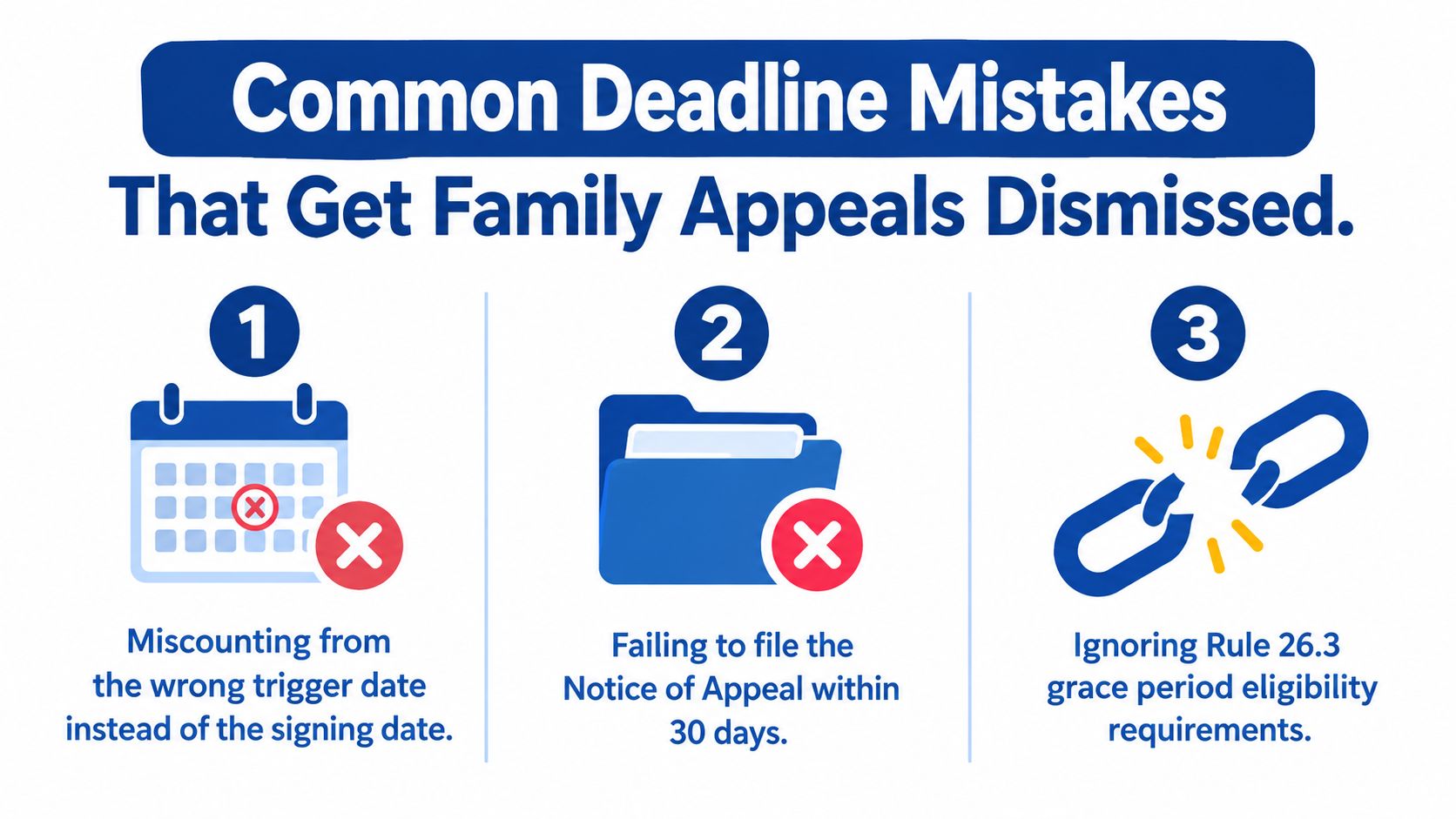
The Texas Supreme Court's discussion of late appellate filings illustrates why a filing problem can become a jurisdictional problem. Before sending the notice, have someone verify the destination, service proof, submission record, and record requests. Those four checks address different failure points, so completing one does not replace the others.
Practical Next Steps and When to Talk to a Texas Family Law Attorney
A parent in Fort Worth may learn on Friday that a final order was signed weeks earlier. Before guessing which deadline applies, build one timeline. Put the signature date at the top, identify whether the appeal is ordinary or accelerated, record each qualifying post-judgment filing and its date, then mark the possible 30-day, 90-day, or 20-day branch.
A same-day checklist
- Preserve the order. Save the signed judgment, docket information, clerk notices, and proof showing when the order was entered or served.
- Classify the appeal. Decide whether the order is an ordinary final decree or an accelerated parental-rights or child-welfare order. That choice changes the starting point and the time available.
- Audit post-judgment filings. List any motion for new trial, motion to modify, motion to reinstate, or request for findings. Confirm that each was timely and legally qualifying, rather than assuming its title extends the clock.
- Protect the record. Ask the district clerk about the clerk's record. Contact the Tarrant County court reporter for the 231st, 233rd, or 322nd District Court immediately to confirm transcript availability. Reporter records are ordered separately from the clerk's record.
- File and serve correctly. Use the Texas appellate e-filing system, then save the submission receipt, timestamp, payment confirmation, service record, and any clerk message.
If the ordinary deadline has passed, review TRAP 26.3 with counsel using your actual docket and filing history. The extension process has specific filing and explanation requirements, so treat it as a narrow procedural option, not a reset of the appeal clock.
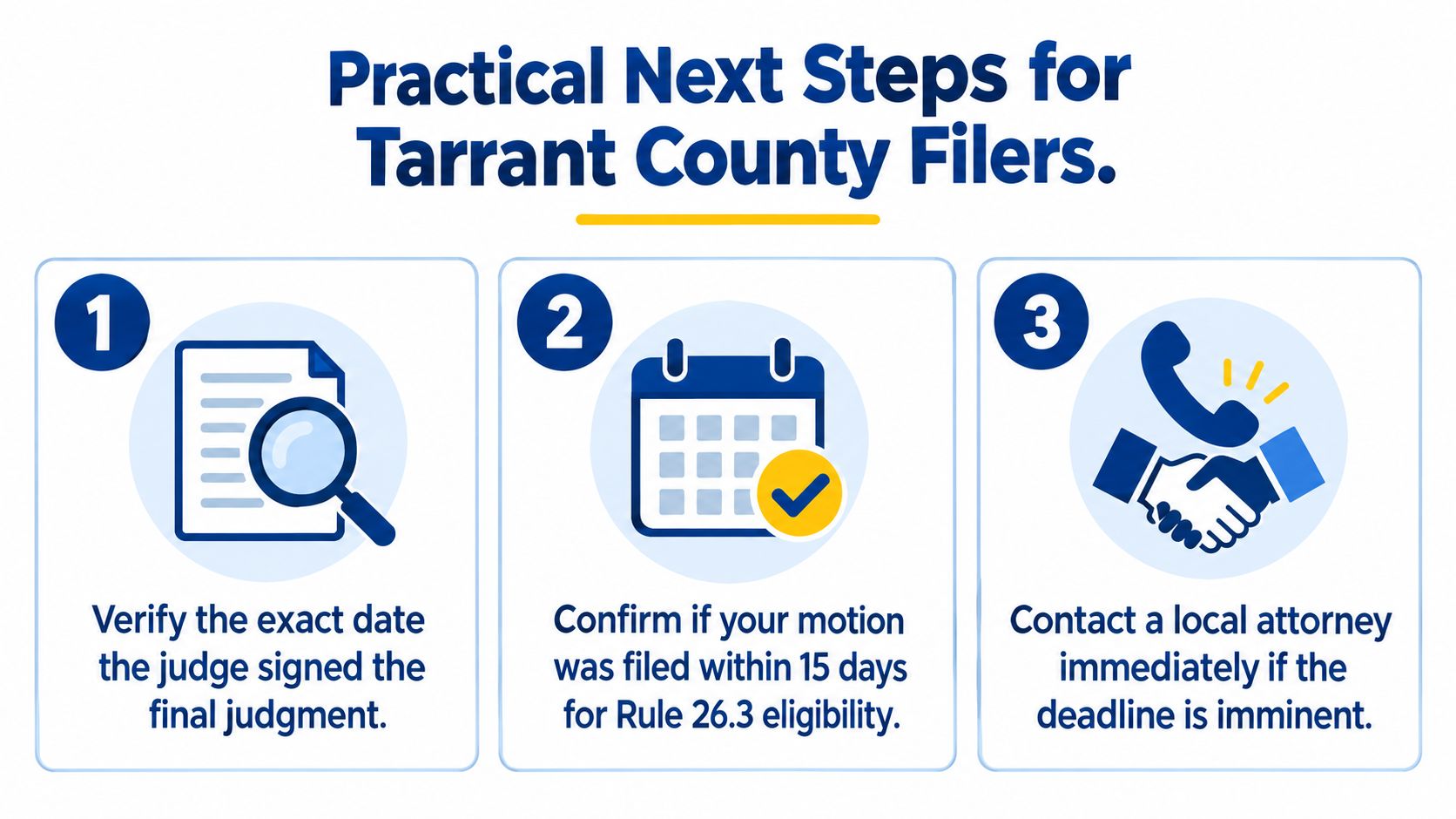
Call a Texas family-law appellate attorney promptly after a termination order, after filing a post-judgment motion, or whenever the order date and deadline branch are uncertain. Counsel can compare the signed order, docket history, motions, and proposed issues, then determine which filing path fits. The Texas family law appeals resource can help organize questions before that call.
The Law Office of Bryan Fagan PLLC provides Texas family-law appellate guidance, including deadline review, notice-of-appeal preparation, and record coordination for Fort Worth and Tarrant County matters. If you cannot tell whether your case follows the 30-day, 90-day, or 20-day branch, review the available next steps and request a consultation through Law Office of Bryan Fagan PLLC.
