 Skip to content

The Second Court of Appeals district covers Archer, Clay, Cooke, Denton, Hood, Jack, Montague, Parker, Tarrant, Wichita, Wise, and Young counties. Tarrant County is the core county because the court sits in downtown Fort Worth.
If a family in Fort Worth receives an unfavorable ruling in a family district court, the next appellate court is usually the Second Court of Appeals. That doesn't mean the case starts over. The court reviews what happened in the trial court, the legal arguments raised, and the record created there.
For a parent challenging a custody order, a spouse disputing property division, or someone responding to an appeal, knowing which counties the court covers is only the first step. You also need to understand what the court can review, what it can't do, and how an appeal affects your case.
Table of Contents
- The Twelve Counties in the Second Court District
- What an Intermediate Appeals Court Actually Does
- How a Tarrant County Case Reaches the Second Court
- Why the Fort Worth Location Matters for Local Families
- Direct Appeals Versus Original Proceedings
- Practical Steps if You Have a Case in This District
- When It Makes Sense to Talk With a Family Law Attorney
The Twelve Counties in the Second Court District
The Second Court of Appeals serves Archer, Clay, Cooke, Denton, Hood, Jack, Montague, Parker, Tarrant, Wichita, Wise, and Young counties. The court's principal location is the Tim Curry Criminal Justice Center at 401 West Belknap Street in downtown Fort Worth, making Tarrant County the administrative center of the district. The court's official materials identify it as an intermediate appellate court serving these twelve counties. The Texas courts' official district information provides the county list and regional structure.
| County | County seat |
|---|---|
| Archer County | Archer City |
| Clay County | Henrietta |
| Cooke County | Gainesville |
| Denton County | Denton |
| Hood County | Granbury |
| Jack County | Jacksboro |
| Montague County | Montague |
| Parker County | Weatherford |
| Tarrant County | Fort Worth |
| Wichita County | Wichita Falls |
| Wise County | Decatur |
| Young County | Graham |
A useful way to picture the district is by geography. Denton and Cooke counties sit in the northern portion. Tarrant, Parker, Hood, and the counties closer to Fort Worth form the central part of the district. Archer, Clay, Jack, Montague, Wichita, Wise, and Young counties extend across the western and northwestern parts of North Central Texas.
The Texas Legislature created the district. Individual counties don't choose a different intermediate appellate court when a party disagrees with a trial-court ruling. If the trial court is located in one of these twelve counties, the resulting appeal generally goes to the Second Court.
Practical rule: County coverage tells you where an appeal belongs. It doesn't, by itself, tell you whether a particular order can be appealed.
A Tarrant County family is more likely to interact directly with the Fort Worth courthouse because the court is located there. Families in the other counties may have fewer in-person connections with the court, but their appeals still enter the same regional appellate system. The district handles appeals from approximately 100 lower courts across the twelve counties, according to official Second Court information.
What an Intermediate Appeals Court Actually Does
An intermediate appellate court reviews decisions from trial courts. It doesn't conduct a second trial, interview new witnesses, or decide the case from a blank page.
Think of a family-law trial as a stage performance. The trial judge hears testimony, receives exhibits, applies the law, and signs an order. The appellate court later reviews the script and the direction. The record of the hearing, including the clerk's record and reporter's record, shows what the trial court had before it and what legal rulings were made.
The Second Court is part of Texas's two-level appellate structure. After the intermediate court issues its decision, a party may seek review from a higher Texas court, depending on the type of case and the legal issue involved. The Second Court itself is composed of seven justices, although a particular appeal may be considered by a panel of three justices. The court's official history and jurisdiction page describes its role in reviewing appeals from district and county courts in the twelve-county district.
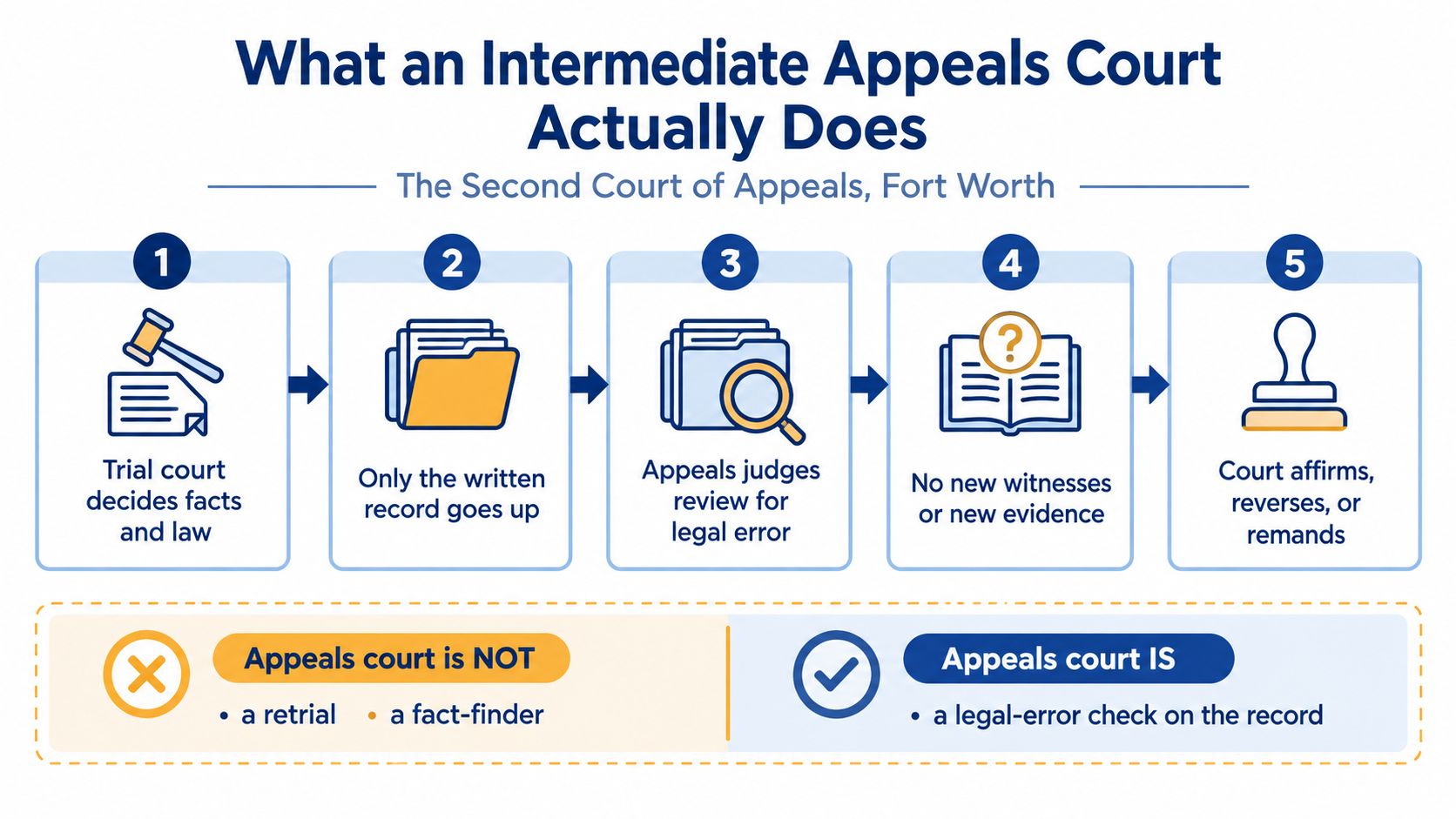
What the justices review
The justices usually work from:
- The written record: Pleadings, orders, admitted exhibits, and other documents filed in the trial court.
- The reporter's record: The transcript of testimony and oral proceedings when a court reporter recorded them.
- The parties' briefs: Written arguments explaining the alleged legal errors and the response to those arguments.
- Oral argument, when allowed or scheduled: A focused opportunity for attorneys to answer questions from the panel.
New evidence generally isn't introduced on appeal, and new witnesses don't appear to retell the case. That's why a complaint about what happened during a custody hearing must be supported by the trial record, not only by a later explanation from a parent.
The court may issue a published opinion or an unpublished memorandum opinion. A published opinion can carry precedential significance, while an unpublished memorandum opinion generally serves a more limited role. The available remedies can include affirming the trial court, reversing part or all of the ruling, remanding the matter for further proceedings, or dismissing the appeal.
A Tarrant County parent considering an appeal can review the firm's family law appeals resource for a general explanation of issues that often arise. The legal question is usually not whether the trial judge reached a result that feels unfair. It's whether the ruling reflects a reversible legal error shown by the record.
How a Tarrant County Case Reaches the Second Court
Consider a hypothetical property-division dispute after a Tarrant County divorce. The trial judge signs a final decree dividing marital property, and one spouse believes the court made a legal error in handling a particular asset.
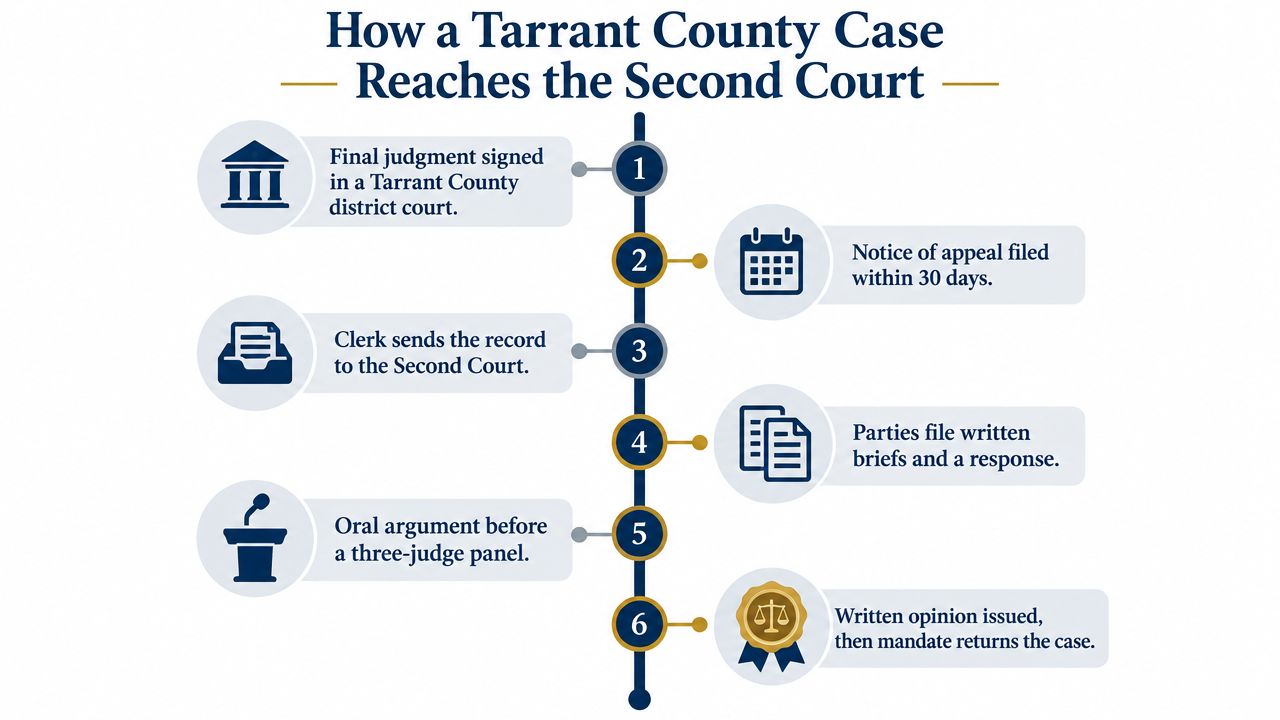
The first decision is not “write an appellate brief.” The first decision is whether the order is final and appealable, whether the Second Court has jurisdiction, and when the notice of appeal must be filed. Appellate deadlines are strict, and the correct deadline depends on the procedural history of the case. A party shouldn't rely on a general rule or a date remembered from another case.
Once the appeal is properly initiated, the record must be assembled. The trial-court clerk prepares the clerk's record, while the court reporter prepares the reporter's record when a transcript is needed. If testimony about the asset was given at a hearing but isn't included in the appellate record, the reviewing court may not be able to consider an argument that depends on that testimony.
Briefing and review
The spouse bringing the appeal, called the appellant, files an opening brief. That brief identifies the alleged errors, explains the governing legal principles, and connects each argument to the record. The other spouse, the appellee, answers in a response brief. The appellant may then file a reply addressing the response.
The court may decide the case from the written submissions or schedule oral argument. If oral argument is scheduled, it may take place at the Fort Worth courthouse, but the attorney must follow the court's instructions about appearance and presentation. The justices then issue a written opinion or memorandum opinion.
Possible outcomes include:
- Affirm: The trial court's ruling remains in place.
- Reverse and render: The appellate court changes the result and renders the decision the law requires.
- Reverse and remand: The appellate court sends the matter back for further proceedings.
- Dismiss: The court ends the appeal without reaching the merits in some circumstances.
After the appellate decision becomes final, the mandate formally returns jurisdiction to the trial court. The trial court may then carry out whatever further action the appellate decision requires. The entire process can take roughly twelve to eighteen months from filing to mandate, but that figure is a general estimate rather than a promise. Timing depends on the record, briefing, motions, oral argument, and any further review.
A related issue can arise when a case involves different types of Tarrant County judges or trial-court orders. The distinction between an associate judge and a district judge may affect how a family-law matter proceeds, so readers can review this comparison of associate judges and district judges in family cases. Every step has its own rules and deadlines.
Why the Fort Worth Location Matters for Local Families
A Tarrant County family may receive an unfavorable ruling in a Fort Worth trial court and then face an appeal. The Second Court's Fort Worth location gives that regional appellate system a local center. It sits at the Tim Curry Criminal Justice Center, 401 West Belknap Street. Its office hours are Monday through Friday, 8:00 a.m. to 5:00 p.m., except holidays, according to the court's official website.
That local address can make the appellate process easier to understand, even though the court serves multiple counties. An attorney may communicate with the clerk's office, monitor filings, prepare for oral argument if one is scheduled, or address an issue arising from a Fort Worth trial-court record. Those tasks connect the appeal to the same community where the family's dispute began.
The courthouse's location does not change the legal test. A Tarrant County parent and a Denton County parent must both identify a reviewable error and support the argument with the trial-court record. Fort Worth may affect travel and coordination, but it does not guarantee faster review, simpler access, or a favorable outcome.
The court's reach extends across a 12-county district: Archer, Clay, Cooke, Denton, Hood, Jack, Montague, Parker, Tarrant, Wichita, Wise, and Young counties. Eligible civil and criminal appeals from those counties follow the same intermediate appellate path. For a local family, the address is Fort Worth, but the jurisdiction is regional.
The courthouse is local to Fort Worth, but the court's jurisdiction is regional.
If a family lives outside Tarrant County, the county where the trial court sits is a useful starting point for identifying the proper appellate court. Venue can raise a separate question before a divorce begins. Families living in another county can review this guide to Fort Worth divorce venue when you live in a neighboring county.
Direct Appeals Versus Original Proceedings
Many family-law litigants use the word “appeal” for every request sent to an appellate court. Texas appellate practice separates a direct appeal from an original proceeding, and the distinction can change the available remedy and the urgency of the filing.
A direct appeal usually follows a final trial-court judgment or another order that the law allows a party to appeal. The appellate court reviews the existing record and the legal complaints raised by the appellant. An original proceeding starts in the appellate court itself. The party asks the court to issue extraordinary relief, such as a writ of mandamus or habeas corpus.
| Feature | Direct appeal | Original proceeding, such as mandamus |
|---|---|---|
| Starting point | An appeal from an eligible trial-court ruling | A request filed directly in the appellate court |
| Main purpose | Review alleged legal error in the existing record | Ask the appellate court to compel or prohibit specific action |
| Typical family-law example | Challenge a final divorce decree or appealable custody ruling | Challenge a serious discovery ruling or seek extraordinary relief |
| Evidence and record | Based on the trial-court record | Often requires a focused record showing why extraordinary relief is justified |
| Timing | Controlled by applicable appellate deadlines | May require immediate action when delay would defeat the requested relief |
| Result | Affirmance, reversal, remand, or dismissal may follow | The court may grant, deny, or request a response to the petition |
A parent who disagrees with a final custody judgment may need a direct appeal. A party who believes a trial judge acted outside the court's lawful authority may consider mandamus, but mandamus isn't just a faster appeal. It has its own requirements, and the appellate court's willingness to intervene is limited.
Habeas-related relief is different again. For example, a person held under a family-court contempt order may raise a habeas issue, but the appropriate procedure depends on the order, the detention, and the legal basis for the challenge. A lawyer must assess the actual record rather than selecting a filing based on the label alone.
The Second Court also handles original proceedings arising from cases in its twelve-county district, including mandamus and habeas-type requests, as described in the court's official fiscal-year materials. These matters can require a faster and more targeted strategy than a standard appeal.
Practical Steps if You Have a Case in This District
If your family-law case began in Fort Worth or another covered county, use this checklist to organize the first conversation with counsel.
Confirm the county and court. Verify that the trial court sits in Archer, Clay, Cooke, Denton, Hood, Jack, Montague, Parker, Tarrant, Wichita, Wise, or Young County. Then identify the order being challenged and determine whether it's final or otherwise appealable.
Check the deadline from the governing rules. Don't guess based on the phrase “thirty days” or “sixty days.” Read the applicable Texas Rules of Appellate Procedure and have a licensed attorney evaluate how the judgment, post-judgment motions, notice, and service affect the calculation.
Preserve the trial record. Save the signed order, pleadings, admitted exhibits, hearing notices, motions, and correspondence. Ask about obtaining the reporter's record if testimony matters. An appellate court can't rely on evidence that never became part of the record.
Create a short procedural timeline. List the hearing dates, the date the ruling was signed, post-judgment filings, and communications about the record. This helps counsel identify urgent issues without forcing you to reconstruct the case from memory.
Use official court information. The Second Court of Appeals website provides official information about the court, clerk, location, and filings. Court websites and rules should be checked for current requirements because procedures can change.
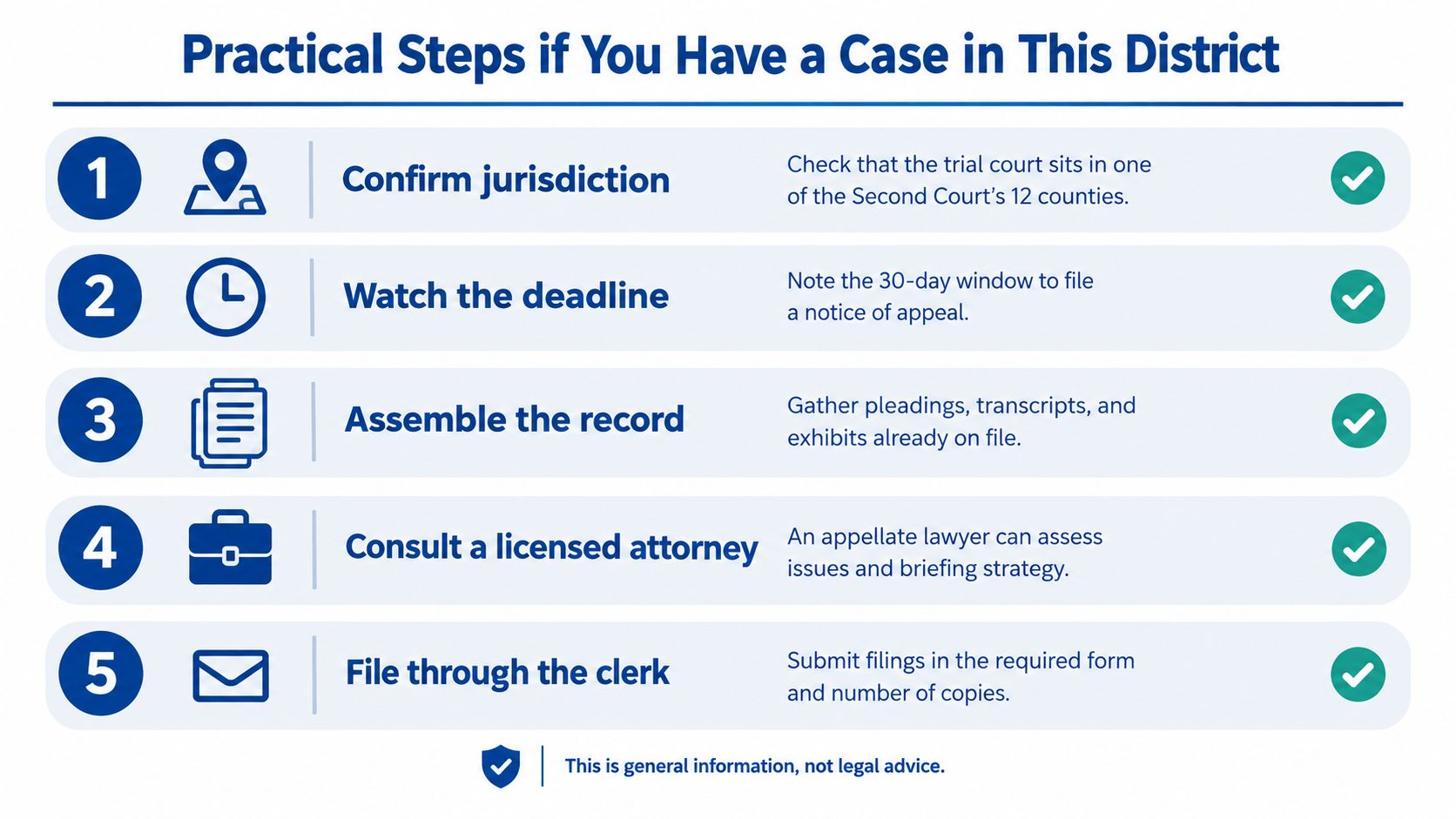
Gathering documents is something you can do immediately. Deciding which issues to raise, drafting a brief, and choosing between a direct appeal and an original proceeding require legal judgment from a licensed attorney.
When It Makes Sense to Talk With a Family Law Attorney
A focused legal review makes sense when a final decree or appealable order has been signed, especially if the ruling affects custody, possession, child support, property division, enforcement, or contempt. It's also sensible to seek help when a trial-court ruling limits your future options, changes the practical terms of parenting, or raises a question you can't answer from the order itself.
Timing matters because appellate deadlines can be strict and may affect the court's jurisdiction. If you're uncertain whether an order is final, don't wait for the opposing party to explain it. The opposing party may have a different view of the deadline or the available remedy.
Before a consultation, collect:
- The trial-court cause number and county.
- The signed judgment, decree, or order.
- A rough timeline of hearings and rulings.
- Important pleadings and motions.
- Information about any current attorney-fee arrangement.
- Notes identifying the specific ruling you believe was wrong and why.
A lawyer will typically begin by reviewing the judgment and the available record. The discussion should include the possible strengths and weaknesses of the appellate issues, whether the record supports those issues, and whether the matter belongs in a direct appeal or an original proceeding.
Fee arrangements can vary. Some attorneys may offer flat-fee appellate work for a defined scope, while others may bill hourly. Ask what the proposed representation includes, such as the notice of appeal, record preparation, briefing, oral argument, motions, or further review.
You can also consult the State Bar of Texas attorney directory and the Tarrant County Bar Association lawyer referral resources. Those directories can help you locate attorneys for an independent consultation. No directory can determine whether your order is appealable or preserve a deadline for you.
The Law Office of Bryan Fagan PLLC provides family-law information and handles family-law matters, including appeals, for people seeking guidance about Texas family-court rulings. A consultation can help you organize the Fort Worth or Tarrant County record, identify the procedural path, and understand the next filing decision without promising a particular outcome.
If a Tarrant County family-law ruling may be appealable, gather the signed order and your case timeline now rather than waiting for uncertainty to become a missed deadline. Visit Law Office of Bryan Fagan PLLC to learn about family-law appeals and request guidance about the Second Court of Appeals process.
