 Skip to content

A missed child support payment can quickly become more than a private disagreement. You may be looking at a notice telling you to appear in court, or you may be trying to understand why repeated nonpayment has placed your case on a contempt docket in Fort Worth. The terms can sound intimidating, especially when the notice refers to a motion for enforcement, a Title IV-D court, or possible jail consequences.
The Tarrant County child support enforcement contempt docket is the local court track for addressing alleged violations of child support orders. It isn't a generic family-law calendar. It operates within Tarrant County's Title IV-D child support system, where enforcement cases are centralized, scheduled, and handled through specialized court administration.
Table of Contents
- What the Tarrant County Contempt Docket Is and How It Works
- How to File for Enforcement and Get on the Contempt Docket
- Choosing the Right Enforcement Remedy Beyond Contempt
- How to Defend Against a Contempt Allegation and Prove Your Case
- What Happens on Your Contempt Docket Court Day in Fort Worth
- Practical Next Steps After Your Enforcement Hearing
What the Tarrant County Contempt Docket Is and How It Works
Suppose a parent in Fort Worth has missed payments for several months and receives a notice requiring a court appearance. The notice may refer to contempt, but the case usually begins with a broader enforcement process. The court must determine what support was ordered, what payments were required, what payments were made, and whether the alleged violations satisfy the legal requirements for the requested relief.
Tarrant County's Title IV-D Court is the dedicated county court for child support matters, and the county states that it hears all Title IV-D child support cases within Tarrant County. The county's Title IV-D Court information identifies this structure as the local forum for these cases.
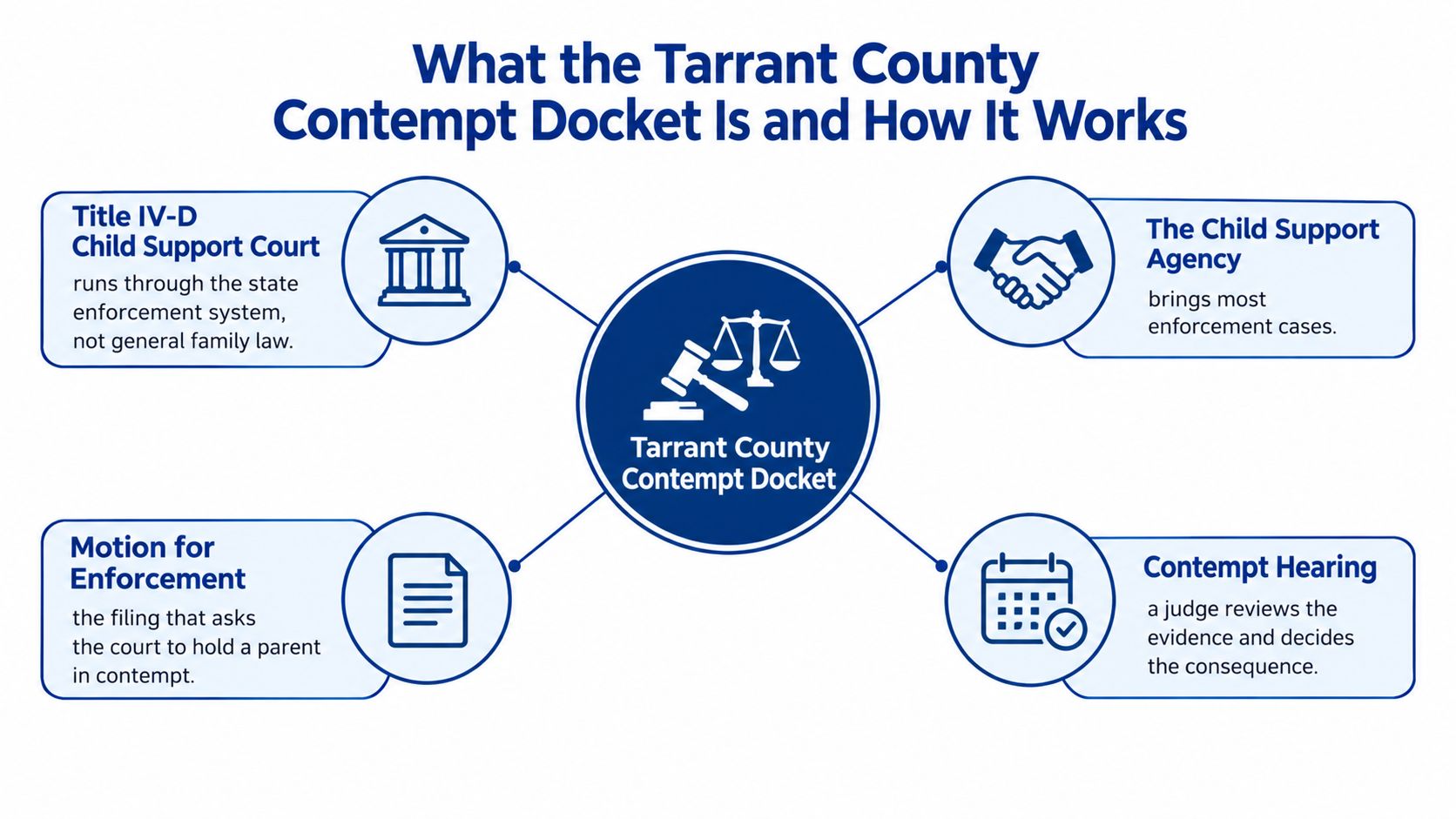
Why the Title IV-D structure matters
The Texas Attorney General's child support enforcement system often provides the administrative foundation for an enforcement case. Tarrant County's enforcement materials direct residents with active child support enforcement matters to its Legal Support Services office and provide a direct phone line. That reflects an established local system, not an informal hearing arranged outside the court structure.
The docket also differs from a custody or modification setting. A modification asks the court to change an existing order because circumstances have changed. An enforcement case asks the court to require compliance with an order already in place. The same family may have both types of cases, but they serve different purposes.
Practical rule: A contempt docket focuses on alleged violations of an existing support order. It doesn't automatically rewrite the support obligation.
Tarrant County's court and docket information indicates that civil dockets are maintained by individual court coordinators. That means scheduling and case administration occur within the county's court-by-court system. If you're trying to find the correct forum, start with the Title IV-D structure rather than searching for a general Fort Worth family-law calendar. Readers looking for a local explanation can also review this guide to the Tarrant County Title IV-D child support court docket.
How to File for Enforcement and Get on the Contempt Docket
A contempt case doesn't begin with a missed payment alone. It begins with a motion for enforcement that asks the court to hold the other parent in contempt. Texas Family Code Chapter 157 governs the enforcement procedure, including the required notice and appearance rules. The Texas Family Code enforcement provisions are the primary authority for this process.
Build the motion around specific violations
A strong filing should identify the order being enforced and describe the alleged violations separately. Rather than writing that a parent “hasn't paid child support,” the motion should connect the obligation to specific missed or incomplete payments, dates, and amounts shown by the available records.
Useful preparation includes:
- Gather payment records: Collect payment histories, arrears information, receipts, bank records, and copies of prior support orders.
- Separate each alleged violation: Identify the payment or obligation at issue instead of combining every complaint into a vague narrative.
- Request appropriate relief: A motion may seek contempt while also asking for alternatives such as an arrearage judgment, wage withholding, or license-suspension relief.
- Confirm the correct parties and order: The court needs a clear connection between the respondent, the enforceable order, and the alleged failure to comply.
After the motion is filed, the court sets the hearing's date, time, and place and orders the respondent to personally appear. The respondent must receive personal service at least 10 days before the hearing, as required by Texas Family Code Chapter 157. Service is not a technical detail to overlook. It can determine whether the court may impose contempt-based relief.
Treat service and filing logistics as part of the case
A filing can contain persuasive payment records and still face a serious procedural problem if the respondent wasn't properly served. Keep copies of the filed motion, service documents, the operative support order, and all supporting records. If you're filing electronically, review the applicable Tarrant County family-case e-filing requirements before submitting documents.
Texas gives child-support enforcement motions priority on the docket. The court can't delay the enforcement hearing merely because another suit for modification is pending. A parent therefore shouldn't assume that a pending request to change support will automatically pause the enforcement case.
Choosing the Right Enforcement Remedy Beyond Contempt
Contempt is serious, but it isn't the only enforcement tool. The Texas Office of the Attorney General describes contempt as one remedy among others, including probation and possible incarceration. It also identifies administrative measures such as suspending driver's, professional, hunting, and fishing licenses through more than 60 licensing agencies in its explanation of what child support enforcement can and cannot do.
The practical question is often not “Can I ask for contempt?” but “What combination of remedies addresses the problem and creates a workable path to compliance?”
Enforcement Remedies Compared for Tarrant County Cases
| Remedy | When It Helps | Key Requirement |
|---|---|---|
| Contempt | When the evidence supports a finding that an existing order was violated and the requested contempt relief is legally available | A properly pleaded motion, proper service, and specific proof of the alleged violations |
| Arrearage judgment | When the unpaid support needs to be formally established as a judgment | Reliable payment and arrears records tied to the support order |
| Wage withholding | When the paying parent has identifiable employment or income subject to withholding | Accurate employment or income information and an enforceable support obligation |
| Probation | When structured compliance conditions may be more useful than immediate incarceration | A court order setting the applicable conditions and obligations |
| License suspension | When administrative pressure may encourage compliance | Eligibility under the applicable enforcement process and coordination with licensing agencies |
| Possible incarceration | When the court determines that contempt-based incarceration is legally supported | Proof satisfying the requirements for contempt and a valid commitment order |
A parent seeking enforcement can request alternatives instead of relying entirely on jail. A parent defending a case should understand that partial payment, unstable income, or a proposed payment plan may affect the evidence and the remedy the court considers, but none of those facts should be assumed to eliminate the underlying obligation.
The better request is often a legally supported compliance plan, not a remedy chosen only because it sounds severe.
How to Defend Against a Contempt Allegation and Prove Your Case
A parent accused of contempt should prepare evidence, not just an explanation. Saying “I couldn't afford it” may be true, but the court needs records that connect the claimed inability to pay with actual income, expenses, employment changes, disability, or partial payments.
Organize the defense around the allegations in the motion. If the filing identifies multiple missed payments, review each one separately. A court may analyze separate alleged violations individually, so a general statement about financial hardship may not address every claim.
Documents that can clarify inability to pay
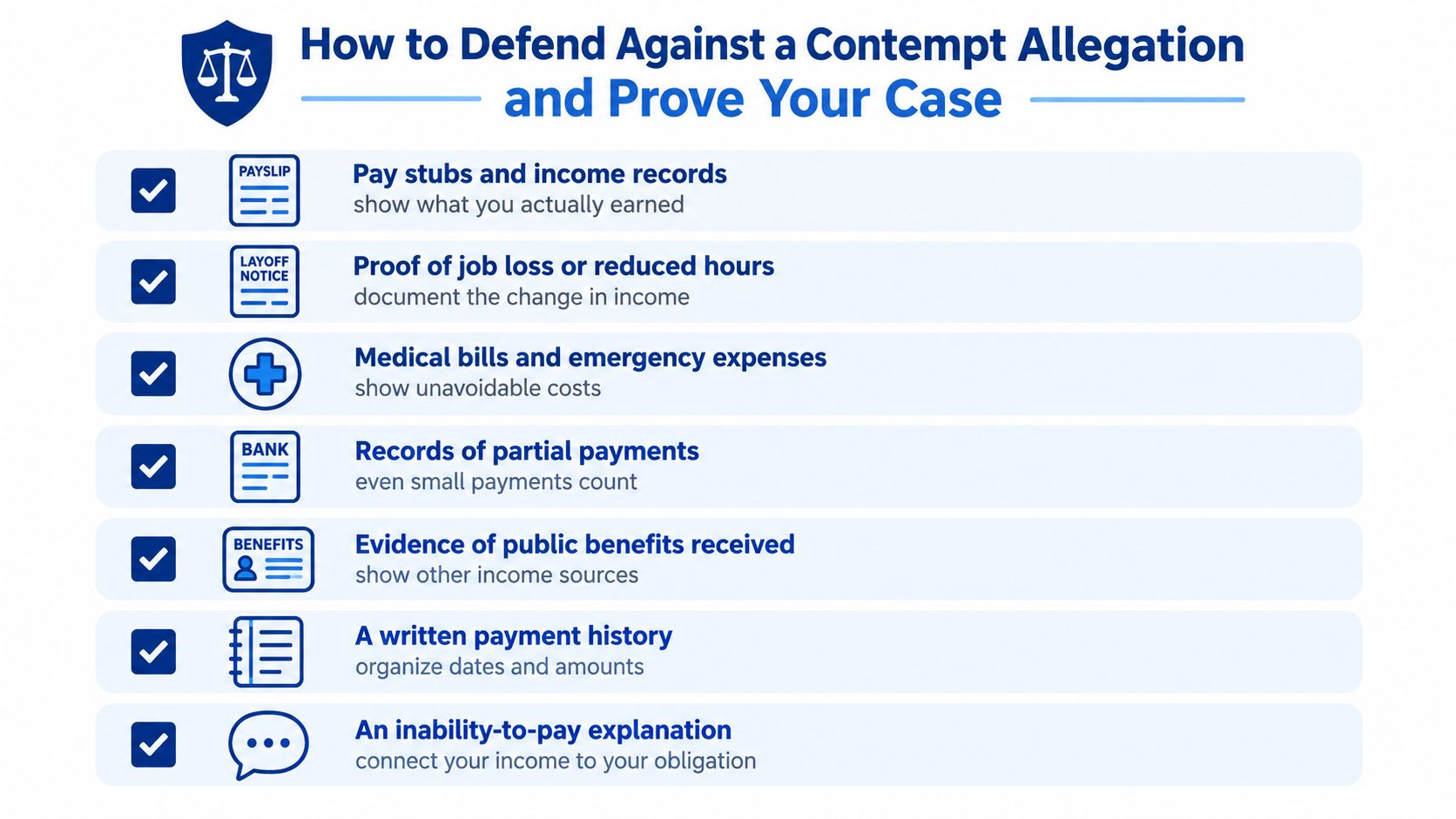
Bring organized records such as:
- Pay stubs and income records: Show what you earned during the period identified in the motion.
- Proof of job loss or reduced hours: Preserve termination notices, employer communications, and schedules that document the change.
- Medical bills and emergency expenses: Use invoices and payment records to explain unavoidable costs.
- Records of partial payments: Bank statements, receipts, and payment confirmations can establish that some payments were made.
- Evidence of public benefits received: These records may help present a complete picture of available income.
- A written payment history: Create a date-by-date ledger that matches payments to the support obligation.
- An inability-to-pay explanation: Explain how income and necessary expenses affected compliance, using documents to support each point.
Why the written order matters
A recent Fort Worth Court of Appeals case from Tarrant County involved a parent who appealed a contempt order for failure to pay child support and medical support. The trial court entered an order granting judgment and commitment to county jail, as reflected in the Fort Worth Court of Appeals case record.
That procedural history illustrates why the written order deserves close attention. Specific findings identify which obligations the court treated as violations and what relief followed. If an appeal or later challenge becomes necessary, the record and written findings matter more than an informal summary of what happened in the courtroom.
Don't arrive with loose papers, incomplete payment screenshots, or a verbal explanation that doesn't match the dates in the motion. A clear timeline helps the court evaluate partial payments, changing income, disability claims, and other defenses without forcing the judge to reconstruct the facts from scattered documents.
What Happens on Your Contempt Docket Court Day in Fort Worth
Court day usually begins with practical tasks. Confirm the courthouse location, allow time to pass through building security, bring your filed documents and identification, and follow the court's instructions about check-in. A parent may wait while the coordinator calls cases and determines which matters are ready to proceed.
The hearing may involve review of the support order, payment records, arrears information, service documents, and testimony. The judge may hear from both sides and consider whether the alleged violations were proven and what relief is legally appropriate. No one should assume that a hearing will produce a particular result because payments are overdue or because the respondent has a financial explanation.

Pending modification doesn't automatically stop enforcement
Texas law gives child-support enforcement motions priority on the docket. The court may not postpone the enforcement hearing because a separate modification suit is pending. A parent who believes the current support amount should change must address modification through the proper legal process while also responding to the enforcement matter.
For location information and building guidance, review this resource about the Tarrant County Family Law Center at 200 East Weatherford. Check current court instructions before appearing because building access and scheduling information can change.
What happens if someone doesn't appear
Personal service and appearance are separate issues. If the respondent was personally served but doesn't appear, Texas Family Code § 157.066 provides that the court may not hold that person in contempt for the failure to appear itself. The court may instead enter a default judgment on proper proof and issue a capias for arrest, as described in Texas Family Code § 157.066.
That distinction matters. Missing court doesn't make the case disappear, and it can leave the court considering other requested relief without hearing the absent parent's explanation.
Practical Next Steps After Your Enforcement Hearing
After the hearing, read the signed order carefully. Confirm what the court decided about arrears, payment obligations, withholding, probation, contempt, or other requested relief. Keep the order with your payment records, because future compliance depends on knowing exactly what the court required.
If you're the parent receiving support, track payments consistently and preserve records of missed or partial payments. If you're the parent ordered to pay, follow the order as written, make payments through the authorized channel, and keep confirmation of every payment. A new financial problem should be addressed through the proper legal process rather than handled through self-help or an informal decision to stop paying.
An attorney may be appropriate when the motion requests contempt or incarceration, the payment history is disputed, service appears defective, multiple orders are involved, income has changed substantially, or a modification and enforcement case are moving at the same time. A qualified Fort Worth family-law attorney can review the order, evidence, procedural history, and available remedies without promising a particular result.
The Law Office of Bryan Fagan PLLC helps Fort Worth and Tarrant County parents understand child support enforcement, contempt allegations, payment records, and courtroom procedure. Visit the firm to learn about the Start Here process and schedule a consultation about the facts of your enforcement matter.
