 Skip to content

You may be looking at a Tarrant County case record because a child-support payment is missing, a hearing date changed, or a notice arrived with the words Title IV-D printed across the top. The docket can look cryptic, especially when you're trying to determine whether the case involves a routine review, a proposed modification, or an enforcement action.
The Tarrant County Title IV-D child support court docket is a specialized family-law docket. It isn't a criminal calendar, and it isn't a general search page for every family-law dispute. It tracks child-support matters handled through the county's Title IV-D system, including parentage, support establishment, modification, enforcement, and related medical-support obligations. The practical guide below explains what that designation means, how to search for a case, how to read common entries, and when the docket isn't enough to answer your question.
Table of Contents
- Finding Yourself on a Tarrant County IV-D Docket
- What Title IV-D Means in Tarrant County
- How to Search the Tarrant County IV-D Docket
- Reading the Entries on a Tarrant County IV-D Docket
- Contacting the Title IV-D Office in Fort Worth
- Why Some Docket Details Stay Private
- Practical Next Steps for Tarrant County Parents
Finding Yourself on a Tarrant County IV-D Docket
A Fort Worth parent may learn about the docket after rearranging work, arranging transportation, and preparing for a hearing, only to discover that the setting was moved. Another parent may be checking the record because an expected payment never arrived and a notice mentions an IV-D court. In either situation, the first useful step is identifying what kind of calendar you're dealing with.
Tarrant County's official Title IV-D Court page explains that the court hears all Title IV-D child-support cases within the county. Those cases can involve:
- Locating an absent parent, when the child-support process requires help finding a parent.
- Establishing parentage, when legal parentage must be determined.
- Establishing support, including child-support or medical-support obligations.
- Modifying support, when an existing order may need to change.
- Enforcing support, when a parent allegedly hasn't followed an existing order.
The county operates dedicated IV-D courts, including IV-D Court No. 1 and IV-D Court No. 2, rather than treating these matters as occasional assignments inside a broader family-law calendar. You can review the county's description of the specialized docket through the official Tarrant County IV-D Courts page.
What the docket can and can't tell you
A docket generally gives you a record of scheduled events, filed documents, party names or identifying information, and case-status entries. It can help you confirm that a hearing was set, continued, reset, or resolved by an order.
It doesn't automatically establish that a parent owes arrears, that a payment was missed, or that support has been changed. Those conclusions may require reviewing the order, payment records, filed pleadings, and the court's actual ruling.
Practical rule: Treat a docket entry as a signpost. It tells you where the case is in the process, but it usually doesn't tell the full story.
Being listed on an IV-D docket also isn't a mark of misconduct or a criminal designation. It means the case is being handled through a specialized child-support enforcement structure. The rest of this guide focuses on how that structure works in Tarrant County and how to investigate your case without relying on a short docket notation as if it were a complete court record.
What Title IV-D Means in Tarrant County
Title IV-D refers to the child-support enforcement program created under Part D of the federal Social Security Act. In Texas, the Office of the Attorney General provides state-level child-support services, while Tarrant County's Domestic Relations Office provides local support connected to the county's IV-D process.
A key local rule dates to October 16, 2000. Tarrant County's local IV-D rule provides that final divorce decrees signed on or after that date, when they include child support, are deemed to include an application for Title IV-D child-support services through the Domestic Relations Office and the Texas Attorney General. The rule also applies to qualifying final paternity decrees that weren't obtained by a Title IV-D agency. A recipient can refuse those services by filing a written refusal.
That arrangement explains why a parent may have a privately handled divorce or paternity case but later see child-support activity connected to the IV-D system. The support portion of the order may have entered the administrative enforcement structure without a separate, dramatic enrollment event.
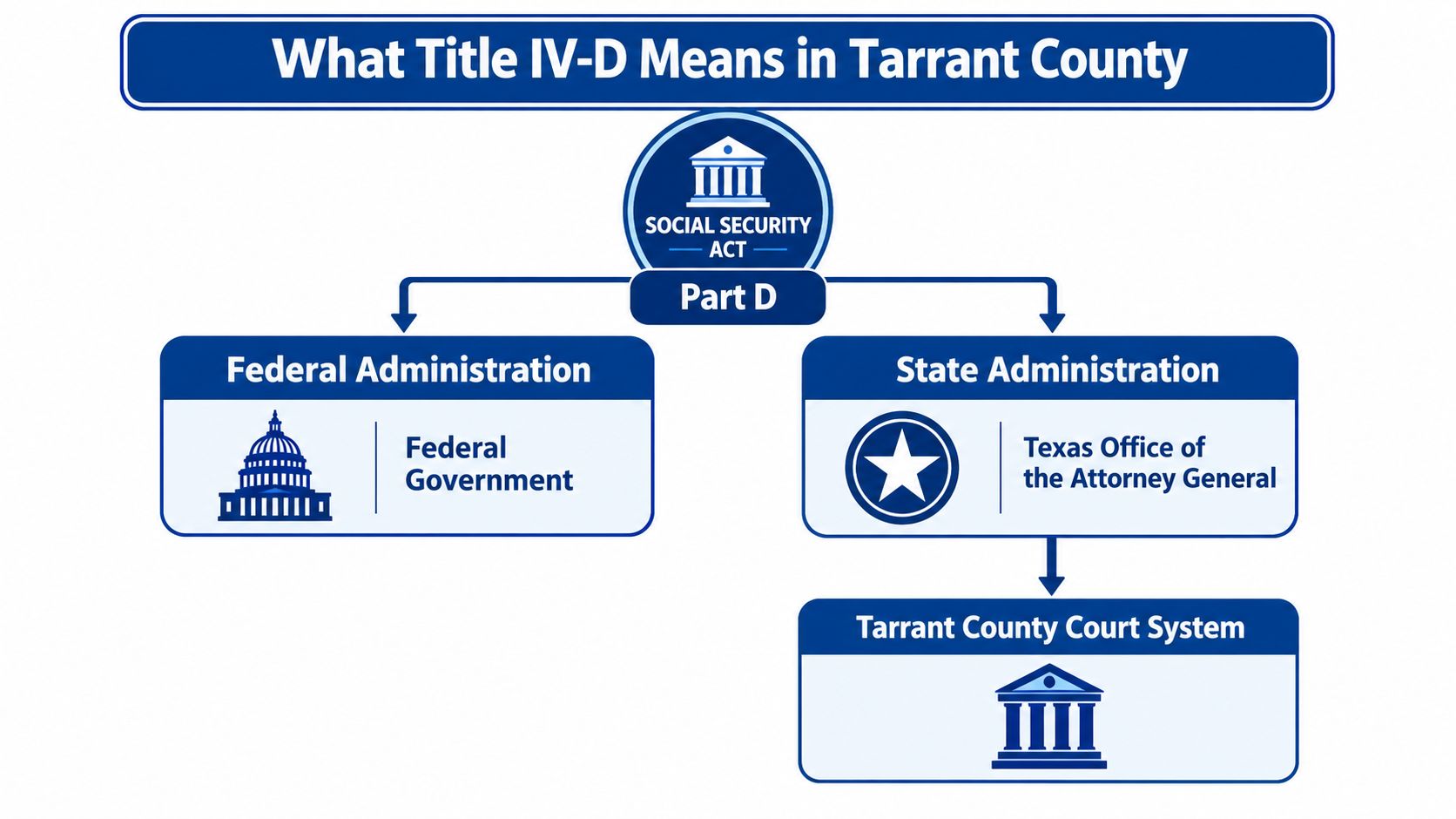
IV-D services versus private family-law litigation
A private custody proceeding focuses on issues such as conservatorship, possession, access, and other parenting questions. An IV-D matter focuses on support administration and enforcement. The two subjects can overlap, but they aren't interchangeable.
For example, an IV-D docket may address whether support should be established, modified, or enforced. It generally isn't the place to resolve every disagreement about holiday possession or a parent's broader custody concerns. If your notice involves both support and parenting disputes, separate legal questions may require separate filings or advice.
The dedicated IV-D courts show that Tarrant County treats these cases as a specialized docket. The county's rule also shows why a support order can enter that system as part of ordinary family-court practice. Understanding that distinction can make an unfamiliar notice less alarming and help you ask the right office the right question.
How to Search the Tarrant County IV-D Docket
Start with the Tarrant County District Clerk's public case-search tools. Search using the information printed on your notice, preferably the cause number. If you don't have it, try the parties' names and then narrow the results to family-law or IV-D-related case information when the portal provides that option.
A practical search sequence
- Copy the cause number carefully. A missing letter, number, or punctuation mark can produce no result or the wrong case.
- Search the party name. Try variations if the name changed after marriage or if the record uses a middle name or initial.
- Review the case type. Confirm that the result is a family-support matter, not a different civil, criminal, or family case.
- Open the docket entries. Look for the next setting, recent filings, orders, and references to enforcement, review, modification, or withholding.
- Save the identifying information. Record the cause number, court designation, parties, and next hearing date.
The county's online record may provide useful docket basics, but public systems don't necessarily display every filing immediately or show the information contained in confidential documents. For a broader explanation of researching a local family case, consult this Tarrant County District Clerk records-search resource.
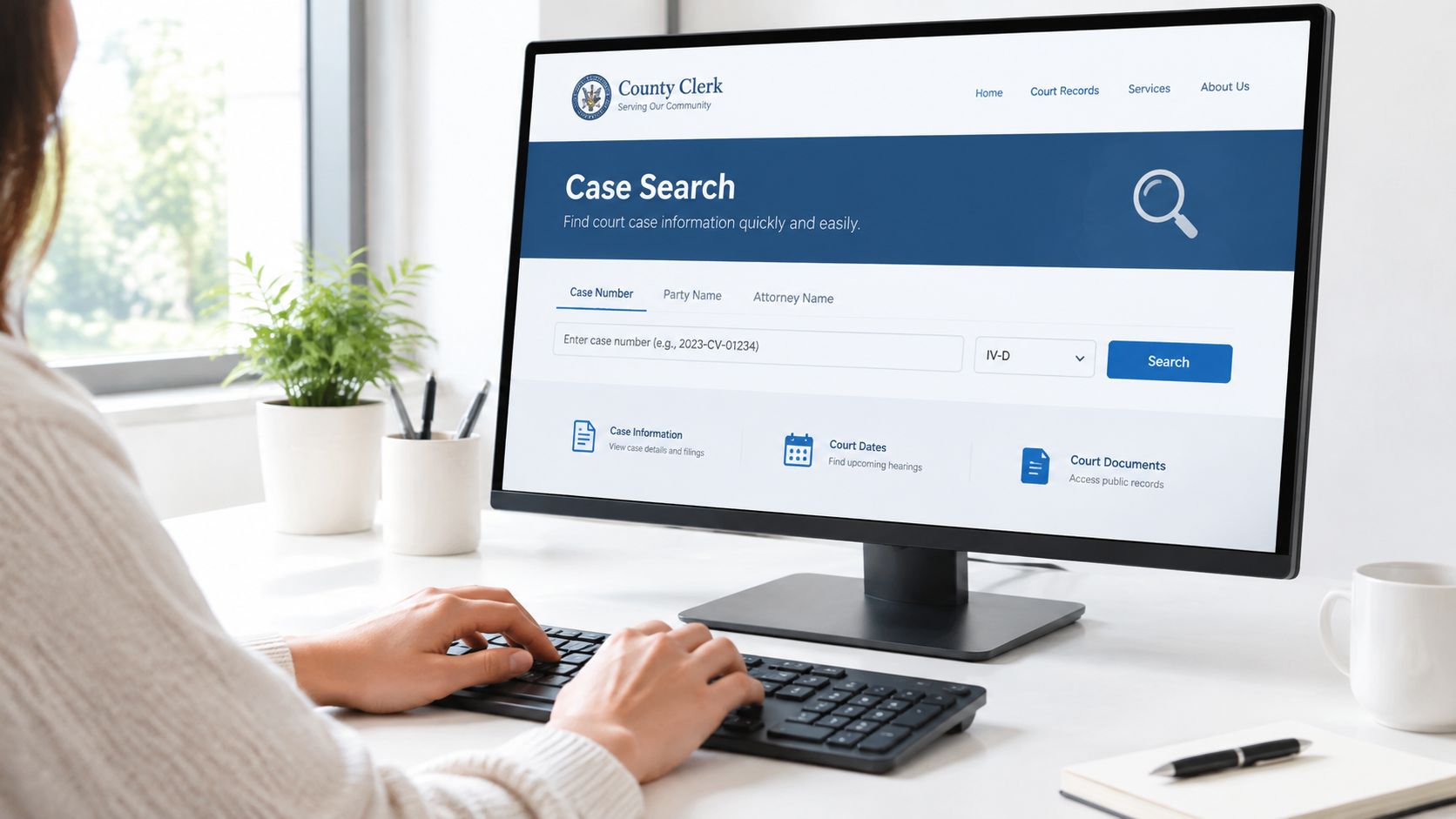
When an online search doesn't answer the question
If the online record is incomplete or you can't tell whether the case carries an IV-D designation, contact the appropriate clerk or IV-D office. You may need to ask whether the local rule paperwork or related designation appears in the file. Ask specifically about the 2000 local IV-D rule if you're trying to understand why an older support order is connected to Title IV-D services.
The Office of the Attorney General may use a child-support case number that differs from the local court cause number. Keep both numbers together and ask the agency to cross-reference them. Public views redact sensitive information, so don't expect to see Social Security numbers, employer identification information, or other protected data online.
If you're going to the courthouse, bring the notice and a valid form of identification. Don't upload or email sensitive personal information unless the receiving office gives you a secure method.
Reading the Entries on a Tarrant County IV-D Docket
Docket entries are abbreviated. A notation may tell you that a motion was filed or a setting occurred, but it rarely provides the evidence considered or the reasoning behind the court's action. Read each entry as a procedural description, then locate the underlying order or pleading before drawing a legal conclusion.
Common entries can include the following:
| Docket Entry / Abbreviation | Plain-English Meaning |
|---|---|
| Initial IV-D setting | The case has been placed on the court's calendar for an initial proceeding or review. |
| Agreed Order | The parties have presented an agreement for the court's consideration. The docket alone doesn't show every term or whether the judge signed it. |
| Agreement on arrears | The parties may have addressed an alleged past-due balance by agreement. Review the filed order for the actual terms. |
| Motion to Enforce, or MOE | A filing asks the court to enforce an existing support obligation. |
| Contempt citation | The court process may require a responding party to appear and answer allegations of noncompliance. |
| Bench warrant issuance | The docket reflects a warrant-related action. The entry itself may not explain the conditions, status, or effect of that action. |
| Income Withholding Order, or IWO | An order directs income withholding for support, subject to the terms of the order and applicable law. |
| Payment review hearing | The court or agency is reviewing payment activity or compliance. |
| Review or revocation setting | A future setting concerns continued compliance, supervision, or another specified issue. |
| MCE, MOE, IWO, CFI, and CSC | These abbreviations can refer to local filing or proceeding labels. Their exact meaning can depend on the clerk's system and the document associated with the entry. |
Some entries signal a more active enforcement posture, particularly a motion to enforce, contempt-related filing, or warrant entry. A payment review may be more routine, but you shouldn't assume that it has no consequences. The notice, motion, and signed order matter more than the shorthand.
A parent who sees “IWO” shouldn't assume the withholding amount is visible on the public docket. Likewise, “Agreed Order” doesn't prove that every disputed issue has been resolved. If the case involves an upcoming setting, compare the entry with the actual notice and any documents served on you.
For related information about local family-court scheduling, see the Tarrant County 325th District Court family docket resource. If an entry refers to contempt, a warrant, or an agreement you don't understand, consider obtaining legal advice before signing or ignoring anything.
Contacting the Title IV-D Office in Fort Worth
Different offices answer different questions. The Texas Office of the Attorney General's Child Support Division handles state-level child-support services, while Tarrant County's Domestic Relations Office provides local child-support support and legal-support functions connected to Title IV-D matters.
For account questions, Tarrant County directs parents to Child Support Services at 817-884-1475. The county lists the office at 200 E. Weatherford, 2nd Floor, East Wing, Fort Worth, TX 76196. That is the appropriate starting point for questions about an account, payment records, or the local handling of child-support services. The county's Child Support Services contact information should be checked before traveling because public-office procedures can change.
Match the question to the office
- Payment history or account balance: Start with Child Support Services and provide the applicable child-support case information.
- Filing or enforcement status: Ask the Domestic Relations Office or the state Child Support Division whether a filing or enforcement action has been processed.
- Certified court records: Contact the clerk responsible for the court record and ask about the requirements for obtaining a certified copy.
- Custody or possession disputes: These generally require family-law guidance and aren't answered by an IV-D account representative.
- Legal strategy: An agency can explain its administrative process, but it doesn't serve as your private attorney.
The county also says its Legal Support Services unit can file Title IV-D child-support motions in the same manner as the Texas Attorney General's Office. Its published contact line is 817-884-1879 during weekday office hours.
Before calling or appearing, gather the cause number, the OAG case number if you have it, the children's full legal names and dates of birth, and the most recent support order. Don't assume an agency employee can advise you whether to sign an agreed order, contest an enforcement action, or seek a modification. For a location overview, use this Fort Worth Family Law Center guide.
Why Some Docket Details Stay Private
A public docket isn't the same thing as an unrestricted case file. Child-support records can contain financial information, employment details, identifying information about children, and sensitive family circumstances. Public access is therefore limited, and an online search may show only a narrow procedural outline.
Texas court-access rules, including Texas Rules of Civil Procedure 76a and 21a, affect access and service questions. Federal IV-D confidentiality requirements, including 45 C.F.R. § 303.15, also form part of the framework for protecting information connected with child-support services. Texas Family Code provisions may impose additional confidentiality protections depending on the record and proceeding.
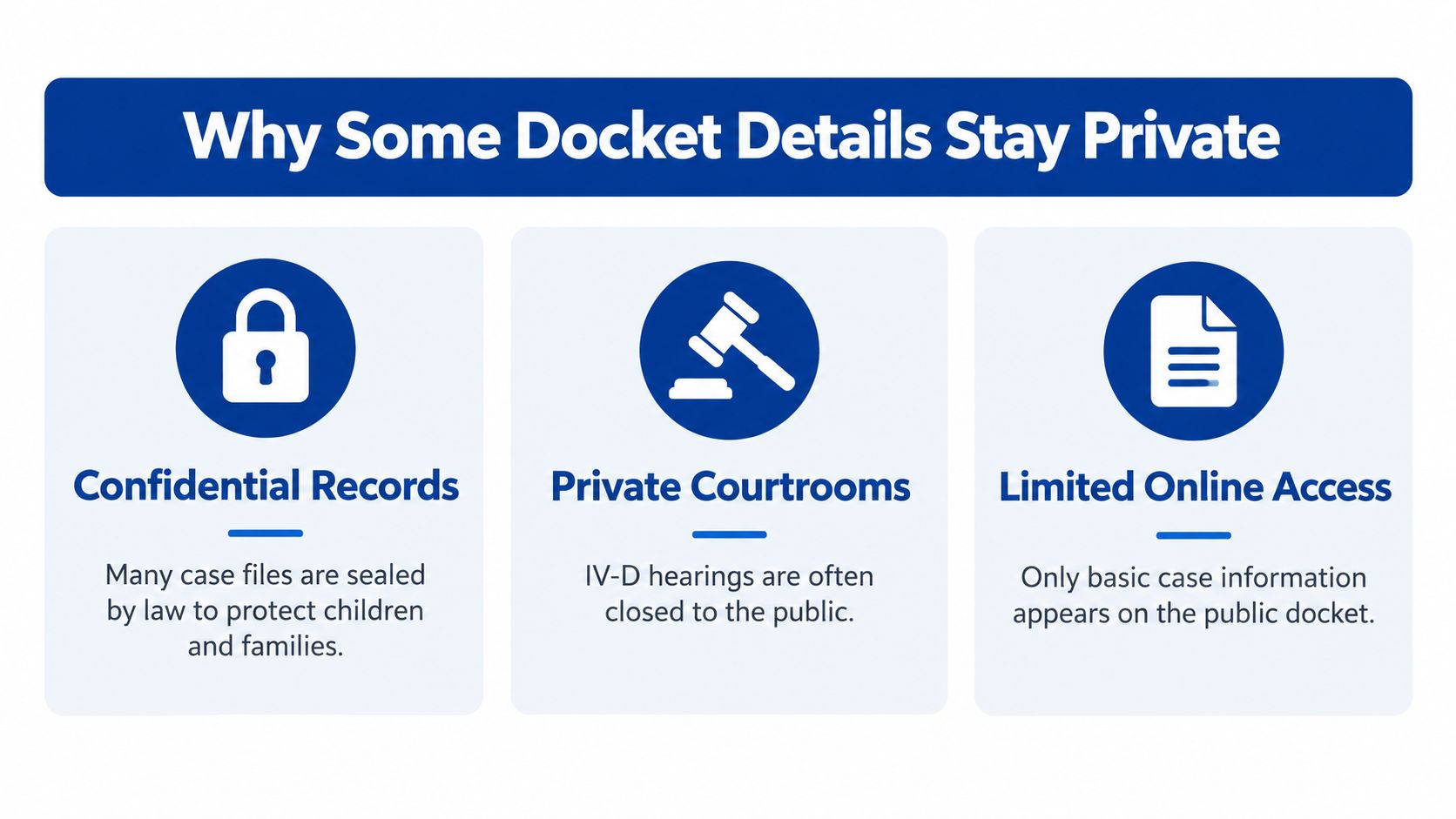
What you may see publicly
The public-facing record may identify the case number, party initials or limited party information, hearing type, court, and judge. It may not display payment amounts, detailed financial findings, children's full names, employer information, or specific medical-support terms.
That doesn't mean the court lacks those records. It means public access and confidential case access are different things. A parent who is a party may have additional ways to obtain information, while a member of the public may see only redacted or limited entries.
Narrow access options can exist, including redacted copies obtained under an applicable court order, certified records requested in person from the District Clerk with valid identification, and sealed findings in limited circumstances. The clerk or IV-D office can explain what request procedure applies to the record you need.
Privacy limits protect children and families. They shouldn't be confused with a finding that the case has no activity.
Avoid posting screenshots of a docket on social media or sending unredacted documents to people who aren't involved in the case. If you believe an important filing is missing, ask the responsible office how parties can obtain an authorized copy rather than assuming the online display is complete.
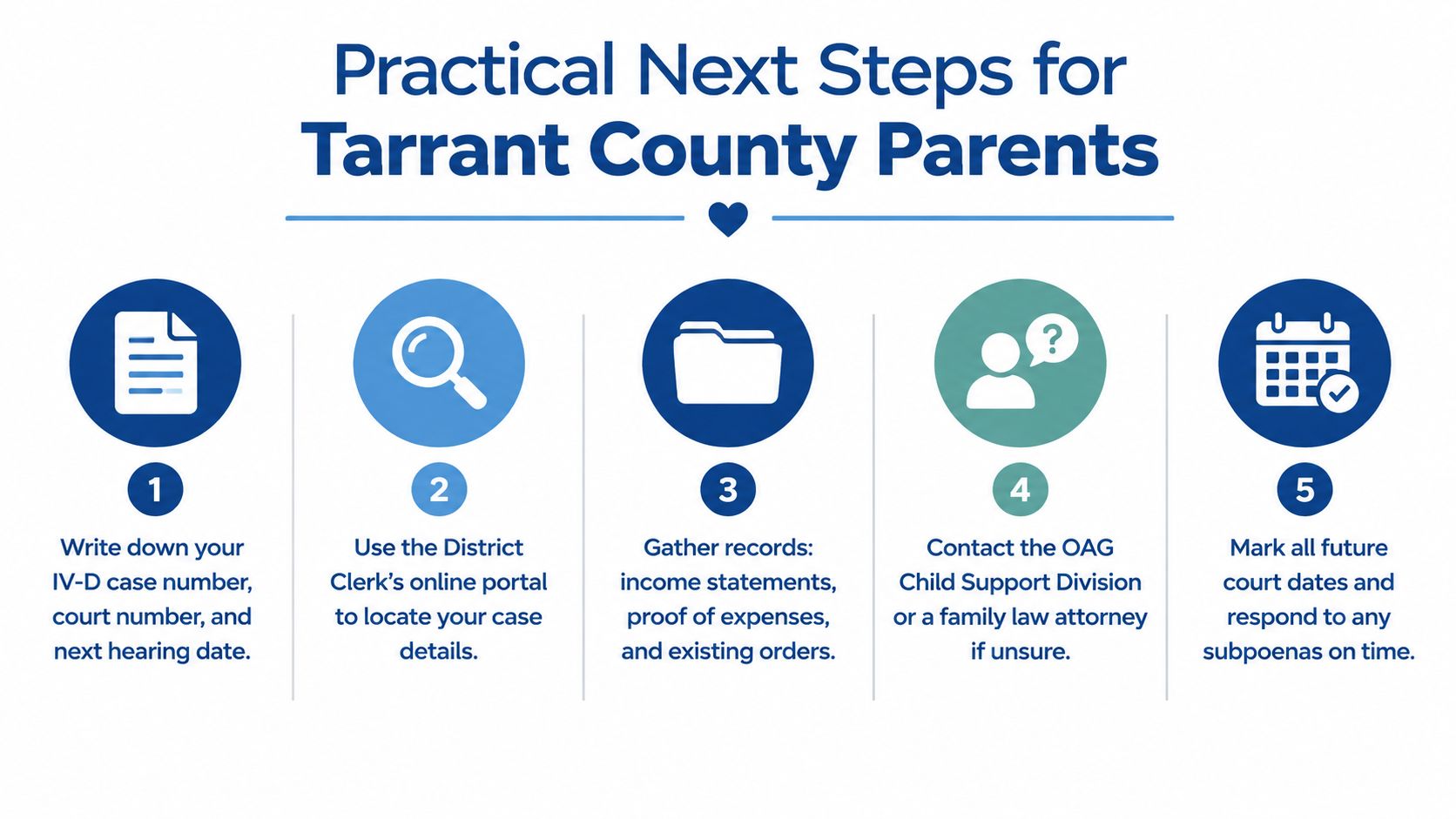
Practical Next Steps for Tarrant County Parents
The docket is most useful when you turn it into a short list of questions and documents. Whether you live in Fort Worth, Arlington, Keller, Mansfield, or another Tarrant County community, use the same disciplined process.
- Write down the identifiers. Record the IV-D case number, court number, cause number, and next hearing date exactly as they appear. If two agencies use different numbers, keep both.
- Collect the controlling documents. Find the existing support order, recent notices, payment history, and relevant income information. Organize them by date so you can identify what changed.
- Confirm the account status. Call Tarrant County Child Support Services and ask about the current balance, recent payments, and filing status. Ask the representative which information comes from the local court and which comes from the state account.
- Separate administrative questions from legal disputes. A payment-history question may be handled through the IV-D office. A challenge to an enforcement motion, a request to modify support, or a proposed stipulation may require a court response and legal analysis.
- Get advice before signing. If you're asked to sign an agreed order, acknowledge arrears, or accept new withholding terms, speak with a qualified Texas family-law attorney before signing if you don't fully understand the consequences.
The docket is a starting point, not a substitute for the order, the evidence, or case-specific legal advice. Don't miss a hearing because an online entry looked routine, and don't assume a changed setting eliminates the need to verify the next date.
If your issue involves enforcement, arrears, income withholding, parentage, or a proposed modification, prepare your questions before contacting counsel. A local attorney can review the docket alongside the underlying filings and explain which decisions require immediate attention. The Law Office of Bryan Fagan PLLC offers family-law guidance for Tarrant County child-support matters, including help understanding IV-D proceedings and preparing for court.
The Law Office of Bryan Fagan PLLC can review your Tarrant County IV-D docket, support order, notices, and related filings with you. Visit the firm's website to learn about the consultation process and request guidance for your child-support or enforcement concern.
