 Skip to content

A Fort Worth resident may receive a city citation, search for the nearest courthouse, and assume every legal problem connected to that citation belongs in the same place. Someone else may be arrested in Fort Worth, see a municipal judge during the early stages, and wonder whether the case is still a city matter or has moved into Tarrant County's criminal courts.
The short answer is this: Fort Worth Municipal Court handles a narrow group of city-level matters, while Tarrant County courts handle broader misdemeanor, felony, civil, probate, and family-law disputes. The location where an event occurred helps determine the court, but the type of case and the court's legal authority matter just as much. That distinction affects where you appear, how warrants and bail are handled, and where an appeal may go.
Table of Contents
- Understanding Your First Court Encounter in Fort Worth
- What Fort Worth Municipal Court Actually Handles
- Comparing Municipal Court and Tarrant County Court Levels
- Process Differences and Appeal Paths Explained
- When Family Law, Felonies, and Civil Claims Leave Municipal Court
- Practical Guidance on Choosing Legal Representation
- Next Steps and Local Resources in Tarrant County
Understanding Your First Court Encounter in Fort Worth
Suppose a Fort Worth resident finds a citation on the windshield after a parking or traffic matter. The notice identifies Fort Worth Municipal Court, so the resident needs to address the citation through the city court process rather than filing something in a Tarrant County family, district, or county court. A city citation doesn't become a county case just because Fort Worth sits inside Tarrant County.
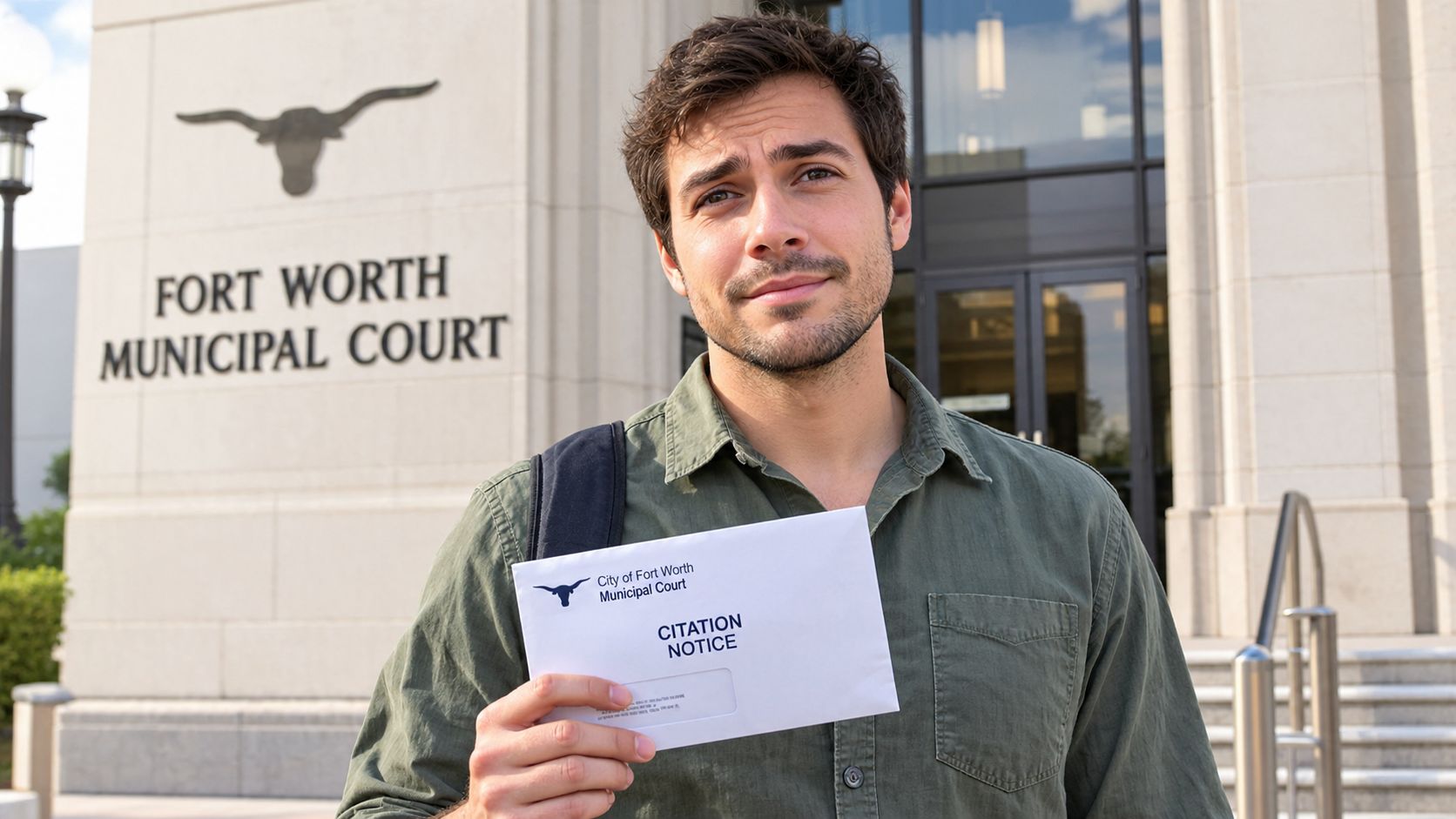
The first practical question is what kind of legal matter is this? A Fort Worth Municipal Court case usually involves a city ordinance, parking or traffic matter, school-attendance issue, or another fine-only Class C misdemeanor within the city's territorial limits. A divorce, custody dispute, child-support case, felony, or substantial civil claim belongs in a different level of court.
That boundary matters from the first appearance. If a person ignores a municipal citation, the court may address the matter through the city's available warrant or enforcement process. If the underlying allegation is a more serious misdemeanor or a felony, the municipal court may be involved in an early magistrate function, but that doesn't give the municipal court authority to conduct the trial on a felony or higher-level misdemeanor.
Why the first court contact can be confusing
Fort Worth Municipal Court can have responsibilities beyond reviewing tickets. Texas court materials explain that a municipal judge may act as a magistrate for counties into which the city extends. That role can involve arrest-related decisions, which is one reason people sometimes see a municipal judge even when the ultimate criminal case belongs in a county or district court.
The practical mistake is treating the judge who first handles an arrest-related matter as the judge who will hear the entire prosecution. Those are separate questions. Magistrate authority concerns an early stage of the process. Trial jurisdiction determines which court can decide the merits of the charge.
Practical rule: Read the charge, court name, and case number carefully before deciding where to file, pay, appear, or seek relief.
A citation that stays within municipal jurisdiction may be resolved through the municipal court's process. A case involving a higher-level misdemeanor can proceed in a Tarrant County criminal court, and a felony generally belongs in a district court. Because warrants, bail, and first appearances can have immediate consequences, a person who has been arrested or missed a required appearance shouldn't assume the citation rules apply to the new situation.
What Fort Worth Municipal Court Actually Handles
Fort Worth Municipal Court is a city tribunal with territorial and subject-matter limits. Under Texas Code of Criminal Procedure Article 4.14, a municipal court has exclusive original jurisdiction inside the city limits over municipal-ordinance cases. It also has concurrent jurisdiction with the local justice court for certain state-law misdemeanors, but that authority remains tied to the geographic limits of the municipality. The Texas municipal-court jurisdiction statute describes those boundaries and fine limits.
That means the fact that conduct occurred somewhere in Tarrant County isn't enough by itself. The court must also have authority over that type of allegation. Fort Worth's own code likewise recognizes limited concurrent criminal jurisdiction for matters arising inside the city and punishable only by fine, along with limited civil authority to enforce municipal ordinances under Local Government Code Chapter 214. The Fort Worth Municipal Code provisions on municipal court authority reinforce why location and case type must be considered together.
The court's ordinary docket
In practical terms, Fort Worth Municipal Court mainly handles:
- City ordinance violations: Alleged violations of Fort Worth rules and code provisions.
- Parking and traffic matters: City parking cases and traffic-related violations filed within Fort Worth city limits.
- Fine-only Class C misdemeanors: Limited criminal matters under city ordinances and applicable provisions of the Texas Penal Code.
- School-attendance cases: Matters involving school attendance enforcement.
- Other authorized city enforcement matters: Proceedings that fall within the court's statutory and local authority.
This is not a general trial court for every dispute arising in Fort Worth. The municipal court isn't the place to file a divorce, ask for a custody order, pursue child support, litigate a major civil claim, or try a felony. Those matters require a court with the correct subject-matter jurisdiction.
Fort Worth Municipal Court Jurisdiction Limits
| Case Type | Jurisdiction Scope | Maximum Fine |
|---|---|---|
| Most municipal-ordinance cases | Exclusive original jurisdiction inside Fort Worth city limits | $500 |
| Fire-safety, zoning, or public-health ordinance cases | Authorized municipal jurisdiction within the city | $2,000 |
| Refuse-dumping ordinance cases | Authorized municipal jurisdiction within the city | $4,000 |
| Certain state-law misdemeanors | Concurrent jurisdiction with the local justice court, when authorized and arising within the city | Depends on the applicable law |
The fine limits help illustrate the court's role. They are not a statement that every municipal case will result in the maximum fine, and they don't replace the specific charge, ordinance, or procedural options in an individual case. They show why the municipal docket is generally a fine-focused city enforcement system rather than the forum for major criminal, family, or civil litigation.
A person who receives a city citation should still take it seriously. A fine-only case may affect driving privileges, court records, warrants, or later legal decisions depending on the facts and the applicable law. Ignoring the notice because the allegation seems minor can create problems that are harder to resolve than addressing the case promptly.
Comparing Municipal Court and Tarrant County Court Levels
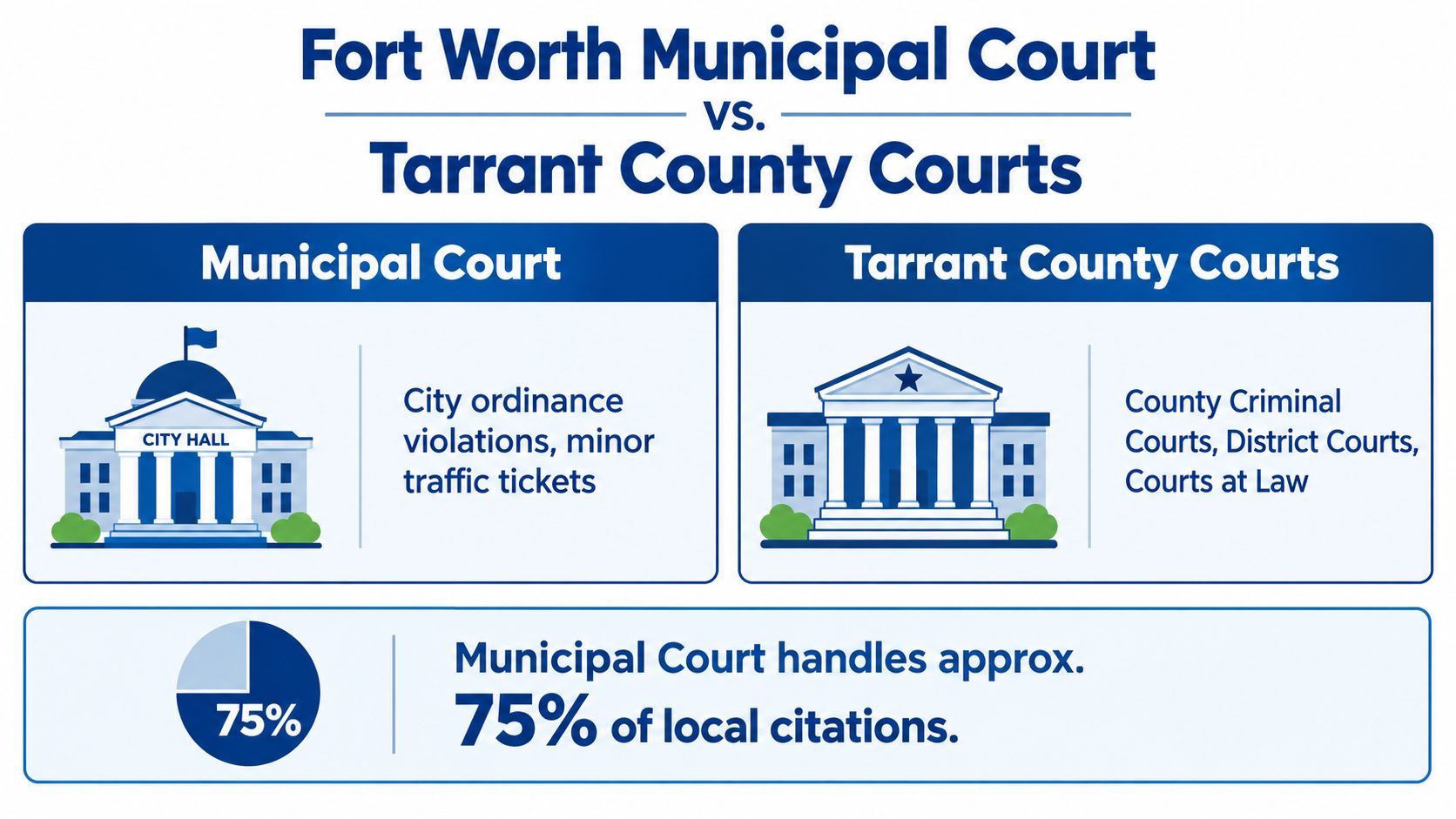
The difference becomes clearer when the courts are viewed as layers rather than as competing courthouses. Fort Worth Municipal Court serves a city-level enforcement function. Tarrant County's system contains multiple courts with different assignments, including 3 county courts at law, 10 county criminal courts, and 8 justice courts, along with family courts, juvenile court, probate courts, and district courts, as listed in the Tarrant County courts overview.
The county system therefore reaches well beyond city ordinances. County criminal courts generally hear Class A and Class B misdemeanors. County courts at law generally hear appeals from justice and municipal courts. District and family courts handle matters that require broader authority, including serious criminal proceedings and family-law disputes.
Criminal cases
A city ordinance violation or fine-only Class C matter generally begins in municipal court when it falls within Fort Worth's authority. A Class A or Class B misdemeanor is a different category. Tarrant County criminal courts have original jurisdiction over those higher-level misdemeanors, so the case isn't a more serious version of a municipal ticket.
Felony matters require still broader criminal jurisdiction. A municipal judge may be involved in an early magistrate capacity, but the court that handles the felony prosecution on the merits is not the Fort Worth Municipal Court.
For a more detailed discussion of the county criminal process, see this explanation of Tarrant County criminal courts at law and the misdemeanor process. The key point is that the classification of the charge controls the route more than the fact that the arrest or conduct occurred in Fort Worth.
Civil disputes and justice courts
Justice courts handle matters within their own statutory jurisdiction, while county courts at law and district courts have broader civil authority. Tarrant County Court at Law No. 3, for example, has concurrent jurisdiction with district court in qualifying civil cases over $500 and up to $250,000 for filings after September 1, 2020, according to the county's court information.
That range demonstrates the structural difference. Municipal court authority is tied to city enforcement and limited ordinance-related matters. County courts can hear civil disputes that are far beyond a municipal fine-only docket.
Family, probate, and juvenile matters
Family courts address divorce, child custody, child support, enforcement, and related parent-child disputes. Probate courts handle estate and probate matters, while juvenile courts address cases involving children within that court system. Those assignments don't shift to municipal court merely because the family lives in Fort Worth or the underlying event occurred there.
The correct question isn't “Which courthouse is closest?” It's “Which court has authority over this type of case?” Filing in the wrong court can waste time and may leave a person without the order or remedy they need.
Process Differences and Appeal Paths Explained
Jurisdiction tells you where a case belongs. Procedure tells you what happens after it arrives there. The two questions are related, but they aren't interchangeable.
A municipal citation may involve notice of the allegation, an opportunity to appear, and a decision about how to respond. Depending on the matter, the person may address the charge, contest it, or seek advice about available options. A county criminal case may involve a first appearance, bond or bail questions, formal charging, and additional proceedings that don't apply in the same way to a fine-only city citation.
What changes after an arrest
When an arrest occurs, the immediate concern may be release, a warrant, or a magistrate proceeding. A municipal judge can have magistrate authority in appropriate circumstances, but that doesn't mean the municipal court will try every charge arising from the arrest. The charge's level and the court with original jurisdiction determine where the prosecution proceeds.
A person should also distinguish between a fine-only outcome and a case where incarceration is legally available. Municipal matters are generally associated with city ordinances and fine-only Class C cases. Higher-level misdemeanors and felonies move into county or district criminal processes, where bond, counsel, and court appearances can carry different consequences.
Do not assume that paying something, appearing on one date, or speaking with a clerk resolves every issue connected to an arrest. Clerks can provide procedural information, but they can't select a defense strategy or determine how a particular charge will affect a person's record.
Appeals from municipal court
Many municipal courts aren't courts of record. As a result, an appeal often proceeds to a county court for a trial de novo, meaning the case is tried anew rather than reviewed only as a traditional record from the municipal proceeding. The Texas judicial branch court overview explains the relationship between municipal, justice, and county courts and the way appeals may proceed.
That appeal path creates a practical trade-off. A person may have another opportunity to present the case, but an appeal still requires attention to deadlines, filings, notices, and preparation. It isn't safe to assume that an appeal automatically pauses every consequence or guarantees a different result.
The Fort Worth appellate court resource can help explain the distinction between a county-court appeal from a municipal case and a later appeal involving an appellate court. Those are different procedural stages, and using the wrong terminology can lead a person to seek help in the wrong place.
When Family Law, Felonies, and Civil Claims Leave Municipal Court
A Fort Worth address doesn't turn every legal problem into a municipal-court matter. The type of relief you need determines the proper court. If you need a divorce decree, a parenting order, a child-support order, or a ruling on marital property, municipal court doesn't have the authority to provide it.

Family-law matters
Fort Worth Municipal Court isn't a general family court. Its core role is limited to city ordinance and code violations, parking and traffic matters, school-attendance violations, and fine-only Class C misdemeanors within Fort Worth's territorial limits, as described by the City of Fort Worth Municipal Court.
Divorce, custody, child support, paternity, possession and visitation, enforcement, and most other family-law disputes belong in Tarrant County's family district courts. A parent who wants a custody order can't obtain that order by appearing on a traffic citation. A spouse who needs a divorce can't file the divorce in municipal court because both parties live in Fort Worth.
For a practical discussion of where felony cases are heard, review which Tarrant County criminal district court hears felony matters. The criminal classification, not the city boundary alone, determines the proper forum.
Serious criminal allegations
A Class A or Class B misdemeanor belongs in the county criminal system rather than the ordinary municipal fine-only docket. Felony allegations require district-court jurisdiction. A person may encounter a municipal judge during an early arrest-related proceeding, but that encounter doesn't change the court that can adjudicate the serious charge.
Civil claims and requested remedies
A civil dispute also requires careful classification. A city ordinance-enforcement matter may fall within limited municipal authority. A broader money claim, property dispute, probate issue, or request for continuing relief may belong in justice court, county court at law, probate court, or district court depending on the claim and the relief requested.
The location of the courthouse is only the starting point. The remedy you're asking for is often the better guide.
Practical Guidance on Choosing Legal Representation
The wrong court can create delay, unnecessary expense, and confusion about what to do next. The mistake often starts with a reasonable assumption: the incident happened in Fort Worth, so Fort Worth Municipal Court must be the right place. That assumption fails when the matter involves family law, a higher-level criminal charge, or a civil remedy outside municipal authority.
When a family-law attorney may help
Consider speaking with a qualified family-law attorney if the issue involves:
- Divorce or property division: You need a judgment addressing the marriage and marital property.
- Custody or visitation: You need an enforceable order concerning a child's schedule, possession, or decision-making.
- Child support or enforcement: You need to establish, modify, or enforce a financial or parent-child obligation.
- Paternity, relocation, or CPS concerns: The case may affect parental rights and require a court with family-law authority.
A family-law attorney can help identify the correct Tarrant County court, explain the relief available, and prepare documents for the type of proceeding involved. That doesn't guarantee an outcome, but it can prevent the basic error of asking a municipal court to issue an order it cannot provide.
When criminal-defense guidance may be appropriate
A criminal-defense attorney may be appropriate when you're dealing with an arrest, warrant, bond issue, Class A or Class B misdemeanor, felony allegation, or an appeal from a municipal case. Bring the citation, charging document, bond paperwork, court notices, and any information about prior appearances. Don't guess about whether a municipal appearance resolved a related county case.
The City of Fort Worth's Municipal Court information explains that the court handles Class C misdemeanor cases under city ordinances and the Texas Penal Code, along with city parking cases filed inside Fort Worth city limits. Tarrant County courts have broader misdemeanor jurisdiction and may receive appeals from municipal cases that aren't finally resolved there.
Before hiring counsel, ask which court has jurisdiction, what immediate deadline or appearance requires attention, whether a warrant or bond issue is involved, and whether the lawyer handles the specific type of case. Clear answers to those questions are more useful than general assurances.
Next Steps and Local Resources in Tarrant County
Start by gathering the citation, charging papers, court notices, warrant information, and any documents showing the court and case number. Confirm current locations and procedures through Tarrant County's official resources, including the George Allen Courts Building and the Tim Curry Criminal Justice Center, as well as the relevant municipal court office. People who need family-law, criminal-defense, or legal-aid guidance should seek a qualified professional before filing in an unfamiliar court.
If your matter involves a Fort Worth citation, an arrest, an appeal, divorce, custody, or child support, don't rely on the city boundary alone. Identify the charge or requested remedy first, then confirm the court with authority to act.
The Law Office of Bryan Fagan PLLC can help Fort Worth and Tarrant County residents understand whether a family-law or criminal matter belongs in municipal, county, or district court and what preparation may be needed next. Visit Law Office of Bryan Fagan PLLC to learn about available legal resources and schedule a consultation for case-specific guidance.
