 Skip to content

You're in Fort Worth, and a weekend arrest has suddenly turned into a criminal case. Maybe the allegation involves DWI, theft, or assault involving a family member. You may have been released from jail, received a court notice, or learned that your case is assigned to a courtroom at the Tim Curry Criminal Justice Center. The immediate question is usually simple: what happens next?
The Tarrant County criminal courts at law misdemeanor process generally moves from arrest and booking to a magistrate hearing, filing, an initial court setting, evidence exchange, negotiations, disposition, and trial if the case doesn't resolve earlier. Tarrant County has 10 county criminal courts handling misdemeanor-level criminal matters, while 11 district courts handle felony-level cases. The county's misdemeanor courts are located at the Tim Curry Criminal Justice Center in downtown Fort Worth, and the County Clerk's criminal section maintains records for those county criminal courts. Tarrant County's criminal courts information explains that separation.
A misdemeanor case can move quickly, but the exact pace depends on whether you're in custody or out on bond, what evidence the State must provide, whether motions are filed, and how the assigned court manages its docket. The county's published materials describe an initial appearance, evidence exchange, disposition, and trial as distinct stages. This guide translates those stages into what you may see, hear, and need to do.
Table of Contents
- What the Tarrant County Misdemeanor Process Actually Looks Like
- Arrest, Booking, and the Magistrate Hearing in Tarrant County
- Filing, Arraignment, and the First Court Setting
- Pretrial Court Settings at the Tim Curry Criminal Justice Center
- How Tarrant County Misdemeanor Cases Get Resolved
- Sentencing Options for Class A and Class B Misdemeanors
- Records, Expunction, and Nondisclosure After the Case Ends
What the Tarrant County Misdemeanor Process Actually Looks Like
Suppose a 28-year-old Fort Worth resident is arrested after a weekend incident and accused of a Class A or Class B misdemeanor. The arresting agency could be Fort Worth Police, the Tarrant County Sheriff's Office, or a police department serving another local city. After booking, the person appears before a magistrate for an initial review and bond decision. If the case proceeds, it is filed into Tarrant County's dedicated misdemeanor court system and assigned to one of the county criminal courts at the Tim Curry Criminal Justice Center.
From there, the case usually follows a recognizable path:
- Arrest and booking. The person is processed through a city or county jail system.
- Magistrate hearing. A magistrate addresses the initial custody and bond issues.
- Court filing and first setting. The charge enters the county criminal court docket, and the defendant receives information about the next appearance.
- Evidence exchange and negotiation. Defense counsel reviews the State's evidence, identifies legal or factual issues, and discusses possible resolutions with the prosecutor.
- Disposition or trial. The case may end through dismissal, a negotiated plea, another agreed resolution, or a trial.
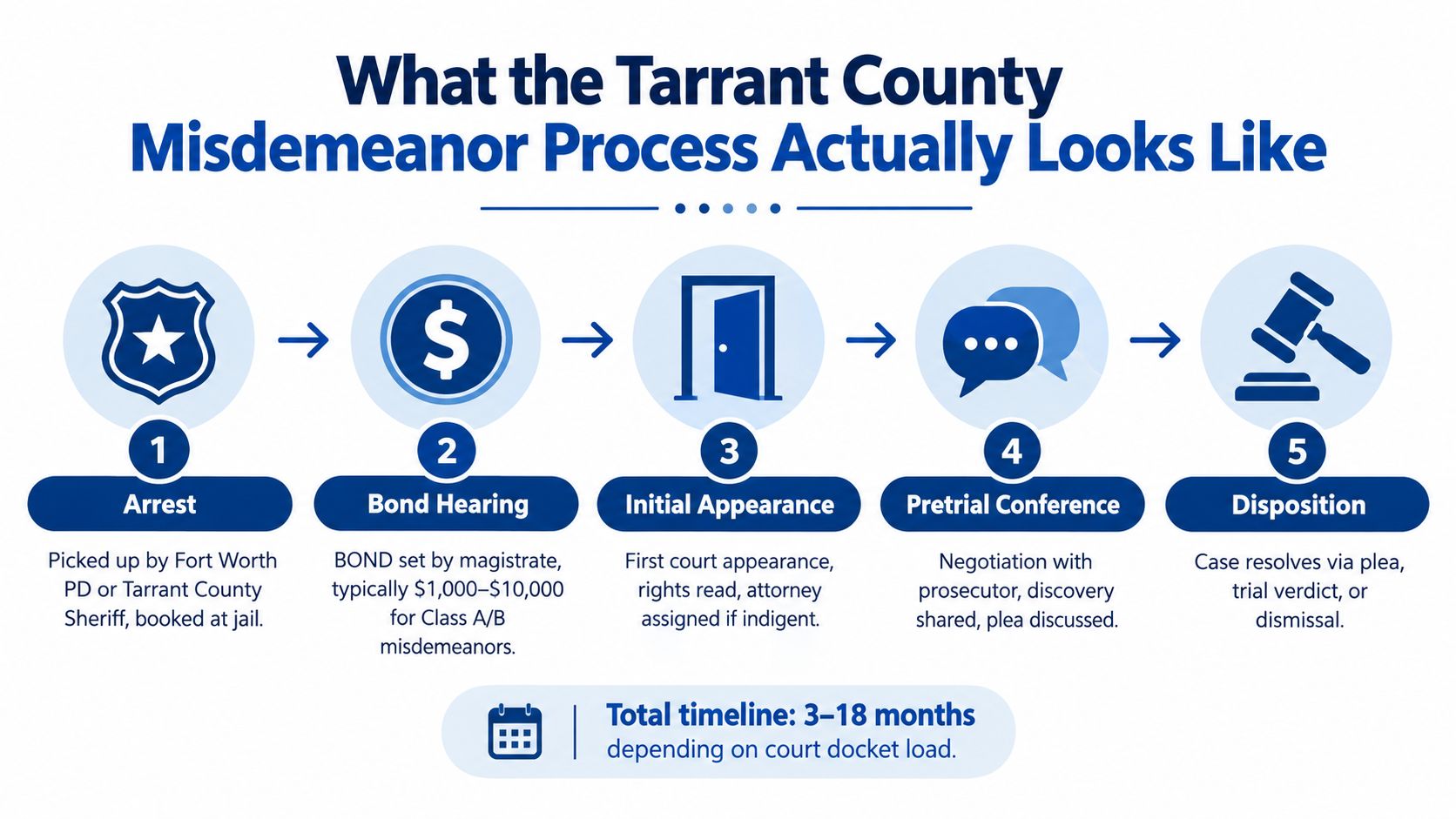
Class A and Class B misdemeanors are handled in the county criminal courts rather than the felony district courts. That distinction affects where the case is assigned, where hearings occur, and how the file is tracked. The process is centralized, but it still isn't one single generic criminal division. Each case has an assigned court, docket, and setting schedule.
Why custody status changes the schedule
An in-custody defendant and a defendant who has posted bond don't necessarily move through the courthouse in the same order. Tarrant County court guidance says in-custody defendants receive priority over bond defendants. For released defendants, the oldest case is generally given priority. The county's court-settings guidance describes those scheduling differences.
That means a person who is out on bond may have more time between settings, while a person still in custody may be brought forward sooner. The county also states that misdemeanor trials generally take no more than two calendar days. The county's misdemeanor court FAQ describes the evidence-exchange and disposition settings that lead up to trial.
The most important early task is to identify your next required appearance and follow every bond condition. Don't assume that a misdemeanor is too minor to require a lawyer, a court appearance, or prompt attention.
Arrest, Booking, and the Magistrate Hearing in Tarrant County
After an arrest in Fort Worth or another Tarrant County community, officers typically transport the person to a city detention facility or the Tarrant County Jail. Booking can include identification, photographs, fingerprints, property processing, and entry of the alleged offense into the jail system. The person may spend this period trying to understand a process that has already begun before any trial judge has addressed the case.
A magistrate hearing is different from a later appearance before the county criminal court judge. The magistrate handles the initial custody decision, informs the accused of certain rights, addresses probable-cause issues, and sets or denies bond as authorized by law. A Tarrant County criminal-defense resource describes magistrate hearings concerning arrest and bond as commonly occurring within 24 to 48 hours. This overview of a Tarrant County magistrate hearing provides additional local context.
How bond types differ
A personal recognizance bond, often called a PR bond, allows release based primarily on the defendant's promise to appear and comply with conditions. A surety bond involves a commercial bond company that posts the required amount, usually for a fee and subject to the company's contract. A cash bond requires the bond amount to be posted directly in cash or another accepted form.
The magistrate may consider the nature of the accusation, prior criminal history, ties to the community, employment, victim-related concerns, and information from the county's risk-assessment process. Those considerations don't guarantee a particular result. A PR bond may be available in some circumstances, while other cases may require a surety or cash bond.
| Bond Type | How It Works in Tarrant County Misdemeanor Cases |
|---|---|
| Personal recognizance bond | Release based on a signed promise to appear and comply with conditions, when authorized by the magistrate |
| Surety bond | A licensed bond company posts the amount, subject to its agreement and charges |
| Cash bond | The defendant or another person posts the required amount directly |
| Bond with conditions | Release may include conditions addressing contact, travel, testing, or other safety concerns |
The magistrate's decision isn't the final decision on guilt. It addresses whether and under what conditions the person may remain free while the case proceeds. A release order can still impose restrictions, and violating them can create additional legal problems or affect the court's view of the case.
Practical rule: Before leaving custody, make sure you understand every written bond condition. A condition that seems narrow may affect communication, travel, residence, testing, or contact with another person.
If you're released, preserve the paperwork from booking and bond. Keep the name of the bondsman, the bond documents, and any court notice together. If you remain in custody, ask how the next court setting will be communicated and whether appointed counsel has been requested or assigned.
Filing, Arraignment, and the First Court Setting
Once the prosecutor files the case, the charge enters the county criminal court system. The case is assigned to one of 10 county criminal courts that handle Class A and Class B misdemeanors at the Tim Curry Criminal Justice Center. The County Clerk's criminal section keeps the court records, while the assigned court manages hearings, resets, negotiations, and final disposition.
The charging instrument may be a complaint or information, depending on the case and applicable procedure. A defendant who is out on bond may receive a summons or other notice directing an appearance. In some circumstances, the State may seek a capias. The practical point is the same: don't ignore mail, electronic notices, bondsman communications, or information from your lawyer.
What happens at the first setting
An arraignment or initial appearance gives the court an opportunity to identify the charge, address representation, and establish how the case will proceed. The defendant may enter a plea of not guilty, guilty, or no contest. A person who qualifies for appointed counsel may have counsel appointed, while another defendant may retain a lawyer.
A not-guilty plea doesn't mean the case is going to trial immediately. It preserves the defense while counsel obtains evidence, investigates the allegation, reviews legal issues, and discusses possible outcomes. A guilty or no-contest plea can have serious consequences and shouldn't be entered just because the first setting feels routine.
The judge may also address conditions connected to release. Depending on the allegation and the order, conditions can include no-contact requirements, travel restrictions, ignition-interlock requirements, or other terms. The exact condition matters, and so does its scope.
Don't confuse a first setting with a final decision
A person may leave the courthouse believing that nothing happened because the case was reset. In reality, the first setting can establish the schedule and create obligations that control the rest of the case. The county's misdemeanor materials describe later evidence-exchange and disposition settings, so the first appearance is only one part of the process.
A guilty plea at the first appearance may occur in some cases, but a defendant should understand the charging instrument, evidence, immigration or employment consequences, and available agreements before accepting responsibility. A lawyer can also determine whether a proposed resolution actually serves the defendant's goals.
Pretrial Court Settings at the Tim Curry Criminal Justice Center
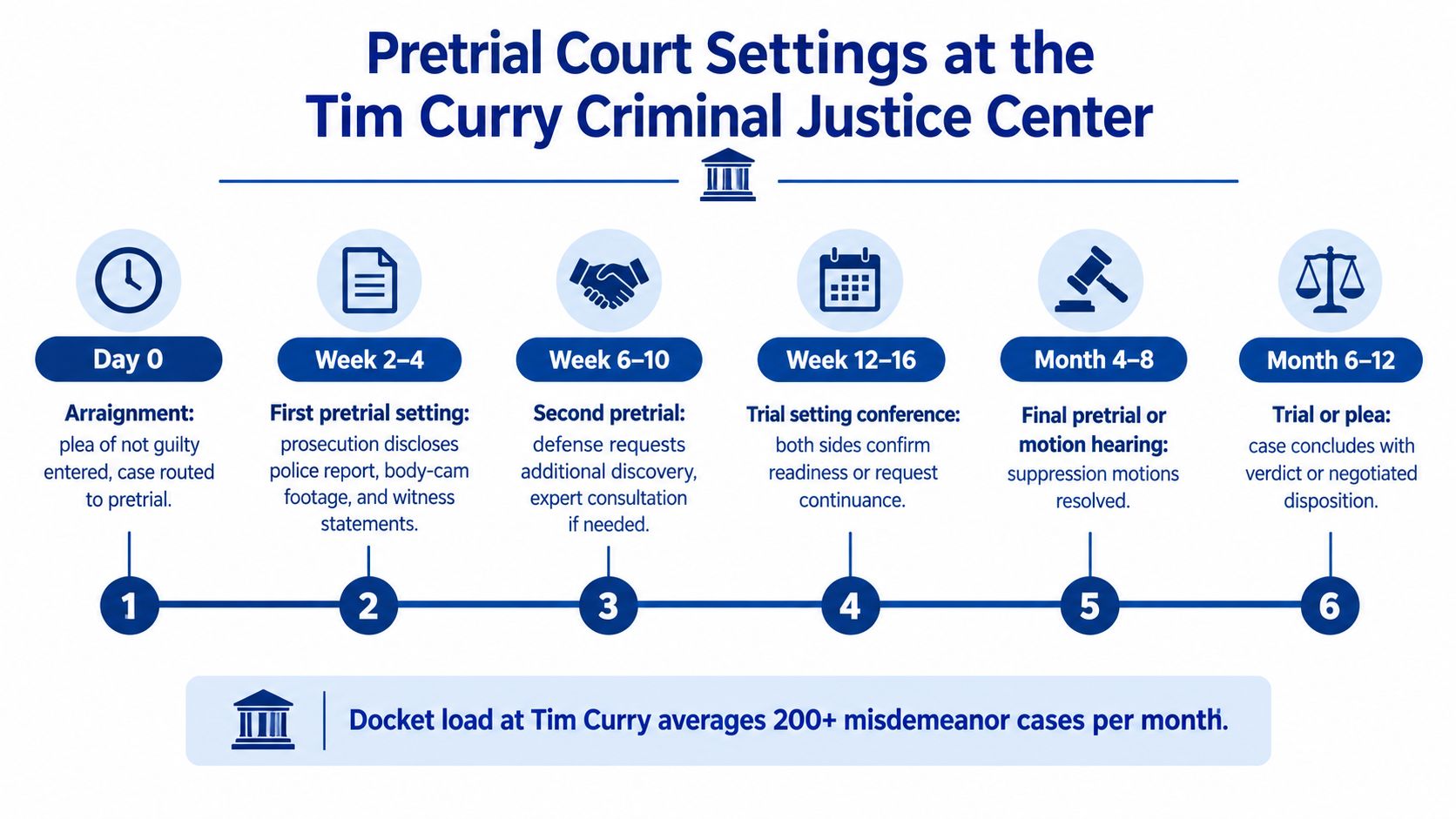
Tarrant County's misdemeanor docket is organized around stages rather than one all-purpose hearing. The evidence-exchange setting is designed for attorneys, and the county says defendants generally aren't required to appear for that setting. The disposition setting is different. The county says defendants are required to appear at disposition settings, and the court warns that a case not resolved by the final disposition setting will be set for trial.
Evidence exchange is an attorney task
At evidence exchange, defense counsel and the prosecutor address what discovery has been opened and what remains outstanding. Depending on the accusation, the evidence may include a police report, body-worn-camera footage, in-car video, dispatch records, witness materials, photographs, laboratory information, or intoxilyzer-related results in a DWI case.
The defense lawyer's work isn't limited to collecting a file. Counsel must compare the report with video, identify inconsistencies, examine how evidence was obtained, and determine whether additional requests or motions are appropriate. A written discovery request may be served through the applicable legal process, but the exact request and timing depend on the case.
The court's guidance says discovery must be opened to the defense by the evidence-exchange setting and that the State must provide its case offer by then. That setting can therefore be significant even when the defendant doesn't attend personally.
Later settings refine the decision
After the initial evidence review, counsel may request additional materials, discuss a revised offer, investigate witnesses, or prepare a motion. A court may grant a reset or schedule a hearing, but defendants shouldn't assume their lawyer can move every setting without court approval.
Bond status also affects scheduling. In-custody cases receive priority under the county's guidance, while released defendants are generally prioritized by the age of the case. A missed required appearance can create bond-forfeiture concerns. Reset fees or other court-related costs may also arise, depending on the circumstances and applicable court requirements.
The Tim Curry Criminal Justice Center resource can help readers locate related Fort Worth courthouse information, but it doesn't replace the notice from your assigned court or instructions from counsel.
A reset isn't the same as a dismissal. It usually means the court has moved the case to another setting while the parties complete work or continue negotiations.
Keep a written calendar with every date, courtroom instruction, and contact person. Ask specifically whether you must appear in person. Don't rely only on a text message from a bondsman or an old notice if the court or your lawyer has provided updated information.
How Tarrant County Misdemeanor Cases Get Resolved
A misdemeanor case can end in several ways. The right comparison isn't just “plea or trial.” A dismissal, diversion agreement, deferred adjudication, probationary plea, or trial can affect the criminal record, future eligibility for record relief, costs, supervision, and the practical burden placed on the defendant.
Resolution paths in plain English
A dismissal ends the pending prosecution without a conviction. It may occur because of evidentiary problems, legal issues, an agreement involving conditions, or the prosecutor's decision not to continue. A dismissal isn't automatic, and completing conditions doesn't guarantee that the court or State will dismiss the case unless the agreement says so.
Pretrial diversion generally involves conditions such as classes, counseling, community service, or other requirements before the State dismisses the case. Availability depends on the accusation, facts, prior history, and current program criteria. Some Class B offenses, theft allegations, and minor drug cases may be considered for diversion, but eligibility must be evaluated individually.
Deferred adjudication involves a plea and a period of supervision without an immediate final conviction. If the defendant completes the required terms, the court may discharge the case according to the governing law and order. Deferred adjudication can still affect record relief, employment applications, licensing, and other decisions.
A straight probationary plea results in a conviction, even though the defendant may avoid immediate jail. A negotiated plea can include a State recommendation about punishment, but the judge must handle the case under applicable law and court authority.
Comparing the major outcomes
| Resolution Path | Conviction on Record? | Typical Use in Tarrant County | Key Trade-Off |
|---|---|---|---|
| Dismissal | Generally no conviction from the dismissed charge | Cases with legal, factual, evidentiary, or negotiated grounds for dismissal | May require conditions, and later record relief may still require a separate process |
| Pretrial diversion | Usually designed to avoid a conviction if completed | Potential option for qualifying cases and defendants | Completion is required, and eligibility depends on program terms |
| Deferred adjudication | No immediate final conviction, but the plea and case history may remain relevant | Negotiated resolutions when the parties seek supervision without an immediate conviction | Record-sealing eligibility is limited and fact-specific |
| Straight probation | Yes | Plea resolutions where a conviction is accepted in exchange for supervision | May restrict later record relief |
| Trial | Depends on the verdict | Cases where no acceptable agreement exists or the defense contests the charge | Requires preparation, creates risk, and takes the case out of negotiated control |
The county's court sequence makes the disposition setting especially important. Counsel should know whether the proposal is a dismissal, diversion, deferred adjudication, conviction with probation, or another resolution. Those labels aren't interchangeable.
A misdemeanor trial may be before a judge or jury, depending on the defendant's election and applicable requirements. A defendant should ask counsel about the right to request a jury, any required fee, and how the choice affects preparation.
Sentencing Options for Class A and Class B Misdemeanors
Texas law places different maximums on Class A and Class B misdemeanors. A Class A misdemeanor can carry up to one year in the county jail and a fine up to $4,000, while a Class B misdemeanor can carry up to 180 days in jail and a fine up to $2,000. The applicable provisions should be reviewed in the Texas Penal Code, because the offense charged and any enhancement allegation can change the analysis.
Those are statutory ceilings, not predictions of what will happen in a particular case. A sentence may involve jail, a fine, community service, restitution, probation, treatment, classes, or a combination of conditions. Credit for time already served and any available release arrangement must be addressed in the actual judgment and order.
What probation can require
Misdemeanor probation can include reporting to a supervision officer, testing when required, counseling, educational programs, community service, restitution, and compliance with court orders. The conditions must be followed exactly. A person who misses a report, fails a required test, or doesn't pay or complete an ordered obligation can face a violation proceeding.
Restitution is directed toward a victim's documented loss when authorized and ordered. Community service may be part of an agreement or sentence, but the number of hours and completion deadline depend on the order. Don't rely on an informal promise that a condition “won't matter.” The written judgment controls.
For a person facing a criminal allegation alongside a custody or visitation dispute, an arrest, protective condition, or conviction can also affect family-law strategy. The criminal-law practice resource provides a way to review the firm's criminal-defense services separately from its family-law information.
Negotiated and open sentencing
In a negotiated plea, the State may recommend a punishment or other terms. The judge handles the formal sentence, and the defendant should review every condition before entering the plea. An open plea gives the defense an opportunity to present mitigation, such as stable employment, family responsibilities, treatment history, or completed educational programming, but it also leaves more of the result to the court.
No sentencing option should be evaluated only by the amount of jail or the size of the fine. A conviction, supervision condition, contact restriction, licensing issue, or record consequence may matter long after the hearing ends.
Records, Expunction, and Nondisclosure After the Case Ends
A case can be over in court while its records remain in different systems. The Tarrant County Clerk maintains the county criminal court file and docket information. A separate state criminal-history repository may also contain information associated with the arrest and disposition. A public search of the county docket and a commercial background check aren't necessarily the same search, so a person should review both when evaluating the effect of a case.
The final result matters. A dismissal, acquittal, conviction, deferred adjudication, and probationary disposition can create different record consequences. Employers, licensing bodies, landlords, and government agencies may also apply different rules to disclosure, eligibility, and access.
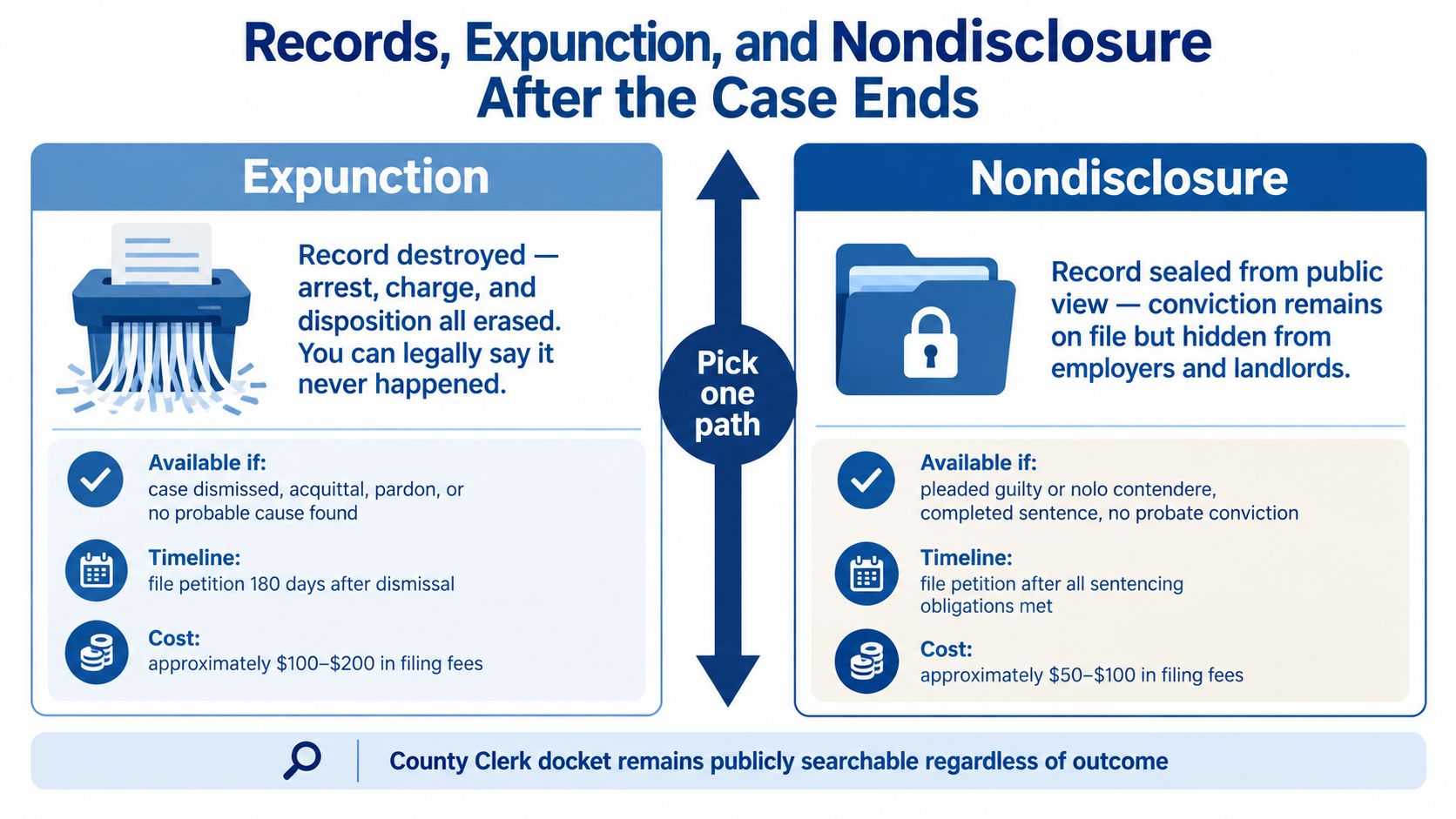
Expunction and nondisclosure aren't the same
Expunction, governed in relevant circumstances by Texas Code of Criminal Procedure Chapter 55A, can result in the destruction or removal of eligible records. Eligibility can involve an acquittal, dismissal, pardon, or other qualifying circumstance. Not every dismissal qualifies, and a plea-based disposition may create a different analysis.
Nondisclosure, addressed in relevant circumstances by Texas Government Code Chapter 411, limits public access to qualifying records but doesn't mean the entire record is destroyed. Eligibility depends on the offense, disposition, supervision, waiting-period rules where applicable, and statutory exclusions. A person should not assume that deferred adjudication automatically qualifies.
The petition is filed in the court with authority over the case, and affected agencies or the State may receive notice and have an opportunity to respond. The court must then determine whether the statutory requirements are satisfied. Because eligibility depends on the exact disposition and history, a lawyer should review the judgment, plea documents, dismissal paperwork, and criminal-history information before filing.
A practical post-case checklist
Use the period after disposition to organize the file rather than guessing about what appears online.
- Collect the court papers: Keep the complaint or information, bond paperwork, plea documents, judgment, dismissal order, and discharge documents.
- Confirm the final result: Ask whether the case was dismissed, resulted in a conviction, involved deferred adjudication, or ended through another disposition.
- Review both record systems: Check the Tarrant County Clerk docket and obtain the relevant state criminal-history information when evaluating record relief.
- Track every obligation: Save receipts, completion certificates, supervision records, and proof of restitution or community service.
- Avoid public discussion: Don't post explanations, screenshots, accusations, or negotiation details about the case online.
- Ask about relief separately: Expunction and nondisclosure require a separate eligibility analysis and filing process.
Mistakes that create avoidable problems
Missing an arraignment because the charge seems minor can lead to serious consequences. So can assuming that a no-contact order applies only to the person named in a police report. Read the actual order, including any definition of prohibited contact and any exceptions.
Another common mistake is accepting the first State offer without reviewing the charging instrument and available evidence. An offer may look attractive until its conviction, supervision, employment, licensing, family-law, or record consequences are understood. The opposite mistake is rejecting an offer without learning whether the evidence presents a meaningful defense.
Local counsel can be particularly useful when the case involves possible jail exposure, alleged violations involving a victim or protected person, witnesses outside Tarrant County, or a Class A misdemeanor with collateral consequences. The right next step depends on the documents, facts, and procedural posture, not just the label “misdemeanor.”
The Law Office of Bryan Fagan PLLC can review the Tarrant County charging documents, bond conditions, court settings, evidence, and possible resolution paths for a misdemeanor case. If you're facing a hearing at the Tim Curry Criminal Justice Center or need help understanding what happens after disposition, visit the firm's site to learn about criminal-defense services and request a consultation.
