 Skip to content

A notice of appeal for a Tarrant County family court order must be filed with the Tarrant County District Clerk at the Family Law Center, 200 E. Weatherford Street, Fort Worth, not directly with the appellate court. The deadline is generally 30 days, but it can be 20 days for an accelerated appeal or 90 days when a qualifying post-judgment motion is timely filed.
You may be holding a signed divorce decree, custody order, child-support ruling, or termination order and wondering what to do before the deadline disappears. The courthouse location and the appellate destination can be confusing, especially because the family judges sit at the same courthouse campus where the clerk processes trial-court filings. The practical answer is straightforward: you start the appeal with the trial-court clerk, not the court of appeals.
Table of Contents
- Where to File Your Tarrant County Notice of Appeal
- Critical Texas Appellate Deadlines You Cannot Miss
- Navigating the Tarrant County Family Law Center
- Determining If Your Family Court Order Is Appealable
- Perfecting the Appeal After the Initial Filing
- When to Consult a Texas Appellate Attorney
Where to File Your Tarrant County Notice of Appeal
For a Tarrant County family court order, file the written Notice of Appeal with the Tarrant County District Clerk at the Family Law Center, 200 E. Weatherford Street, Fort Worth, Texas 76196. The notice goes into the trial-court file, meaning the file maintained by the court that signed the order you want to challenge.
That distinction matters. The Second Court of Appeals in Fort Worth reviews qualifying appeals from Tarrant County, but you generally don't begin by delivering your notice there. Filing directly with the appellate court can create a serious procedural problem because Texas appellate procedure places the initial notice in the trial court clerk's office. You can review local appellate jurisdiction through this guide to the Second Court of Appeals in Fort Worth and the counties it covers, but that appellate court isn't the starting filing office for your notice.
Trial-court filing versus appellate review
Think of the process as having two different locations with two different jobs:
- Tarrant County District Clerk: Receives and files the Notice of Appeal in the underlying family case.
- Second Court of Appeals: Reviews the appellate record and written arguments after the appeal is properly initiated and transferred through the appellate process.
- Family courts: Hear and decide the underlying divorce, custody, support, enforcement, or other family-law dispute.
The clerk's office is more than a convenient drop-off point. The notice is a jurisdictional filing. If the proper notice isn't filed within the applicable deadline, the court of appeals may dismiss the case without reaching whether the trial judge made a legal error.
Practical rule: Treat the notice as a deadline-sensitive court filing, not as a letter explaining why you disagree with the ruling.
The notice should identify the judgment or order being appealed and comply with the applicable Texas appellate requirements. Don't assume that a letter to the judge, an objection at the hearing, or a filing in the appellate court substitutes for the notice. Those actions may express disagreement, but they don't necessarily perfect an appeal.
If you're filing without a lawyer, confirm the clerk's current filing options and requirements before submitting anything. Electronic, in-person, and other filing logistics can change. Keep proof of what you filed and when it was accepted, because a later dispute about the filing date can become its own procedural problem.
Critical Texas Appellate Deadlines You Cannot Miss
The appellate clock generally starts when the trial judge signs the judgment or appealable order. It doesn't necessarily begin when you receive a copy, when the clerk uploads it, or when you first realize the ruling has serious consequences.
For an ordinary family-law appeal, the notice is generally due within 30 days after the judgment is signed. That period can extend to 90 days when a timely motion for new trial, motion to modify the judgment, motion to reinstate, or qualifying request for findings of fact and conclusions of law is filed. The applicable Texas appellate rules are available in the Texas Rules of Appellate Procedure.
Some family matters move on an accelerated schedule. An accelerated family appeal generally allows only 20 days after the order is signed, and Texas treats termination-of-parental-rights appeals as accelerated appeals. The Texas courts' published rules provide the governing framework for these deadlines and the consequences of missing them. You can also review this resource addressing the Second Court of Appeals family-law appeal filing deadline.
| Order Type / Action | Filing Deadline | Key Trigger |
|---|---|---|
| Ordinary family-law judgment or appealable order | 30 days | The date the judgment or order is signed |
| Timely qualifying post-judgment motion | 90 days | The signed judgment plus a timely motion for new trial, motion to modify, motion to reinstate, or qualifying findings request |
| Accelerated family appeal | 20 days | The date the accelerated order is signed |
| Termination-of-parental-rights appeal | 20 days | The signed termination order, because the appeal is accelerated |
Build your calendar from the signed order
Obtain the signed order immediately. Mark the signature date, identify whether the order is final or accelerated, and determine whether a qualifying post-judgment motion was timely filed. Don't calculate from the hearing date unless the hearing and signature occurred on the same date.
A motion that doesn't qualify, or one filed too late, may not extend the deadline. That is why filing a motion after an adverse ruling shouldn't be treated as an automatic way to obtain more time.
Missing the filing deadline can end the appeal for lack of jurisdiction, even when the underlying complaint involves custody or parental rights.
If you're close to the deadline, don't wait for a complete appellate strategy before protecting the filing date. An attorney can evaluate the order, deadline, and available remedies, but the jurisdictional clock continues while that review occurs.
Navigating the Tarrant County Family Law Center
The Tarrant County Family Law Center is located at 200 E. Weatherford Street in Fort Worth. The county's official materials identify the Family Law Division on the third floor and list the District Clerk's Family Law Division phone number as 817-884-1265. Verify current office and filing information before traveling, particularly if you have only a short period remaining.

Use the clerk's office as your procedural checkpoint
The Family Law Division is the local administrative hub for family-case paperwork. That includes the trial-court filing needed to begin an appeal from a Tarrant County family order. The courthouse's physical setting can make it appear that the family judge or the appellate court is the place to submit appellate paperwork. The legally significant step is filing with the clerk who maintains the trial-court case.
The Tarrant County Family Law Center location and floor guide can help you prepare for an in-person visit. Still, don't rely on an online page alone for same-day requirements, payment methods, hours, or filing technology. Call the clerk's office and ask what the current process requires for a Notice of Appeal in your case.
Requesting records for an appeal
You may need family court records to determine what happened in the trial court and what materials belong in the appellate record. Tarrant County's official materials state that family court records requests may be submitted in person or by mail to the Family Court Records address. That reinforces the District Clerk's role as the central records and filing hub for these matters. See the Tarrant County District Clerk's official family-law information for county-specific records and office information.
Bring or retain copies of the signed order, your filed notice, confirmation of filing, and any post-judgment motions. If you mail a records request or other document, allow time for delivery and processing. Mailing something before a deadline doesn't necessarily solve every filing problem, so confirm how the clerk treats the submission.
Determining If Your Family Court Order Is Appealable
A family court judge can issue many rulings during a case, but not every ruling is immediately appealable. A signed document isn't automatically a final judgment, and a party who files without identifying an appealable order can spend valuable time pursuing a remedy the court of appeals can't hear at that stage.
A final divorce decree or final custody judgment usually has a different procedural posture from a temporary order. A temporary order may address possession, support, decision-making, or restrictions while the case remains pending. The fact that the temporary ruling is painful or disruptive doesn't by itself make it immediately appealable.
Final orders and temporary rulings are different
Ask these questions before treating an order as the basis for a standard appeal:
- Does the order dispose of the entire case or only one issue?
- Does the document clearly identify the judgment or order being challenged?
- Does another hearing remain before the trial court can resolve the dispute?
- Is the order temporary, interlocutory, or subject to a specific accelerated procedure?
- Were post-judgment motions filed, and do they qualify under the appellate rules?
A final order may resolve the divorce, property division, custody arrangement, support obligations, or another complete family-law proceeding. A temporary order generally manages the case while the court retains authority to enter a later final ruling. These categories can affect both whether an appeal is available and which deadline applies.
Accelerated matters require immediate review
Termination of parental rights is a particularly high-stakes example. Texas treats those appeals as accelerated, so the notice deadline is 20 days after the order is signed, not the ordinary 30-day period. A parent who assumes every family appeal follows the standard schedule can lose appellate jurisdiction before counsel has time to review the record.
The right question isn't "Do I dislike this ruling?" It is, "What order was signed, is it appealable now, and which appellate timetable governs it?" The Texas appellate rules should be checked against the actual order and procedural history.
Don't confuse an appeal with asking the trial judge to reconsider, modify, or enforce an order. Those remedies may involve different filings and deadlines. A qualified Texas family-law or appellate attorney can identify the order's status before you commit to a procedural path.
Perfecting the Appeal After the Initial Filing
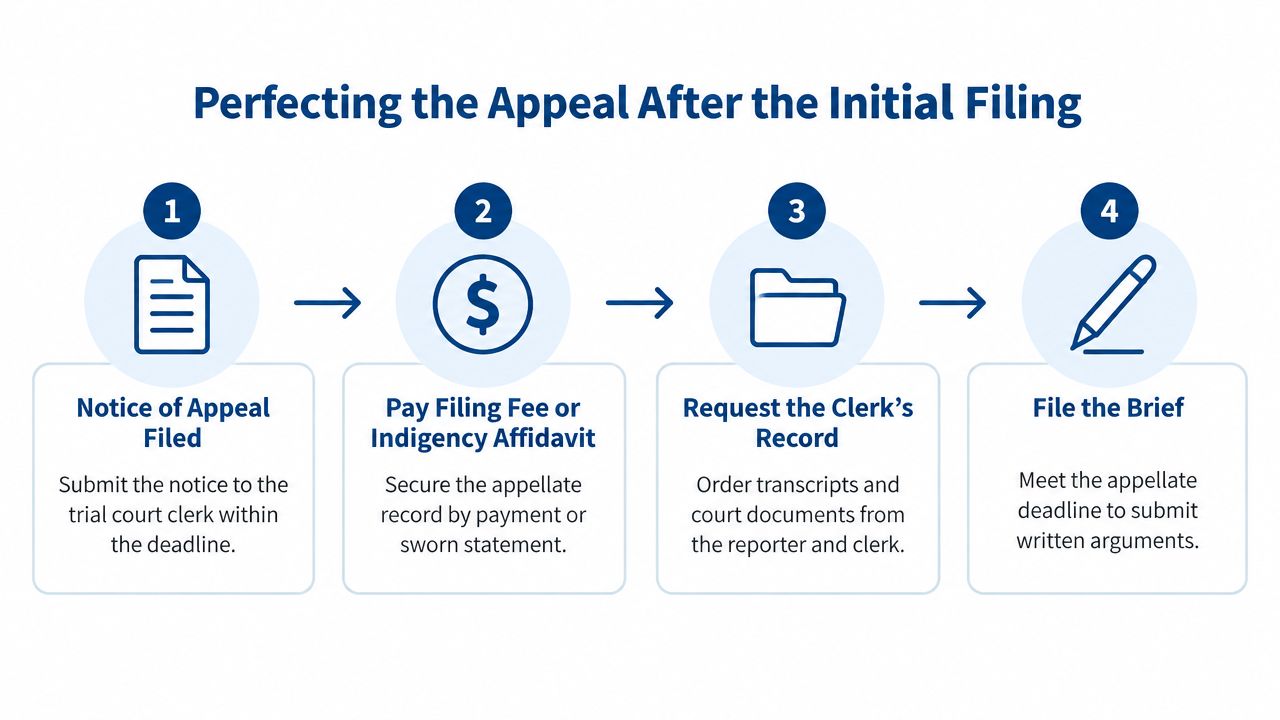
Filing the Notice of Appeal protects the starting point, but it isn't the entire appellate case. After the notice is filed, the appellant must handle the record, fees or indigency issues, deadlines, and written arguments. A missed follow-up requirement can place the appeal at risk even after the initial notice was timely.
The record controls what the appellate court can review
An appellate court reviews the record from the trial court. That record can include the clerk's record and, when relevant, the court reporter's record or transcript. The appellate lawyer must identify what was admitted, what objections were made, what testimony occurred, and what rulings are preserved for review.
The record doesn't automatically contain every document or every conversation you believe mattered. Coordinate with the trial-court clerk about the clerk's record and with the court reporter about any needed reporter's record. Ask promptly about costs, ordering procedures, and applicable deadlines.
Handle fees and record requests early
The appeal may involve an appellate filing fee and expenses associated with preparing the record. A person who can't afford required costs may need to pursue an indigency affidavit or other fee-waiver procedure. Don't assume financial hardship automatically pauses deadlines or completes the waiver process. The required sworn paperwork must be filed and handled correctly.
A practical post-filing checklist includes:
- Preserve your confirmation: Keep the filed notice, confirmation, and file-stamped copy.
- Address fees: Pay required fees or submit the appropriate indigency paperwork.
- Request the record: Coordinate requests for the clerk's record and reporter's transcript.
- Review preservation: Identify objections, motions, rulings, and evidence relevant to the appeal.
- Prepare briefing: Develop legal arguments based on the record and applicable Texas authority.
- Track every deadline: Use written calendar entries and confirm deadlines with appellate counsel.
The appellate court generally doesn't retry the family dispute. It reviews claimed legal error through the record and the parties' written arguments.
That difference changes the work. A parent who believes a trial judge misunderstood testimony may need to show a legal or evidentiary problem preserved in the record, not merely repeat the testimony from memory. A spouse who disagrees with property division must connect the complaint to a reviewable error and supporting portions of the record.
When to Consult a Texas Appellate Attorney
A family-law appeal isn't a second trial. Trial litigation focuses on presenting witnesses, exhibits, and arguments to the judge. An appeal focuses on the existing record, preservation of error, legal research, standards of review, and a carefully structured brief.
Self-representation can be especially risky when the deadline is close or the order affects custody, support, property, or parental rights. The filing location is only the first procedural issue. You must also determine whether the order is appealable, select the correct deadline, preserve the record, request necessary transcripts, and present arguments that the appellate court can legally consider.
Why appellate preparation differs
An appellate lawyer will typically need to examine:
- The signed order: Its language may determine finality, scope, and the applicable timetable.
- The docket and post-judgment motions: These can affect the notice deadline and available relief.
- The reporter's record: The transcript may show whether an objection or legal argument was preserved.
- The clerk's record: Pleadings, exhibits, motions, and orders provide the procedural foundation.
- The legal issues: The brief must explain the alleged error with authority and record citations.
- The requested relief: The remedy must fit the error and the court's appellate power.
Start the consultation immediately after receiving an adverse ruling. Waiting until the ordinary deadline is nearly over can leave no practical time to evaluate accelerated treatment, post-judgment motions, record preservation, or the scope of review.
The Law Office of Bryan Fagan PLLC identifies Family Law Appeals as a service involving appellate representation for Tarrant County family court rulings, including custody, divorce, and support orders. Other qualified Texas appellate attorneys may also be appropriate, particularly when the case involves a narrow appellate issue or a highly specialized record.
This article provides general information, not individualized legal advice. If your order came from a Tarrant County family court, gather the signed order, note the signature date, preserve every filing confirmation, and obtain case-specific guidance before the applicable deadline expires.
The Law Office of Bryan Fagan PLLC offers guidance on Texas family law appeals, including evaluating a Tarrant County order, filing the Notice of Appeal, and preparing the appellate record and briefs. Visit the firm to learn about the Start Here process and request a consultation before a filing deadline threatens your appellate rights.
