 Skip to content

Parents with rotating or overnight shifts in the Alliance Corridor can create a custody schedule that works for their job, but it must be designed around their verified work cycle rather than the traditional weekend-only possession pattern. A parent may need a schedule tied to published rosters, recovery sleep, transportation, and childcare instead of a fixed Friday-to-Monday block.
A warehouse employee near AllianceTexas may leave work after sunrise, sleep through a Friday evening exchange, and wake to messages accusing them of missing parenting time. Another parent may work aviation, manufacturing, or distribution shifts that change every few weeks. The problem isn't a lack of commitment to the child. The problem is a written schedule that assumes ordinary business hours.
AllianceTexas developed from a major industrial airport into a broad logistics and employment corridor. The airport opened in December 1989, and by 2018 AllianceTexas had created more than 61,600 jobs, including approximately 37,600 directly associated with logistics and related transportation and industrial activity, according to AllianceTexas's 35-year history. Those jobs support families throughout Fort Worth, Tarrant County, Keller, Haslet, Roanoke, and nearby communities, but many operate overnight, on weekends, or on rotating schedules.
Table of Contents
- Why Standard Custody Schedules Fail Shift Workers in Fort Worth
- How Texas Possession Rules Interact With Nonstandard Hours
- Designing A Possession Schedule Around Your Work Cycle
- Comparing SPO Weekends to Alternative Possession Structures
- Drafting Clear And Enforceable Agreement Language
- Negotiating With The Other Parent and Preparing a Court Proposal
- Modification And Enforcement Options When Circumstances Change
Why Standard Custody Schedules Fail Shift Workers in Fort Worth
Consider a parent working overnight shifts at a logistics warehouse near Alliance. The current order provides possession beginning Friday at 6:00 p.m. The parent is scheduled to work Friday night, has a long commute, and needs recovery sleep before safely driving or caring for the child. A literal reading of the order gives the parent possession during the weekend, but the exchange time may be impossible.
The other parent may see repeated missed exchanges. The working parent may see a schedule that ignores the job keeping the household financially stable. Both concerns can be real at the same time.

The schedule follows possession periods
Texas custody schedules are built around possession periods, not a parent's job title. The Texas Standard Possession Order generally includes weekends beginning at 6:00 p.m. on the first, third, and fifth Friday of each month, along with weekday, holiday, and summer periods. The Texas Attorney General's parenting-time overview describes those recurring periods, but a standard calendar can't automatically account for a rotating Alliance-area roster.
A night-shift parent can technically have possession while facing practical barriers:
- Work conflicts: The parent may be required to remain at work during the exchange.
- Recovery sleep: Possession immediately after an overnight shift may create a safety and supervision problem.
- Transportation: The parent may not be available to make a school, daycare, or evening exchange.
- Childcare: A child may need care while the parent works, particularly during overnight hours.
- Changing rosters: A schedule that works this month may fail after the next shift assignment.
Practical rule: A possession period isn't meaningful if the parent can't safely exercise it or reliably complete the exchange.
The law values consistency because children need predictable routines. Shift work requires flexibility because the parent's availability changes. A workable order has to reconcile those interests with specific terms, rather than leaving the parents to renegotiate every week by text message.
How Texas Possession Rules Interact With Nonstandard Hours
Texas doesn't create a separate custody schedule for Alliance-area employees or other shift workers. Courts generally use the Standard Possession Order as a baseline, but possession and access decisions remain governed by the child's best interest. Texas Family Code §153.002 identifies the child's best interest as the primary consideration, and the Texas Attorney General's parenting-time schedule guidance explains the standard framework.
The Standard Possession Order is therefore a starting point, not an unchangeable destination. A court may approve an agreed schedule that differs from the standard arrangement, and a different schedule may be ordered when the standard terms are unworkable or don't serve the child's best interest.
What best interest means in a shift-work case
For a Fort Worth or Tarrant County parent, best interest usually requires more than showing that a job is inconvenient. The proposal should show how the alternative protects:
- Stability: The child knows when possession occurs and who handles transportation.
- Continuity: School, daycare, medical care, and activities remain dependable.
- Safety: The parent has a realistic opportunity to sleep after overnight work.
- Emotional connection: The child receives meaningful time, not merely nominal hours in a calendar.
- Predictability: Both parents can plan without guessing whether a shift changed.
A court is more likely to evaluate a documented, repeatable plan than a request for unlimited flexibility. “When available” doesn't tell either parent, a school, or a neutral third party when possession starts or ends.
The broader labor market makes this issue locally significant. Dallas Regional Chamber data identifies 70,069 heavy-truck-driver jobs, 81,344 hand freight-and-material movers, 96,088 stockers and order fillers, and 29,575 shipping, receiving, and inventory clerks in the regional industry data, as reported in the local custody-schedule discussion. Those figures illustrate why a rigid school-night or weekend pattern may collide with employment realities for families connected to the Alliance Corridor.
Designing A Possession Schedule Around Your Work Cycle
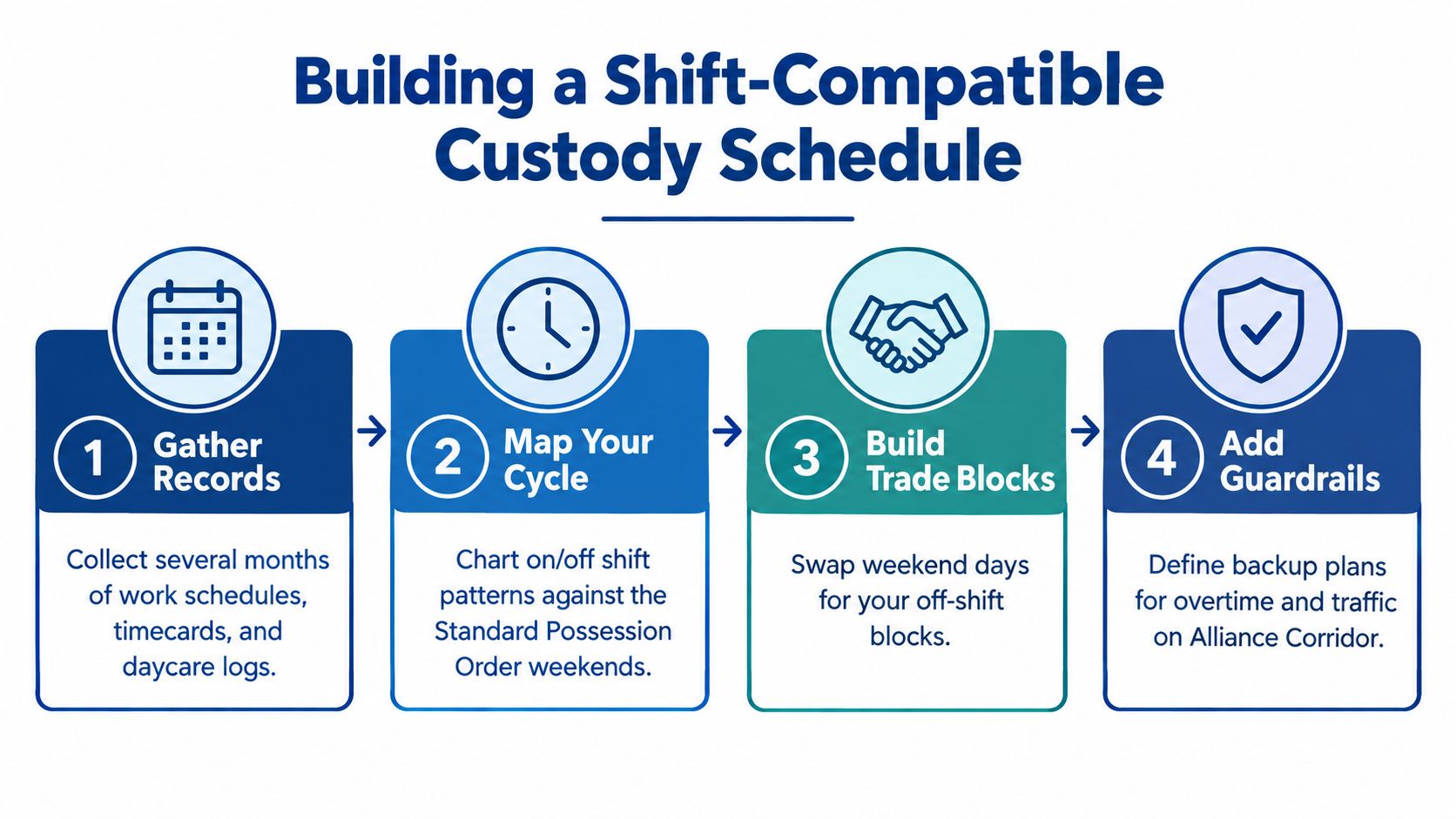
A strong proposal starts with records, not assumptions. The question is not which days you prefer. It is which blocks of time you can repeatedly provide safe, attentive, and reliable parenting.
Start with objective records
Collect several months of materials before proposing a new schedule:
- Work rosters: Save posted schedules, shift assignments, and notices of mandatory overtime.
- Time records: Keep timecards or payroll records showing actual start and end times.
- Commute information: Record the travel time between work, the child's school, daycare, and exchange locations.
- Sleep needs: Show the recovery period required after overnight work.
- Childcare details: Identify school hours, daycare hours, and any backup caregiver.
- Exchange options: List locations that are safe and realistic for both parents.
Next, place those records on a repeating calendar. Mark work, commute, sleep, school, activities, and the blocks when the child would be with you. A calendar that counts every hour after a shift as available parenting time may look generous but won't reflect the child's experience.
Match the calendar to the child's routine
Test the proposed schedule against school attendance, medical appointments, holidays, transportation, and the child's age. A parent working Sunday through Thursday nights might have better possession during daytime blocks on Monday through Friday, with exchanges after adequate sleep and before school responsibilities. The precise times would depend on the parent's roster and the child's routine.
A parent working a rotating four-on/four-off schedule may need a monthly calendar tied to published shifts. That approach can work if both parents receive the calendar early enough and the order explains what happens when the employer changes the roster.
Add operating rules
The order should address the details that cause most disputes:
- Exact exchanges: State the day, time, and location.
- Transportation: Identify who picks up and who returns the child.
- Roster notice: Require advance notice when a published shift changes, subject to reasonable exceptions.
- Backup care: Explain who may care for the child during unavoidable work hours.
- Holidays: Build holiday time into the rotating schedule instead of ignoring it.
- Make-up time: Define when lost possession can be replaced.
- Communication: Provide a dependable method for sharing schedules and confirming exchanges.
- Missed exchanges: Explain the process for notice, documentation, and rescheduling.
Parents dealing with aviation-related schedules may also benefit from reviewing guidance on custody schedules for airline pilots based in the Dallas-Fort Worth area. The same planning principle applies to warehouse, manufacturing, trucking, and distribution work: build around verified availability and the child's needs.
Comparing SPO Weekends to Alternative Possession Structures
No single structure fits every Alliance Corridor employee. The right choice depends on the work rotation, commute, sleep pattern, school schedule, and whether the employer publishes changes in advance.
| Structure | Best For | Advantages | Drawbacks |
|---|---|---|---|
| Traditional SPO weekends | Stable day-shift parents | Familiar, easy to understand, and predictable | Often conflicts with Friday evening work, overnight recovery, or weekend shifts |
| Midweek possession blocks | Parents consistently free on Wednesday or Thursday | Can preserve meaningful school-week contact without relying on weekends | May create transportation pressure on school nights |
| Monthly calendar possession | Four-on/four-off or regularly rotating schedules | Connects possession to a published work roster | Requires timely calendar sharing and clear change procedures |
| Split possession with make-up time | Parents with occasional overtime or isolated conflicts | Preserves replacement time without rewriting every period | Can become confusing if make-up rules lack exact deadlines and times |
Weighing the trade-offs
Traditional Friday evening through Monday evening possession may work well for a day-shift parent who can make the exchange and handle the child's Monday routine. It often fails for a parent who works Friday night or spends the weekend recovering from overnight shifts.
Midweek blocks can be more practical when the parent has consistent days off. For example, a Wednesday evening through Thursday evening period may fit a parent whose Monday and Tuesday nights are working nights but whose Wednesday and Thursday availability is dependable. The schedule still must account for homework, school transportation, and bedtime.
A monthly calendar offers flexibility, but flexibility without a deadline creates conflict. The order should say who publishes the calendar, when the other parent receives it, and what happens if the employer changes the roster afterward.
Split possession and make-up time can preserve the relationship when overtime is occasional. It shouldn't become a permanent substitute for modifying an order that repeatedly fails. Parents considering supervised exchanges or safety-related arrangements can review Tarrant County domestic-relations resources on supervised visitation, although shift work alone doesn't automatically require supervision.
Drafting Clear And Enforceable Agreement Language
Vague language is the enemy of enforceability. “The child will stay with the parent when available” leaves too many unanswered questions, especially when the parents disagree about whether a shift conflict was genuine.
Use a simple quality-control test: Could a neutral third party identify every exchange from the written order without guessing? If not, the provision needs more detail.
Put the mechanics in writing
A shift-compatible order should address:
- Times: State exact start and end times, including whether the time is local Fort Worth time.
- Locations: Name a daycare, school, neutral public location, or another specific exchange site.
- Transportation: Identify the parent responsible for each trip and what happens if traffic delays the exchange.
- Notice: Explain how and when a parent must provide a changed roster.
- Childcare: State whether a backup caregiver may be used during a work shift and how that caregiver is identified.
- Holidays: Allocate holiday possession in a way that accounts for rotating work rather than assuming weekends are always free.
- Make-up time: Set out the replacement period, notice, and limits.
- Communication: Identify the approved method for sharing rosters and confirming changes.
A proposal should prove the work pattern. Include rosters, timecards, employer notices, commute information, school schedules, and a calendar showing actual availability. Don't count a nominal overnight as meaningful parenting time if the parent will be at work or asleep for most of it.
Texas Family Code Chapter 111 requires possession guidelines to be made available in qualifying courtrooms, as reflected in the Texas statutory provisions on possession guidelines. Those guidelines aren't a guarantee that every family receives identical dates or times. Parents may request adjusted terms when mandatory overtime, overnight work, or changing days off makes ordinary alternating-weekend possession unworkable.
An informal text-message swap may help the parents manage a temporary change, but it doesn't safely replace a written agreement or court modification when the existing order repeatedly fails. Until the order changes, assume the written terms remain controlling.
Negotiating With The Other Parent and Preparing a Court Proposal
Start with a written proposal that treats the other parent as a participant in solving a scheduling problem, not as the cause of it. Attach the work records, explain the proposed exchange blocks, and show how the plan protects school attendance, transportation, sleep, and dependable childcare.
Focus the discussion on the child's stability rather than parental convenience. A proposal is stronger when it explains who gets the child to school, how missed time is replaced, how holidays work, and how both parents receive notice of roster changes.

Use negotiation before litigation when possible
If the other parent is resistant, mediation may offer a structured way to discuss the calendar before filing a contested request. A private mediator or an available family-court mediation service may help the parents identify workable exchange locations, replacement periods, and communication rules.
The working parent should also acknowledge legitimate concerns. If the other parent worries that overnight work leaves the child with a caregiver, address that directly with a childcare provision rather than dismissing it. If the working parent wants meaningful time, propose time when the parent will be rested and present, not merely hours that look equal on paper.
A court proposal should include:
- Current order and disputed provisions
- Work rosters and timecards
- Employer notices or offer letters
- Commute and transportation information
- School, daycare, and activity schedules
- A repeating or monthly possession calendar
- Proposed holiday and summer terms
- Backup-care and make-up-time provisions
- Messages showing attempted coordination
The 231st, 233rd, and 322nd District Courts are among the Tarrant County district courts where family matters may be heard, and the George Allen Courts Building is a courthouse venue associated with those proceedings. Court involvement should be treated as a formal process, not as an informal scheduling meeting.
The following video may help parents think through collaborative calendar planning:
Texas courts may approve an agreed schedule that differs from the Standard Possession Order. If agreement isn't possible, a parent can present evidence that the standard arrangement is unworkable or inconsistent with the child's best interest, but no particular result is guaranteed.
Modification And Enforcement Options When Circumstances Change
A new job or shift assignment doesn't automatically change an existing custody order. A parent who accepts a warehouse, aviation, manufacturing, or technology position must still follow the written order unless the other parent agrees to a change that is legally effective or a court modifies the terms.
The key distinction is between a temporary scheduling problem and a sustained material change. A single mandatory overtime shift may call for notice and make-up time. A lasting change in start time, commute, overnight assignment, or rotating schedule may justify evaluating a modification request.
Document the change before exchanges fail
Preserve evidence showing what changed and why the existing schedule no longer works:
- Employment records: Keep the offer letter, posted rosters, payroll records, and overtime notices.
- Transportation proof: Document commute duration and the effect on school or exchange timing.
- Childcare arrangements: Identify who would care for the child during work hours.
- Communication history: Save messages about missed exchanges, proposed swaps, and notice.
- Replacement plan: Offer specific alternative periods rather than only asking for flexibility.
- Child-focused reasons: Explain effects on school, sleep, activities, medical care, and routine.
Modification changes the order. Enforcement addresses an alleged violation of the order. If a parent disregards the existing terms, the other parent may pursue a motion for enforcement and seek available remedies. A parent who repeatedly cannot comply because of a changed work schedule should consider how Tarrant County courts handle child-custody modifications before the missed exchanges become the central evidence.
Review geographic restrictions before moving
A work transfer or new schedule may also raise location issues. A custody order can limit where a child may live, and a parent should review that restriction before moving the child outside the permitted area. Travel between Fort Worth, Keller, Haslet, Roanoke, or another surrounding community can affect school transportation, exchange timing, and the other parent's possession.
A move or work change doesn't authorize a parent to ignore the current order. Texas law includes specific provisions addressing child-custody jurisdiction and related possession issues, so a major relocation or interstate question requires careful review of the actual order and facts. The Texas Family Code provisions on custody jurisdiction provide the statutory framework, but they don't replace case-specific legal advice.
Speak with a qualified Fort Worth family-law attorney when the schedule has changed substantially, the other parent won't agree to practical adjustments, an exchange dispute is escalating, or a geographic restriction may apply. Bring the current order, work records, calendars, messages, and proposed schedule so the attorney can evaluate whether negotiation, modification, enforcement, or another approach fits the circumstances.
Law Office of Bryan Fagan PLLC can help Fort Worth and Tarrant County parents evaluate shift-work possession schedules, prepare a documented proposal, and address custody modification or enforcement concerns. Visit Law Office of Bryan Fagan PLLC to learn about the firm's family-law services and request guidance for your circumstances.
