 Skip to content

Tarrant County Domestic Relations Office supervised visitation is a court-connected, fee-based program run through Family Court Services at 200 E. Weatherford St. in Fort Worth, with visits offered on the first and third weekends only. All visits must be arranged through the office and must occur in Tarrant County.
A Fort Worth parent may receive a supervised visitation order after a custody dispute, enforcement proceeding, or safety concern has made ordinary exchanges unworkable. The order can feel restrictive, but it also gives the family a defined process for maintaining parent-child contact while the court's concerns are addressed.
The phrase “supervised visitation” can describe more than one county service. Tarrant County separates the structured visitation-center model from its Community Supervision Unit, which handles broader court-ordered monitoring and enforcement matters. Understanding that distinction helps parents contact the right office, prepare for the correct process, and avoid assuming that an informal relative or friend can substitute for court-approved supervision.
Table of Contents
- Introduction What Tarrant County Supervised Visitation Means for Your Family
- Understanding the Tarrant County Domestic Relations Office and Family Court Services
- How to Request and Schedule Supervised Visitation in Tarrant County
- What to Expect at the Visitation Center Rules Schedule and Fees
- Supervised Exchanges and Alternatives When the Center Is Not the Right Fit
- How Supervision Can Be Reduced or Ended Under Texas Law
- Next Steps for Fort Worth Families Considering Supervised Visitation Help
Introduction What Tarrant County Supervised Visitation Means for Your Family
A parent leaves a Fort Worth custody hearing with a signed order and immediate practical questions. Where will the visit occur? Who schedules it? Can the parent select the supervisor? What happens if the other parent does not cooperate?
For families using Tarrant County's published program, supervised visitation runs through Family Court Services at the Family Law Center, 200 E. Weatherford St. in Fort Worth. The county lists 817-212-7296 as the direct phone number. The visitation center operates on the first and third weekends, offering one-hour supervised visits on Saturdays from 9 a.m. to 6 p.m. and Sundays from 1 p.m. to 6 p.m. Tarrant County's supervised visitation information contains the current published rules and contact details.
The center track works like a scheduled facility service, not an informal family arrangement. Parents do not choose a relative or friend, then report the visit to the court. The program sets the location, scheduling process, supervision requirements, and fees.
Practical rule: Read the possession order alongside the county's program rules. The order establishes legal rights, while program procedures explain how an authorized visit is arranged and conducted.
Tarrant County's other track is the Community Supervision Unit. Family Court Services handles the visitation-center process, while the Community Supervision Unit addresses court-ordered supervision and enforcement matters. Those matters can include contempt for failure to pay child support under Texas Family Code section 157, Subchapter E, or contempt involving failure to allow possession of and access to a child.
That distinction matters because the weekend center and community supervision are not interchangeable. A parent must first identify which track the court order uses, then follow that track's process rather than assuming either service can approve a different arrangement.
The path may change as circumstances improve. A parent seeking less restrictive access may need to comply with the existing order, document progress, and request a court-authorized modification. Texas law can provide a route from supervised contact toward broader possession, but the order remains controlling until the court changes it. If the order is unclear or the other parent will not follow it, case-specific legal guidance can help identify the authorized next step.
Understanding the Tarrant County Domestic Relations Office and Family Court Services
在一次探視安排中,家長可能只看見「受監督探視」這幾個字,卻忽略了 Tarrant County 有兩條不同的服務軌道。先分清楚是哪一條,才能知道應向哪個單位聯絡、探視在哪裡進行,以及法院命令如何執行。
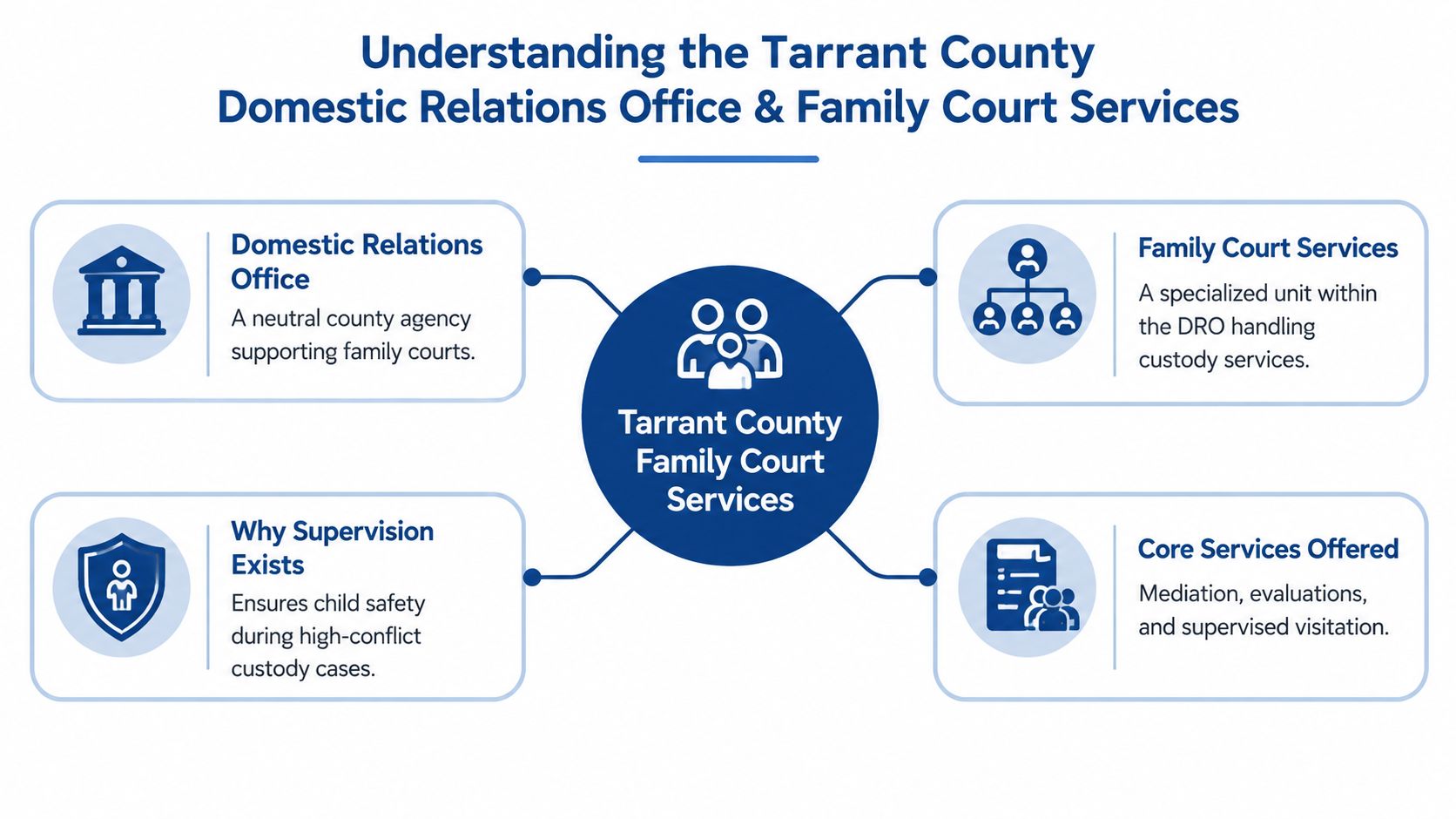
Tarrant County Domestic Relations Office 支援縣家庭法院處理家庭法爭議。Family Court Services 是其中的專門部門,為受監督探視提供受控環境,讓家長與子女相處時由監督人員在場觀察。
探視中心軌道
探視中心是以設施為基礎、裁量較少的選項。探視須在指定中心,依照計畫規則進行,不能自行改到家中或由家長任意選定的地點。對於衝突較高的家庭,固定的場地、時間表和監督流程能劃出清楚界線。
縣政府表示,透過 Family Court Services 安排的受監督探視,必須在 Tarrant County 內進行。因此,即使家長住在 Arlington、Keller、Mansfield 或其他鄰近社區,仍應把縣政府公布的服務範圍納入交通安排和命令遵循之中。
Community Supervision Unit 軌道
Community Supervision Unit 的職能不同。它負責與法院命令、違反命令及藐視法庭事項相關的監督,包括依 Texas Family Code section 157, Subchapter E 處理未支付子女扶養費的藐視法庭案件,也包括未讓另一方行使子女占有及接觸權、涉及探視的藐視法庭案件。Tarrant County Domestic Relations Office materials 說明了這項執法關聯。
這個單位不是探視中心的另一個名稱。探視中心處理的是受監督的親子接觸,Community Supervision Unit 則處理與既有違規或藐視法庭裁定相連的監督和執行工作。
| 服務軌道 | 主要功能 | 實際特點 |
|---|---|---|
| 探視中心 | 安排受監督的親子接觸 | 受控的設施環境,提供公布的週末探視 |
| Community Supervision Unit | 處理與執行及藐視法庭事項相連的法院命令監督 | 監督範圍較廣,重點在遵守法院命令 |
家長若要安排中心探視,應依 Family Court Services 的程序辦理。若案件涉及執行命令、藐視法庭裁定或不准接觸子女的違規,則應仔細閱讀法院命令,確認 Community Supervision Unit 是否被指定。
無論屬於哪條軌道,書面的 possession order 仍然有效。私人協議不能取代命令要求,尤其是命令指定必須透過特定服務接受監督時。若情況已改善,家長可依命令完成現有安排、保留進展紀錄,再向法院申請較少限制的接觸方式。在法院修改命令前,原命令仍是適用標準。
How to Request and Schedule Supervised Visitation in Tarrant County
A temporary or final custody order is the starting point for supervised visitation. A private agreement between parents cannot replace the court's requirements. Review every page of the order, including attachments, to identify who supervises, where visits occur, how transportation works, and whether the order names the visitation center or Community Supervision Unit.
After reviewing the order, contact Family Court Services through the county's published information. The program is identified at the Family Law Center, with 817-212-7296 listed as its direct phone number. The county's current procedures should be confirmed before anyone selects a date or makes travel arrangements.

Preparing for intake
Treat intake like matching a key to a lock. The office needs the complete order to determine which service track fits the case. An incomplete copy may require clarification before a visit can be scheduled.
Have these materials and details ready:
- Court paperwork: Provide the signed order and each later order that changes possession, access, supervision, transportation, fees, or communication.
- Contact information: Supply current phone, email, and mailing information for every required participant.
- Scheduling limits: Explain work, school, transportation, or other limits. Do not assume the office can approve an exception.
- Communication records: Keep messages showing attempts to coordinate, especially if the other parent does not respond.
- Questions about authority: Ask whether the order requires the weekend visitation center, Community Supervision Unit, or another approved arrangement.
A Fort Worth parent named Jordan might receive a temporary order requiring supervised contact. Jordan should not arrange a visit at a relative's home and assume that it satisfies the order. Jordan should submit the order, complete intake, and wait for confirmation of the approved time and location.
Choosing the correct supervision track
The weekend visitation center is the facility-based route. It is designed for scheduled parent-child contact in a controlled setting. The Community Supervision Unit is a separate route tied to court-order enforcement, contempt matters, or monitoring required by the order. The two tracks work like different lanes: one schedules supervised contact, while the other addresses compliance with court requirements.
That distinction affects the next call. A parent seeking a center visit should follow Family Court Services intake. A parent dealing with an enforcement-related monitoring requirement should read the order carefully and ask whether Community Supervision Unit procedures apply.
The Tarrant County Community Supervision Agreement should be reviewed when the order specifically requires community supervision. It may not be the correct document for an ordinary center appointment.
The office, not either parent alone, confirms the visit. A preferred date remains only a request until the provider accepts it. A parent who arrives without a confirmed appointment may not have a visit that complies with the order.
For background on requesting a change to an existing custody arrangement, see how Tarrant County courts handle child custody modifications. A modification case is separate from scheduling contact under the current order. Until a judge changes that order, both parents should follow its existing terms.
What to Expect at the Visitation Center Rules Schedule and Fees
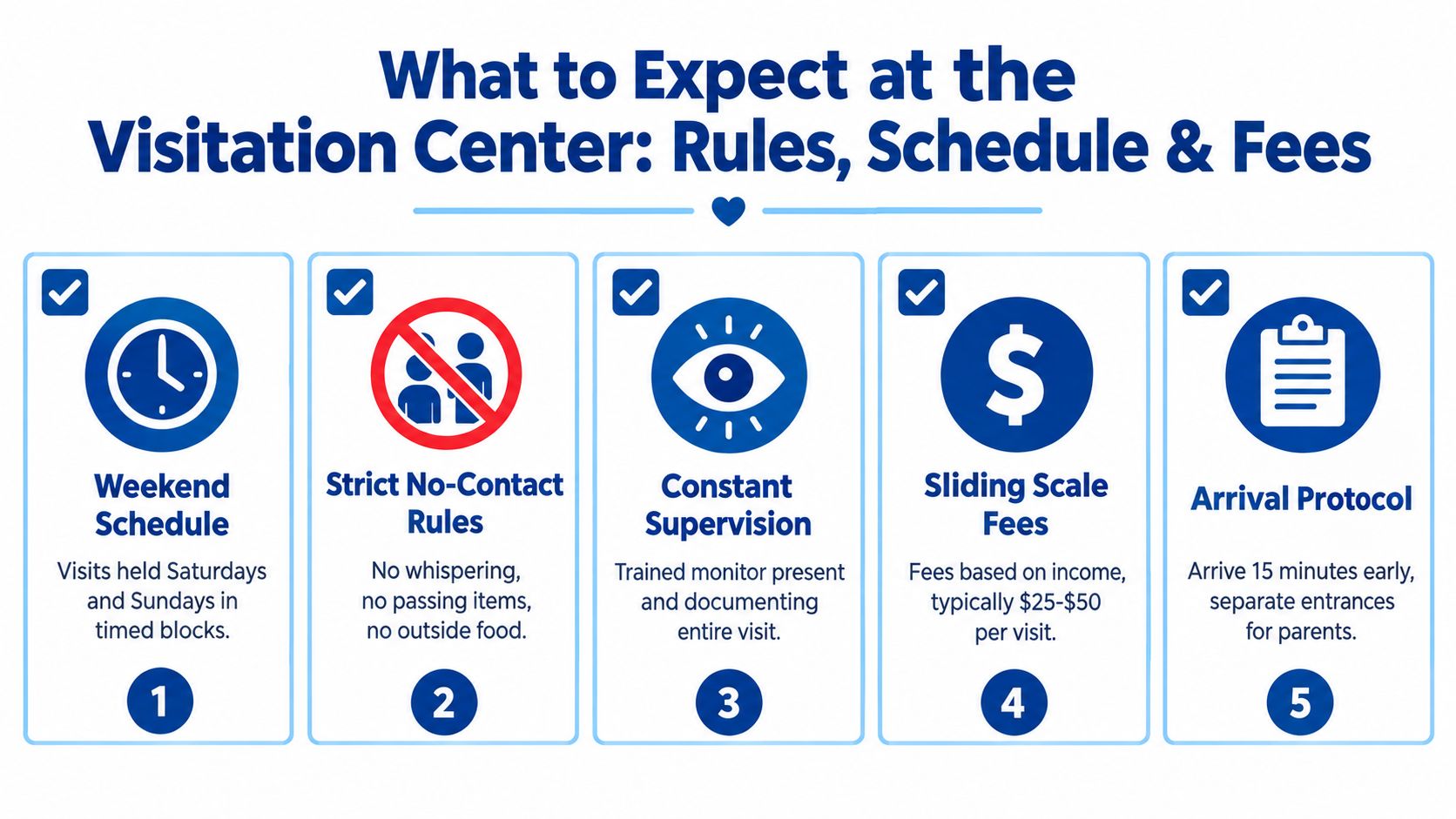
A confirmed center appointment gives the visit a clear frame: a set weekend, a defined hour, and a monitor present throughout parent-child contact. The county's published schedule uses one-hour supervised periods. Saturdays run from 9 a.m. to 6 p.m., Sundays run from 1 p.m. to 6 p.m., and the center operates only on the first and third weekends. Review Tarrant County's published supervised visitation rules before making plans.
The center fee and community rate are different
The facility-based program charges a $15 per-visit fee for each scheduled weekend visit at the visitation center. Community supervised visitation follows a separate rate of $55 per hour, with a two-hour minimum and a three-hour maximum. The community option is the second track, used when the order and county requirements call for supervision outside the regular weekend-center format. These are separate services, not two prices for the same appointment.
That distinction works like choosing between a scheduled office appointment and a field visit. The center fee applies to the controlled facility. The hourly community rate applies when supervision is arranged through the community model, subject to the governing order and applicable procedures.
Before the first visit, confirm:
- Appointment confirmation: Obtain the exact date, time, and location approved by the office.
- Arrival expectations: Ask what check-in process and arrival time apply.
- Conduct requirements: Follow rules for communication, personal items, and behavior.
- Payment instructions: Confirm the amount, due time, and accepted payment method.
- Cancellation procedures: Contact the office promptly if an emergency affects attendance.
The published rules should guide preparation. A friend's experience at another county's center may not match Tarrant County's process. For directions inside the building, use this guide to the Tarrant County Family Law Center at 200 E. Weatherford.
Conduct matters as much as attendance
Showing up is only one part of complying with the arrangement. A parent can make future visits harder by arguing with the other parent, discussing the case with the child, or challenging the monitor's instructions. Calm communication, respect for facility directions, and attention to the child's comfort support a productive visit.
Ask before bringing food, gifts, medication, electronics, or other items. Something that appears harmless may conflict with facility rules or the child's needs.
During the visit: Focus on the child, follow the monitor's directions, and save disputes about the other parent or the court order for a legal consultation.
Supervised Exchanges and Alternatives When the Center Is Not the Right Fit
A supervised visit and a supervised exchange address different risks. At a supervised visit, a monitor observes the parent's interaction with the child throughout the contact. At a supervised exchange, the monitor focuses on the transfer between parents. The child's time with the receiving parent may then take place elsewhere, if the possession order allows it.
This distinction creates two separate tracks in Tarrant County. The weekend visitation center provides a controlled facility setting under its published schedule. Community Supervision Unit services are broader and may fit orders involving ongoing monitoring, enforcement, or contempt concerns, including issues related to child support or possession and access.
Private providers can offer another setting when the county center's location, schedule, or structure does not fit. Agreement between the parents alone does not authorize the substitution. The provider and arrangement must comply with the possession order, and a court may need to approve any change.
| Option | Best for | Location and schedule | Cost structure |
|---|---|---|---|
| Visitation center | Families needing a controlled facility setting | Tarrant County, first and third weekends under the published center schedule | Published per-visit center fee |
| Community supervision | Orders requiring broader monitoring or enforcement-related supervision | Community-based arrangements within the terms of the order | $55 per hour, with a two-hour minimum and three-hour maximum, according to the county's published service information |
| Private provider | Families whose order permits a different approved provider or setting | Depends on the provider and court order | Provider-specific, confirmed before services begin |
Cost and convenience should come after the written order. The relevant questions include the type of supervision ordered, the level of conflict, transportation limits, safety concerns, and whether the judge approved a particular provider. A private supervisor may be easier to reach, yet still be the wrong choice if the order names the county center or requires professional supervision.
Avoiding informal substitutions
A relative, neighbor, family friend, or therapist may be trusted by both parents, but that person may not meet an order requiring county or professional supervision. Informal arrangements also make later disagreements harder to resolve because the parties may dispute what occurred and whether the supervisor satisfied the order.
If the center does not work, request guidance before changing the arrangement. Depending on the order and case facts, the appropriate path may be clarification, a modified order, Community Supervision Unit services, or another court-approved provider. The goal is a lawful transition toward access that matches the child's safety needs and the court's instructions.
How Supervision Can Be Reduced or Ended Under Texas Law
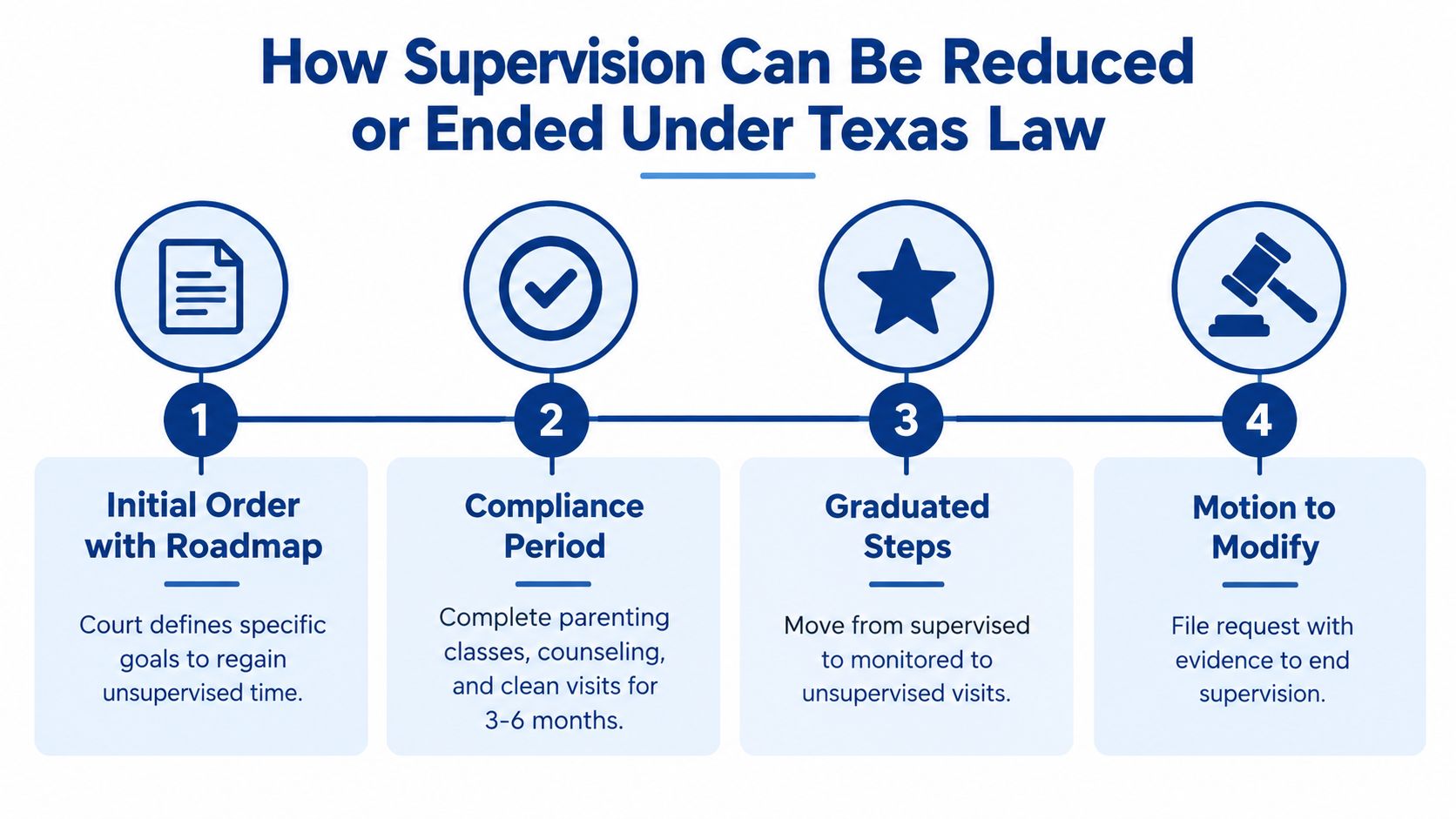
Supervision doesn't have to be treated as a permanent label. Texas law requires a court order imposing supervised visitation to do more than state a restriction. Under Texas Family Code section 263.109(c), the order must outline specific steps the parent must take to reduce the level of supervision. The text of Texas Family Code section 263.109 provides that statutory requirement.
That roadmap matters because it turns a general goal, “earn unsupervised visits,” into conditions the parent can understand and address. The exact steps depend on the order and the facts that led to supervision. They may involve compliance with court-directed services, safe conduct, reliable attendance, or other requirements identified by the judge.
Building a record of compliance
Parents seeking less restrictive access should treat each visit as part of the court's factual record. Consistent attendance, respectful conduct, and compliance with the written rules can help show that the parent is taking the order seriously. Keep copies of confirmations, receipts, completion records, and communications, but don't alter or manufacture records.
A parent may also need to address the concern that caused supervision. If the order identifies a service or condition, completing something unrelated may not satisfy the court's requirement. Ask counsel to review the language before assuming that a particular class, counseling program, or other action is enough.
The goal isn't to bypass supervision. It's to follow the court's roadmap and request a lawful change when the facts support one.
A request to modify access generally requires evidence tied to the child's circumstances and the parent's compliance. The court may consider the full history, not just a recent successful visit. Attempting unsupervised time before a new order authorizes it can create enforcement problems.
For related information about evaluations and custody evidence, review this guide to the Tarrant County social study and custody evaluation process. That process is distinct from supervised visitation, but it may become relevant when a parent seeks a broader custody modification.
Next Steps for Fort Worth Families Considering Supervised Visitation Help
Start by identifying which problem you have. You may need help understanding an existing order, contacting Family Court Services, preparing for intake, responding to an enforcement issue, or asking the court to change supervision. Those are different legal tasks, and combining them can lead to missed deadlines, the wrong referral, or an informal arrangement that doesn't satisfy the order.
Gather the signed orders, notices, relevant communications, payment records, and any documents showing completed requirements. Write down the questions you need answered, including whether the order requires the visitation center, Community Supervision Unit, a private provider, or another arrangement.
The information in this guide is general education, not legal advice for a particular family. A qualified Texas family law attorney can review the actual order and explain what options may be available in Fort Worth or elsewhere in Tarrant County without promising a specific result.
The Law Office of Bryan Fagan PLLC offers educational family law resources and consultations concerning supervised visitation, possession and access, enforcement, and custody modifications. Visit the firm's website to learn more through its Start Here process and decide whether discussing your order with counsel is the appropriate next step.
The Law Office of Bryan Fagan PLLC can help Fort Worth and Tarrant County parents review supervised visitation orders, understand the difference between center services and community supervision, and prepare for enforcement or modification questions. Visit the firm to learn more and schedule a consultation when you need case-specific guidance.
