 Skip to content

A DFW-based pilot can leave for work expecting to pick up a child after school on Friday, only to face a delayed inbound flight, reserve assignment, or mandatory rest period. The other parent is waiting at a Tarrant County school, the pilot is still away from the airport, and a standard possession order offers no practical answer for the missed exchange.
For an airline pilot custody schedule in Fort Worth that is DFW based, the solution isn't to rely on goodwill or vague promises. The possession order should translate the pilot's published roster into specific selection deadlines, exchange procedures, backup plans, and make-up parenting time. A court order should measure reliable caregiving, not assume that an airline employee is either unavailable or automatically suited to a conventional schedule.
Table of Contents
- Why Standard Texas Schedules Fail Airline Pilots
- Friction Points in the Standard Possession Order
- Converting Flight Rosters into Enforceable Calendars
- Alternative Parenting Time Models for Aviation Careers
- Documenting Schedule Changes for Tarrant County Courts
- When to Modify Your Order and Seek Legal Counsel
Why Standard Texas Schedules Fail Airline Pilots
A DFW-based pilot can technically have the first weekend of the month under a possession order and still be unable to complete the exchange safely. The roster may show a Friday return, then a delay pushes the arrival later. After reaching the terminal, collecting luggage, driving home, and observing a necessary rest period, the pilot may miss the school pickup window. The other parent sees a missed exchange. The pilot sees an operational delay that the order never addressed.
The problem is mechanical, not merely personal. The order must answer what happens when the scheduled pickup time conflicts with a flight assignment or a fatigue-safe driving window? If it does not, the parents are left to negotiate under pressure, often after one parent has already made alternate arrangements.
DFW supports a large aviation workforce. American Airlines began operating at DFW in 1974, moved its headquarters to Fort Worth in 1979, and established DFW as a hub in 1981. American's 2025 DFW fact sheet lists 4,589 pilots and 7,846 flight attendants among more than 36,000 team members connected with its DFW operation, and the same American Airlines' DFW fact sheet identifies DFW operations as supporting approximately 228,000 jobs in North Texas. Those figures explain why this custody problem appears repeatedly in Fort Worth and Tarrant County.
Domicile isn't the same as availability
A DFW domicile identifies where the pilot reports for duty. It does not establish the pilot's duty days, release time, overnight location, reserve obligation, or safe driving window. A pilot may live in Fort Worth, Keller, Southlake, Grapevine, or another North Texas community while spending several days away from home.
The roster may include:
- Early departures that make school-morning exchanges unrealistic.
- Late arrivals that conflict with evening return times.
- Reserve periods requiring the pilot to remain available without knowing the eventual assignment.
- Multi-day trips with overnight layovers away from North Texas.
- Training, reassignment, or deadhead travel that changes the expected timeline.
- Weekend and holiday duty during periods a standard order automatically allocates to the pilot.
A conventional Monday-through-Friday assumption cannot account for every aviation schedule. The court order must convert the pilot's bid period and reserve status into objective possession terms. It should state when roster information is due, how available dates are selected, when a delay triggers a substitute exchange, and how fatigue affects transportation without turning every disruption into a contempt dispute.
Practical rule: A pilot's home address and airline domicile should never be the only facts used to draft possession terms.
The workable approach is a calendar with operating instructions, not a promise to “be flexible.” Specify the notice method, the latest safe exchange time, the approved exchange location, the backup caregiver process, and the make-up period created by a missed flight-related exchange. Those clauses give both parents a predictable process and give a Tarrant County court an enforceable standard to apply when the roster changes.
Friction Points in the Standard Possession Order
A fixed weekend can look workable on paper and fail at the gate. A DFW-based pilot may receive a first-weekend pairing, remain on reserve during the third weekend, or learn too late that a fifth weekend is the only realistic option. The Texas Standard Possession Order gives the family a recognizable baseline, but it does not automatically translate an airline bid period into safe, enforceable possession time.
The commonly described schedule gives the noncustodial parent possession on the first, third, and fifth weekends, alternating holidays, and a summer period. For parents who live within 100 miles, the stated summer period is generally 30 days. When parents live more than 100 miles apart, the stated period is 42 days. These provisions appear in the Texas Standard Possession Order materials.
That structure assumes the parent can identify recurring weekends and plan around them. A pilot's monthly bid sheet may assign a multi-day trip across the first weekend, place the pilot on reserve during the third, or create a fifth weekend that cannot be selected confidently until the roster is published. The order and the roster use different operating systems.
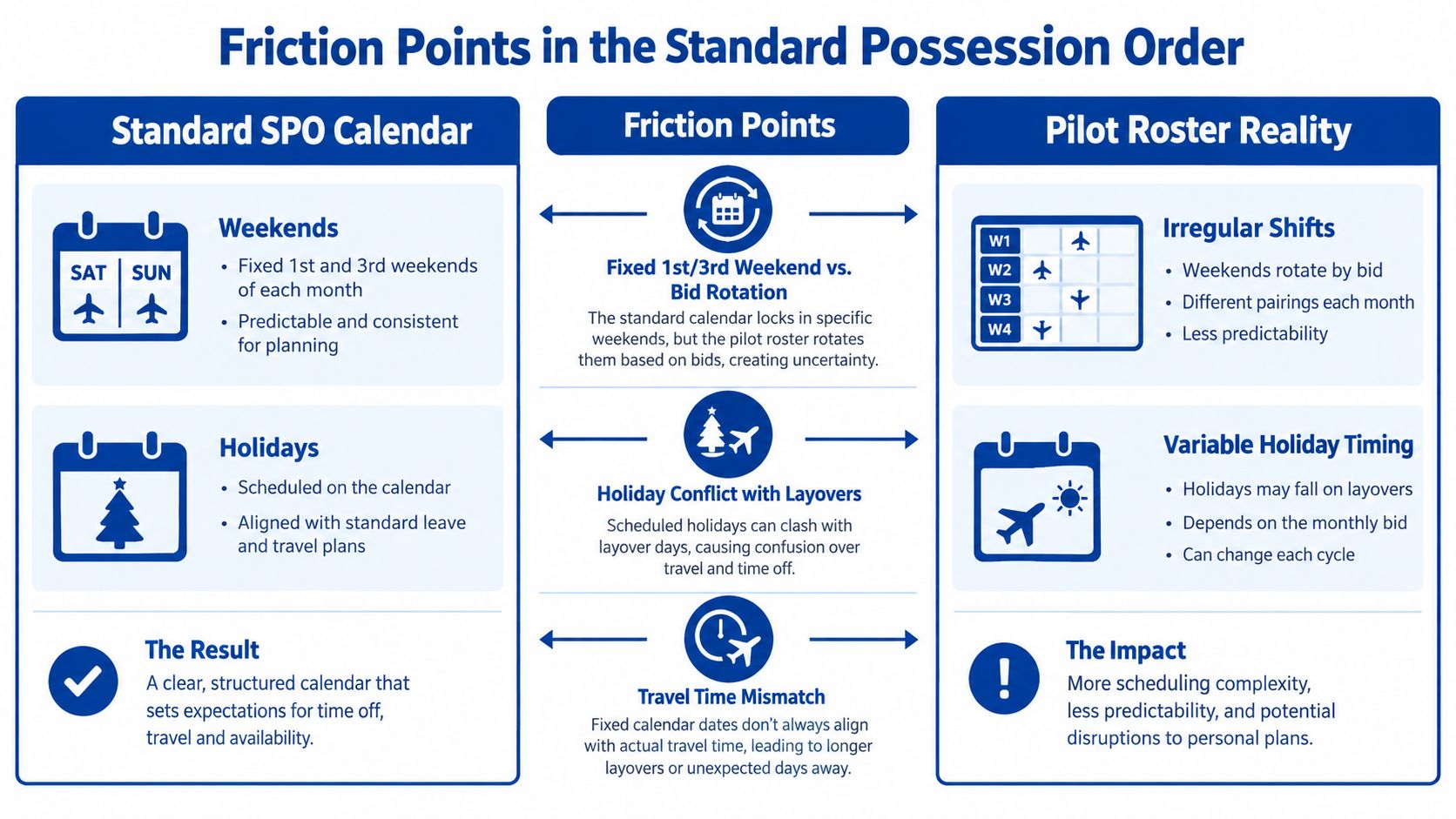
The calendar and the roster speak different languages
The SPO also relies on advance notice. A parent seeking summer dates different from the default dates generally must provide notice by April 1. An airline may publish, revise, or reassign operational duties on a timetable that does not match that selection deadline. For orders issued on or after September 1, 2021, and when parents live within 50 miles, an extended weekend can run from 6 p.m. Thursday until 8 a.m. Tuesday, under Texas Family Code § 153.3171.
Those rules create predictable friction:
- Fixed weekends and bid rotations: The order assigns recurring weekends, while the airline assigns trips through a monthly bid and roster process.
- Holiday conflicts and layovers: A holiday period may overlap with a required flight, overnight layover, or reserve obligation.
- Travel-time mismatch: Pickup and return times may ignore release from duty, the drive from DFW, traffic, or a fatigue-safe rest window.
- Late schedule changes: A trip may be reassigned after the pilot has notified the other parent.
- School disruption: A replacement period may interfere with attendance, homework, activities, or the child's sleep schedule.
The SPO is not automatically wrong for an airline pilot. It is a starting point that may require individualized terms when recurring weekends do not fit the family's actual roster. Texas law allows possession by mutual agreement under Texas Family Code § 153.001 and permits courts to specify alternative terms when the default schedule is not workable. The order should protect the child's best interests through measurable procedures, including roster notice, selection deadlines, safe transportation limits, and a defined make-up process.
A pilot should not treat every assignment as an automatic excuse for noncompliance. A co-parent should not treat every missed exchange as proof of unreliability. The stronger solution is a Tarrant County order that converts bid periods, reserve status, and fatigue-safe driving windows into objective clauses before the next disruption occurs.
Converting Flight Rosters into Enforceable Calendars
A strong plan starts with the official monthly bid or flight schedule, not a verbal estimate. The order should require the pilot to provide the roster to the other parent through a defined method, such as email or a designated co-parenting application, within a stated period after receiving it.
A reported Texas appellate case involving an airline pilot used a specific mechanism. The order required the pilot to provide written notice within 48 hours after receiving the flight schedule and identify seven overnight possession periods for the following month. That example appears in the Texas appellate opinion concerning an airline pilot's possession schedule. The case doesn't create a universal schedule for every DFW pilot. It demonstrates why precise drafting matters.
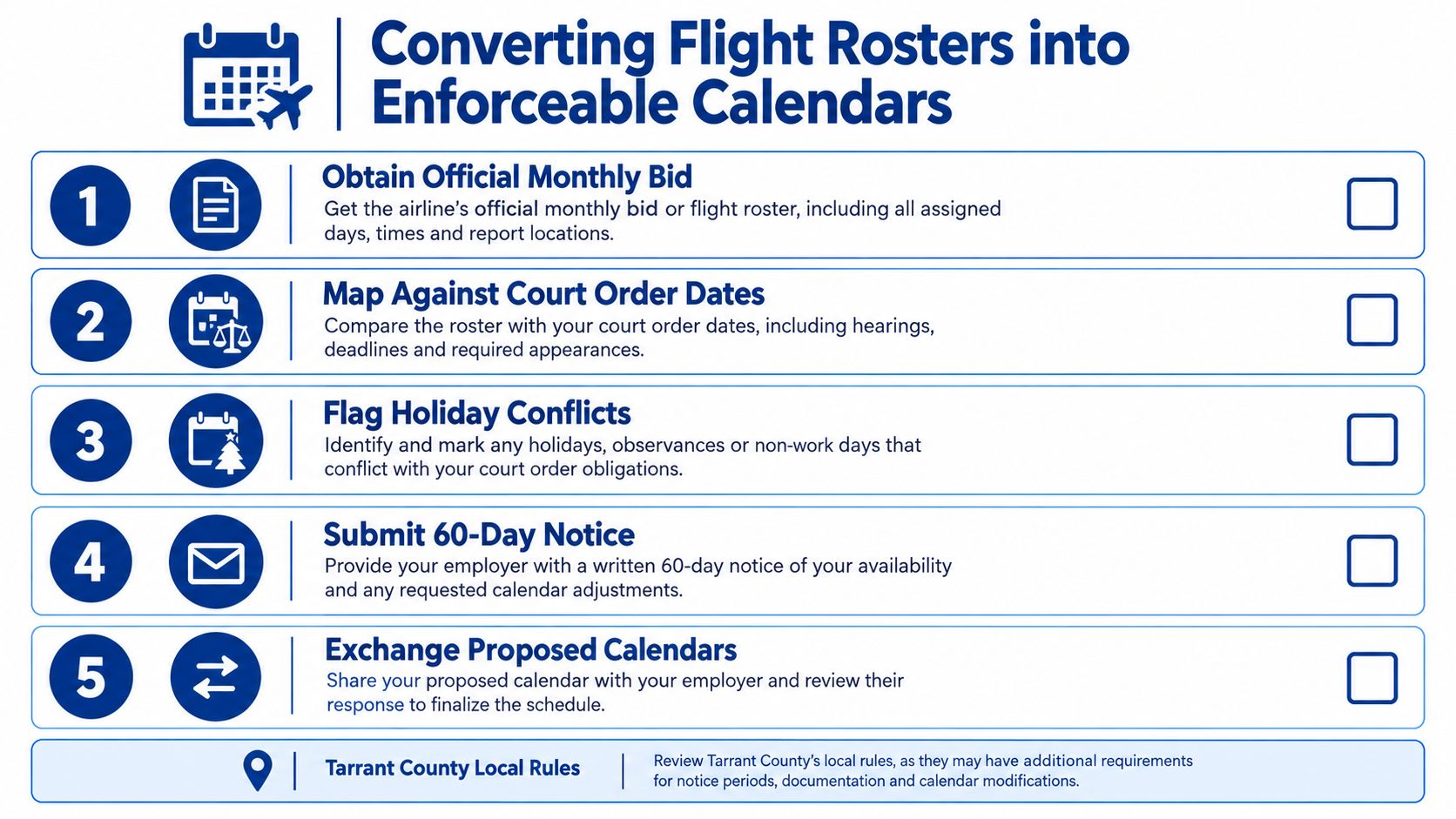
Draft the mechanics before arguing about flexibility
A proposed Tarrant County order should answer these questions in plain language:
- When is the schedule delivered? Tie the deadline to the pilot's receipt of the official roster, and specify the required delivery method.
- What periods can the pilot select? Identify the number of overnight periods, weekends, weekdays, holidays, or school breaks available for selection.
- When must selections be made? Set a date and time instead of using “reasonable notice.”
- Where do exchanges occur? Consider the child's school, a home location, or an airport-area exchange point when that location reduces unnecessary driving.
- What happens after a delay or cancellation? Require prompt notice and establish a defined replacement process.
- How are reserve and training handled? State whether the pilot can select possession during a reserve period and what proof is used if the assignment changes.
- How is make-up time calculated? Use a rolling period or another defined method instead of leaving make-up time to unlimited discretion.
The exchange clause should account for the pilot's release from duty and a safe drive from DFW or the pilot's residence. A pilot shouldn't be required to drive while too fatigued to do so safely, but “fatigue” shouldn't become an unverified excuse for cancelling possession. The order can require timely notice, objective schedule records, and a practical alternate exchange window.
Drafting advice: Replace “the parties will work it out” with a trigger, a deadline, a location, and a backup rule.
Test the proposed calendar against at least three representative months: a normal line month, a reserve-heavy month, and a month with irregular operations. That exercise often exposes conflicts that aren't visible in a negotiated outline. It can show that a recurring Friday exchange is unrealistic, while a longer block beginning after the pilot's release may work well for the child.
The employer's schedule doesn't replace the court order. It supplies information for applying the order. If the parties need a different arrangement, they should document the agreement or seek an appropriate court-approved change rather than assuming a text message permanently modifies possession terms.
Alternative Parenting Time Models for Aviation Careers
A conventional weekend schedule isn't the only way to create dependable parent-child contact. It may also be a poor fit for a pilot who has concentrated off-duty periods. The right model should protect school attendance and routines while giving the pilot substantial, predictable time when the pilot is available.
Extended blocks can outperform scattered weekends
An extended off-duty block may work better than forcing possession into every first, third, or fifth weekend. For example, a pilot who is unavailable during a sequence of trips may have several consecutive days at home afterward. A parenting plan can permit a block during that period if the pilot provides the required roster, selects the dates on time, and can manage transportation without disrupting school.
This approach can create richer parenting time, but it needs boundaries. The order should specify the maximum or permitted block, the notice process, the child's school obligations, and the return time. It should also state whether the other parent receives comparable holiday or summer opportunities, subject to the child's best interests.
Virtual contact fills a different role
A midweek video call or telephone period can maintain the relationship during a layover or multi-day trip. It doesn't replace in-person possession, and it shouldn't be used to claim that a pilot has exercised an overnight period that never occurred. It does provide a predictable point of contact when the pilot is away.
The order should address the practical details, including the communication method, a reasonable window, and what happens if the pilot is in the air, on duty, or unable to connect. The plan should keep the burden age-appropriate. A young child may need the other parent to help establish the call, while an older child may prefer a direct message or video appointment.
Holiday planning needs aviation-specific judgment
Airline travel often intensifies around holidays, but that doesn't automatically justify removing holiday possession. Parents can compare the pilot's actual holiday assignments with the child's school calendar and allocate holiday time in a way that avoids predictable conflicts. One parent might receive the holiday itself while the pilot receives an adjacent block, or the order might provide a selection process for dates surrounding the holiday.
The analysis should focus on actual caregiving reliability:
- Roster history: What do the pilot's monthly pairings and reserve periods show?
- Child's routine: Will the proposal interfere with school attendance or established activities?
- Transportation: Can the pilot complete the exchange after release and required rest?
- Childcare: Who cares for the child during the pilot's duty periods?
- Other parent's schedule: Does the other parent have work obligations that affect exchanges?
- Child's age and needs: Does the child benefit more from frequent short contact or longer blocks?
High travel volume doesn't automatically justify reduced parenting time. A pilot may have concentrated availability that supports meaningful care. Conversely, a conventional 50/50 schedule isn't automatically best if repeated exchanges create missed school, cancelled trips, or unstable routines.
For families who need safeguards during transitions or have concerns about how possession will occur, Tarrant County supervised visitation resources may provide useful general information. Supervision isn't a default requirement for airline work. It belongs in the discussion only when case-specific safety concerns support it.
The strongest plan measures what each parent can reliably do. It doesn't stereotype the pilot's occupation, and it doesn't treat flexibility as permission for either parent to change the schedule unilaterally.
Documenting Schedule Changes for Tarrant County Courts
When a possession dispute reaches court, a clean record is more persuasive than a series of competing explanations. The pilot should preserve the official roster, trip-release information, reserve notices, reassignment messages, delay records, and communications about the proposed exchange. The other parent should preserve the same communications and document the child's actual availability and school obligations.
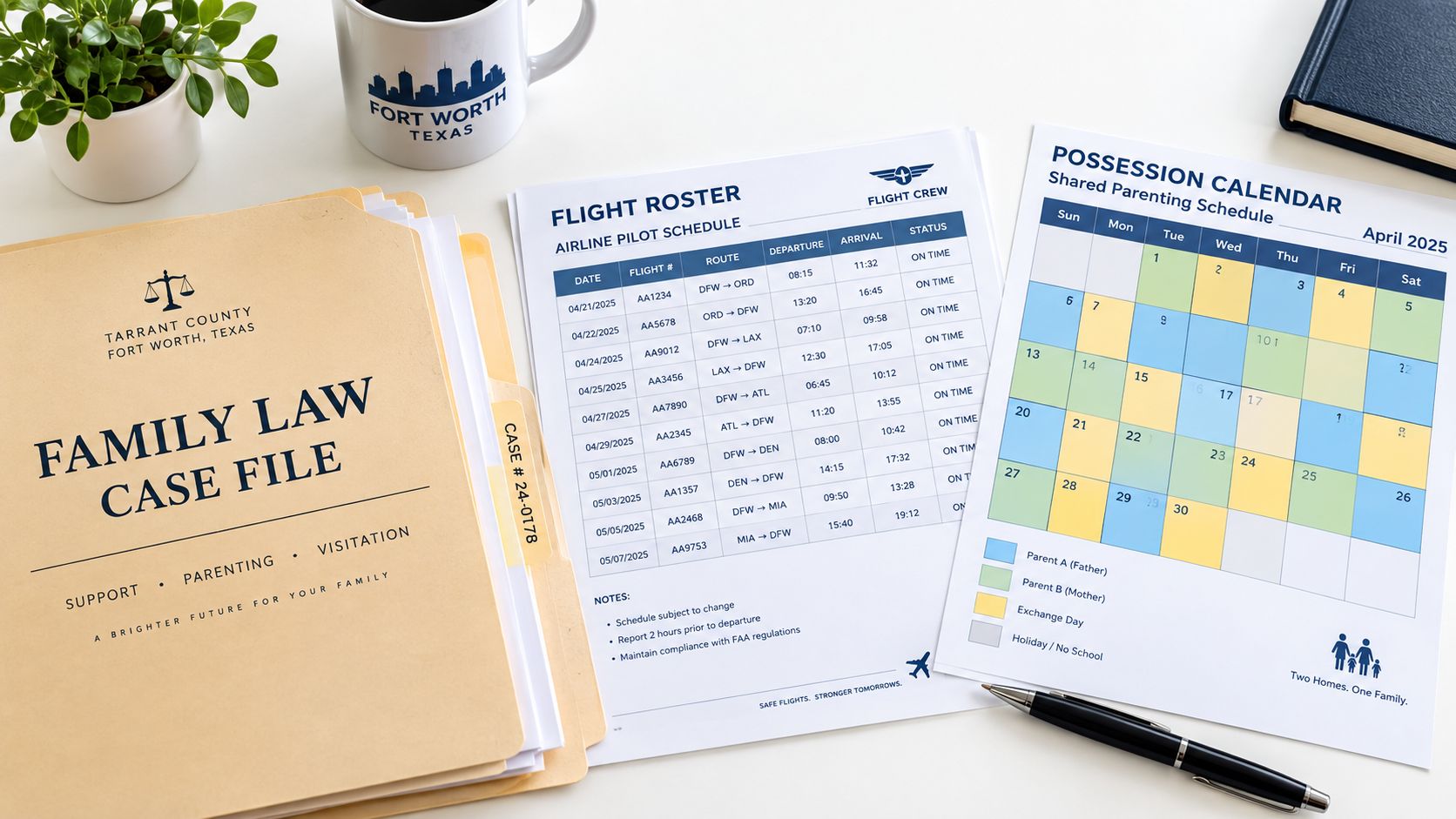
Build one possession file
A practical file can contain:
- The governing order: Keep the current signed order and identify the provisions covering weekends, holidays, notice, and exchanges.
- The official schedule: Save each monthly bid or roster in its original form.
- Operational changes: Record reserve assignments, cancellations, delays, training, deadhead travel, and reassigned trips.
- Exchange communications: Keep messages showing when notice was given, what was proposed, and whether the other parent agreed.
- Transportation details: Note the expected release time, drive from DFW or the pilot's home, and the safe window for pickup or return.
- The child's actual schedule: Preserve school calendars and information showing whether a proposed change would affect attendance or routine.
- Make-up time: Track missed, offered, accepted, and completed replacement periods.
A calendar is especially useful when it distinguishes between scheduled possession, offered possession, cancelled possession, and completed possession. That distinction prevents a later argument from collapsing every change into “the pilot missed time” or “the other parent refused time.”
An informal text-message arrangement may help the parents get through a particular week, but it can create uncertainty about whether the original order still controls. A mutual agreement should state the dates being changed, the replacement dates, the exchange details, and whether the arrangement applies only to that occurrence. If the parties repeatedly need different terms, they should address a formal modification rather than rely on an expanding collection of messages.
Use records to show reliability, not just excuses
A pilot who repeatedly provides the roster on time, proposes workable dates, gives prompt notice of changes, and completes make-up periods creates a record of responsible planning. A co-parent who offers reasonable alternate exchanges and documents refusals creates a different kind of record. Neither parent should edit the facts to make the other look worse.
Parents can use the Tarrant County district clerk records search for a family case to locate case information, but a public records search doesn't replace reviewing the signed order and obtaining case-specific legal advice. The controlling language may be found in an order, modification, or agreed document that differs from what either parent remembers.
The best evidence usually answers three questions: what did the order require, what actually happened, and what did each parent do to solve the problem?
A record can't guarantee a result in an enforcement or modification proceeding. It can give the court a clearer basis for evaluating the child's routine, the pilot's operational constraints, the other parent's conduct, and whether the proposed schedule is workable.
When to Modify Your Order and Seek Legal Counsel
A temporary text-message workaround is different from a durable possession order. If a pilot changes seniority, receives a new fleet assignment, moves from line flying to reserve-heavy work, or changes the DFW reporting arrangement, the existing order may no longer reflect actual family life. The same is true when a child's school, age, health needs, or activities make the current exchange pattern impractical.
Don't wait for repeated enforcement threats before reviewing the order. Vague language such as “reasonable notice,” “as agreed,” or “when the pilot is available” leaves too much room for disagreement. A precise order can identify roster delivery, selection deadlines, exchange locations, delay procedures, reserve assignments, make-up periods, and communication expectations.
Texas law permits possession by agreement and allows alternative terms when a standard arrangement doesn't fit the family's circumstances. Whether an existing order should be modified depends on the specific facts, the child's best interests, the evidence available, and the wording of the current order. Information about how Tarrant County courts handle child custody modifications can help you identify the questions to raise with counsel.
Seek legal guidance before signing proposed language that gives either parent unlimited discretion. A pilot needs an order that recognizes reserve duty, delays, training, and safe transportation without creating an automatic excuse for missed time. A co-parent needs clear notice and dependable return procedures without being forced to absorb every operational change.
If you live in Fort Worth, Arlington, Keller, Southlake, Grapevine, Colleyville, Mansfield, or another surrounding North Texas community, gather the current order, recent rosters, school calendar, exchange history, and proposed schedule before a consultation. Those documents allow an attorney to evaluate whether the present arrangement can be clarified, whether a negotiated parenting plan is realistic, or whether formal court action may be necessary.
The Law Office of Bryan Fagan PLLC provides Texas family law guidance on customized possession schedules, modifications, enforcement, and custody disputes involving irregular airline work. Contact the firm to discuss how your DFW-based roster, exchange logistics, and child's routine can be translated into clearer, more enforceable parenting terms.
