 Skip to content

You've just signed a decree in Fort Worth, and the phrase Standard Possession Order is sitting in front of you. You're trying to plan next Friday, a birthday, and summer break, and the schedule you found online doesn't match what your order says. That confusion is normal, and it's exactly why Texas standard visitation rights need more explanation than a weekend formula.
Table of Contents
- Where Parents Usually Get Stuck With Texas Visitation
- What the Texas Standard Possession Order Actually Is
- Reading the Default Possession Schedule
- How Age and Distance Change the Default Rule
- Exchanges, Supervision, and Tarrant County Resources
- Modifying or Enforcing a Visitation Order in Texas
- Practical Next Steps for Fort Worth Parents
Where Parents Usually Get Stuck With Texas Visitation
A parent in Tarrant County might come home from court with a final order, open a calendar app, and try to mark the first month. The first question sounds simple. Which weekends are mine?
Then the harder questions follow. Does possession start at school dismissal or at 6:00 p.m.? Who drives to the exchange, and where does it happen if school is closed? What happens when a holiday lands on the other parent's weekend?
Why the short online summary falls short
Most quick summaries stop at first, third, and fifth weekends. That phrase describes part of the pattern, but it doesn't tell you whether your order includes Thursday overnights, alternative pickup times, or a different summer period. It also doesn't tell you what to do when your child is under three or when the other parent lives across the county.
Parents also get stuck on language. Texas orders talk about possession and access, conservators, and elections, not just visitation. If you don't know what those labels mean in your decree, you can't tell whether the default schedule even applies to you.
The signed order controls your family life, not the generic schedule summary you found in a search result.
Another common point of confusion is agreement. Parents can often arrange different times when they both agree in advance, but an informal text exchange doesn't rewrite the order. When parents stop agreeing, the written terms are what a court, a mediator, or a county program will look at.
Take a realistic example. One parent assumes a Thursday dinner visit ends at 8:00 p.m. because that's what a friend's order says. The other parent reads their own order and expects a Thursday overnight during the school term. Both parents think they're following Texas standard visitation rights, but only one reading matches the document the judge signed.
That's the practical risk here. You can miss time you're entitled to exercise, show up at the wrong place, or create a conflict that didn't need to happen. Reading the order closely, and understanding how age, distance, and elections change it, prevents most of those problems before they become court problems.
What the Texas Standard Possession Order Actually Is
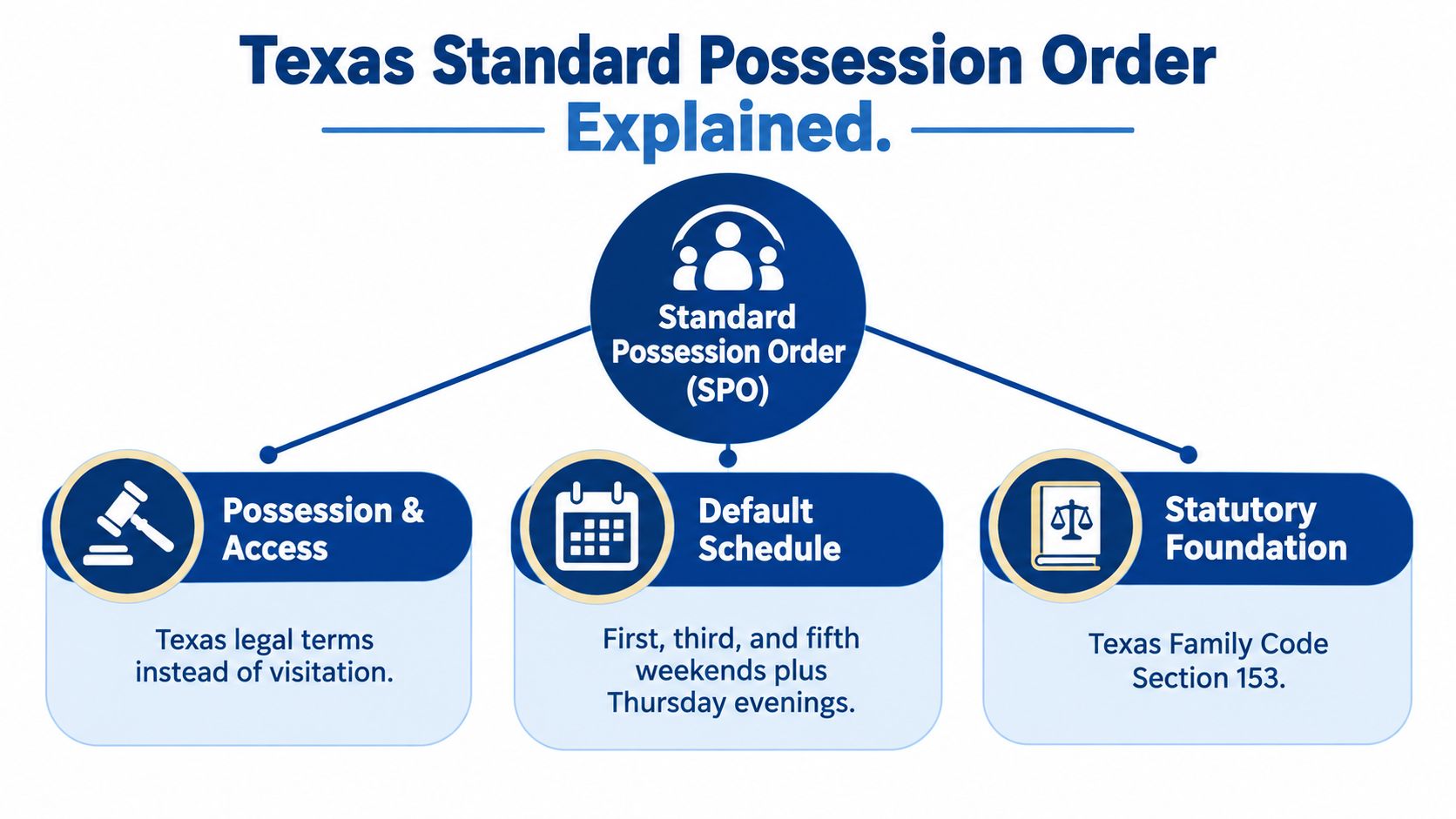
Texas doesn't build its system around the word visitation alone. Your order will use possession and access because those are the operative terms in the Texas Family Code. Possession describes the periods when a child is physically with a parent, and the order sets the days and times for those periods.
The legal definition matters because it tells you where to look. The Texas Family Code definition of standard possession order in Section 101.029 links the term to Subchapter F of Chapter 153, the part of the code that governs standard possession orders. When your decree references that framework, it's pointing to a statutory schedule, not a judge's personal preference.
Who the schedule is written for
Texas courts name parents as conservators. A joint managing conservator shares certain rights and duties, while a possessory conservator is the parent whose possession periods the schedule typically defines. One parent usually has the exclusive right to designate the child's primary residence, and the other parent's time is laid out in the possession schedule.
Those labels don't measure how much a parent matters to a child. They're legal categories that determine decision making, residence, and the structure of parenting time. If you're reading your decree for the first time, find your designation before you look at the calendar pages.
A guideline built for older children
Under Texas Family Code Section 153.251 on the purpose of the standard possession guidelines, the guidelines are designed to guide courts in setting possession for a parent named a possessory conservator and to establish minimum possession for a joint managing conservator. That same statute specifies the standard order is designed for children age 3 or older.
That design choice explains why the SPO works as a baseline rather than a guaranteed result. For a child who's three or older, Texas law presumes the SPO serves the child's best interest. Parents can still agree to a customized schedule, and a court can order different terms when the child's best interest requires something else.
For Fort Worth families, the takeaway is straightforward. The SPO gives courts and parents a predictable starting point when they can't agree, but it doesn't erase your child's age, health needs, school situation, or the specific wording in your signed order.
Reading the Default Possession Schedule
For parents who live 100 miles or less apart, the basic pattern repeats by the numbers on the calendar. Possession generally occurs on the first, third, and fifth weekends of each month, and a fifth weekend only matters in a month that contains five Fridays. Many months have only two qualifying weekends, so you shouldn't assume three weekends every month.
When the regular school term election isn't used, weekend possession generally begins at 6:00 p.m. Friday and ends at 6:00 p.m. Sunday, as described in the Texas Attorney General parenting time schedule guidance for parents 50 miles apart or less. When an elected version applies during the school term, possession may instead begin when school dismisses on Friday and end when school resumes after the weekend. Your order should state which version applies, and that single detail changes pickup logistics every other week.
Texas SPO default timing at a glance for 100 miles or less
| Period | Default start | Default end | Source |
|---|---|---|---|
| Weekend possession | 6:00 p.m. Friday, or school dismissal if elected | 6:00 p.m. Sunday, or school resuming if elected | Texas Family Code Section 153.312 and Attorney General guidance |
| Thursday period | Thursday evening during the school term | As stated in the signed order | Texas Family Code Section 153.312 framework |
| Major holidays | Alternating schedule in the order | As stated for each holiday | Signed possession order |
| Summer possession | Extended summer period | After 30 consecutive days for the noncustodial parent | Texas official parenting time guidance |
The Thursday period and alternating holidays fill in the gaps between weekends. Holiday possession typically overrides the regular weekend pattern when the two conflict, which is why you need to read the holiday section before you promise travel plans. A weekend that looks like yours on the regular rotation may belong to the other parent under the holiday schedule that year.
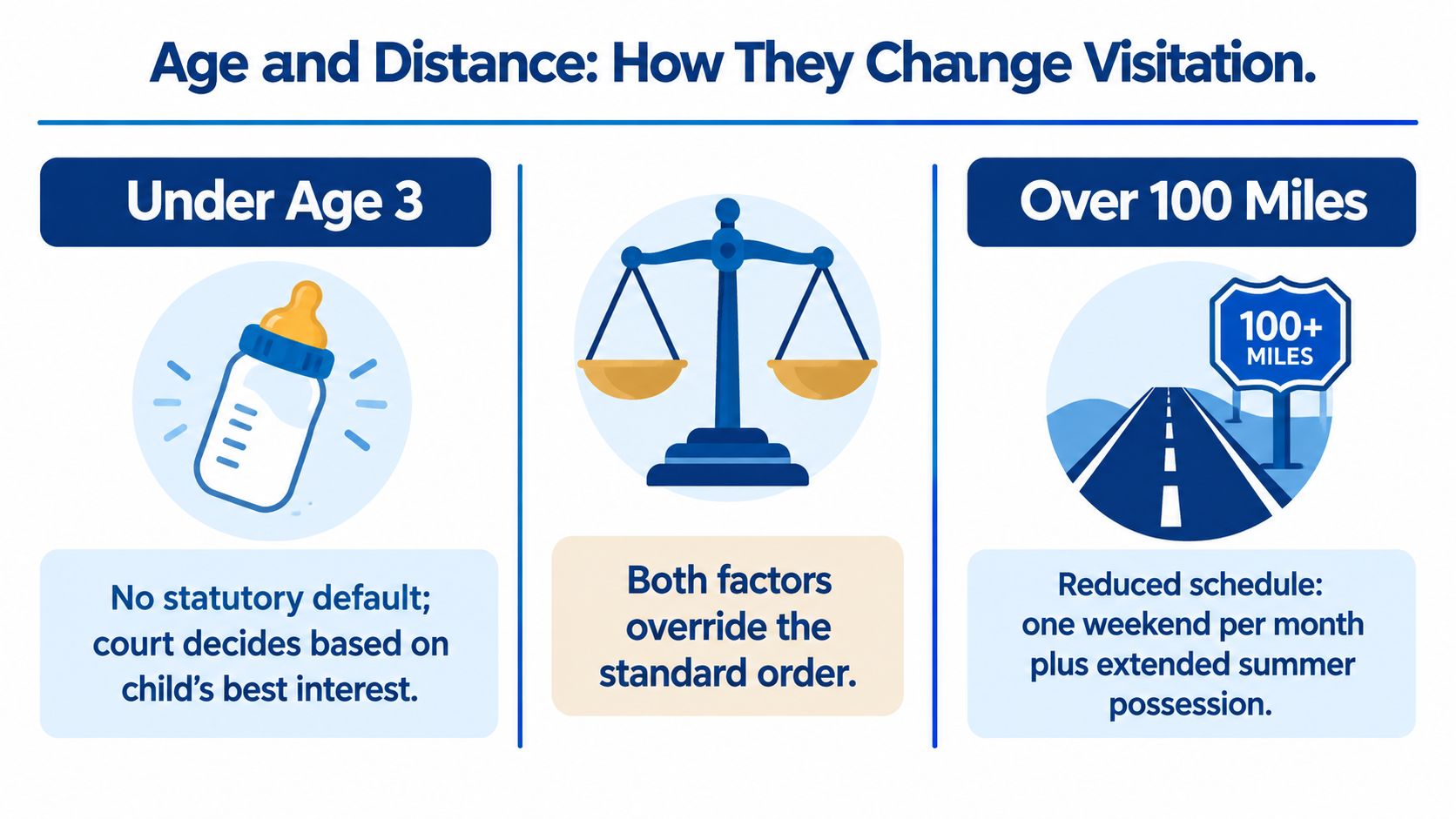
Summer works differently from the school year. Texas official guidance describes 30 consecutive days of summer possession for the noncustodial parent at this distance. When parents live more than 100 miles apart, that summer period may increase to 42 days, reflecting fewer opportunities for regular weekend travel during the school year.
How to mark your own calendar
Start with Fridays. Count only the Fridays that fall in that calendar month, then mark the first, third, and fifth. Next, layer in Thursdays, holidays, and summer dates from your order, in that order, because holidays and summer terms can displace the regular rotation.
Calendar rule: Build your calendar from the signed order outward, starting with weekends, then adding holidays and summer periods that override them.
If something in your order doesn't match this default framework, that doesn't mean your order is wrong. Elections, distance, school calendars, and best interest findings can all produce a different schedule. The default tells you what to compare your order against, not what your order must say.
How Age and Distance Change the Default Rule
Two facts change the analysis more than any others. The first is your child's age, and the second is how far apart the two homes are. Either one can move your family away from the schedule described above.
For children under three, the presumption that helps older children doesn't apply. TexasLawHelp guidance on child visitation and possession orders explains that parents may first arrange possession at mutually agreed times, and that without agreement the schedule depends materially on distance and circumstances. For a baby or toddler, a court can set a developmentally appropriate schedule instead of imposing the ordinary weekend pattern.
That might mean shorter, more frequent periods at first, with a step up toward longer possession as the child grows. Breastfeeding, nap routines, and a parent's prior involvement can all shape what a court considers workable. If your child is under three and someone tells you the standard schedule automatically applies, that advice is skipping a step Texas law requires.
The three distance bands
Texas law currently distinguishes three ranges. There's an expanded approach for residences within 50 miles, a standard schedule for 51 to 100 miles, and a long distance schedule for more than 100 miles. Shorter distances allow more frequent weekday and weekend exchanges, while longer distances push possession toward fewer, longer blocks during school breaks and holidays.
The 50 mile line deserves close attention in Tarrant County, where a move from Fort Worth to a nearby community can change the category. Under Texas Family Code Section 153.3171 on parents who reside 50 miles or less apart, when a possessory conservator lives no more than 50 miles from the child's primary residence, the court generally must apply specified alternative beginning and ending times unless an exception applies. Exceptions include a parent rejecting the alternatives in writing or in open court, a court restricting possession in the child's best interest, or a finding that a particular alternative isn't in the child's best interest.
Elections you cannot make later by assumption
Alternative times for weekends, Thursdays, and holidays come from Texas Family Code Section 153.317 on alternative beginning and ending possession times, and an election generally must be made before or at the time the possession order is rendered, in a filed writing or on the record in open court. You can't discover months later that a school dismissal pickup would suit you better and start using it. If the election isn't in the order, it isn't your schedule yet.
Irregular work also exposes the limits of a default calendar, which is why some North Texas parents review resources on custody schedules for airline pilots and other DFW based shift workers when a standard rotation collides with bidding schedules or overnight trips. Before you propose or dispute any schedule, document both addresses, the school location, who provides transportation, and actual drive time. Those facts, not assumptions about Texas standard visitation rights, drive the distance analysis.
Exchanges, Supervision, and Tarrant County Resources
Consider a Friday in Fort Worth. A noncustodial parent leaves work late, hits traffic, and arrives at the other parent's home well after the time in the order. The other parent says the weekend is forfeited, the arriving parent says traffic shouldn't cancel possession, and the child is standing in the middle of an argument neither parent planned.
That dispute usually turns on details parents skim. A Texas possession order controls the specific days, times, and exchange location, and an order may require a parent to surrender the child at a stated place, such as that parent's residence, when possession begins. Substituting a different parking lot or a later time because it feels reasonable can create an enforcement problem, even when your intentions are good.

Help resolving conflicts without new litigation
Tarrant County runs an Access and Visitation Program for parents who already have final orders and need help resolving visitation conflicts outside new litigation, including disputes about exchanges and schedule interpretation. The Tarrant County Access and Visitation Program information from the Domestic Relations Office uses a first, third, and fifth weekend schedule running from 6:00 p.m. Friday to 6:00 p.m. Sunday as its example. The county also advises parents to attempt visitation in person at the precise days, times, and locations in the order, bring an adult witness when possible, and keep a journal of each attempt.
That journal advice is practical, not bureaucratic. If exchanges repeatedly fail, contemporaneous notes about dates, arrival times, witnesses, and what was said carry more weight than a summary written months later from memory.
When visits are supervised
Supervised visitation is a different structure entirely, not a shorter version of the SPO. Parents who want the local details can review how supervised visitation through the Tarrant County Domestic Relations Office is set up before they assume a center visit works like a weekend exchange. These services require an order, recommendation, Rule 11 agreement, or mediated settlement agreement, so you can't choose supervision on your own because an exchange felt tense.
The county's published terms show how limited the service is. According to Tarrant County Family Court Services supervised visitation information, visitation center visits are limited to the first and third weekends and last one hour per visit. After intake, the county reports a 30 day wait list for a time slot, a one time $50 setup fee that may be waived only by the court, and a $15 cash fee at each supervised visit.
- Confirm authorization first: Check that your order or agreement provides for supervised visits.
- Plan for intake and waiting: Expect intake steps and a wait before a slot is assigned.
- Budget the stated fees: Bring the required payment in the form the county specifies.
If supervision is part of your order, confirm current county procedures before you appear. Showing up without completing intake, or expecting a full weekend at a center that offers one hour visits, sets everyone up for a wasted trip.
Modifying or Enforcing a Visitation Order in Texas
Parents often use modify and enforce as if they mean the same thing. They don't, and choosing the wrong one wastes time. Enforcement asks a court to make a parent follow the existing order, while modification asks a court to change the order itself.
Enforcement proceedings are governed by Texas Family Code Chapter 157, and they begin with a motion identifying how the order was violated. A court may order make up possession in appropriate cases, among other remedies it has discretion to consider. What strengthens that request is records, including calendars, preserved messages, witness names, and the journal described in the prior section.

Changing the schedule requires a different showing
Modification generally requires a filed petition and a hearing, and the parent asking for change must meet the material and substantial change standard along with the child's best interest. A new job schedule, a relocation, or a child aging out of a toddler schedule may support that discussion, but disagreement with the original order alone isn't the test. Parents weighing that route often start by reviewing how Tarrant County courts handle child custody modifications to understand how modification differs from an enforcement filing.
Not every dispute needs either filing. A disagreement about what a paragraph means, or which parent has a particular holiday this year, may be resolved through the county program discussed above before anyone files anything. Sorting interpretation problems from genuine violations saves money and keeps the conflict smaller.
Mistakes that weaken your position
- Informal schedule changes: Trading weekends by text for months, then insisting on the written schedule without notice, creates avoidable disputes.
- Social media posts: Public comments about the other parent can surface in court and distract from the schedule issue.
- Undocumented exchanges: Arriving without a witness or record makes a denied visit hard to prove later.
- Acting before reading: Assuming an election or holiday rule applies, without checking your order, leads to missed or wrongful possession.
Enforcement proves the order was violated. Modification proves the order no longer fits. Your evidence should match the request you're actually making.
If you're unsure which path fits, don't file first and sort it out later. The pleading you choose frames what the court can do for you, and fixing a mismatched filing costs more than getting advice at the start.
Practical Next Steps for Fort Worth Parents
Pull out your signed order this week and read it with a highlighter. Mark the conservator labels, the weekend and Thursday language, any election of alternative times, the holiday schedule, summer possession, exchange locations, and notice requirements. If a term in your order differs from the default framework, your order wins.
Next, build one shared calendar from that document alone. Mark weekends first, then holidays and summer periods, and note who transports the child for each exchange. Where the order is silent or unclear, write the question down instead of filling the gap with an assumption.
Documentation habits that protect you
- Keep a visitation journal: Record each exchange, arrival time, and whether possession occurred.
- Preserve messages: Save texts and emails about schedule changes rather than relying on screenshots of partial threads.
- Use witnesses wisely: Bring a neutral adult to exchanges that have previously failed.
- Confirm agreements in writing: Note any agreed swap in advance, with dates and return times stated clearly.
If a conflict is about interpreting the order, consider whether a county resource can resolve it before litigation. If possession is being denied, or the schedule no longer fits your child's age, distance between homes, or work reality, you're likely looking at enforcement or modification instead. Families who need case specific guidance on Texas standard visitation rights can speak with the Law Office of Bryan Fagan PLLC about reviewing an existing order, and should do so before a holiday or summer deadline forces a rushed decision.
If your order doesn't match the schedule you expected, or exchanges in Tarrant County keep breaking down, the Law Office of Bryan Fagan PLLC can review your possession terms and explain whether agreement, enforcement, or modification fits your situation. Visit Law Office of Bryan Fagan PLLC to learn more about its Fort Worth family law services and schedule a consultation about your parenting time questions.
