 Skip to content

Your marriage isn't over when you're served, and you generally have until 10:00 a.m. on the first Monday after 20 days have passed to file a written Answer with the clerk. That deadline protects your right to be heard, but it doesn't create temporary rules for parenting time, housing, bills, or property.
That's the gap that catches people off guard. You can file on time and still have no court order telling either spouse who pays the mortgage, where the children sleep this weekend, or whether money can be moved. What happens after divorce papers are served is really two tracks running at once, the response deadline and the separate request for interim relief, and you need to handle both.
Table of Contents
- What Being Served With Divorce Papers Actually Means
- Calculating the Answer Deadline Step by Step
- Where to File in Tarrant County and How the Court Is Identified
- Temporary Orders That Shape the Case Before It Ends
- Discovery, Mediation, and Settlement Conferences
- Final Hearings, Trial, and the Decree That Ends the Marriage
- Common Mistakes After Service and How to Avoid Them
- Practical First Steps If You Were Served in Fort Worth
What Being Served With Divorce Papers Actually Means
A Fort Worth manager gets called to the front desk at work, signs nothing, and is handed a thick envelope by a process server. Inside is a citation, the court's formal notice that a case exists and that a written response is required, plus a copy of the petition your spouse filed. The petition states what your spouse is asking for. It isn't what a judge has decided.
Service doesn't end the marriage and doesn't by itself start Texas's mandatory waiting period for a final divorce, a distinction reflected in Texas Family Code provisions governing divorce suits. It also doesn't automatically change who owns property, who lives in the house, or how parenting time works. Those changes require agreement or a court order.
What to Check in the First Hour
Read every page before you call anyone. Packets sometimes include a temporary restraining order, often called a TRO, or other orders signed by a judge. Those pages can restrict transfers of money, contact, or other conduct right away, and they're easy to miss if you stop at the petition.
- Write down the service date: Note the exact date and time you received the papers, because your deadline runs from that date.
- Find the court and cause number: Both appear on the citation and petition, and you'll need them for every filing.
- Keep the full packet together: Don't discard duplicates, hearing notices, or forms that look unimportant.
Don't sign a waiver, agreement, or proposed order tucked into the packet just to make the moment end. Read it, keep it, and get advice first.
Resist two impulses in that first hour. Don't move money, close accounts, or move out of the home in a panic, and don't fire off a long text to your spouse trying to settle the case. Nothing you say informally stops the clock, and a rushed financial move can create a problem you'll spend months explaining. Stay calm, preserve the paperwork, and treat the service date as day zero.
Calculating the Answer Deadline Step by Step
The rule is specific, and guessing is how people miss it. You generally have until 10:00 a.m. on the first Monday after 20 days have passed from service to file your Answer, counted by excluding the day of service and including weekends and holidays in the count, as explained in TexasLawHelp's guide for a spouse who was served with divorce papers. If that Monday falls when the court is closed, the Answer is due the next day the court is open.
The timeline below shows how the count moves from the service date to the Monday deadline.
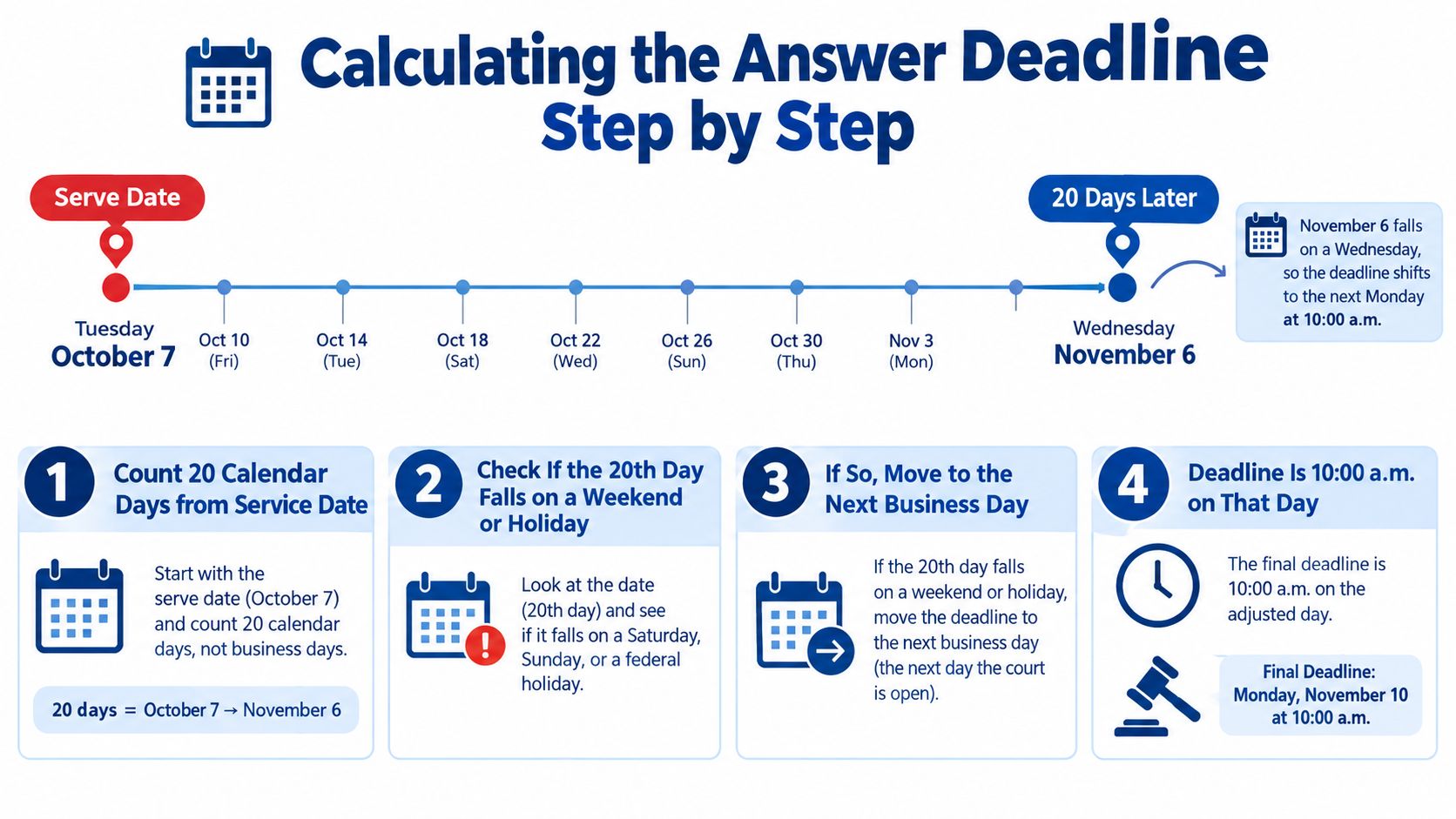
Say you're served on a Friday. You don't count that Friday. You count 20 calendar days forward, weekends included, which lands on a Thursday. Your deadline isn't that Thursday, it's the following Monday at 10:00 a.m. That extra move to Monday is the part people get wrong when they count 20 days on a phone calendar.
Choosing How to Respond
An Answer with a general denial tells the court you're participating and puts your spouse to their proof. An Answer paired with a counterpetition goes further, it states your own requests on property, debts, or children. A waiver of service is different, it gives up formal service and can affect your right to notice of later settings, so don't sign one casually.
This short video walks through the response step in plain language.
If you miss the deadline, your spouse may seek a default judgment and ask the court to proceed without your input. Default doesn't guarantee every requested term gets granted, since the petitioner still must prove required facts and follow court procedures. You may still file an Answer after the deadline if the divorce hasn't been finalized, but don't count on that safety net.
Calendar the date today, identify the assigned court, and file with the clerk. A phone call or email to your spouse's lawyer doesn't preserve your deadline.
Where to File in Tarrant County and How the Court Is Identified
Knowing the deadline doesn't help if you file in the wrong place. Tarrant County identifies the Family Law Center at 200 East Weatherford Street in Fort Worth as the location for family law filings and records, according to the Tarrant County District Clerk family division page. Confirm current filing instructions with the District Clerk before you go, because procedures and accepted filing methods can change.
Your cause number does more than label the file. The first three digits identify the assigned district court, such as the 231st, 233rd, or 322nd. That number tells you which court your case belongs to and, for many post-service hearings, which associate court handles the setting.
Why Misrouting Costs You Time
Picture a self-represented respondent from Arlington who drives downtown without the cause number, waits in the wrong line, and learns the file can't be located quickly. Nothing about the merits of that person's case changed. The loss was time, and time is the one thing a served spouse can't recover.
- Bring the citation and petition: The clerk can identify the court from the cause number on those pages.
- Ask for a file-stamped copy: Keep proof showing when your Answer was filed.
- Request copies of signed orders: Check whether any TRO or other order is already in the court file.
Practical rule: Verify the court, cause number, and filing method before you travel. A five minute confirmation beats a wasted courthouse trip on deadline week.
Court assignment can also matter when spouses live in different counties, which is why questions about Fort Worth divorce venue when you live in a neighboring county should be raised early rather than after settings are missed. Tarrant County provides self-represented resources, but it also strongly encourages people representing themselves to hire a lawyer. County webpages explain mechanics. They don't replace advice about your children, property, or safety.
Temporary Orders That Shape the Case Before It Ends
Filing an Answer keeps you in the case. It doesn't decide who pays the electric bill next month. Either spouse may seek temporary orders to stabilize finances, parenting, and property control while the divorce is pending, covering child support, conservatorship and possession, use of property, payment of debts, and attorney's fees, as outlined in Tarrant County's temporary orders packet for a divorce with children. Those orders generally remain in effect until dismissal or the final decree.
A temporary restraining order is narrower and shorter. It can restrict specified conduct before a full temporary orders hearing, and it generally lasts 14 days or until the hearing, whichever occurs first. Read any TRO in your packet word for word, because violating a valid order can expose you to contempt consequences.
What Temporary Relief Can and Cannot Do
| Issue | Temporary Order | Final Decree |
|---|---|---|
| Children | Sets interim possession, decision making, and support | Sets long term conservatorship, possession, and support |
| Home and bills | Assigns interim use and who pays debts for now | Divides property and debts finally |
| Money movement | Can restrict transfers and preserve accounts | Confirms separate property and divides community property |
| Duration | Governs while the case is pending | Ends the marriage and replaces interim terms |
In Tarrant County, a motion for temporary orders is filed with the clerk at the Family Law Center, and the requesting party must obtain the required appearance and service paperwork for the other party. Related restrictions may also come from a standing order, so review what a Tarrant County standing order in a divorce restricts before you assume ordinary spending is still ordinary.
Prepare like the hearing is soon, because it may be. Gather recent pay records, bank and credit card statements, insurance information, child care costs, school and medical records, and a proposed parenting schedule. Temporary orders don't finally divide property or decide permanent custody. They create the operating framework you'll live under, sometimes for many months, so treat that hearing as consequential, not preliminary in importance.
Discovery, Mediation, and Settlement Conferences
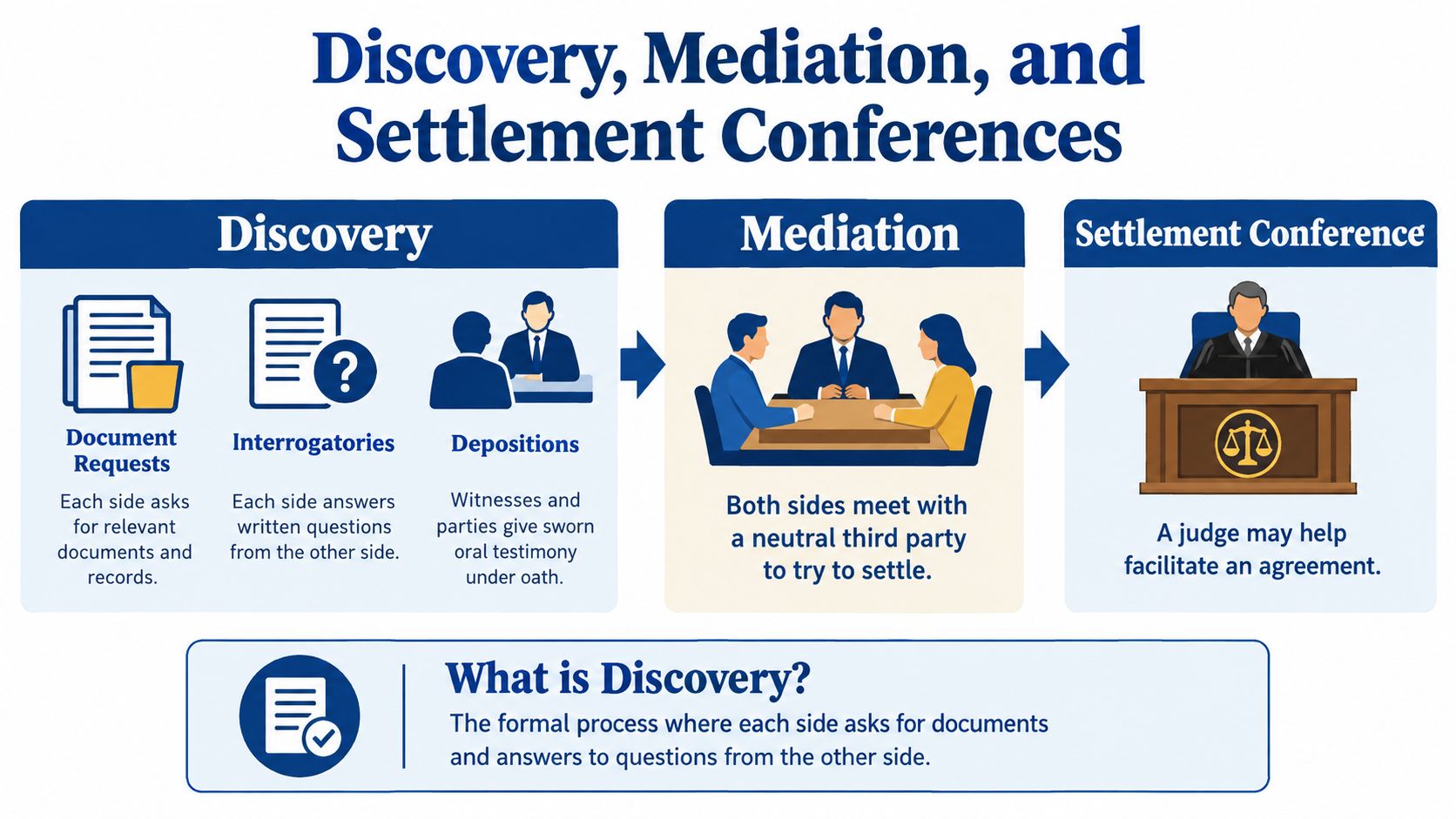
Once you've answered and any urgent temporary issues are set, most contested cases enter a longer middle phase. Discovery is the formal exchange of information, document requests, written questions, and financial records each side uses to prove property values, income, debts, and parenting facts. It feels tedious because it is detailed, and sloppy responses create credibility problems later.
Start organizing before you're asked. Keep pay records, account statements, tax documents, and records about the children in one place, and don't delete messages or financial data that may be relevant. Complete disclosure protects you more than selective disclosure does.
The flow below shows how discovery, mediation, and settlement efforts typically connect.
How Settlement Efforts Differ
Mediation brings both sides together with a neutral mediator who helps negotiate but doesn't decide the case. Informal negotiation between lawyers is less structured, while a settlement conference may involve more direct court involvement in narrowing issues. Local expectations matter here, including Tarrant County local rules on mediation before final trial, so ask early whether mediation will be required in your case.
If mediation produces a signed settlement, that agreement often becomes the framework for the final decree. That can save the cost and uncertainty of trial, but only if the terms are complete and you understand them before signing. Don't agree to a parenting schedule or property split in a hallway just to end a long day.
Timing varies with cooperation and complexity. An agreed case can move comparatively quickly, while a contested case with business interests, hidden account questions, or disputed parenting can run much longer under temporary orders. Settlement and trial aren't good versus bad. They're two routes to a final order, and each asks something different of you in preparation, cost, and control over the outcome.
Final Hearings, Trial, and the Decree That Ends the Marriage
Some divorces end at a short final hearing, often called a prove-up, where the court reviews agreed paperwork and required testimony. Others go to trial because settlement couldn't resolve specific issues. Either way, the final decree of divorce is the document that ends the marriage, not the petition, not service, and not temporary orders.
At the final stage the court addresses the full set of issues. That includes division of community property, confirmation of separate property, assignment of debts, conservatorship and possession of the children, and child and medical support. Where Texas law allows it, spousal maintenance may also be decided.
What a Contested Final Hearing Can Look Like
Consider a Tarrant County couple who settled the house and retirement accounts in mediation but couldn't agree on the children's primary residence, a vehicle debt, and possession during school breaks. Their final hearing isn't a relitigation of the whole marriage. Each side presents evidence and witnesses on those remaining disputes, the judge rules, and the agreed terms are incorporated into the decree.
- Agreed cases: The judge reviews the proposed decree and supporting testimony before signing.
- Contested cases: Each side presents documents, testimony, and argument on unresolved issues.
- Default cases: The petitioner still must prove required facts and comply with court procedures.
Temporary orders governed your life while the case was pending. The decree replaces them, so read the final draft against every temporary term you relied on.
Don't assume a verbal ruling is the same as a signed decree. The signed decree is what changes marital status and sets enforceable long term terms for property and children. Keep a copy, calendar any deadlines in it for transfers or refinancing, and follow its possession and support terms exactly unless a later court order changes them.
That long arc is why the first weeks matter. Decisions about records, temporary arrangements, and negotiation posture after service shape what evidence exists at the end. A served spouse who participates early gives the court a complete picture. A spouse who freezes leaves that picture to the other side.
Common Mistakes After Service and How to Avoid Them
Most early damage is self-inflicted, and it's preventable. The graphic below pairs frequent mistakes with the corrective move.
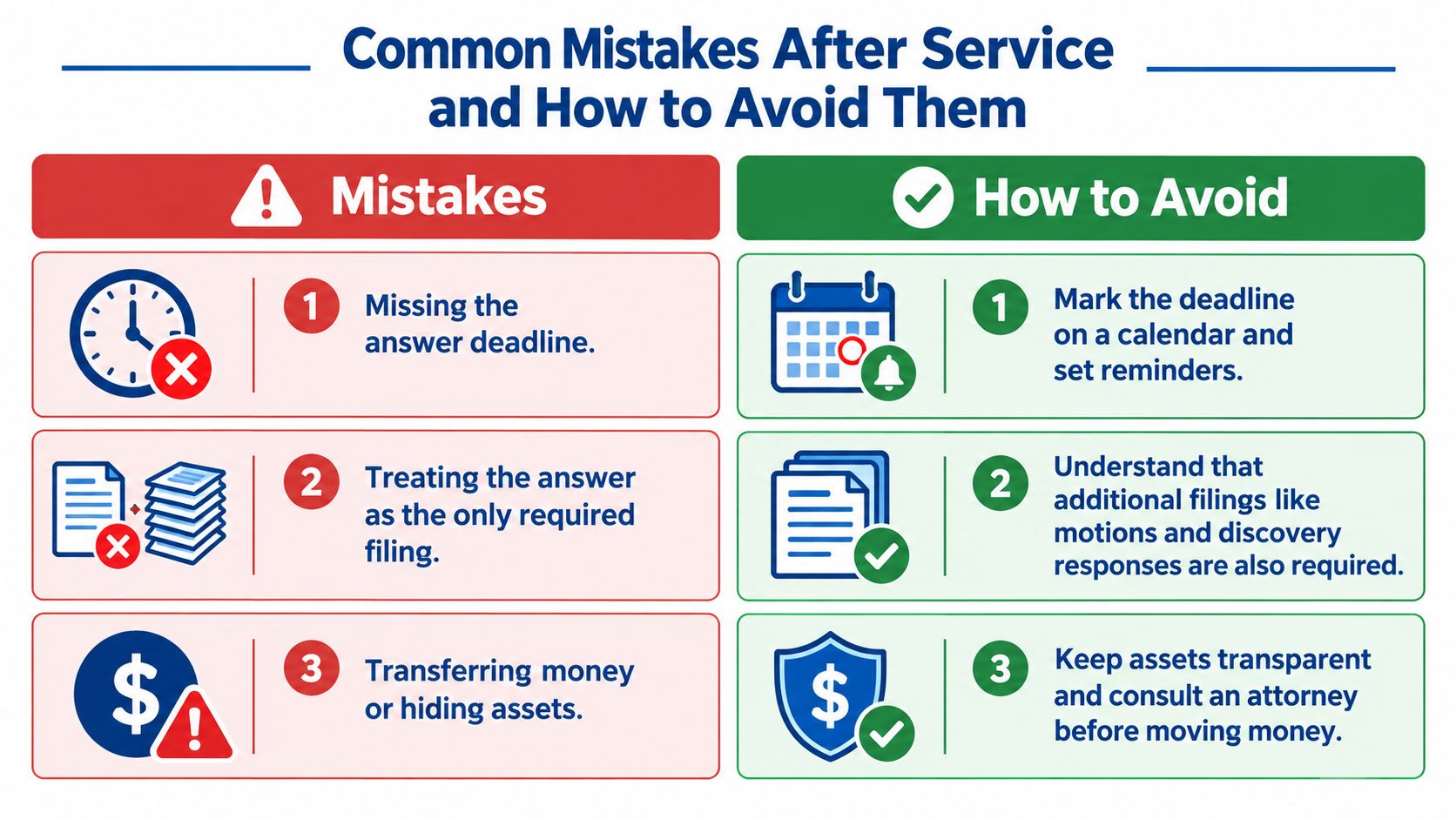
Missing the Answer deadline is the clearest error. Fix it by calendaring the Monday at 10:00 a.m. date the day you're served and filing well before it. Waiting to see if your spouse calms down isn't a strategy.
Treating the Answer as the only filing leaves housing, support, and parenting unaddressed. Ask about temporary orders at your first attorney meeting, especially if you need access to funds, a possession schedule, or exclusive use of the home. If no one asks the court for interim rules, you may not get any.
- Moving money or property: Don't transfer, hide, or sell assets without legal guidance, and preserve records of ordinary, necessary spending.
- Moving children abruptly: Keep children in their existing routine and don't relocate them to gain an advantage.
- Ignoring a TRO: Follow every restriction in signed orders and keep proof of compliance, even if you disagree with the terms.
- Posting online: Take social media silent on the case, your spouse, new purchases, and parenting disputes.
Relying on informal promises is another trap. Your spouse may say the case will be dropped or the deadline doesn't matter. Unless an agreement is documented, filed where required, and signed by the court when an order is needed, assume the deadline still applies.
Silence hurts too. Going dark on the other parent, refusing all communication about the children, or skipping exchanges creates a record you won't like at a hearing. Communicate briefly, in writing, and only about logistics unless counsel advises otherwise.
Practical First Steps If You Were Served in Fort Worth
Do these steps today, in order. First, read the citation, not just the petition, and highlight any TRO, hearing date, or restriction on money, contact, or the children. Second, write down the date of service, the cause number, and the assigned court, then calculate and calendar your Answer deadline with a reminder several days early.
Third, start a single folder, paper or digital, for the case. Add recent pay records, bank and credit card statements, insurance information, mortgage or lease papers, and, for children, school, medical, and child care records plus notes on their current routine. Tarrant County notes that temporary orders hearings are handled through the associate court for the assigned district court, information reflected in Tarrant County family court services frequently asked questions, so knowing your court matters before any hearing is set.
- Photograph the packet: Keep a backup copy of every page you were served with.
- Don't sign yet: Bring any waiver or proposed agreement to a lawyer before signing.
- Limit contact about the case: Don't negotiate property or parenting terms by text tonight.
Fourth, talk with a Fort Worth family law attorney promptly if children, safety concerns, substantial property, or a threatened default are involved. Bring the full packet and your calculated deadline to that meeting. The Law Office of Bryan Fagan PLLC is one option for that consultation, and the right first conversation should leave you with a filed Answer plan and a clear decision on temporary orders.
If you were served in Fort Worth or elsewhere in Tarrant County, bring your citation, petition, and any temporary restraining order to a confidential consultation before your Answer deadline runs. The Law Office of Bryan Fagan PLLC helps served spouses calculate that deadline, prepare a response, and decide whether temporary orders are needed for children, support, housing, and property. Visit Law Office of Bryan Fagan PLLC to take the next step.
