 Skip to content

The filing county must be the county where either spouse has lived for the prior 90 days, paired with the requirement that at least one spouse has been domiciled in Texas for the preceding six months. Someone living in a county neighboring Tarrant County generally can't file a divorce in Fort Worth unless that county-residency requirement is met.
You may work in Fort Worth, use Tarrant County doctors and schools, and spend much of your week in the city while living across the county line. Those facts don't automatically give Tarrant County authority to hear your divorce. Texas venue law focuses on where a qualifying spouse resides, not which courthouse is closest or most convenient.
That distinction matters when spouses live in Parker, Denton, Johnson, Hood, Dallas, or Wise County. It also matters when one spouse recently moved, when children live in another county, or when a protective-order application becomes part of an already difficult family-law dispute. The right filing decision at the beginning can prevent a venue challenge from interrupting the case later.
Table of Contents
- The Quick Answer on Where to File
- How Texas Venue and Residency Rules Actually Work
- Common North Texas Scenarios and Where Venue Falls
- How Venue Affects Custody, Children, and Protective Orders
- What Happens If You File in the Wrong County
- Practical Next Steps Before You File
- Getting Local Guidance on Your Tarrant County Case
The Quick Answer on Where to File
For a Texas divorce, start with two questions. Has either spouse been domiciled in Texas for the preceding six months? And has either spouse lived in the county where you want to file for the preceding 90 days? Texas Family Code § 6.301 requires both requirements before the divorce can be maintained in that county. Read the statute through the Texas divorce residency and venue rule.
If you live in Parker County and your spouse lives in Tarrant County, Tarrant County may be the proper venue if your spouse has lived there for the required period. If both of you live outside Tarrant County, Fort Worth generally isn't an available filing location because your employer, attorney, children's activities, or family connections are there.
The same answer applies to a spouse living in Denton, Johnson, Hood, Dallas, or Wise County. You generally can't select Tarrant County for convenience unless you or your spouse satisfies the county-specific residence requirement. The Texas State Law Library describes the filing county as the district court county where either party has lived for the last 90 days, rather than a nearby county chosen for convenience. Its guide to filing for divorce in Texas is a useful starting point for general procedure.
Practical rule: Identify the qualifying spouse and county before preparing the petition. Don't choose the courthouse first and try to justify it afterward.
Some situations involve unusual procedural questions, including waiver of service or an agreement by the non-resident spouse. Those circumstances don't turn an improper county into a proper one automatically. They're exceptions that require careful legal analysis, not a substitute for proving the residency facts.
For general information about the courts that handle family-law matters in Fort Worth, review what courts handle family law cases in Fort Worth. The essential point remains simple: Texas domicile gets you into the state system, but 90-day county residence determines where the divorce belongs.
How Texas Venue and Residency Rules Actually Work
Texas divorce venue operates as a two-part gate. First, one spouse must have been a Texas domiciliary for the six months immediately before filing. Second, either the petitioner or respondent must have lived in the filing county for the preceding 90 days. Section 6.301 of the Texas Family Code supplies the controlling rule.
“Domicile” involves more than a temporary stay. The issue is whether a spouse has made Texas home and has the required connection to the state before filing. A person may satisfy the Texas requirement while still failing the county requirement for Tarrant County.
The two requirements work together
Consider the difference:
- Texas requirement: Either spouse has the necessary six-month Texas domicile.
- County requirement: Either spouse has lived in the proposed filing county for the necessary 90 days.
- Venue result: The petition belongs in a county that satisfies the second requirement while the case also satisfies the first.
A spouse who moved to Texas long enough ago may meet the statewide requirement but still need to file in a different county. Living in Tarrant County for fewer than 90 days doesn't become sufficient because the spouse has lived in Texas for six months.
Residence questions are usually supported with ordinary records. A lease, utility bills, pay records, vehicle registration, voter registration, mail, a Texas driver's license, and testimony can help establish where a spouse lived. No single document necessarily answers every dispute, so keep records that show both the address and the dates.

Four ways the county analysis can come out
If both spouses qualify in different counties, either qualifying county may be available under the general divorce venue rule. The filing spouse should compare practical concerns, including access to records, witnesses, temporary-orders needs, and the location of the children.
If only one spouse qualifies in a county, that county generally controls. If neither spouse qualifies in Tarrant County, a Fort Worth filing creates a venue problem even if the family has strong ties to Fort Worth.
Once a divorce is properly filed, the case generally remains in that county. A transfer may still become relevant if a party seeks relief under applicable venue law or if a mandatory child-related venue rule affects a separate proceeding. That's why the residence facts should be verified before filing, not assumed from a mailing address or workplace.
Common North Texas Scenarios and Where Venue Falls
Cross-county situations become easier when the facts are placed on a timeline. The question isn't which spouse feels more connected to Fort Worth. It's which county satisfies the statutory residence requirement for either spouse at filing.
| Scenario | Where Spouses Live | Qualifying Venue County | Why |
|---|---|---|---|
| One spouse in Tarrant County, the other in Parker County | Petitioner lives in Tarrant County, respondent lives in Parker County | Tarrant County | The Tarrant County spouse qualifies if that residence has lasted the required period |
| One spouse in Johnson County, the other in Tarrant County | Petitioner lives in Johnson County, respondent lives in Tarrant County | Tarrant County or Johnson County, depending on qualifying residence facts | The filing spouse may use Tarrant County if the responding spouse has the required Tarrant County residence |
| Both spouses outside Tarrant County | One spouse lives in Denton County, the other in Dallas County | Denton County or Dallas County | Fort Worth isn't proper when neither spouse satisfies the Tarrant County requirement |
| Recent move from Tarrant County to Hood County | Petitioner moved to Hood County 45 days ago | Tarrant County may remain relevant if the other spouse still qualifies there, otherwise the move creates a timing problem | The Hood County residence hasn't reached the required 90-day period |
In the first scenario, the petitioner prepares an Original Petition for Divorce identifying Tarrant County as the venue and stating the residency facts accurately. Service may then need to be arranged across the county line in Parker County. Parenting logistics may affect requests for temporary orders, but they don't change the initial venue analysis.
In the second scenario, the Johnson County spouse may file in Tarrant County if the Tarrant County spouse qualifies there. The petition should identify the respondent's Tarrant County residence rather than implying that the petitioner lives in Fort Worth. That distinction matters if the responding spouse later challenges venue.
The third scenario is the clearest warning against forum shopping. A Denton and Dallas County couple can't select Tarrant County merely because Fort Worth is between them or because one spouse works there. The petition belongs in a county supported by one spouse's qualifying residence.
The fourth scenario requires careful date review. A person who moved from Tarrant County to Hood County 45 days ago hasn't completed the new county's residence period. If the other spouse no longer qualifies in Tarrant County, filing may need to wait or proceed in the county where a spouse does qualify.
After filing in the correct county, the case typically moves through filing, service or waiver, responses, requests for temporary relief when needed, information exchange, negotiation or litigation, and final orders. The precise path depends on the facts, children, property, and whether the other spouse contests the divorce or venue.
How Venue Affects Custody, Children, and Protective Orders
Divorce venue and child-related venue overlap, but they aren't identical. Texas Family Code Chapter 103 generally places an original suit affecting the parent-child relationship, often called a SAPCR, in the county where the child resides. The statute expressly yields when venue has already been fixed in a dissolution proceeding under Chapter 6. Review the Texas Family Code provisions on original child-custody venue.
That means a properly filed Tarrant County divorce can carry custody, possession, and conservatorship issues in the same case, even when the child or other parent has connections to Parker, Johnson, Denton, or another neighboring county. Consolidation can reduce the risk of parallel cases and competing procedural requests.
A separate child-related proceeding may require a different analysis. Continuing jurisdiction, the child's residence, and the history of prior orders can affect where a later SAPCR, modification, or enforcement proceeding belongs. A child who has lived elsewhere for the required period may create a transfer question even though the divorce remains tied to its original county.
| Issue | Statutory Basis | County Where Filed | Example |
|---|---|---|---|
| Divorce | Texas Family Code Chapter 6 | County where either spouse satisfies the county-residence requirement | A qualifying Tarrant County spouse files divorce in Tarrant County |
| Custody filed with divorce | Chapter 103's exception for dissolution suits | Divorce venue county | Custody and possession proceed with a properly filed Tarrant County divorce |
| Separate SAPCR or later child proceeding | Child-related venue and jurisdiction rules | Often tied to the child's residence or prior court jurisdiction | A later proceeding may raise transfer or continuing-jurisdiction issues |
| Protective order | Applicable protective-order statutes and filing rules | Potentially the applicant's county, respondent's county, incident county, or a county where a related case is pending | A protective-order application may be filed in Tarrant County even when the respondent lives nearby |
Protective orders require separate attention because safety can't wait for a venue argument. Texas materials recognize multiple possible filing locations, including the county where a person lives, where the respondent lives, where the incident occurred, or where a related divorce or SAPCR is pending. A Tarrant County order may impose requirements on a respondent who lives in Denton, Johnson, Parker, or Wise County.
If there's an immediate safety concern, address protection first. Don't delay an emergency filing while trying to solve every divorce-venue question at the same time.
The correct county for each request depends on the pleadings, prior orders, child residence, and safety facts. A family-law attorney can map those issues before multiple filings create unnecessary conflict.
What Happens If You File in the Wrong County
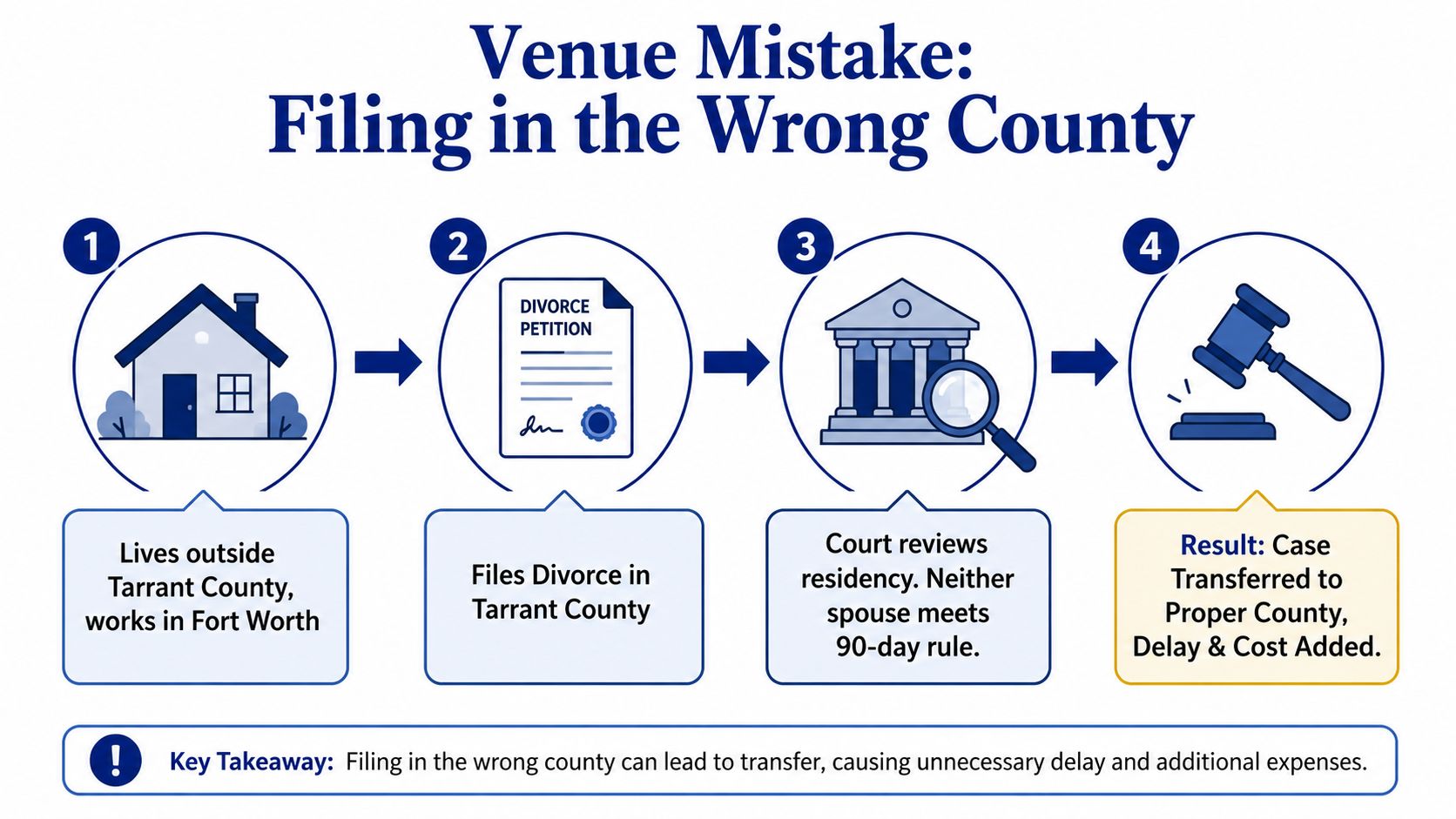
A wrong-county filing isn't a harmless clerical mistake. If you file in Tarrant County without the required county residence for either spouse, the other side can challenge venue. Depending on the circumstances, the court may consider a venue-transfer request under Texas Rule of Civil Procedure 257 or a plea in abatement directed at the improper filing.
A plea in abatement can pause the case while the venue defect is addressed. A transfer motion asks the court to move the case to a county recognized as proper. Texas Law Help and Texas legal materials describe venue as mandatory in this setting, and appellate coverage emphasizes that a properly filed divorce generally remains in its proper county. The Texas Bar continuing legal education materials on venue provide additional background for the procedural issue.
The mistake doesn't invalidate the marriage or permanently decide the divorce in the other spouse's favor. It can, however, add delay, expense, and uncertainty. Temporary-orders relief may become harder to coordinate if the case is paused or moved while the parties argue about where it belongs.
A common Fort Worth filing mistake
Suppose a Keller resident works in Fort Worth, files in Tarrant County, and has lived in the filing county for fewer than 90 days. If the spouse also fails to qualify in Tarrant County, the respondent may file a plea in abatement. The case can pause while the court addresses venue, and the petitioner may need to proceed in the proper county or wait until the residence requirement is satisfied.
The petition's residency allegations must match reality. Don't use a Fort Worth work address, a relative's address, or a recently changed mailing address to create the appearance of Tarrant County residence.
Before signing the petition: Confirm the move dates, the actual home address, and which spouse satisfies venue. Never finesse residency dates to obtain a preferred courthouse.
Practical Next Steps Before You File
You can organize the essential information before meeting with counsel. Put the tasks in this order so a venue decision comes before detailed litigation planning.
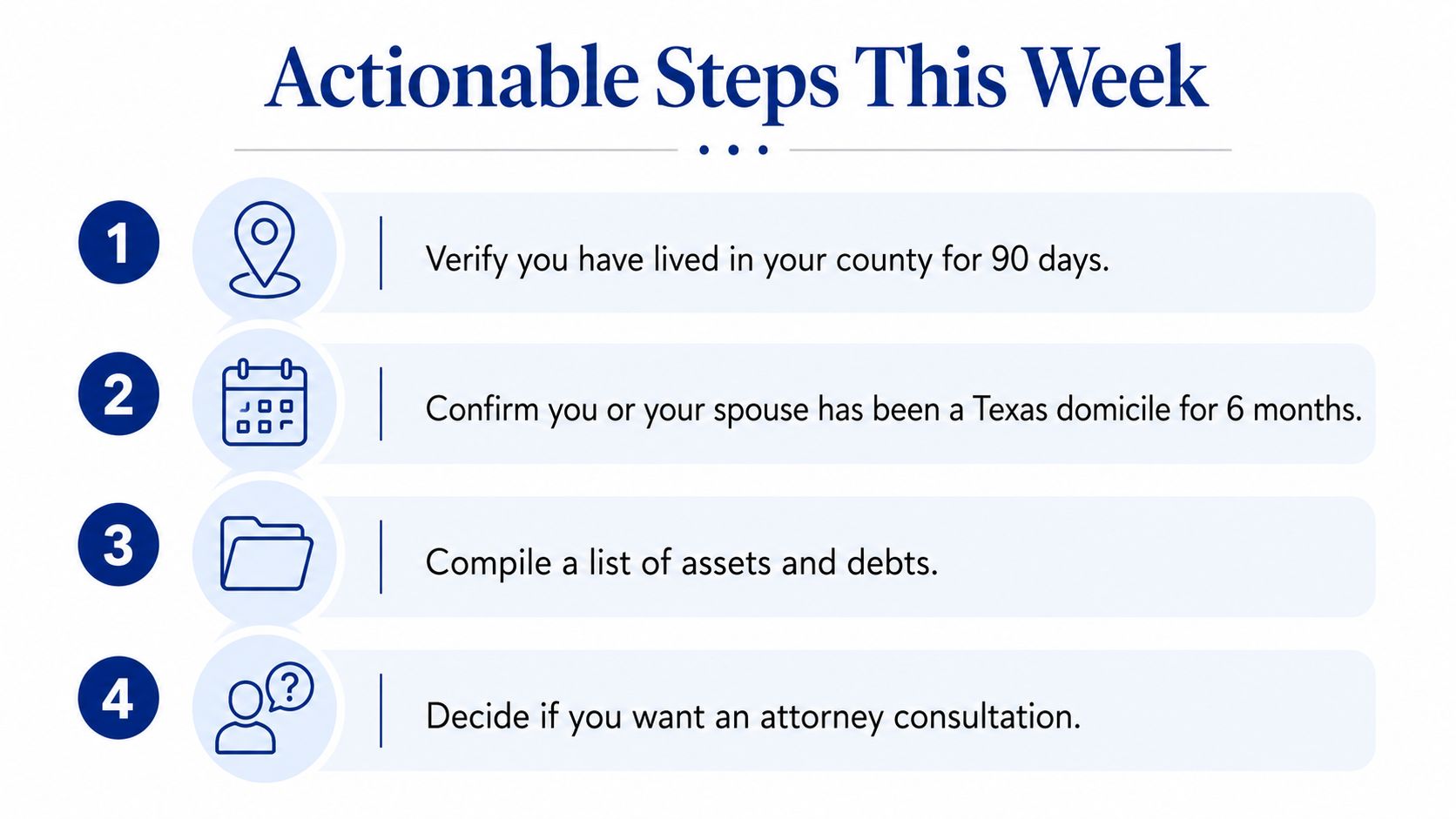
Build the residency file. Gather utility bills, leases, pay stubs, vehicle registration, mail, and a Texas driver's license showing the correct county address. Mark the date each spouse began living at the current address.
Confirm both residency gates. Check whether either spouse has maintained the required Texas domicile for six months and whether either spouse has lived in the proposed filing county for 90 days. The TexasLawHelp explanation of Texas divorce residency requirements also addresses filing when one spouse lives outside Texas.
Collect financial records. Pull tax returns, pay records, bank statements, retirement-account statements, and a recent credit report. These records help identify income, debts, accounts, and property that may need to be disclosed.
Separate property records from marital records. Locate any premarital agreement, inheritance documents, and deeds dated before the marriage. Keep original documents secure and create an organized copy for review.
Prepare the children's information. List schools, medical providers, addresses, activities, and the current possession schedule. If temporary orders may be necessary, these details help counsel evaluate parenting time, support, possession, and communication issues.
Check for urgent safety concerns. Preserve threatening messages, photographs, police records, and other relevant evidence. A protective-order question should be raised immediately, not buried inside property discussions.
Before the petition is filed, schedule a consultation with a Tarrant County family-law attorney who handles cross-county filings. Bring the residency records, financial documents, and any existing court orders. For information about local procedures, review Tarrant County 360th District Court divorce procedures.
This video may also help you understand the basic Texas divorce process before a consultation:
Getting Local Guidance on Your Tarrant County Case
If you live in Denton, Parker, Johnson, Wise, or Dallas County, the first question isn't whether Fort Worth would be easier. It's whether you or your spouse has the residence connection that makes Tarrant County proper. A focused consultation should resolve that question before anyone files a petition.
Counsel can review the move dates and supporting records, identify the appropriate filing county, and determine whether a custody matter raises a separate transfer or jurisdiction issue. The discussion should also cover whether temporary orders, a protective-order application, service across county lines, or immediate parenting arrangements may be needed.
You can also check for existing proceedings through the Tarrant County District Clerk's online records search, and you can review Texas self-help forms and procedural information through Texas Law Help's family-law resources. Those resources can help you understand the process, but they don't replace a case-specific venue review.
For courthouse location information, consult the Tarrant County Family Law Center on East Belknap. Early guidance is valuable because it can prevent an abatement or transfer dispute after the case is already underway.
The Law Office of Bryan Fagan PLLC can review your county-residency records, identify the proper venue, and help address custody, temporary-orders, or protective-order issues connected to a Fort Worth-area divorce. Visit Law Office of Bryan Fagan PLLC to learn more and schedule a case-specific consultation.
