 Skip to content

You moved from Denton County to Fort Worth, Keller, Southlake, or another Tarrant County community. Your child's school, home, and daily routine are now in Tarrant County, but the divorce or custody case still carries a Denton County cause number. The practical question is immediate: can the family case move with the child, and what must you file to make that happen?
Usually, the answer depends on venue, continuing exclusive jurisdiction, the child's principal residence, and filing deadlines, not on which county feels more convenient. Texas law often requires a timely transfer when the statutory residence requirements are met, but a missed deadline can change the available options. The steps below explain the Denton-to-Tarrant process, including the six-month residence threshold, motion requirements, hearing calendar, evidence, and what to do if you waited too long.
Table of Contents
- Why Families Move a Texas Family Case From Denton to Tarrant
- Texas Venue and Continuing Exclusive Jurisdiction Explained
- Drafting and Filing the Motion to Transfer
- Hearing Timing and the Rule 87 Calendar
- Preparing Evidence and the Possible Outcomes
- A Realistic Denton to Tarrant Transfer Scenario
- Common Mistakes and Your Next Step With a Tarrant County Attorney
Why Families Move a Texas Family Case From Denton to Tarrant
A relocation across the county line changes more than a mailing address. It can affect school transportation, exchanges, witnesses, medical records, work schedules, and the courthouse where future custody, support, or enforcement issues are heard. A parent who once lived in Denton County may now be raising the child in Fort Worth, Keller, Southlake, or another Tarrant County city, while the other parent remains in Denton County.
That move doesn't automatically transfer the case. If a Denton County court issued the existing order, that court may continue to control the case until a legally sufficient transfer occurs. The proper request is generally a motion to transfer, not a new lawsuit filed in Tarrant County.
Two Texas Family Code provisions commonly appear in this analysis. Texas Family Code § 155.201 addresses transfer from the court with continuing, exclusive jurisdiction when the child has lived in another Texas county for the required period. Texas Family Code § 155.202 addresses transfer for convenience and the interest of justice. You can review the relevant transfer provisions in the Texas Family Code provisions governing venue and transfer.
The move itself isn't the legal test
Your personal preference for a Fort Worth courtroom won't usually carry the motion. The stronger question is whether Tarrant County has become the legally proper venue because the child's principal residence is there, or whether the facts support transfer because Tarrant County is substantially more practical for the people and evidence involved.
The law focuses on the child's actual home rather than a temporary visit. For transfer disputes, the court examines the child's principal residence during the relevant period, and Texas law doesn't require that residence period to be continuous and uninterrupted. Short travel, temporary stays, and brief disruptions may not defeat the residence analysis when the day-to-day home remained in Tarrant County. Texas transfer law explains how the child's residence is measured.
What this process can change
A successful transfer can place later hearings, modifications, enforcement proceedings, and related filings in the proper Tarrant County court. It doesn't erase the existing order, reopen every issue from the divorce, or automatically change possession, conservatorship, support, or geographic restrictions.
My recommendation is simple: pull the existing order, identify the Denton court and cause number, document the child's Tarrant County residence, and check the transfer deadline before filing anything else. A parent who waits to investigate may lose a procedural objection that would otherwise have been available.
Texas Venue and Continuing Exclusive Jurisdiction Explained
Continuing, exclusive jurisdiction, often shortened to CEJ, is the court's ongoing authority over a particular parent-child case under Texas Family Code § 155.001. The Denton court that issued the final order generally keeps that authority after a parent moves to Fort Worth. A new residence alone does not give a Tarrant County court power to modify or enforce the existing order.
Venue identifies the county where a proceeding should be heard. For an original SAPCR, Texas law generally places venue where the child resides. In a later proceeding, Denton may retain CEJ while Tarrant County becomes the proper venue. If venue is improper, the court must transfer the case when a party other than the petitioner files a timely motion.
When Tarrant County becomes the proper destination
For a modification or enforcement proceeding, Texas Family Code § 155.201 requires the CEJ court to transfer the case when the child has lived in another Texas county for the required period and the motion is timely. The statute applies a six-month residence threshold, measured by the child's principal residence before the suit began. Once the statutory conditions and deadline are met, the transfer rule is mandatory. The Texas Family Code transfer rule for modification and enforcement proceedings explains that structure.
The judge is assessing the child's established home and the case's procedural requirements. Personal preferences, such as a shorter commute or a more convenient courthouse, do not replace the residence analysis.
Convenience remains a separate path
Section 155.202 provides a different, convenience-based framework. The court may consider the child's location, the distance between the parties and courthouses, school continuity, records, witnesses, and the history of hearings. These factors matter when the mandatory residence rule does not decide the issue.
Parents who have moved across the county line should also review this explanation of Fort Worth divorce venue when you live in a neighboring county.
Your motion should identify the legal basis precisely. State whether transfer is required under the residence rule, requested under the convenience provision, or supported by both. Name the specific Tarrant County court rather than asking generally for “Fort Worth.” Check the deadline before filing another motion, because a missed deadline can change which transfer arguments remain available.
Drafting and Filing the Motion to Transfer
The motion should tell the Denton judge exactly why Tarrant County is the proper place for the case. Avoid a general statement that you moved and now prefer Fort Worth. The pleading should connect verified facts to the statute that supports transfer.
Facts the motion should establish
A careful motion typically addresses:
- The child's residence: State where the child has principally lived during the legally relevant period and identify the Tarrant County city.
- The parent's residence: State the moving parent's Tarrant County address and move-in date.
- The length of residence: Explain how long the child and each relevant party have lived in Tarrant County.
- The existing order: Identify the Denton court, cause number, and order that created the continuing jurisdiction.
- Any written agreement: Attach or describe a written agreement if both parents have agreed to transfer.
- Convenience and justice: Explain the effect on school, transportation, witnesses, records, work schedules, and future hearings.
The residence facts need to be specific. Texas practice materials explain that the motion itself doesn't need verification, but the venue facts should be pleaded with particularity and supported by affidavits or declarations. The Texas Law Help discussion of transferring a family law case also emphasizes the importance of a timely filing and properly supported venue facts.
Selecting the Tarrant County court
Don't stop at “Tarrant County.” The motion should identify the proper Tarrant County district court where the child will reside and where the proceeding should be assigned. The caption should match the original Denton case, including the parties' names, cause number, and existing court information.
File the motion in the Denton County District Clerk's office in the pending case. Include a proposed order that gives the judge a clear document to sign if transfer is granted. The hearing must be set under the applicable Rule 87 process, and you must follow the court's filing, notice, and service requirements.
A verification can take the form Texas law permits, such as an affidavit or an unsworn declaration. It should confirm the factual statements, especially the child's residence and the dates connected to the move. Don't sign a declaration casually. An inaccurate residence timeline can undermine the motion and create credibility problems.
Timing can determine the result
For a modification proceeding, Texas Family Code § 155.204 sets a strict deadline tied to service of citation or notice. The motion must be filed before the second Wednesday after the 20th day after service, or the right to transfer may be waived. The statutory deadline for transfer motions should be checked against the actual service date, not an estimate.
You should also file the motion before, or at the same time as, the first responsive pleading or other motion, except a special appearance. Filing an answer or another motion first can waive the venue objection. This is why I recommend reviewing the docket and service record before filing anything on the merits.
Hearing Timing and the Rule 87 Calendar
Rule 87 creates a calendar that requires close attention. The motion doesn't transfer the case the moment it is uploaded or accepted by the clerk. The Denton court must handle the motion, the other side must receive notice and an opportunity to respond, and the judge must sign an order directing the transfer.
The verified procedural materials describe a working sequence that includes 45 days' notice for the hearing, opposition affidavits due 30 days before the hearing, and reply affidavits due seven days before the hearing. Those dates can control what evidence the judge considers, so calculate them from the actual hearing date and confirm any local filing requirements.
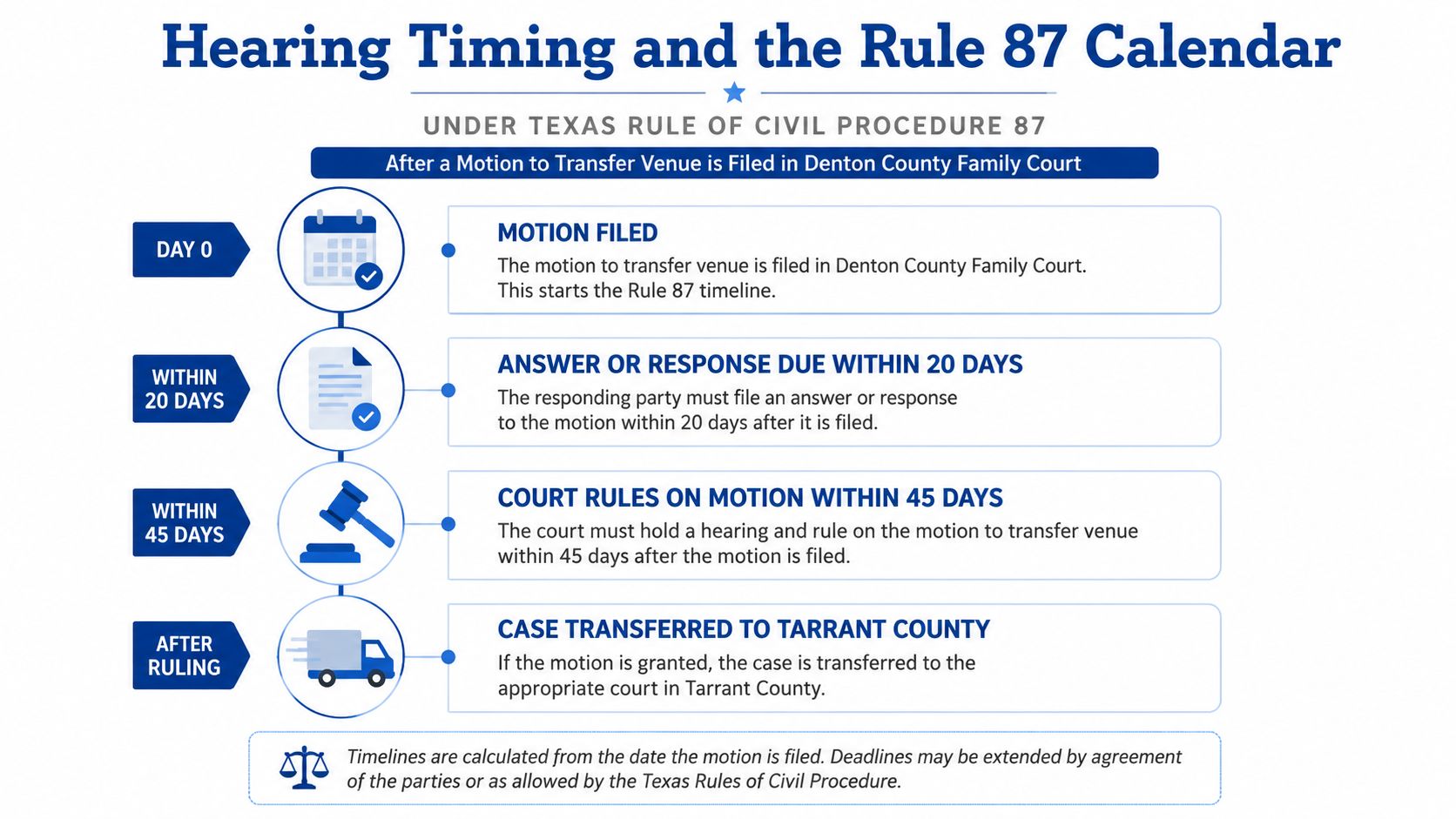
A practical calendar
At the start, file the motion in the Denton case and obtain a hearing setting that complies with the notice period. The opposing parent can challenge the transfer through written opposition and supporting affidavits. You then need to monitor the reply deadline and make sure the clerk has every document needed for the judge.
The court's ruling should be in writing. Until the signed transfer order is entered and processed, treat the Denton case as active there. Don't assume that a hearing date alone authorizes you to file future requests in Tarrant County.
For courthouse information that may help you identify the relevant Fort Worth facility, review the Tarrant County Family Law Center location information. Confirm current filing and local procedures directly with the clerk because family-court requirements can change.
Silence can have consequences
A party who wants to oppose venue must respond within the applicable time. A missed response can waive the venue challenge, just as the moving party can waive its transfer right by filing late. The safest practice is to create a written calendar immediately after service, then work backward from the hearing date for affidavits, objections, replies, and service.
Preparing Evidence and the Possible Outcomes
A transfer hearing is decided on facts, not just a parent's statement that Fort Worth would be easier. Build a record showing the child's actual home and the practical connection to Tarrant County.
Useful supporting materials can include:
- Residence documents: A lease, mortgage record, utility bill, or other document connecting the child and moving parent to the Tarrant County home.
- School records: Enrollment or attendance material showing the child's daily connection to a Tarrant County school.
- Employment evidence: An employer letter or similar record tying the parent's work and residence to Fort Worth or a surrounding Tarrant County city.
- Court records: The final order, docket information, and any documents showing the Denton court's continuing jurisdiction.
- Sworn statements: The moving parent's affidavit or unsworn declaration, plus corroborating declarations from a neighbor, coworker, or another person with direct knowledge.
Don't submit documents merely because they show a Tarrant County address. Explain what each document proves and how it supports the statutory venue theory. A school record may establish the child's daily location, while an employer letter may explain why the move is stable rather than temporary.
What the hearing can produce
The realistic possibilities are narrower than many parents expect. The judge may grant transfer to the requested Tarrant County court, deny the motion and leave the case in Denton County, or issue a procedural order requiring additional briefing, mediation, or another step before deciding the request.
A denial doesn't necessarily mean the judge rejected your entire custody or support position. It means the case remains in Denton County under the ruling on transfer. Likewise, a transfer doesn't change the existing parenting order unless a separate modification or enforcement request is properly presented.
The difference between a district and associate judge can also affect how a family case is managed. Review this explanation of Tarrant County associate judges and district judges in family cases before assuming every hearing has the same function or authority.
A Realistic Denton to Tarrant Transfer Scenario
A parent finalized a divorce and possession order in Denton County, then moved with the children to Southlake for a new job while the other parent remained in Denton County. The parent wants future custody matters handled closer to the children's home and school. Those facts can support transfer when the children's principal residence is now in Tarrant County and the statutory requirements are met.
The early-filing path
Before requesting a modification or enforcement, the parent reviews the Denton order, confirms the cause number, and checks the service and docket history. Counsel prepares a motion identifying the Southlake residence, the move date, the children's school connection, and the specific Tarrant County court requested.
The parent gathers residence records and signs a supporting declaration. The motion is filed in the Denton case within the applicable deadline and before another responsive pleading creates a waiver issue. The hearing is set under the Rule 87 calendar, and the other parent receives the required materials.
If the court grants transfer, the existing order remains in effect. Later proceedings can then occur in the designated Tarrant County court. The transfer itself does not change custody, possession, or support rights. Any requested modification or enforcement still requires the proper pleading.
The late-filing path
Change one fact: the parent waits until the child has lived in Southlake for the relevant period, then files an answer or another motion before requesting transfer. The residence evidence may remain favorable, but the filing sequence and statutory deadline create a waiver argument.
Do not abandon the case or open a new Tarrant County case as a shortcut. Review the exact service date, every prior filing, any written agreement, and whether a convenience or justice theory remains available under the record. A late motion is harder to win, and the available argument depends on the documents and procedural history.
The timing problem often begins before the parent realizes a deadline is running. Preserve the move timeline, school and residence records, and copies of all Denton filings. Obtain legal advice before responding to another pleading, because that response may affect the ability to seek transfer.
Prompt legal review is more valuable than waiting for the move to feel permanent. A Fort Worth family lawyer can evaluate the Denton order, identify the proper Tarrant County destination, and determine whether the request is timely or requires a different strategy.
Common Mistakes and Your Next Step With a Tarrant County Attorney
Parents usually run into trouble because they treat the transfer as an informal change of address. The court needs a properly supported request in the existing case, directed to the correct destination court and filed within the applicable period.
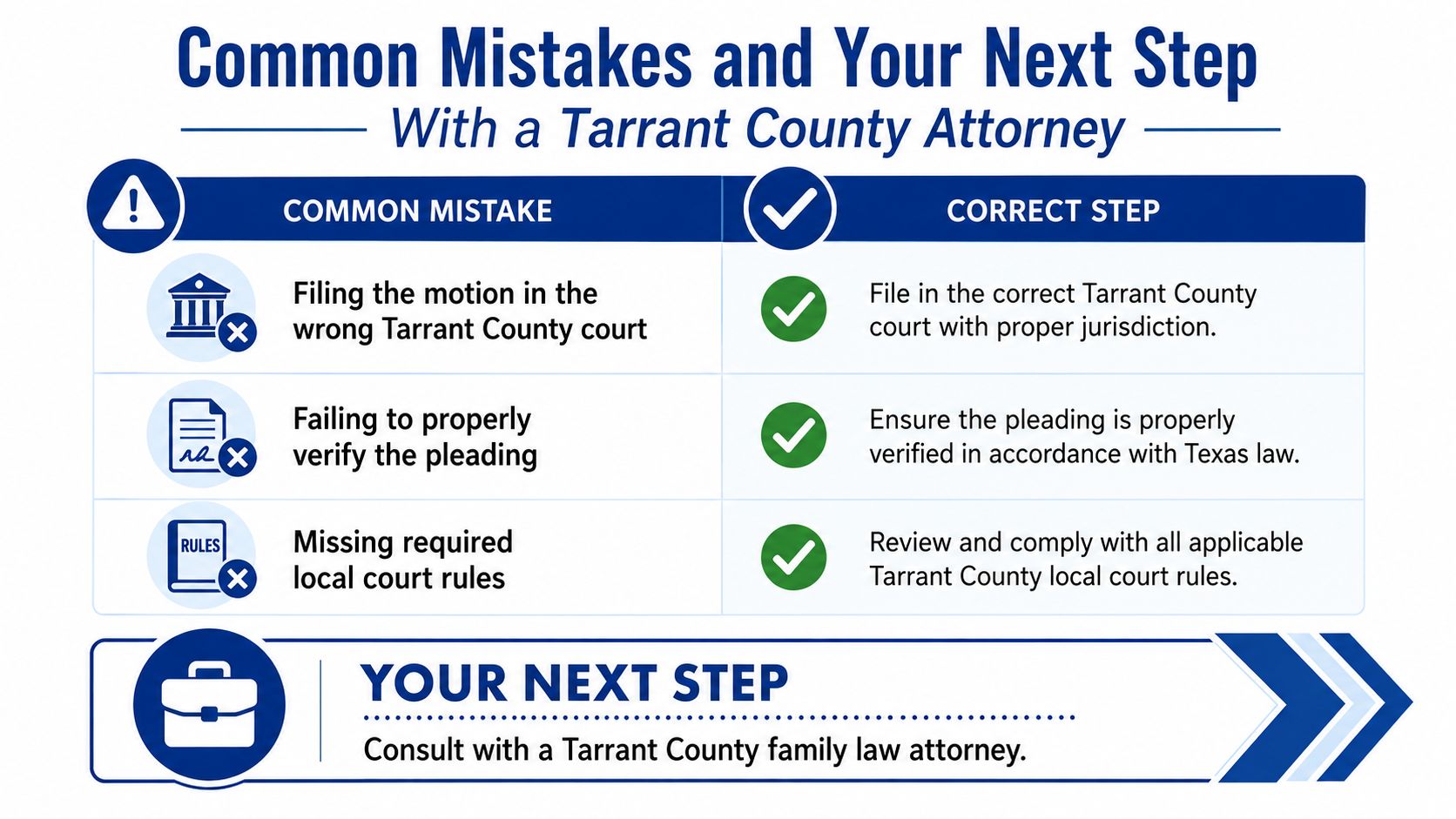
Watch for these errors:
- Wrong Tarrant County court: Naming only Tarrant County, or selecting a court without confirming where the child will reside, can create avoidable problems.
- Unverified factual record: Failing to support the residence timeline with an affidavit or unsworn declaration leaves the court with less reliable evidence.
- Missed deadline: Waiting beyond the statutory deadline, or filing another responsive pleading first, can create waiver risk. Some practice materials describe a response period in general terms, but the controlling calculation depends on the statute, service date, pleading, and applicable court rules.
- Poor service: Failing to serve the other parent correctly can delay the hearing or prevent the court from acting on the motion.
- Confusing temporary orders with transfer: A temporary orders hearing can address immediate parenting or support issues, but it doesn't automatically transfer the underlying SAPCR from Denton County to Tarrant County.
- Ignoring local requirements: Missing required local court rules, filing conventions, or clerk procedures can delay an otherwise viable request.
What to gather now
Start with the Denton County District Clerk's records. Obtain the final order, cause number, court designation, docket information, and any documents showing recent filings or service. Then collect Tarrant County residence proof, school records, employment information, and a written timeline of where the child has principally lived.
Contact the Tarrant County Family Law Center to identify the appropriate court and confirm current clerk procedures. Don't rely on an online form that doesn't match your case type or assume that a filing accepted by the clerk will automatically satisfy the legal deadline.
A consultation with a Fort Worth family law attorney can help you determine whether the mandatory residence transfer rule applies, whether convenience provides an alternative, and whether a deadline has already been missed. The purpose isn't to escalate conflict. It is to protect the child's stability and prevent a procedural mistake from controlling where future family-law disputes are heard.
The Law Office of Bryan Fagan PLLC can review your Denton County order, Tarrant County residence facts, filing history, and transfer deadlines, then explain the available path for your case. Visit Law Office of Bryan Fagan PLLC to learn about arranging a consultation before you file another pleading or allow a transfer deadline to close.
