 Skip to content

File the original will and the application with the Tarrant County Clerk's probate office at 100 W. Weatherford Street in Fort Worth, using Room 233 for probate filings and Room B90 in the basement of the Old County Courthouse for pro se muniment filings. After filing, the case is heard in Tarrant County Probate Court No. 1 or No. 2 at the same courthouse complex.
If you're looking up Tarrant County muniment of title where to file, you're probably dealing with a practical problem, not an academic one. A parent or spouse has died, there's a house to deal with, and someone has told you that a muniment of title may be the simplest probate option if the facts fit. The confusion usually starts when county materials refer to the clerk's probate office, the probate courts, Room 233, Room B90, and the Old County Courthouse all in the same process.
The good news is that the path is narrower than it first appears. A muniment of title is a probate filing, but it's a special kind of probate filing. That means where you file, what you bring, and what happens after the clerk accepts it all matter.
Table of Contents
- What Muniment of Title Means in Texas and Who Qualifies
- Where to File a Muniment of Title in Tarrant County
- What to Prepare Before You File in Fort Worth
- How Filing Fees Citation and Hearing Work in Tarrant County
- Common Mistakes to Avoid and When Muniment Is Not the Right Fit
- Next Steps for Fort Worth Families After Muniment of Title
What Muniment of Title Means in Texas and Who Qualifies
A common Fort Worth probate problem starts like this. A parent dies, the will leaves the house to one child, and the family does not need someone to collect accounts, fight creditors, or run an estate for months. They need a court order that lets the land records catch up with what the will says.
That is what a muniment of title is for.
In Texas, a muniment of title is a probate procedure that admits a will to probate without opening a full estate administration. Tarrant County's pro se materials explain the practical result. No personal representative is appointed, and no letters are issued under this procedure when the case fits the county's requirements (Tarrant County Probate Court pro se policy).
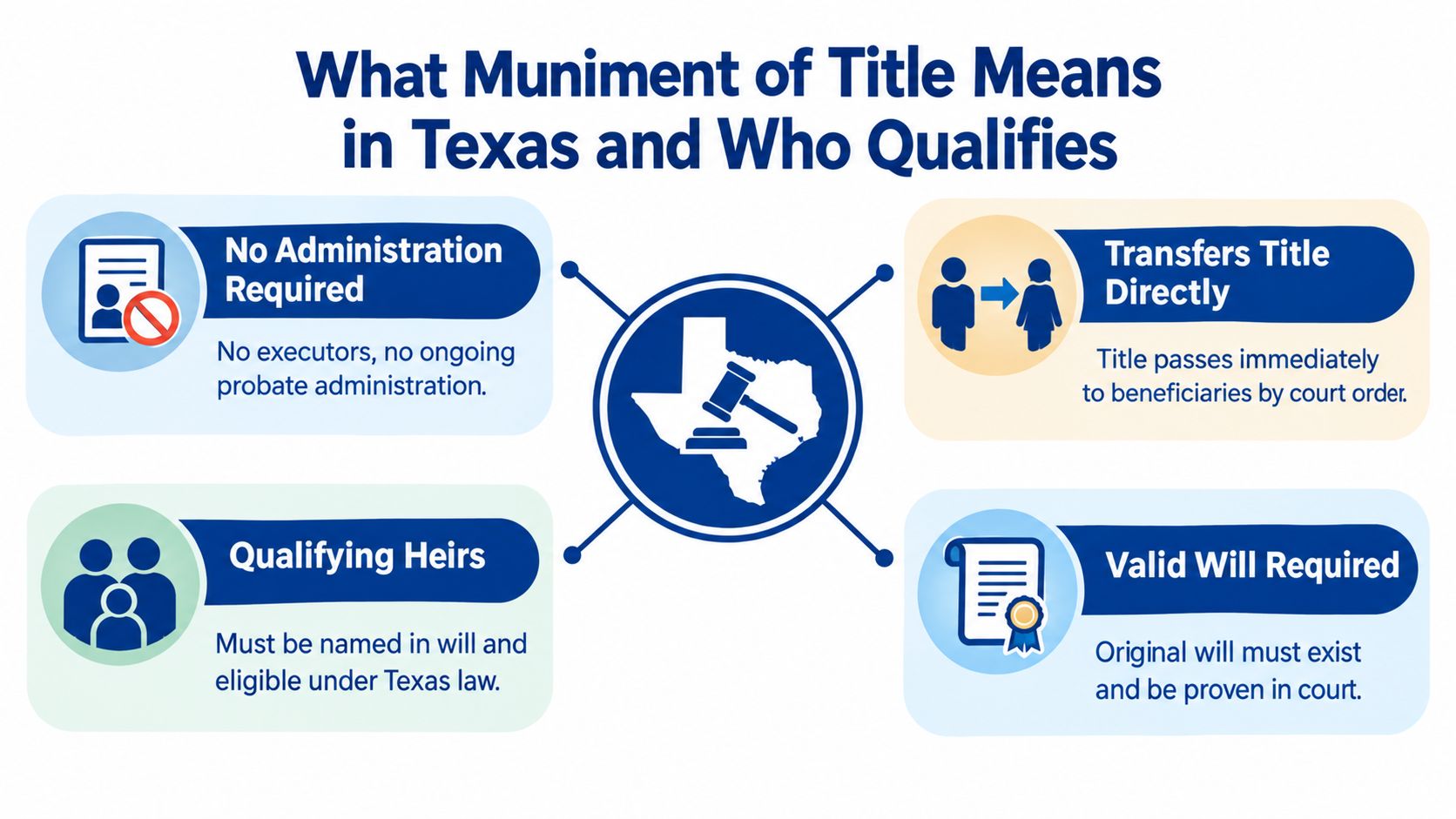
The basic idea
A full probate administration gives someone legal authority to act for the estate. That person may need to gather assets, pay debts, and deal with issues that continue after the hearing.
A muniment serves a narrower job. It puts the will through probate so the court's order can support title transfer, often for a house or other real property. A good everyday comparison is this: full administration is a full toolbox, while a muniment is a single tool used for one clear task.
That narrow purpose explains the workflow families see in Tarrant County. The clerk accepts the filing, the probate court reviews whether the case qualifies, and after the signed order is entered, the order and will are typically recorded in the property records so title companies and future buyers can trace ownership. If you keep that path in mind, the eligibility rules make more sense.
Who usually qualifies
Tarrant County applies a fairly strict screen for pro se muniment cases. In plain English, the case usually needs to look like this:
- The death was recent enough to fall within the legal filing window.
- The original will can be filed.
- The will was properly executed under Texas law.
- The will includes a valid self-proving affidavit.
- The applicant fits the county's pro se requirements, including the sole-beneficiary condition stated in the county policy.
- The estate has no unpaid debts other than debt secured by real estate, such as a mortgage or other lien tied to the property.
Those points are easy to skim past, but each one matters. A muniment is not the “easy probate” option. It is a limited probate procedure for a limited fact pattern.
A simple example
Suppose a Fort Worth mother dies owning a house in her name alone. Her original will leaves that house to her daughter. The home still has a mortgage, but there are no unpaid credit cards, no medical bills left open, and no need for anyone to manage a larger estate. That is the kind of case that may fit a muniment of title.
Change one fact, and the answer can change fast.
If unpaid unsecured debts exist, if the original will cannot be located, or if someone needs formal authority to act for the estate, the probate court may require a different procedure. That is why families often benefit from checking qualification first, before worrying about which intake room to use or how the $256 filing fee moves through the Tarrant County process.
Practical rule: If the family mainly needs the court to confirm what the will says about the house, a muniment may fit. If someone needs authority to handle the estate itself, a different probate case is often the better match.
Where to File a Muniment of Title in Tarrant County
You arrive at the courthouse with the original will in hand, and the first question is practical, not legal. Which room takes the filing?
In Tarrant County, a muniment of title starts with the Probate Clerk at 100 W. Weatherford Street, Fort Worth, Texas 76196. The county's probate filing guide points filers to the probate intake system and helps explain why families see two room numbers in different county materials: Room 233 and Room B90 (Tarrant County probate filing guide).
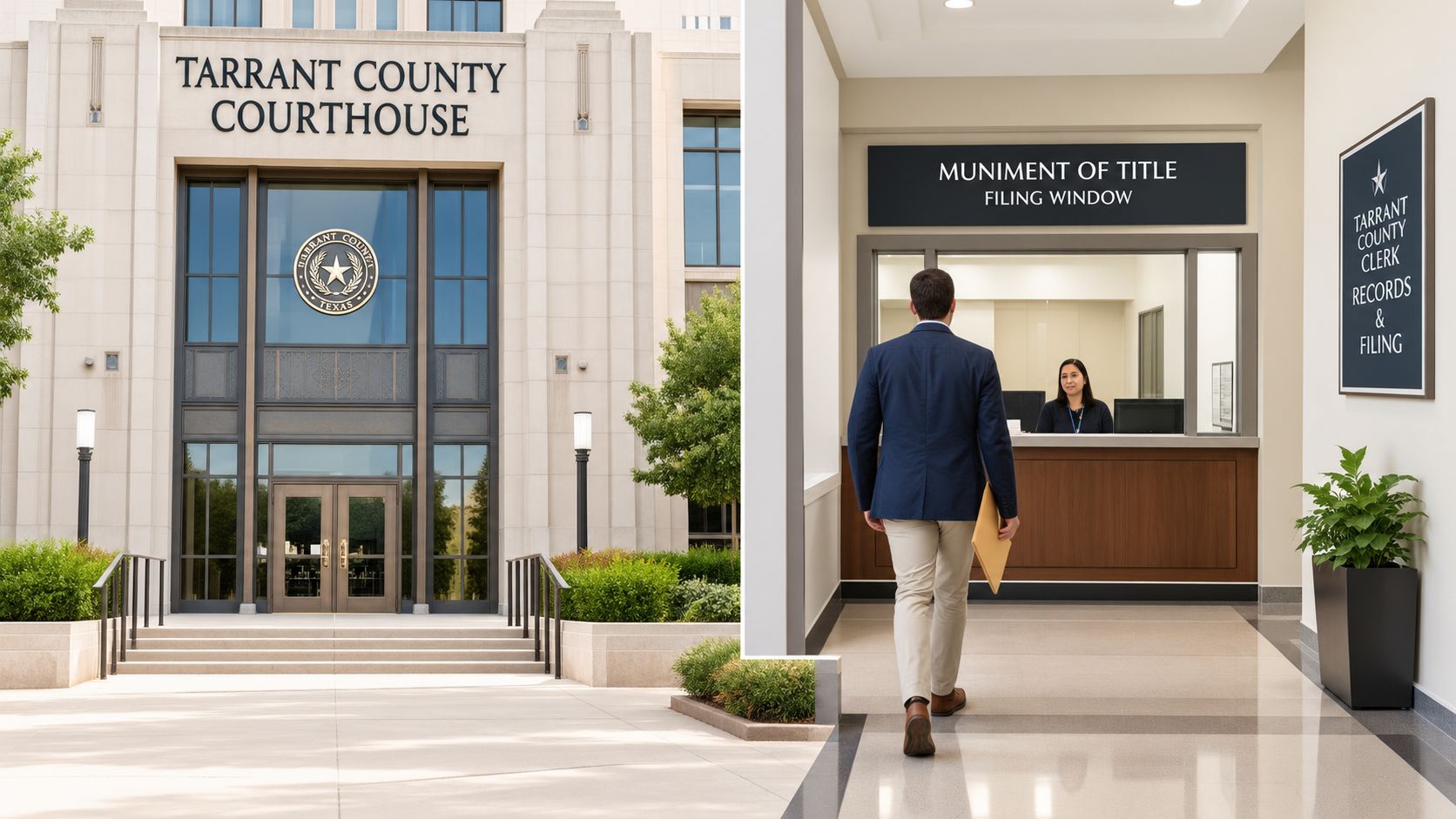
Why Room 233 and Room B90 both appear
The easiest way to sort this out is to separate the process into stages.
Room 233 appears in county probate materials as the general intake point for wills filed in a probate case. Room B90 appears in the county's pro se muniment instructions for applicants using that specific filing path. Those are not competing answers. They are two directions inside the same probate system at the same courthouse address.
A simple courthouse map helps. First, the clerk accepts the filing packet. Next, the case is assigned into the probate court system. After that, the matter goes to Probate Court No. 1 or Probate Court No. 2 for hearing. The judge does not take the papers at intake, and the courtroom is not the place where the case begins.
The workflow families usually need to picture
A muniment case has three separate stops, and mixing them together causes confusion:
- Clerk intake: You file with the probate clerk at 100 W. Weatherford. Depending on the filing path described in the county materials, the room reference may be 233 or B90.
- Probate court hearing: After intake, the case is heard in one of Tarrant County's probate courts.
- Real property records: Once the judge signs the order admitting the will as a muniment of title, a certified copy is commonly recorded in the county's real property records so the land records reflect the transfer.
That last step matters because a muniment works like a court-approved link in the chain of title. The probate court admits the will. The property records then show the world what happened to the house.
Tarrant County's local application materials reflect that separation between filing the application, obtaining a hearing, and using the signed order for title purposes (Tarrant County muniment application materials).
Which court hears the case after filing
The hearing will be in Tarrant County Probate Court No. 1 or No. 2, not at the intake counter. If you want help understanding which Tarrant County Probate Court No. 1 or No. 2 may hear the case, that guide gives the local court context without changing the filing location.
The short answer
If you are asking where to file a muniment of title in Tarrant County, file it with the probate clerk at 100 W. Weatherford Street in Fort Worth, then follow the room direction that fits your filing path. In practice, that means families should pay close attention to the county's intake instructions, especially the difference between Room 233 and Room B90, because the case starts with clerk intake, then moves to the probate court hearing, and only later reaches the deed records.
What to Prepare Before You File in Fort Worth
Most muniment delays aren't about difficult legal arguments. They start because someone arrives at the clerk's office without the right packet.
At minimum, Tarrant County's materials make two points clear. The original will must be filed, and the application and original will should be filed together. If either piece is missing, the filing path can stall.
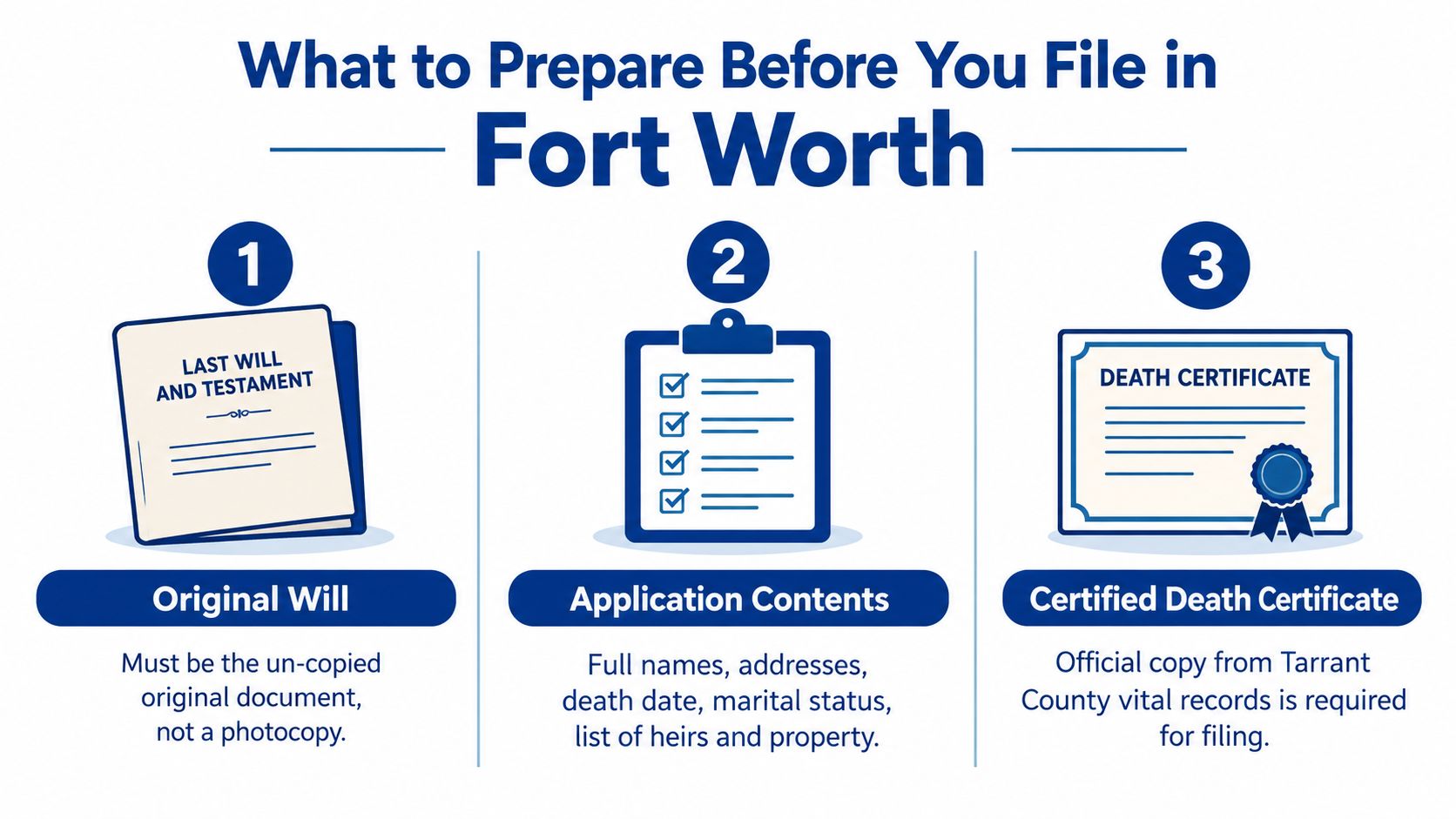
Your filing packet should be organized before you leave home
A practical packet often includes:
- The original will: Not a photocopy. Tarrant County's local materials specifically require the original.
- The application for probate of will as muniment of title: This is the pleading that asks the probate court to admit the will in this limited form.
- A death certificate: Families commonly need this for probate-related filings and related title work.
- A proposed order: Courts typically need an order to sign if the application is granted.
- Identification and payment method: You'll want to be ready when the clerk accepts the filing.
Check the will before you stand in line
The county's pro se policy doesn't just ask whether there is a will. It screens for whether the will appears to meet the county's muniment requirements, including a proper signature setup and a valid self-proving affidavit.
A simple self-check can save a trip:
- Look for witness signatures: The county's pro se policy requires at least two witness signatures for this route.
- Look for the self-proving affidavit: If the document doesn't contain one, don't assume the court will treat the case as routine.
- Check whether the applicant is the sole beneficiary: That is part of the county's listed pro se conditions.
- Think through debts: If there are unpaid debts other than real-estate liens, the filing may need a different probate strategy.
Missing paperwork usually doesn't mean the case is impossible. It means you may need to slow down and choose the right procedure before paying a filing fee.
A realistic example of what goes wrong
Suppose a daughter from Arlington brings a copy of her mother's will, but not the original. She also assumes that because the will leaves her the house, a muniment is automatic. At the clerk's window, she learns the original will needs to be filed and that the county's local eligibility checklist is narrower than she expected.
That kind of delay is common because people confuse “I have a will” with “I have a muniment-ready file.”
If you're trying to get oriented around the downtown courthouse area before you go, this page about the Tarrant County Family Law Center and downtown court navigation can help with general courthouse planning, even though a muniment filing itself goes through the probate clerk at 100 W. Weatherford.
How Filing Fees Citation and Hearing Work in Tarrant County
A common Fort Worth scenario goes like this. A family member files the muniment application, pays the clerk, and assumes the next stop is the courtroom that same day. In Tarrant County, the process is more like a relay. The probate clerk intake step comes first, citation must run its course, then the hearing is set, and only after a signed order do the deed records matter.
The money path is usually straightforward. The county lists Probate of Will as a Muniment of Title at $256, and that filing cost includes the poster citation. County materials also list an optional $2 judge-signature prepayment. The practical point is simple: the clerk filing fee gets the case opened and the citation issued, but it does not skip the waiting period before the hearing.
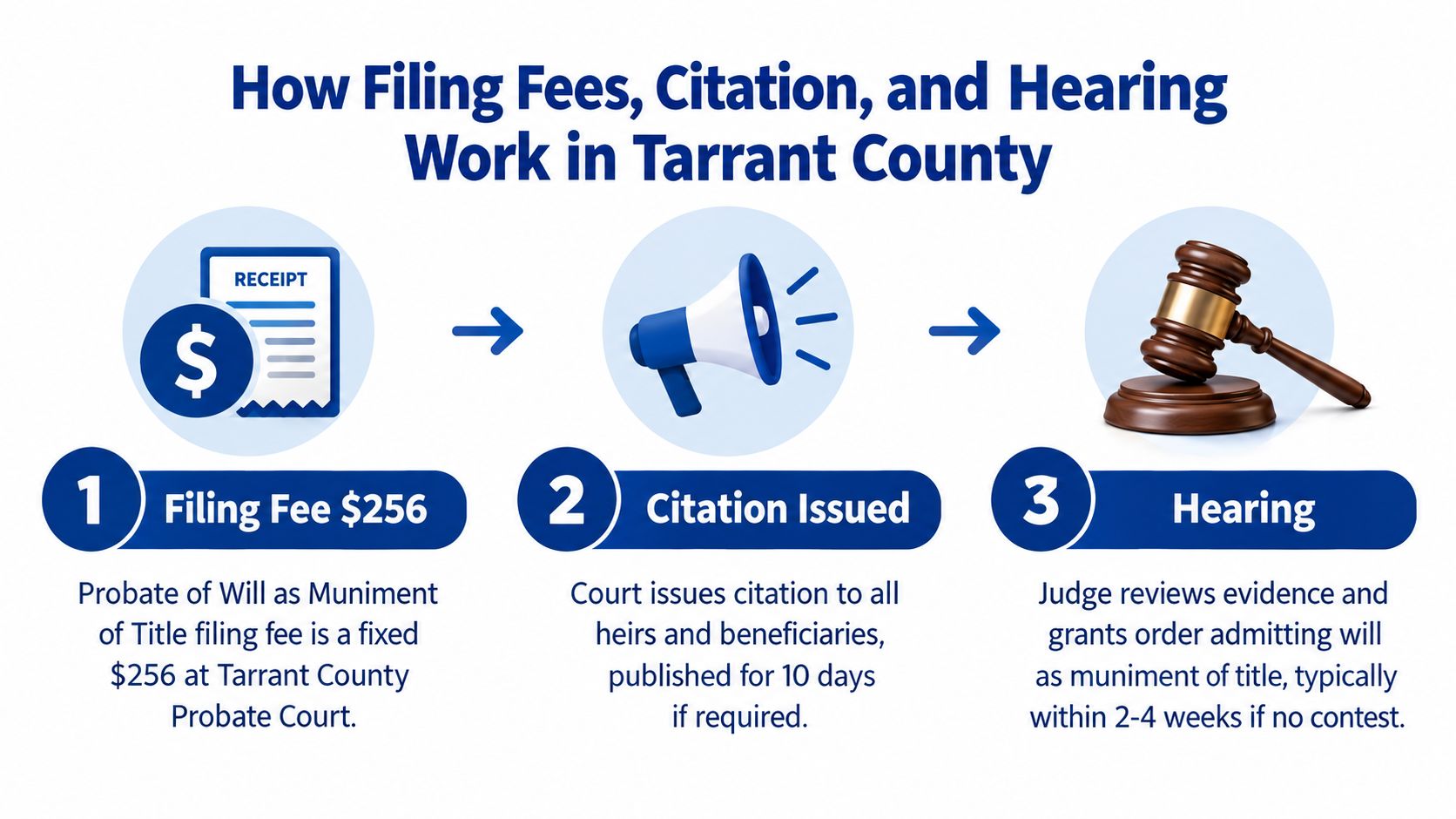
What happens after filing
After intake, the clerk issues citation for posting at the courthouse. Under the county's local process described earlier, that citation stays posted until the next Monday that occurs after 10 days from filing. Only after that return point does the hearing calendar open in the ordinary course.
That gap catches people off guard.
If you filed papers in Room 233, do not assume the next stop is Room B90 on the same trip. Room 233 is the intake side of the workflow. Room B90 matters later, when a probate court hearing is set. Those room numbers sound like minor courthouse details, but they mark two different stages of the same case.
Tarrant County Muniment of Title Timeline and Costs
| Milestone | What Happens in Tarrant County |
|---|---|
| Filing accepted | The probate clerk opens the muniment case and takes the filing fee. |
| Initial fee | The listed filing cost is $256, with poster citation included, and county materials also reference an optional $2 judge-signature prepayment. |
| Citation posted | The clerk issues citation, and the posting period must run before the hearing is set in the usual sequence. |
| Hearing set | After the return date, the applicant contacts the court to obtain a personal hearing date. |
| Order signed | If the judge admits the will as a muniment of title, the signed order becomes the probate document used for title purposes. |
| Post-order compliance | A compliance affidavit is due within 180 days, as noted earlier in the county's local materials. |
| Real property follow-through | A certified copy of the signed order is commonly recorded in the real property records so the title chain reflects what the probate court did. |
What the hearing is really for
The hearing serves a narrow job. The judge is deciding whether the will can be admitted as a muniment of title under Texas probate rules and the county's local practice.
That is different from proving up ownership to a title company. Probate court decides whether the will and application meet the legal standard for this limited procedure. If the answer is yes, the signed order becomes the paper that others can rely on when they review title.
Bring a file that answers basic questions cleanly. Dates should match. Names should match. The will, application, and proposed order should tell the same story.
The step families often miss after the judge signs
The court order does not finish the title cleanup by itself. It works more like a key than a final destination. You still have to use that key in the county records system.
In practice, that means getting a certified copy of the signed muniment order and recording it in the deed records after the hearing. For Tarrant County families, this is the handoff point between probate and property records. Probate gets you the order. Recording puts that result where future buyers, lenders, and title examiners expect to find it.
A short example helps. A son files downtown, waits through the posting period, appears at the probate hearing, and receives a signed order admitting the will as a muniment of title. If he stops there, the courthouse has a probate file, but the land records may still look unchanged. Once the certified order is recorded, the public title chain has a clearer link from the decedent to the beneficiary.
That last recording step is often where confusion starts, because families are dealing with two systems at once. Probate court handles the case. Deed records handle the public land title trail.
Common Mistakes to Avoid and When Muniment Is Not the Right Fit
Some filings fail because the person picked the wrong room. More often, the deeper problem is that the case never belonged in a muniment track to begin with.
The county's local materials describe a narrow route. If your facts don't fit, paying filing fees first and asking questions later can cost time, not save it.
Common filing mistakes
Here are several trouble spots families in Fort Worth and surrounding communities run into:
- Using a copy instead of the original will: Tarrant County's probate materials require the original will with the application.
- Assuming every will can be handled by muniment: The county's pro se policy uses a strict eligibility checklist.
- Ignoring debts: Unpaid debts other than real-estate liens can push the estate toward a fuller probate administration.
- Showing up at the wrong intake location: The county's room references matter because probate filings move through the probate clerk's channel.
- Stopping after the hearing: If the signed order isn't properly carried into the county records system, title problems can linger.
When another probate option may fit better
A short comparison helps:
| Situation | Muniment may fit | Another probate path may be needed |
|---|---|---|
| Original will is available | Yes, if the other requirements also fit | No, if the original can't be produced and another procedure is required |
| No unpaid debts except real-estate liens | Often yes | If unsecured debts remain, a fuller administration may be more appropriate |
| Sole beneficiary under county's pro se checklist | More likely | Multiple competing interests can make the case less suited to this shortcut |
| Valid self-proving affidavit appears in the will | More likely | If proof problems exist, the court process may become more involved |
| Main goal is title transfer | Often yes | If someone needs broad authority to act for the estate, another route may fit better |
Some families start with a muniment because it sounds simpler. Simpler only helps when it's the correct legal tool.
Title issues can outlast probate if you skip the property side
Even after the court signs the order, title work may still need attention. For some families, especially when no will exists or the facts don't line up with a muniment, a recorded property affidavit may be part of the larger conversation. This guide to a Tarrant County affidavit of heirship for real property records explains a different title-record approach that sometimes comes up when families are comparing options.
If you're unsure whether your situation belongs in probate court as a muniment or in another process, that's usually the point to get legal guidance before filing.
Next Steps for Fort Worth Families After Muniment of Title
Once a muniment order is signed and recorded, the practical question becomes whether the title issue is resolved in the world. That often means checking whether the county records reflect the probate result the way a title company, lender, or future buyer would expect to see it.
For many families in Fort Worth, Arlington, Keller, Grapevine, Mansfield, and nearby communities, the best next step is simple. Gather the will, identify any debts, confirm whether the local muniment checklist fits your facts, and make sure the filing plan includes the court side and the recording side.
A workable next-day checklist
- Find the original will: If you only have copies, pause before assuming a muniment filing is ready.
- List outstanding debts: Be specific. Mortgages and other real-estate liens are treated differently from unsecured debts in the county's local muniment policy.
- Review the will for signing details: Check for witness signatures and a self-proving affidavit.
- Think about the goal: Is the problem mainly title to a house, or does someone need broader authority to manage an estate?
- Plan the courthouse trip carefully: Confirm the current probate filing intake path at 100 W. Weatherford before you go.
- Don't forget the post-hearing step: If the court signs the order, follow through with the deed-record side of the process.
When to speak with a lawyer
Some cases deserve a lawyer's review before anything is filed. That's especially true if the will is incomplete, several relatives are involved, debts may exist, or the property history already looks messy.
The Law Office of Bryan Fagan PLLC is one option for families who need help evaluating whether a muniment of title fits or whether another Texas probate procedure makes more sense. The value in that kind of consultation is not just document preparation. It's avoiding the wrong filing path in the first place.
A good probate plan answers three separate questions. Where do we file, do we qualify, and what must happen after the order so the property records make sense later?
If your situation involves conflict, uncertainty about the original will, or concern about whether title will clear after probate, that's usually the moment to stop relying on assumptions and get case-specific advice.
If you need help deciding whether a muniment of title is the right probate path in Tarrant County, Law Office of Bryan Fagan PLLC offers information and legal services related to probate, estate planning, and related Texas court procedures. You can use the site to learn more about local probate issues, review next steps, and decide whether a consultation makes sense for your family's situation.
