 Skip to content

A lot of Fort Worth families land in the same spot. A parent dies, there's no will, the house is still in the parent's name, and now the children are trying to sell it, refinance it, or keep the taxes and insurance straight without opening a larger probate case than the situation really needs.
That's usually when an affidavit of heirship comes up.
In Tarrant County, that document is best understood as a real property record, not a probate shortcut that fixes everything. It goes into the county's deed records to document who the heirs are and how title passed when someone died intestate. Texas law gives it a specific evidentiary role. Under Texas Estates Code § 203.001, a properly executed affidavit may be treated as prima facie evidence of a decedent's family history, marital status, genealogy, or heirs once it has been of record for at least five years in the right county deed records.
That matters because families often assume the affidavit itself transfers everything. It doesn't. It can help document ownership of real estate in the chain of title. It doesn't by itself transfer bank accounts, resolve debts, or insulate heirs from every later dispute.
If you're dealing with a Fort Worth home after a death without a will, the practical job is usually this: search the Tarrant County real property records, confirm whether an affidavit already exists, prepare a complete and accurate document if one doesn't, get it properly sworn and notarized, and record it in the county land records so the property history is clear for the next title review.
Table of Contents
- When a Fort Worth Family Ends Up With Heirship Paperwork
- Searching Tarrant County Real Property Records for an Affidavit
- Preparing and Notarizing the Affidavit of Heirship
- Recording the Affidavit With the Tarrant County Clerk
- How a Recorded Affidavit Affects Title and Future Sales
- When an Affidavit Is Not the Right Tool for the Estate
- Practical Next Steps for Tarrant County Heirs
When a Fort Worth Family Ends Up With Heirship Paperwork
A Fort Worth family usually reaches this point the same way. A parent dies owning a house in only that parent's name. There is no will, no pending probate, and no immediate dispute among the children. Then the family tries to sell the home, refinance it, or straighten out ownership after years of paying the taxes and insurance.
The title company pulls the deed and sees a gap. The deceased owner is still the last person shown in the property records. At that point, the family needs title evidence, not just family agreement.
That is why an affidavit of heirship comes up.
In Tarrant County, the affidavit is a land-records document used to support the chain of title for real estate. Families often assume it is something filed in probate court because it deals with heirs. For a house, the practical focus is usually the county clerk's real property records, where the affidavit is recorded alongside other instruments affecting title.
That distinction matters in real life. If the only issue is getting the family history and heirship facts into the property record for a house that passed under Texas intestacy law, an affidavit may do the job. If the estate also has disputes, unpaid creditor issues, questions about who the heirs are, or assets beyond the house, the affidavit may be too thin a tool.
What the affidavit does well
Used in the right situation, an affidavit of heirship can help with several title-related problems:
- Identify the heirs who inherited the property under Texas intestacy rules.
- Place family-history facts in the deed records, such as marriages, deaths, and children, so a later title examiner can follow how ownership passed.
- Support a future sale or refinance by giving the title company a recorded explanation for why the deceased owner is no longer the only person with an interest.
That is the practical value. The affidavit gives the title file something concrete to review instead of leaving the family to explain the history by phone or email.
What it does not fix
An affidavit of heirship does not settle the whole estate.
It does not transfer bank accounts by itself, clear liens, cut off creditor claims, or resolve a fight over paternity, marriage, divorce, or missing heirs. It also does not guarantee that every buyer, lender, or title company will treat the property as ready to close on the same timeline. Some title underwriters are comfortable with a well-prepared recorded affidavit and supporting deeds. Others want more.
That is the trade-off families need to hear early. An affidavit is often cheaper and faster than opening a probate case, but only when the facts are clean enough for the document to carry real evidentiary weight in the property records.
I tell families to treat it as title paperwork, not magic paperwork. If the affidavit is incomplete, signed by the wrong witnesses, or vague about the family history and legal description, it can leave a title problem behind for the next closing instead of solving one now.
Searching Tarrant County Real Property Records for an Affidavit
A Fort Worth family often reaches this point after finding a house deed in a parent's name and realizing nobody knows whether heirship paperwork was ever recorded. Before anyone fills out a form, check the property records. In Tarrant County, that search usually answers the first practical question: are you creating a new affidavit, or cleaning up a record that already has one in it?
Many families find more than they expected. A brother may have recorded an affidavit years ago. A title company may have required one for an earlier refinance. Sometimes the record does not contain an affidavit at all, but it does contain the deed with the exact legal description you will need later.

Where to look
Search the county clerk's real property records, not just probate filings. That distinction matters in Tarrant County because an affidavit of heirship tied to land is usually recorded in the deed records as a real property instrument.
Families miss this point all the time. They search for a probate case, find nothing, and assume no heirship document exists. The land records may tell a different story.
If you also need a separate court-file search for a divorce, custody case, or another family matter, use this guide to Tarrant County District Clerk records search for a family case. That is a different system from the county clerk's property index.
How to search without wasting time
Start with the decedent's name as it appears on the deed, including middle initials or suffixes if the prior record used them. Then widen the search if needed. I usually tell families to search the clean version first, then try common variations, married names, and abbreviated initials.
Use the record search for more than one document type. Look for deeds, correction deeds, affidavits, survivorship agreements, divorce-related conveyances, and older probate-related recordings that may have been filed in the property records.
A few search habits save trouble later:
- Run a name search in both directions. Check the deceased owner as grantor and grantee if the system allows it.
- Pull the last recorded deed. That deed usually gives you the legal description title companies expect to see repeated accurately.
- Follow the chain, not just the address. Street addresses change, legal descriptions do not.
- Use prior references if you have them. Instrument numbers, volume and page references, or a title commitment can shorten the search.
- Check for family transfers. Prior deeds between spouses, parents, children, or trusts often explain why title sits the way it does today.
The legal description is where families make preventable mistakes. The appraisal district address is helpful for locating the property, but it is not a substitute for the recorded lot-and-block description or metes-and-bounds description in the deed records.
What the search needs to confirm
The search should answer three property-record questions:
- Is an affidavit of heirship already recorded?
- What legal description was used in the most recent deed into the decedent?
- Does the chain of title show another document that affects ownership, such as a survivorship agreement, divorce decree, correction deed, or recorded probate order?
Those answers tell you whether an affidavit will clarify the record or whether a bigger title problem is sitting underneath it. For example, if the deed into the decedent was never recorded, or if a prior spouse still appears in the chain without a clear transfer out, an affidavit alone may not satisfy the next title examiner.
Here's a walkthrough video if you want to see the public records portal in action before you start searching:
If your search turns up nothing, that only means the deed records do not already contain the heirship document. It does not mean the family can skip the title work. It usually means you are preparing the first affidavit in that property's recorded history.
Preparing and Notarizing the Affidavit of Heirship
Once you've confirmed the property history, the next job is accuracy. The affidavit isn't a place for rough guesses about marriages, children, or “I think that was his only house.” Title problems often start with partial family history.
Texas provides a prescribed affidavit form in Texas Estates Code § 203.002. Tarrant County's fillable heirship affidavit also reflects a standard workflow. Confirm the decedent died intestate, identify all heirs, include the full legal description of each parcel, swear to the affidavit before a notary, and record it in the county where the land is located. The same materials warn about common failure points such as missing legal descriptions, incomplete heir histories, and treating the document like a substitute for probate. See the county form here.
Information you need before anyone signs
Gather the facts before you fill in a single line:
- Decedent details. Full legal name, last address, place of death, and date of death.
- Family history. Every marriage, every child, whether any child predeceased the decedent, and whether descendants of a deceased child are living.
- Property details. The complete legal description from the recorded deed, not just the mailing address.
- Title source. How the decedent acquired the property in the first place.
Supporting records often help you verify the family tree and the title trail. Families commonly pull the death certificate, prior deeds, marriage records, divorce records, and birth records where needed to establish lineal descent.
Who should sign
An affidavit of heirship usually works best when it's signed by disinterested witnesses with real knowledge of the family history.
Texas guidance in this area shows the state expects concrete facts, not vague conclusions. The public-assistance heirship affidavit guidance discussed within § 203.002 requires at least two disinterested witnesses and factual statements about issues like whether a surviving spouse exists, whether a personal representative proceeding is pending, whether 30 days have passed since death, and whether estate value excluding homestead and exempt property is $50,000 or less in that separate context. That form serves a different purpose, but it highlights the level of detail Texas expects when people document succession.
A good affidavit reads like verified family history, not a family rumor written on notarized paper.
A disinterested witness is generally someone who knows the family well enough to testify about the relationships but doesn't stand to inherit from the estate.
What usually goes wrong
Problems tend to cluster around a few avoidable mistakes:
- Leaving out a marriage or child. Even a short prior marriage can matter.
- Using the tax record instead of the deed description. The tax account helps identify the parcel, but title work usually depends on the legal description in the deed chain.
- Naming heirs casually. “His kids” isn't enough. Heirs need to be identified clearly and completely.
- Using interested witnesses only. A child of the decedent may know the facts, but that doesn't make them the strongest witness for title purposes.
If the facts are complicated, a lawyer can draft the document or review a family-prepared version before recording. That's often cheaper than fixing a bad affidavit after a buyer is waiting.
Recording the Affidavit With the Tarrant County Clerk
After the affidavit is signed and notarized, the next step is recording it with the Tarrant County Clerk in the property records. This is a recording task, not a probate-court filing.
Tarrant County's county clerk materials classify affidavits of heirship among land-related affidavits, and the official records system places them in the public archive used to document ownership history for land and title purposes. That's why the recording location matters. You want the document in the same record system where a title examiner will look for deeds, correction instruments, and other chain-of-title documents.
What to bring or send
For a typical recording, families should have:
- The original affidavit with original notarization
- A complete legal description in the body or attached exhibit
- Return-address information so the recorded original can be returned
- Readable pages that can be scanned and indexed clearly
If the property is in Tarrant County, record it there. If the decedent owned land in another county too, recording in Tarrant County won't place the affidavit into that other county's land records.
Why county location matters
TexasLawHelp explains that the affidavit must be filed in the county where the land is located, and practitioner guidance notes that if land spans multiple counties, identical filings are needed in each county. That's one reason multi-county estates often deserve more planning than a single-house Fort Worth estate. The practical guidance appears in TexasLawHelp's affidavit of heirship article.
Recording point: Put the document where the title examiner for that parcel will actually search.
Common rejection and cleanup issues
County recording offices and later title reviewers often stumble over the same defects:
- Missing or defective notarization
- Illegible attachments
- Incomplete property description
- Heir information that conflicts with other public records
- Mailing or return information problems
Even when the county accepts a flawed affidavit for recording, acceptance isn't the same thing as clean title evidence. Recording gets the document into the records. It doesn't guarantee that a later title company will rely on it without questions.
How a Recorded Affidavit Affects Title and Future Sales
Once recorded, the affidavit becomes part of the property's chain of title. That's the point many online guides skip. The document isn't just family paperwork stored at the courthouse. It becomes one of the recorded instruments a future title examiner reads when deciding whether heirs can sell, refinance, or otherwise deal with the property.
Under Texas Estates Code § 203.001, a court may treat a properly executed affidavit as prima facie evidence of the decedent's family history, marital status, genealogy, or heirs if it has been of record for at least five years in the deed records of the county where the property is located, or where the decedent lived or was domiciled at death. That statutory role is what gives the affidavit real title value over time.
What title companies usually care about
A title company reviewing inherited property is looking for a reliable ownership story.
The affidavit helps answer questions like:
- Who inherited when the owner died without a will?
- Is the family history complete enough to account for all heirs?
- Does the legal description in the affidavit match the rest of the deed chain?
- Are there other recorded instruments that conflict with the affidavit?
A well-prepared affidavit can support a sale or refinance. A thin affidavit can trigger demands for corrective affidavits, additional supporting documents, or a probate proceeding.
Title treatment over time
| Time After Recording | Statutory Weight | Typical Title Company Response |
|---|---|---|
| Shortly after recording | Recorded evidence in the chain of title, but not yet at the five-year statutory milestone | Careful review. The company may ask for stronger backup, corrective documents, or another probate path depending on the facts. |
| After five years in the proper deed records | Prima facie evidence under Texas Estates Code § 203.001 | More likely to be treated as a workable title-evidence document if the affidavit is complete and no conflict appears in the record. |
That table doesn't mean every title company treats every file the same way. It means the five-year recording history changes the legal weight of the affidavit in a way that matters to title review.
Limits families should keep in mind
The affidavit still has boundaries.
It doesn't transfer personal property by itself. It doesn't eliminate liens. It doesn't prevent a later challenge if the family facts were wrong or incomplete. And it doesn't turn a disputed estate into an undisputed one because something was recorded.
That's why families should think of the affidavit as evidence in the title record, not a magic deed.
When an Affidavit Is Not the Right Tool for the Estate
Sometimes the fastest-looking route is the wrong one.
An affidavit of heirship works best when the decedent died without a will, the family history is clear, the heirs are known, and the practical need is to document who inherited real property. If those facts shift, the better tool may be something else.
Situations that should make you pause
An affidavit may be the wrong fit when:
- There's a will. If the decedent died testate, the question usually isn't heirship. It's probate of the will.
- The heirs disagree. A recording won't solve a family conflict about marriage, paternity, or who inherits.
- The estate includes more than a house. Business interests, complicated debt issues, or mixed assets often need broader administration.
- A minor or disabled heir is involved. Extra planning may be needed before anyone tries to transfer or sell property.
- There are multi-county properties. Separate filings may be needed where each tract is located.
Comparing the main paths
A small-estate affidavit and an affidavit of heirship are not interchangeable.
Texas guidance on heirship affidavits shows they sit alongside other estate tools, but the choice isn't automatic. An affidavit of heirship is tied to documenting title for land. A small-estate procedure may help in a different kind of estate, but it isn't a universal fix for titled real estate problems. If a will exists, or if a court order is needed to clear title cleanly, probate may be the better route.
For families trying to sort out court assignment questions, this overview of Tarrant County Probate Court 1 and 2 can help orient you.
Some estates don't need a shortcut. They need the right court order.
Red flags that justify legal review first
If any of these are present, talk with a probate lawyer before recording:
- a probate case is already pending somewhere
- someone says a will exists, even if nobody has produced it yet
- the decedent owned property outside Texas
- there may be creditor pressure or a claim against the estate
- a family member believes an heir was omitted
- title to the property was already messy before the death
In those situations, recording an affidavit too early can complicate matters instead of simplifying them.
Practical Next Steps for Tarrant County Heirs
Once the affidavit is recorded, don't stop there. Recording is only the beginning of the cleanup work that usually follows an intestate property transfer.
For a Fort Worth family keeping or selling a home, the most useful next move is usually to organize the property file the way a future title examiner or lender would want to see it.
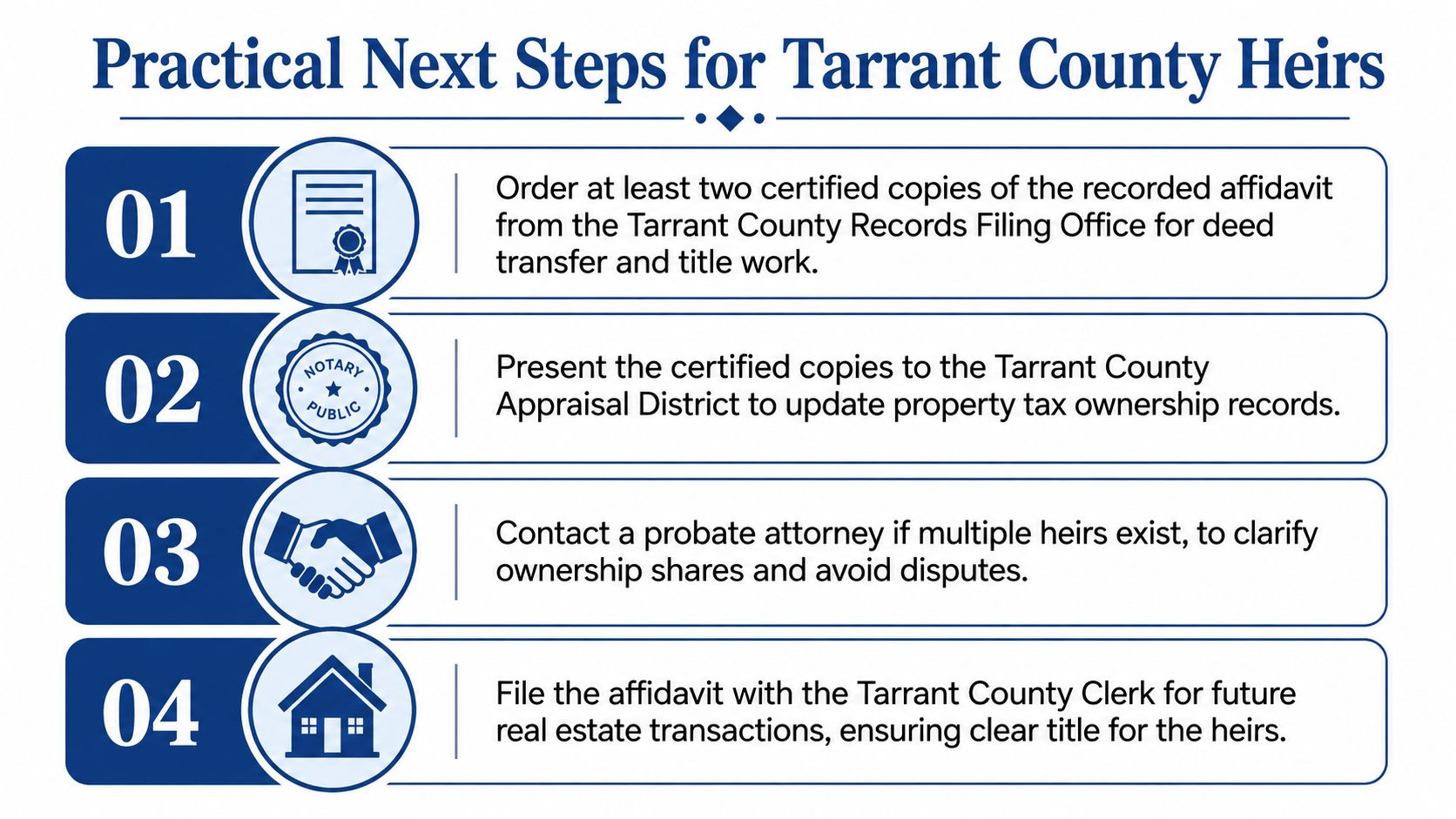
Your immediate checklist
- Order certified copies. Keep recorded copies available for title work, lender review, or a future buyer.
- Store the original safely. Don't leave the only signed original in a kitchen drawer at the inherited house.
- Update the practical records. Notify the mortgage servicer, insurance carrier, and property-tax authorities as needed.
- Get title reviewed before a sale. Don't wait until closing week to learn the affidavit left unanswered questions.
What families often miss after recording
The document may be in the county records, but the people and companies dealing with the property may still be working from the old owner's file.
That can affect insurance, loan communication, tax correspondence, and future closing documents. If an heir plans to keep living in the house, tax and occupancy records may also need attention. If the heirs plan to sell, a title commitment requested early in the process can reveal whether the affidavit will likely be enough or whether a corrective step is needed first.
For families who know the estate is getting complicated, a lawyer can help compare the affidavit route against other probate options. The probate services page is one place to start if you're weighing that decision.
When to bring in a lawyer
Some files are simple enough for careful self-help plus title-company guidance. Others aren't.
Consider legal help if:
- The family tree is complicated. Prior marriages, deceased children, or uncertain paternity can change inheritance rights.
- The property is part of a broader estate problem. Multiple assets, debts, or a possible will call for more than a land-record affidavit.
- One heir may challenge the transfer. It's better to address that risk before a buyer appears.
- You need a document that will hold up under later scrutiny. Drafting details matter when a house may be sold years later.
One practical option for families in Fort Worth and surrounding communities is to have an attorney prepare or review the affidavit before it's recorded. That can be done through private counsel, and the Law Office of Bryan Fagan PLLC is one local option among firms that handle probate and related title-transfer issues.
The goal isn't paperwork for paperwork's sake. The goal is a record that makes sense when the next person in the chain, whether that's a title company, lender, buyer, or heir, opens the file.
If you're trying to sort out inherited real estate in Fort Worth or elsewhere in Tarrant County, Law Office of Bryan Fagan PLLC helps families evaluate whether an affidavit of heirship is the right tool, prepare the supporting paperwork, and address the title issues that often come with property passed outside probate. To learn more or take the next step, visit Law Office of Bryan Fagan PLLC.
