 Skip to content

If you're trying to file a small claim in Fort Worth or anywhere in Tarrant County, the first thing to understand is that you are not walking into one countywide court. You are dealing with eight justice-of-the-peace precinct courts, and the precinct tied to the defendant's address usually decides where the case starts. That one detail drives everything that follows, from filing to service to whether your case moves.
Tarrant County's justice courts handle civil matters up to $20,000 in controversy, and the county treats small claims as part of that civil docket in each precinct. Under Texas Rule-based justice-court practice, the case can involve money damages, personal property, civil penalties, or other relief allowed by law, but it still has to fit the small-claims framework. If you're a landlord, consumer, contractor, or former tenant trying to recover a modest amount, the precinct system is the gatekeeper.
A lot of people get tripped up before they even open the petition. They pick the wrong precinct, name the wrong defendant, or budget only for the filing fee and forget service costs. That usually doesn't kill the case forever, but it does slow everything down, and in small claims, delay is the enemy.
Table of Contents
- Understanding Tarrant County Justice of the Peace Precinct Small Claims Courts
- Choosing the Correct Precinct and Confirming Jurisdiction
- Filing Fees and Total Cost to File in 2026
- Preparing Your Petition and Required Forms
- Serving the Defendant the Right Way
- What Happens at the Small Claims Hearing
- Judgment, Enforcement, and When to Get Legal Help
Understanding Tarrant County Justice of the Peace Precinct Small Claims Courts
Tarrant County's JP system is local by design. The county operates 8 justice-of-the-peace precinct courts, with access points in places like Fort Worth, Arlington, Hurst, Southlake, Lake Worth, and Mansfield, and the county sends filers to the right precinct based on the defendant's address, not the plaintiff's convenience. That's why the county's address directory matters so much. Small claims here are not filed into a single downtown courtroom and sorted later, they're routed precinct by precinct from the start. Tarrant County's small-claim guidance makes that structure plain.
What these courts actually hear
These courts are built for straightforward civil disputes, not for drawn-out litigation. The most common matters are unpaid debts, security deposit disputes, vehicle damage, contractor disputes, and consumer complaints. That list matters because it shows how broad the JP civil docket really is, especially for people in Fort Worth and the surrounding communities who need a forum for modest-dollar disputes. Texas justice courts also follow the simplified small-claims framework in the Texas Rules of Civil Procedure, which keeps the process more accessible than district court. Texas Rules of Civil Procedure, Part V
Practical rule: if the amount you're asking for belongs in the ordinary consumer, landlord-tenant, or contract bucket, start by checking the precinct first, not by drafting a long story.
A simple example makes it clear. Suppose a Fort Worth landlord says a former tenant owes $2,400 and the tenant has moved to Arlington. The landlord doesn't file wherever it feels easiest. The landlord starts by confirming which precinct covers the tenant's current address, because that precinct usually determines where the case belongs. Miss that step and you create avoidable delay before the judge ever sees the file.
Choosing the Correct Precinct and Confirming Jurisdiction
A defendant in Arlington may live only a few streets from a precinct boundary. File in the wrong court, and the case can face a transfer issue or dismissal fight before the judge reaches the underlying dispute. Precinct selection is one of the decisions that determines whether a pro se filing proceeds toward judgment.
Tarrant County's justice court guidance directs filers to identify the proper precinct by address. Use the defendant's current residence or the business's current location, not an old invoice or text thread. A utility bill, county property record, or Tarrant County Appraisal District record can help confirm the address.
How to verify the right court
Then use Tarrant County's Justice of the Peace precinct map and court directory to cross-check that address before preparing the petition. The county's precinct pages identify the court serving each area, while the directory supplies the applicable court information. If the courthouse address appears unfamiliar, confirm the location before filing, including the Tarrant County Family Law Center at 200 E. Weatherford Street.
Arlington, Fort Worth, Keller, and Mansfield can involve different precincts depending on the exact street address. City names do not reliably identify the correct JP court, and split addresses create avoidable mistakes.
I'd rather a filer spend ten careful minutes verifying the precinct than spend weeks cleaning up a filing mistake later.
A wrong precinct can give the other side a procedural objection before the court considers the merits.
Budget before you file
Confirm the filing and service amounts before submitting the case. Tarrant County's 2026 materials show a $54.00 small-claims filing example, a $90.00 service of process fee in another fee column, and additional charges when the case names more defendants. Localized county schedules show examples totaling $121 or $144 for one defendant, depending on the precinct and service fee structure. Tarrant County 2026 fee sheet and Tarrant County JP fee schedule example
| Cost Item | Amount |
|---|---|
| Small-claims filing, one filing example | $54.00 |
| Service of process fee | $90.00 |
| One defendant, example total with service | $121 or $144 |
| Additional defendants | Additional charges apply |
Budget for service and every named defendant before you file. For a plain-English reference to county filing charges, review the Tarrant County filing fee schedule resource.
Filing Fees and Total Cost to File in 2026
Do not walk into a small-claims case with a vague idea of cost. Tarrant County's 2026 fee materials show that the out-of-pocket total depends on the filing line, service method, and whether you name more than one defendant. That matters because a case can be legally sound and still stall if the plaintiff doesn't have the money ready for service or added defendants.
What the county's fee pages tell you
The county's published examples show a small-claims filing with service on one defendant at $54 for the filing fee, plus a constable service fee that can be $75 or $90 depending on the precinct. That's why the county examples land at $121 or $144 for one defendant in those published schedules. Tarrant County JP fee schedule example
The county's 2026 filing-fee sheet also shows that the structure changes by defendant count, and the fees for extra defendants are not folded into the base filing number. If you're suing more than one person or entity, budget for that before you click submit. The county's materials also steer filers toward eFile Texas Self Help or eFile Texas, so the practical problem is not just cost, it's getting the filing category and party information right the first time. Tarrant County 2026 fee sheet
How I'd think about the budget
A one-defendant case is usually the easiest to cost out. Once you add another defendant, change the service county, or need another filing step, the total moves up fast enough that people feel it.
Budget rule: if you can't afford service, you're not ready to file yet.
For readers comparing filing costs and service assumptions, the county's own schedule is the best benchmark. It's better to work from the actual local fee sheet than from a general Texas summary that doesn't reflect precinct differences.
Preparing Your Petition and Required Forms
Start with the correct online path, not with a generic form downloaded from somewhere else. Tarrant County directs new small-claims filers to use eFile Texas Self Help for the guided form-building path, while eFile Texas is used for filing and uploading documents after you've prepared them. That difference matters because self-help filing is built for pro se users, but the standard e-filing route does not walk you through the case the same way. Tarrant County precinct filing guidance
What belongs in the petition
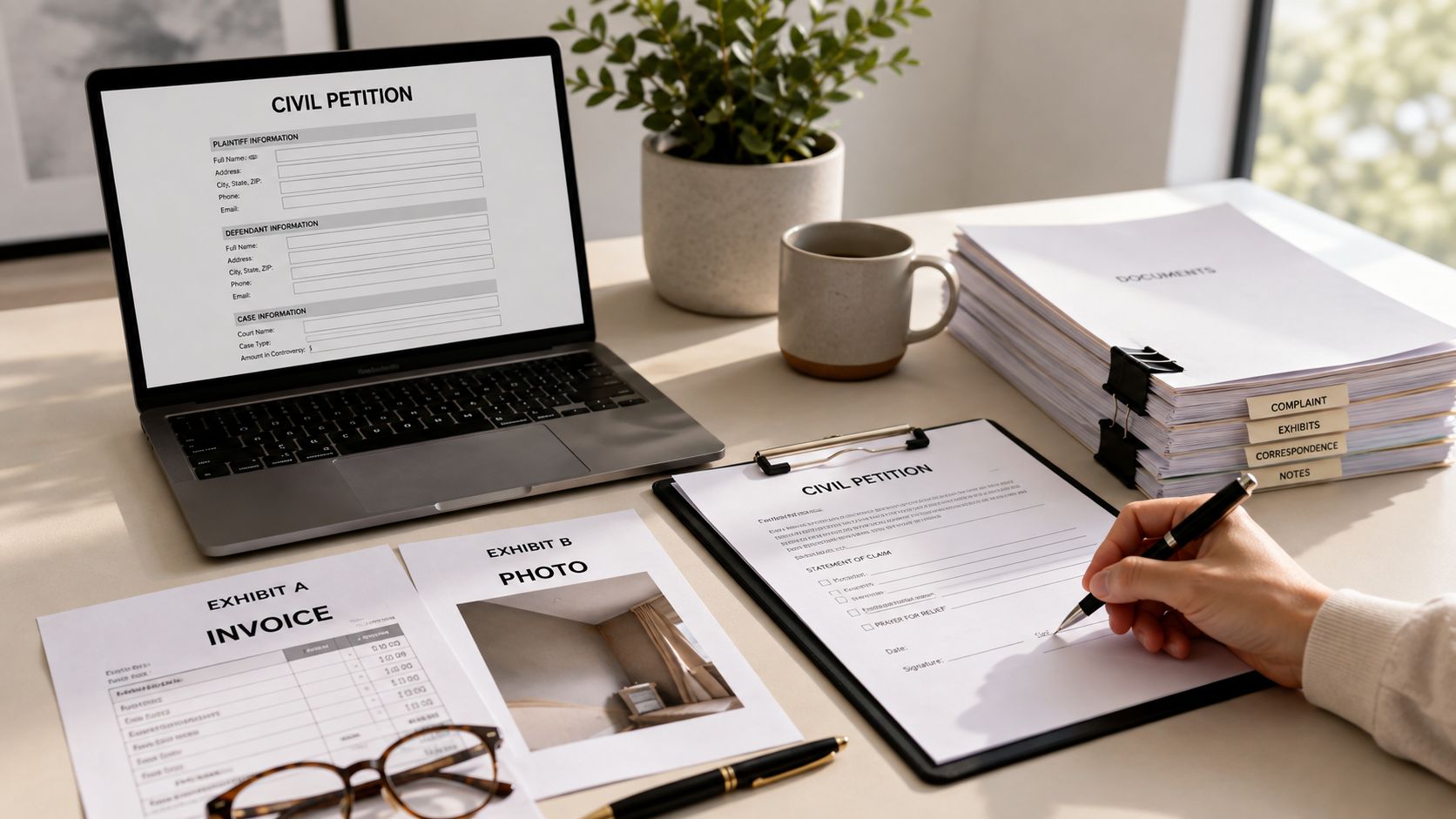
Your petition should identify every defendant correctly, including the full legal name, last known address, and whether the party is an individual, LLC, or corporation. If you misname the party, service gets harder and the case can bog down before the defendant ever answers. State the amount in controversy clearly and keep it within the $20,000 small-claims cap under Texas justice-court rules. Texas Rules of Civil Procedure, Part V
The rest should be short and factual. A claim for unpaid rent, property damage, breach of contract, or a debt on a sworn account doesn't need a dramatic narrative. It needs dates, amounts, and supporting proof that the judge can follow without guessing.
Attach your evidence as exhibits. Invoices, contracts, text messages, photos, and ledgers are often enough to show the dispute clearly. Sign the petition, verify your contact information, and make sure the precinct number matches the defendant's address before you upload anything.
Picking the right service path
If the defendant is in Tarrant County, personal service by constable usually gives you the strongest proof. Certified mail can be cheaper, but it is more fragile if the person refuses delivery or has moved. If the defendant is outside Tarrant County, service becomes more cumbersome because you're dealing with another county's sheriff or a process server in that county, plus the added time and cost that come with it.
If you're comparing filing and service choices, the right answer is the one that gets proof into the court file without creating avoidable delay. That's why a clean petition with the right defendant name and address matters more than people think.
Serving the Defendant the Right Way
Service is where many small-claims cases can fall apart. The claim can be valid, the petition can be well written, and the file can still stall if the defendant isn't served correctly. In Tarrant County JP practice, the proof of service is what lets the court move from filing to a live case.
Three service methods and why they matter
Personal service by a Tarrant County constable is the strongest option when the defendant is local. It usually costs about $80 to $100 per defendant, and the return of service filed by the constable gives the court the most reliable proof that service happened. That matters if the defendant later says they never got the papers.
Certified mail through the clerk is cheaper, but it can fail when the defendant refuses the mailing or no longer lives at the address. When that happens, you're back to fixing service, and the case sits still until you do.
Service outside Tarrant County is the most cumbersome path. You need the sheriff or a private process server in the other county, and you should expect added time and higher fees. If you're suing someone who moved from Fort Worth to another county, many pro se filers underestimate the work.
| Method | Typical Cost | Proof Strength | Best For |
|---|---|---|---|
| Constable personal service in Tarrant County | About $80 to $100 per defendant | High | Local defendants and stronger proof |
| Certified mail through the clerk | Lower than personal service | Moderate to weak if refused or undeliverable | Lower-cost attempts when the address is solid |
| Service outside Tarrant County | Higher and county-dependent | High when completed properly | Defendants now living outside the county |
The answer deadline is usually 14 days after service, so don't lose track of the clock. If the defendant does nothing by then, the court can move the case forward, but only if service was done right in the first place.
For readers who want to understand service mechanics in a broader Texas context, the county's public service materials are more helpful than generic statewide summaries. The same principle also shows up in the firm's constable service resource, which is useful for understanding how local constable service works in practice.
What Happens at the Small Claims Hearing
A Tarrant County JP hearing is usually short, but only if you come prepared. The judge wants the dispute organized, the exhibits in order, and the witnesses ready. A messy presentation wastes the only real chance you get to explain the case.
What the courtroom day looks like
Arrive early, check in with the clerk, and make sure your exhibits are tagged before the case is called. Bring your witnesses on time, because a witness who isn't there is not helping you. Once the judge calls the case, the judge will administer oaths and hear each side.
Keep your opening statement brief. Two minutes is plenty if you know your facts. Walk through the exhibits in chronological order, ask your witnesses direct questions, and stop arguing with the other side. The defendant gets the same chance to respond, and the judge may ask direct questions of both parties.
What judges usually respond to
Organized evidence wins more hearings than thick binders do. JP judges in Tarrant County expect concise presentations, and they usually do better with a few clean documents than with a stack of loose papers. A hearing can wrap up quickly, or the judge can take it under advisement and issue a written judgment later.
Once the judge rules, that judgment becomes the starting point for whatever happens next. If you win, the other side still has to pay or deal with enforcement. If you lose, your attention shifts to post-judgment options and deadlines.
Keep your closing argument short. Repeat the amount, the basis for the claim, and the document that proves it. Don't try to retry the whole dispute in your last minute.
Judgment, Enforcement, and When to Get Legal Help
A JP judgment is not the end of the story if the losing side doesn't pay. It's a court order, and it gives you a toolbox for collection, but each tool has rules, fees, and timing steps of its own. A lot of pro se filers win the case and then lose momentum because they don't plan for enforcement.
What you can do after judgment
If you won, payment may come voluntarily, but you should still stay organized. If it doesn't, a writ of execution can authorize the constable to seize non-exempt property, a writ of garnishment can reach certain bank accounts or wages with statutory limits, and a Turnover Order under Texas Civil Practice and Remedies Code Chapter 31 can help when assets are hard to reach. An abstract of judgment can also cloud real property in Tarrant County, which matters when the debtor owns land or may try to sell it later.
The judgment itself lasts a long time under Texas law and can be renewed, so don't treat it like a short-lived order that disappears after the hearing. If you're budgeting recovery, include the filing and service steps for enforcement, not just the cost of the original case.
The mistakes that cost people the most
The recurring pro se mistake is waiting too long after the hearing. Some people skip post-hearing motions when a default judgment needs to be set aside, and others miss the appeal timeline entirely. In JP cases, the losing party generally has 21 days to appeal to county court, so that deadline is not something to keep in your head casually.
Another common problem is chasing collection against property that is exempt or against funds that are protected. Bankruptcy filings, transferred assets, and larger disputes can change the whole strategy fast. Once the amount in controversy exceeds the small-claims limit, or the enforcement fight turns into a real collection case, that's the point where legal help stops being optional and starts being practical.
For families and business owners in Fort Worth who want a lawyer to review a JP filing, the Law Office of Bryan Fagan PLLC handles Texas legal matters for clients in Tarrant County, and this topic fits naturally with the firm's broader local civil and family-law work. If your dispute touches property division, support issues, or another family-law problem, don't force it into a small-claims box just because the dollar amount looks manageable.
If you're dealing with a small claim, a service problem, or a judgment that needs enforcement in Tarrant County, the Law Office of Bryan Fagan PLLC can help you sort out the next step with a Texas-focused strategy. Visit Law Office of Bryan Fagan PLLC to learn more about local legal support for Fort Worth and Tarrant County matters, and use the firm's site to get oriented before you file or respond.
