 Skip to content

In Tarrant County, divorce papers are typically served by a constable in the precinct where the respondent lives or works, the standard constable service fee is $90 per defendant, and service isn't complete until a Return of Service is filed with the court. If you've just filed for divorce in Fort Worth, that handoff from the district clerk to the correct constable precinct is the step that turns filed paperwork into legally documented notice.
A spouse may sign the Original Petition for Divorce and receive a Citation, then discover that filing alone doesn't notify the other spouse. The papers must reach the respondent through an authorized method, and the court needs a valid record showing what happened. In Tarrant County, the precinct-based constable system makes the respondent's location central to the process.
Table of Contents
- Why the Constable Handles Service in Tarrant County
- How Service Works From Filing to Return of Service
- Choosing the Right Precinct in Tarrant County
- Costs and Paperwork You Should Expect
- Common Mistakes That Delay a Tarrant County Divorce
- What to Do When Service Stalls or the Spouse Is Evasive
- Practical Next Steps for Fort Worth Filers
Why the Constable Handles Service in Tarrant County
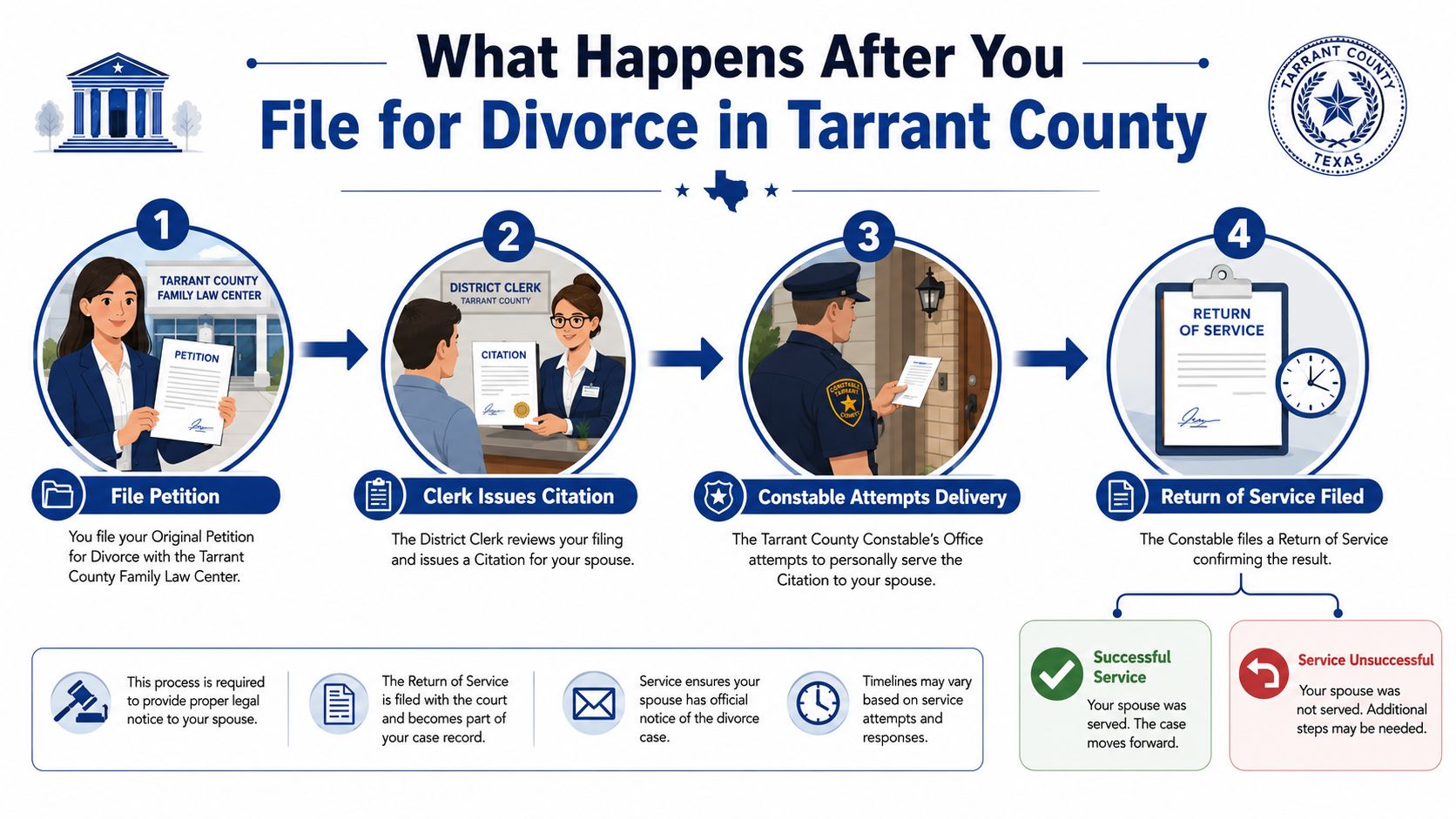
You leave the Tarrant County Family Law Center with a filed petition and an issued Citation, then face a practical question: who will deliver the papers? In Tarrant County, constables handle civil process in the county, including service of court documents. That makes a constable the usual local starting point for serving an initial divorce petition, although Texas procedure may also permit an authorized sheriff, private process server, or, in limited circumstances, the clerk. TexasLawHelp's guide to serving initial divorce papers explains the authorized methods and why proof of delivery matters.
Because service is tied to the respondent's location, precinct selection is covered in detail below.
Why this structure helps
The constable gives the filer a court-recognized service option and a formal paper trail. After delivery, the process server completes a Return of Service stating when and where service occurred. The respondent generally does not need to sign the papers for personal service to be valid.
For someone handling a straightforward divorce without counsel, that option can be more practical than locating and coordinating a private process server. The trade-off is administrative responsibility. You must provide a usable address, choose the appropriate precinct office, submit the required packet, and monitor the request. A constable cannot complete service at an address that is outdated, incomplete, or wrong.
The constable system also separates filing from notice. Filing opens the case, while valid service gives the respondent legally recognized notice and starts the response process. If the respondent avoids known locations or initial attempts fail, further court action may be needed rather than repeated informal delivery efforts.
For information about where family cases are handled, review this guide to Fort Worth courts that handle family law cases.
How Service Works From Filing to Return of Service
The process has several handoffs. A missing document or incorrect address can stop the request before anyone reaches the respondent.
Start with the clerk-issued packet
First, file the Original Petition for Divorce with the appropriate clerk and obtain the Citation. The Citation is not interchangeable with the petition. It's the formal document that tells the respondent a case has been filed and identifies the response obligation. The service packet should include the Citation, the petition, and any attachments that must be delivered.
Second, submit the packet to the constable's civil-process office serving the respondent's location. Before leaving it, confirm that the office has the correct address and knows whether the request concerns personal service or another authorized method. The practical question isn't merely whether the papers were accepted. It's whether the constable has everything needed to make a legally effective attempt.
Wait for an attempt and verify the return
The constable then attempts delivery using a method authorized by Texas procedure. Personal delivery or certified mail generally comes first. If those efforts fail, alternative service isn't automatic. Texas Rule 106 requires documented unsuccessful attempts before a court may authorize substituted methods.
The key document is the Return of Service. It records the method, location, and timing of service, or it may document that service wasn't completed. The filer should check the district clerk's records and obtain a conformed copy rather than assuming the case file is complete because the constable accepted the packet.
Practical rule: Dropping papers at the constable's office starts the service request. It doesn't prove that the respondent received legal notice.
The Texas State Law Library explains that, after personal service or service by certified mail, the answer deadline is 10:00 a.m. on the Monday after 20 days have passed, creating a specific procedural milestone. The Tarrant County divorce filing fee schedule can help filers identify the clerk-side charges before submitting the case.
The initial citation must also generally be served at least 6 days before the trial date, according to Texas civil procedure guidance. That notice requirement is separate from the response deadline, so a filer should track both the service record and all scheduled court dates.
Choosing the Right Precinct in Tarrant County
The respondent's location controls the practical precinct choice. Tarrant County's structure is precinct-based, and its constables serve civil process throughout the county and adjacent counties. A person seeking service should identify where the respondent lives, works, or can be found, then confirm the correct constable office before delivering the papers.
Fort Worth addresses may fall within Precincts 1, 5, 6, 7, or 8, depending on the specific street and location. Precinct 4 covers much of Arlington, while Precincts 2 and 3 serve southern and rural parts of the county, including portions of Mansfield, Crowley, and unincorporated communities. These examples are useful starting points, not substitutes for checking the exact address with the county.
| Precinct | Typical Coverage Area | Example Cities / Neighborhoods |
|---|---|---|
| Precinct 1 | Fort Worth area | Central Fort Worth and nearby locations |
| Precinct 2 | Southern and rural Tarrant County | Parts of Mansfield and surrounding rural areas |
| Precinct 3 | Southern and rural Tarrant County | Parts of Crowley and nearby unincorporated areas |
| Precinct 4 | Arlington area | Much of Arlington |
| Precinct 5 | Fort Worth area | Fort Worth locations determined by street |
| Precinct 6 | Fort Worth area | Fort Worth locations determined by street |
| Precinct 7 | Fort Worth area | Fort Worth locations determined by street |
| Precinct 8 | Fort Worth area | Fort Worth locations determined by street |
A workplace can be just as important as a home address. If the respondent works in Fort Worth but lives in Arlington, the employment location may determine where personal service is attempted. If the respondent recently moved, provide the most reliable address available and ask the precinct office whether it can accept the request.
Tarrant County's Constable Precinct 6 FAQ confirms the countywide and adjacent-county civil-process authority while emphasizing the importance of location. Calling the office before submission can prevent a rejected packet and an avoidable trip.
Costs and Paperwork You Should Expect
Tarrant County publishes a concrete cost benchmark for a new filing. The constable service fee is $90 per defendant, and the district clerk filing fee is $54, with copy charges added separately, according to the Tarrant County District Clerk family law information. The county gives an online example in which a new case against one defendant involving a nine-page document totals $114, consisting of the $54 filing fee, $90 constable service fee, and $3 in copy charges.
| Item | Typical Amount | Paid To |
|---|---|---|
| District clerk filing fee | $54 | Tarrant County District Clerk |
| Constable service fee per defendant | $90 | Appropriate Tarrant County constable office |
| Copy charges | $3 in the county's nine-page example | Clerk or applicable office |
| Example total for one defendant and nine-page document | $114 | Combined filing and service charges |
Those figures show that the main charges are standardized rather than improvised. They don't establish every possible charge for every request, so ask the specific precinct about payment methods and any additional copy requirement before submitting the packet.
Assemble the documents carefully
The constable generally needs the issued Citation, the Original Petition for Divorce, and filed attachments that must be delivered. Keep a complete copy for your records. The service request should identify the respondent and give a usable address, along with any information that helps the deputy locate the person.
Tarrant County lists multiple precinct offices. For example, Precinct 1 is located at 100 W. Weatherford Street in Fort Worth and lists office hours from 7:30 a.m. to 4:30 p.m. Confirm the correct office and current requirements before traveling. Request a receipt showing what you paid and what documents the office accepted.
Common Mistakes That Delay a Tarrant County Divorce
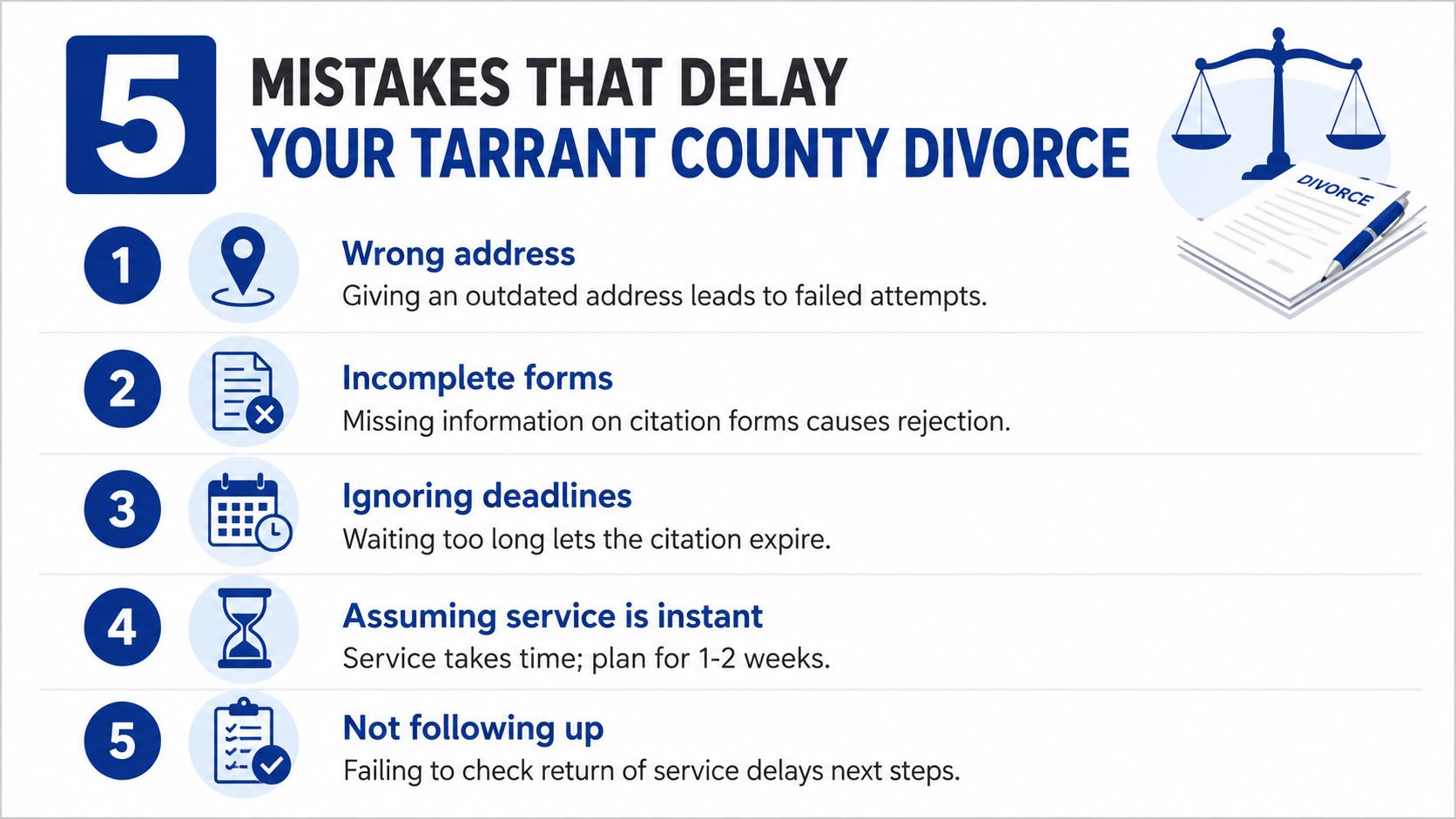
The most damaging assumption is that service occurs when the filer hands the packet to a constable. It doesn't. Service depends on an authorized delivery method and a properly completed Return of Service filed with the court.
A wrong address creates a second problem. The constable may attempt service exactly where instructed, but an old residence, an abandoned workplace, or an incomplete apartment address won't give the deputy a realistic opportunity to find the respondent. If the spouse recently moved, update the service information promptly instead of allowing the request to sit at an address that no longer works.
Problems that deserve immediate attention
- Wrong precinct: A location-based mistake can send the packet to an office that can't handle the request efficiently.
- Incomplete documents: The Citation, petition, and required attachments must be provided in a form the server can deliver.
- No record check: Don't assume the Return of Service was filed. Confirm it in the clerk's records.
- Missed deadlines: Once service occurs, calendar the response deadline described by the Texas State Law Library.
- Automatic substituted service assumption: A missed attempt doesn't authorize electronic delivery, posting, or another substitute by itself.
Texas Rule 106 generally requires personal delivery or certified mail first. If those methods fail, the filer must preserve concrete information about attempts, addresses, dates, and results before asking the court to approve another method. A careful address check and a file containing receipts, attempt notes, and the filed return can prevent a later hearing from becoming a scramble for basic proof.
What to Do When Service Stalls or the Spouse Is Evasive
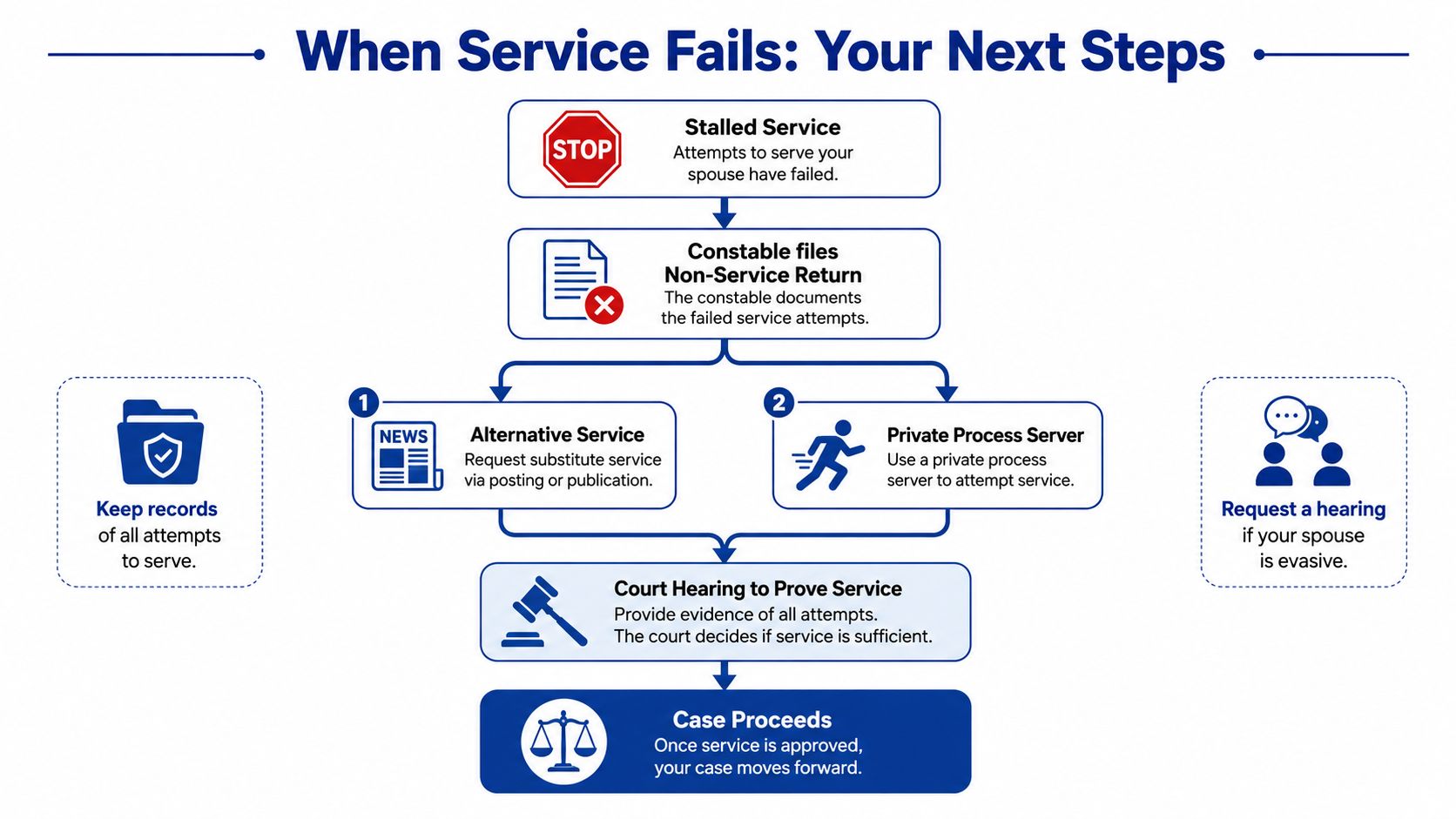
The constable's failed attempt is not the end of the case, but it must become part of the court record. Request the service result or non-service return showing where the deputy went, what happened, and why delivery failed. The Texas State Law Library's service instructions explain why the filed Return of Service matters. A conversation with a clerk or constable does not substitute for that document.
Build the Rule 106 record
Texas Rule 106 generally requires unsuccessful attempts at personal delivery or certified mail before a court will consider substituted service. Preserve the details while they are fresh:
- Addresses tried: List the respondent's home, workplace, and other reliable locations.
- Attempt details: Record each date, time, location, and result reported by the server.
- Location information: Keep the facts supporting the belief that the respondent could be found there.
- Supporting affidavit: Describe the efforts made to locate and serve the respondent.
If those attempts fail, the filer can ask the court for substituted service through a motion supported by the available evidence. The judge, not the constable, decides whether another method is authorized. Depending on the facts and the court's order, that method might involve leaving papers with an appropriate adult at a residence, certified mail, electronic service, posting, or publication. The order controls, so do not use a method the judge did not approve.
Keep every attempt log. A failed attempt may become important evidence when the court evaluates whether another service method is justified.
A private process server may help when a precinct constable has limited availability, a heavy workload, or difficulty making targeted attempts. The trade-off is added cost, and the same Texas service rules still apply. Changing servers will not correct an unreliable address or replace a valid return.
After an approved method is completed and properly returned, the respondent's answer period follows the applicable service rule. Default judgment is not automatic. The respondent may still appear or challenge service. Cases involving children, property, safety concerns, or urgent financial issues call for case-specific legal guidance before choosing the next service strategy.
Practical Next Steps for Fort Worth Filers
Treat service as a document-control task, not a single courthouse errand. Before submitting anything, verify the respondent's home and work addresses, identify the location that gives the constable the best chance of personal delivery, and confirm the corresponding precinct with the county office.
Use this working checklist:
- Confirm the location: Verify the respondent's current home or workplace address from reliable, lawful information.
- Prepare the packet: Gather the filed Original Petition, issued Citation, attachments, and the copies the constable requires.
- Submit to the precinct: Take the packet and the $90 per-defendant constable fee to the correct office, then request a dated receipt.
- Track service: Save the receipt, attempt information, and Return of Service together.
- Calendar the response milestone: After valid personal service or certified mail, use the Texas State Law Library's rule for the answer deadline, which is 10:00 a.m. on the Monday after 20 days have passed.
- Escalate with records: If service fails, don't ask for substituted service without the documented attempts needed under Texas Rule 106.
For courthouse logistics, review the information about the Tarrant County Family Law Center at 200 East Weatherford before you go. Office locations, hours, accepted payment methods, and document requirements should be confirmed directly because administrative details can change.
If the respondent is avoiding service, the address is uncertain, or a default judgment may be considered, speak with a qualified Tarrant County family law attorney before taking the next procedural step.
The Law Office of Bryan Fagan PLLC can help you evaluate the service packet, precinct selection, documented attempts, and available options when service stalls in a Tarrant County divorce. Visit Law Office of Bryan Fagan PLLC to learn about the firm's family law resources and request a consultation about your situation.
