 Skip to content

Certified divorce decrees in Tarrant County come from the District Clerk's Family Law division, not the County Clerk, and certified paper copies cost $1 per page plus a $5 certification fee. In-person requests can often be fulfilled the same day if the file is pulled in time.
You may need that certified decree for a refinance, a legal name change, an immigration filing, retirement-account division, or to prove the exact terms of your divorce order. The process is straightforward when you send the request to the right office, provide enough information to locate the case, and select the correct delivery method.
The most common mistake is starting with the wrong records office. A divorce decree is a district-court record, not a birth or marriage certificate. In Tarrant County, the correct starting point is the District Clerk's Family Law division.
Table of Contents
- Where to Request a Certified Copy in Tarrant County
- Information and Documents You Need to Provide
- Request Methods and How Each One Works
- Fees and Total Cost Based on Page Count
- Common Request Problems and How to Fix Them
- Practical Next Steps for Fort Worth Residents
Where to Request a Certified Copy in Tarrant County
The Tarrant County District Clerk maintains divorce decrees for cases decided in Tarrant County. The County Clerk and Texas Vital Records office aren't the correct destinations for a certified copy of a district-court divorce decree. Official guidance confirms that divorce decrees must be obtained from the district clerk in the county where the divorce was granted. The federal court's explanation of where certified divorce decrees are issued reinforces that jurisdictional rule.
For a Fort Worth or surrounding Tarrant County family case, begin with the District Clerk's Family Law division at the Family Law Center in Fort Worth. The county's family law page identifies that division as the office handling divorce decree copies and lists 817-884-1265 for divorce decree requests. The county also lists 817-884-1880 as the District Clerk's main contact number. Check the county's current instructions before traveling because office locations, public-window hours, and submission procedures can change.
The office that certifies the decree
The District Clerk certifies the court document itself. That means the certified copy contains the divorce court's order, including enforceable provisions involving property division, child custody, child support, and other terms included in the decree. Vital Records may handle certificates in other contexts, but it won't certify the district-court order you need for a legal or financial transaction.
If you're trying to confirm where the Family Law Center is located or which floor handles family-law services, use this Fort Worth Family Law Center location guide before you go. Bring a government-issued photo ID and the identifying information for the case.
Older paper files need extra planning
Older divorce cases may not be immediately available through the same digital lookup process used for newer files. If the case predates the county's digital imaging conversion, call the District Clerk's Family Law division before submitting a request. Staff may need to locate a physical file or direct you to the appropriate records process.
The key rule is simple: request the decree from the court that granted the divorce. If the case was filed outside Tarrant County, even if you now live in Fort Worth, contact the district clerk in the county where the divorce was obtained.
Information and Documents You Need to Provide
The clerk can only certify the correct document after locating the correct case file. Your request should give staff enough detail to distinguish that file from other divorce cases involving similar names.
Include these details in a written request or request form:
- Case number: Provide it if you know it. This is the fastest way to identify the file.
- Full legal names: List both spouses exactly as they appeared in the divorce case, including middle names, suffixes, maiden names, or hyphenated names when available.
- Divorce date: State the date the court granted the divorce if you know it.
- Issuing court: Identify the Tarrant County district court that entered the decree, when known.
- Your contact information: Include a mailing address, telephone number, and email address so the clerk can communicate about the request.
- Copy instructions: State that you need a certified copy of the final divorce decree, and specify whether you prefer paper or electronic delivery.
For an in-person request, take a government-issued photo ID. A mail request should include a legible photocopy of valid identification, along with the signed written request and required payment.
A practical mail-request example
Suppose you live in North Richland Hills and need the decree for a mortgage refinance. You don't need to make the trip to downtown Fort Worth if your request isn't urgent. Prepare a signed letter with both spouses' names, the case number, the approximate divorce date, and the district court. Add a photocopy of your photo ID, payment in the form allowed for mail requests, and a self-addressed stamped envelope for the clerk's response.
The county recommends providing party names and as much identifying detail as possible. A missing case number doesn't automatically prevent a request, but it makes the clerk's search more dependent on names and other details.
Practical rule: Use the names printed on the original divorce paperwork, not only a current married name or an informal version of a name.
A requester generally doesn't have to be one of the former spouses to seek a certified copy of a divorce decree once the record is available as a public court record. That doesn't eliminate restrictions that may apply to sealed or otherwise limited records. If the clerk can't release the document through the ordinary process, ask what additional authorization is required rather than sending repeated incomplete requests.
Request Methods and How Each One Works
If a refinance closing or filing deadline is close, choose the method based on the document format you need and the time available. Tarrant County accepts requests for certified divorce decrees in person, by mail, or by email through the District Clerk's Family Law division, not the County Clerk or Vital Records office.
In-person requests
The Family Law window at the District Clerk's office is the best choice for an urgent paper copy. Bring your photo ID, case information, and payment. Staff may complete the request the same day if they can pull the file before the commonly cited 4:00 p.m. cutoff, but file availability and office workload can prevent same-day service.
The office accepts cash, check, money order, and credit card for in-person requests. Call the Family Law division before driving from Arlington, Keller, Southlake, or another surrounding community if you need the decree that day.
Mail requests
Mail works for a nonurgent paper request when you do not want to travel to central Fort Worth. Send a signed written request, identifying information, a photocopy of valid ID, the required payment, and a self-addressed stamped envelope to the District Clerk's office.
The usual turnaround is seven to ten business days after the office receives the request, followed by return-mail time. Older files, mismatched names, missing payment, or limited case details can extend that period. Use the names shown on the divorce paperwork and include the case number when available.
Email requests
Email suits remote requesters who need an electronic certified copy. The District Clerk accepts a scanned PDF request through its public-records email process. Requests are handled in the order received, and processing commonly takes several business days. Credit-card payment for this method runs through the county's online payment portal.
Keep the submitted PDF, payment confirmation, and all email correspondence. A certified-copy request is a records transaction, not a motion or pleading filed in an active case. If your broader family-law matter involves electronic filing, review the Tarrant County District Clerk e-filing requirements for family cases before submitting scanned documents so the file meets the stated format requirements.

| Method | Typical Turnaround | Accepted Payment | Best For |
|---|---|---|---|
| In person | Often same day if pulled before the 4:00 p.m. cutoff | Cash, check, money order, or credit card | Urgent transactions |
| Seven to ten business days after receipt, plus return mailing | Check or money order | Nonurgent requests | |
| Several business days | Credit card through the online portal | Remote and electronic requests |
Choose in person for an urgent paper decree. Use mail when time allows and email when an electronic certified copy meets the receiving agency's requirements. Confirm that format before ordering, because some institutions require paper certification.
Fees and Total Cost Based on Page Count
Tarrant County uses a page-based fee structure, not one flat price for every certified decree. The official Family Law fee schedule states that certified paper copies cost $1 per page plus a $5 certification and seal fee. Certified electronic copies cost $1 for the first 1 to 10 pages, then 10 cents per additional page, plus the same $5 certification and seal fee. See the county's District Clerk Family Law fee schedule for the current instructions.
For paper copies, the math is direct. A 10-page certified paper decree costs $15, before mailing or service costs. The price rises as the decree gets longer because each additional page adds to the copy charge.
| Decree Length | Copy Fee | Certification Fee | Estimated Total |
|---|---|---|---|
| 10 pages | $10 | $5 | $15 paper |
| 12 pages | $12 | $5 | $17 paper, $7.20 electronic |
| More than 10 pages | $1 per page | $5 | Varies by page count |
The county's fee structure also gives a useful comparison for electronic delivery. A 12-page certified electronic decree costs $7.20, calculated as $1 for the first 10 pages, 20 cents for the two additional pages, and $5 for certification. That can make electronic delivery materially cheaper for longer orders, although the organization requesting the decree may insist on paper.
Don't assume postage or payment-processing costs are included in the copy fee. Mail requests need a self-addressed stamped envelope, and an online credit-card payment may involve a processing surcharge. Confirm the current payment instructions before submitting money.
Before paying, check the original case record or ask the clerk whether the requested decree is available and how many pages it contains. That page count is the best way to estimate the charge. For filing-related costs in a family case, consult the current Tarrant County District Clerk divorce filing fee schedule rather than treating certified-copy charges as filing fees.
Common Request Problems and How to Fix Them
Most failed requests aren't complicated legal disputes. They're identification and packaging problems. The clerk has to pull the correct court file, apply the correct certification, collect the required payment, and send the copy to the right address.
Name mismatches
A former spouse may have remarried, dropped a hyphen, changed a middle name, or be known by a name that doesn't appear in the original petition. Providing only a current name can cause a delay or lead staff to search the wrong file.
List every version you know, especially the names used in the original divorce case. Include the case number whenever possible. If you don't know it, provide both spouses' full names, the approximate filing or divorce date, and the court that issued the decree.
Sealed or restricted records
A sealed decree can't always be released through the ordinary public-records request process. Access may require the petitioner, respondent, or an attorney of record to obtain a court order authorizing release. The exact requirements depend on the order restricting access and the clerk's instructions.
Don't try to solve a sealed-record problem by submitting multiple ordinary requests. Call the Family Law division and ask what authorization the court requires. If a court order is necessary, a Tarrant County family law attorney can help determine the proper procedure.
Missing case numbers and older files
If you don't have the case number, start with Tarrant County's online case-records search and search using the parties' names. Treat the search as a starting point, not a substitute for confirming the correct decree with the clerk.
Older paper-only files, including cases from the 1970s and 1980s, may require a manual pull. Call before sending payment if the case is old or the online record is incomplete. Staff may need more time or additional information to locate the physical file.
Mail packets that come back
A mail request can be returned or delayed when the application is unsigned, payment is missing, the ID copy is unreadable, or the return envelope is omitted. Recheck each item before mailing:
- Signature: Sign the written request or required form.
- Payment: Use the payment type accepted for mail requests.
- Identification: Include a clear photocopy of valid photo ID.
- Return envelope: Add a self-addressed stamped envelope.
- Case details: Provide names, case number, court, and divorce date when available.
Practical Next Steps for Fort Worth Residents
A certified decree is often needed because someone else, such as a lender, government agency, retirement-plan administrator, or licensing office, needs proof of what the divorce court ordered. The document may be used to support a name change, refinance a home, divide retirement benefits through a QDRO, or confirm custody and support terms.
Start by identifying the exact purpose. If a lender needs a certified paper copy, ordering an electronic version may create another trip. If an agency accepts electronic certification, that option may be more convenient and less expensive under the county's page-based schedule.
Use this decision sequence
- Confirm the document you need. Make sure the request is for the final divorce decree, not a marriage certificate, birth certificate, docket sheet, or another filing.
- Confirm the issuing county. Tarrant County can provide a decree only when the divorce was granted in a Tarrant County court. A divorce granted elsewhere requires a request to that county's district clerk.
- Collect the identifiers. Gather both spouses' legal names, the case number, divorce date, and issuing court.
- Choose the delivery method. Use in person for urgent needs, mail for a nonurgent paper request, or email when electronic submission and delivery fit the receiving organization.
- Inspect the finished copy. Confirm that the document is the decree you requested and that the certification, clerk signature, and raised seal or other certification markings are present.
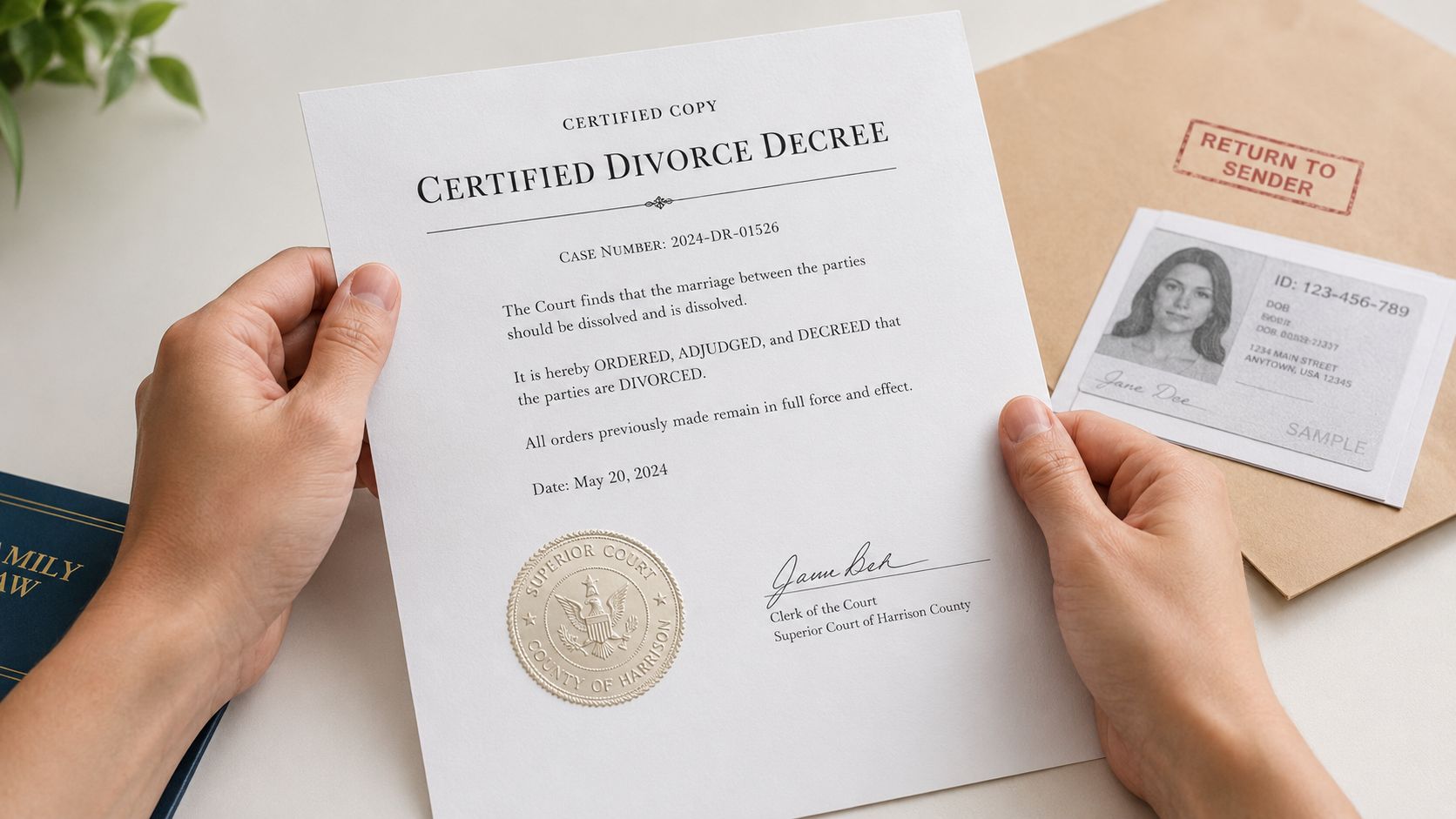
Call the District Clerk's Family Law division before filing a written request when the case is old, the online record doesn't identify the file, or the decree may be sealed. A short call can clarify whether the clerk needs a manual search, additional names, or a court order.
Obtaining a copy is different from interpreting or enforcing the order. Speak with a qualified Tarrant County family law attorney if the decree appears to contain an error, the property division doesn't match what you agreed to, a sealed record requires court authorization, or your former spouse isn't following custody, support, or property-related provisions. The certified copy gives you the controlling document, but legal guidance may be needed to decide what action follows.
The Law Office of Bryan Fagan PLLC helps Fort Worth and Tarrant County families obtain, review, and address divorce orders when a records request raises a larger family-law issue. Visit Law Office of Bryan Fagan PLLC to learn about the firm's family-law services and schedule a consultation about your situation.
