 Skip to content

You're out of the Tarrant County Jail, but you can't go home. Your children may be waiting for you, your belongings may still be inside the residence, and a family court order may say you're entitled to possession time. Then you read the bond paperwork and see that you're prohibited from contacting the alleged victim or going near a location you previously had every legal right to visit.
That confusion is common after a family-violence arrest in Fort Worth. The bond order controls your immediate conduct, even when it conflicts with a custody, possession, or access order. This guide explains what Tarrant County bond conditions in a family violence case can require, how magistration works, why child-related orders can be temporarily overridden, which mistakes put release at risk, and how an attorney may seek a modification.
Table of Contents
- What Happens Right After a Family Violence Arrest in Fort Worth
- How Texas Defines Family Violence and Bond in Plain English
- Common Bond Conditions a Tarrant County Magistrate May Impose
- Inside a Tarrant County Bond Hearing and Magistration
- How Bond Conditions Interact With Protective Orders and Custody
- Common Mistakes That Put Release at Risk in Tarrant County
- Practical Next Steps for Compliance and Modifications
What Happens Right After a Family Violence Arrest in Fort Worth
Consider a common situation. A parent is arrested after a family-violence allegation and eventually released from the Tarrant County Jail near downtown Fort Worth. At release, the person receives several pages of bond paperwork and learns that going back to the family residence could violate the release terms. The parent also discovers that calling the other parent about the children may be prohibited, even though a custody order provides a regular possession schedule.
The immediate process generally involves booking, an appearance before a magistrate, a decision on bond, and written conditions attached to release. The magistrate may impose restrictions designed to protect the alleged victim or the community. Those restrictions can include no direct communication, exclusion from specific locations, and electronic or GPS monitoring under Texas law. The order may also address firearms, child exchanges, or other conduct.
The first few hours are where many mistakes begin. A person may send a text saying, “I'm sorry,” ask a relative to arrange a child pickup, drive past the home to collect medication, or attend a child's school event because the custody order says possession is allowed. A criminal bond order is not a suggestion, and a family court order doesn't automatically excuse conduct prohibited by that bond order.
Practical rule: Until a lawyer reviews every page of the release paperwork, assume the strictest reasonable reading applies. Don't contact the alleged victim, don't visit listed locations, and don't ask someone else to communicate for you.
Fort Worth residents often need help with both sides of the problem. The criminal case determines the release conditions, while the family-law case may involve custody, possession, divorce, property, or a protective order. You can learn more about the broader Tarrant County misdemeanor court process, but case-specific bond questions require prompt legal review.
This article addresses the legal meaning of family violence and bond, the conditions a magistrate may impose, what happens at magistration, and how the order affects existing custody arrangements. It also explains what to do if the conditions are too restrictive, unclear, or impossible to follow without disrupting child-related responsibilities.
How Texas Defines Family Violence and Bond in Plain English
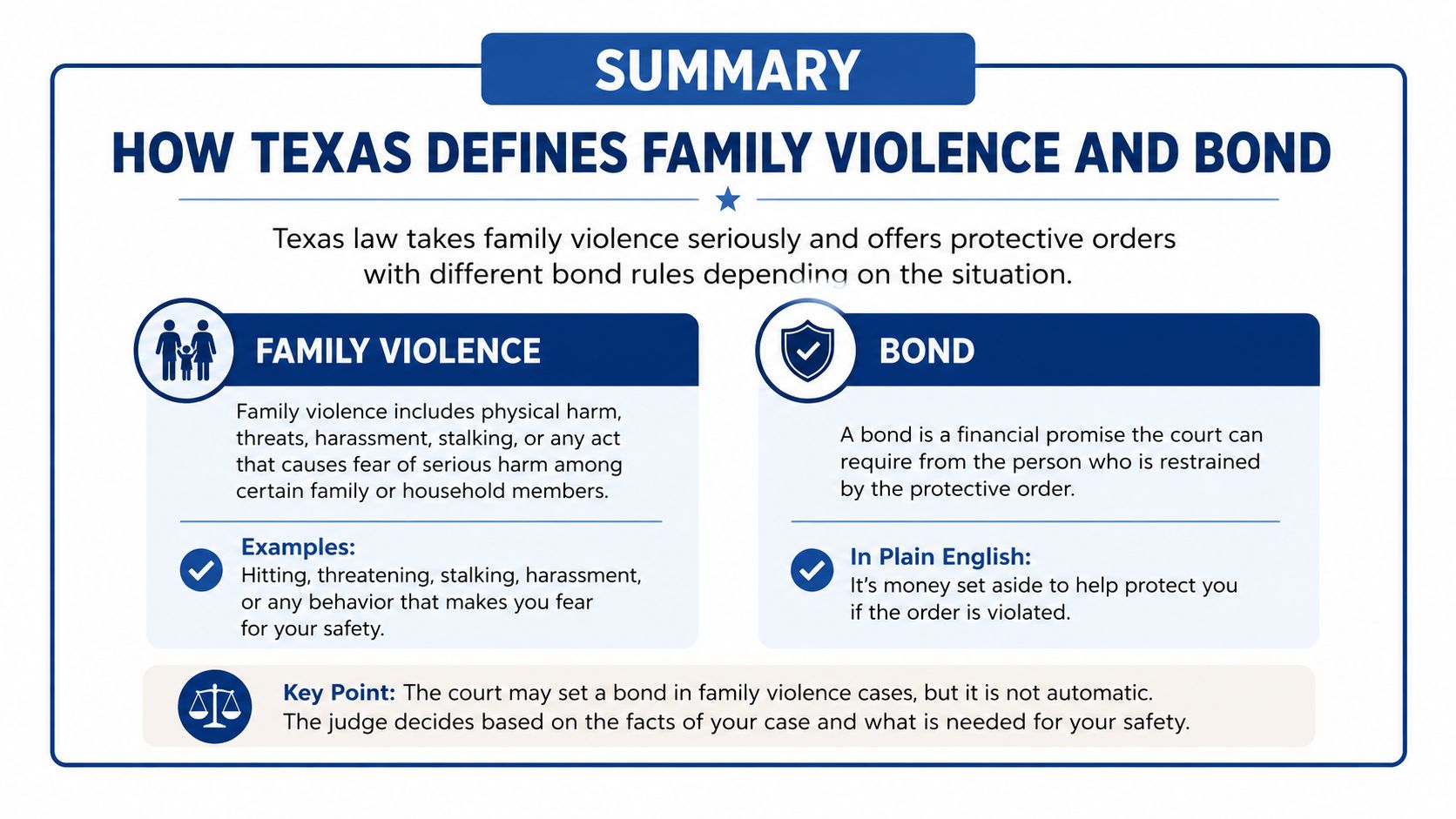
In everyday language, a family-violence case involves an allegation of harmful or threatening conduct connected to a family, household, or dating relationship. The relationship can matter even when the people no longer live together. A spouse, former spouse, dating partner, household member, or co-parent may be connected to the allegation, and the alleged conduct may involve physical harm, threatened harm, or conduct the law treats as family violence.
Bond is not a fine. It's a financial or legal promise connected to appearing in court and following release rules while the criminal case is pending. A person can satisfy the financial part of bond and still remain subject to conditions that control where they go, whom they contact, and what monitoring or safety requirements they must follow.
Texas law gives a magistrate authority to impose reasonable bond conditions tied to the safety of the alleged victim or community. The Texas Code of Criminal Procedure provisions on bond conditions are the key authority behind that power. In practical terms, the magistrate isn't limited to setting a dollar amount. The magistrate can attach behavioral rules that affect the defendant's home, employment, communications, firearms, and contact with children.
Why the relationship matters
The family or dating relationship gives the allegation a context that can lead to protective release terms. A magistrate may focus on preventing further contact, separating the parties, and reducing opportunities for intimidation or escalation while the case proceeds. That can happen before a family court has reviewed a custody dispute or before a defense attorney has had a meaningful opportunity to request narrower terms.
A person reading a bond order should identify four things immediately:
- Protected people: Determine whether the order names only the alleged victim or also addresses children, household members, or other people.
- Restricted conduct: Look for direct contact, indirect contact, threats, harassment, messages through another person, and communication through children.
- Restricted places: Identify every residence, workplace, school, childcare location, or other listed area.
- Monitoring and property rules: Check for GPS or electronic monitoring, firearm surrender, reporting, testing, or other conditions.
The wording controls. A custody order may grant access to a child, but that doesn't authorize conduct prohibited by a criminal bond condition. If the documents conflict, don't decide for yourself which one is more convenient. Obtain legal advice before acting.
Common Bond Conditions a Tarrant County Magistrate May Impose
A Tarrant County magistrate can attach conditions that reach far beyond a routine promise to appear. The exact language matters, and two orders that both use the phrase “no contact” may define permitted conduct differently. Read the actual paperwork, not a summary from a family member or a jail conversation.
No contact can include more than a phone call
A no-contact condition may prohibit calls, texts, emails, social-media messages, and in-person conversations. It may also prohibit indirect communication through a friend, relative, attorney, or child. If the parties share children, the safest approach is to treat the alleged victim as unavailable for communication unless the order expressly creates an approved method or a court later modifies it.
A child shouldn't become the messenger. Telling a child to deliver a message, ask the other parent a question, or coordinate an exchange can create a serious compliance problem even if the subject seems harmless.
Stay-away terms can change your daily route
A location condition may bar the defendant from going to or near specifically described places frequented by the alleged victim. That may include a residence, workplace, school, childcare facility, or another listed location. The alleged victim must have an opportunity to provide a list of areas from which they want the defendant excluded, and the magistrate must consider that request when identifying restricted locations under Article 17.49 of the Texas Code of Criminal Procedure.
Don't assume a quick visit to collect clothing, retrieve a vehicle, or pick up personal documents is automatically allowed. Ask counsel about a lawful retrieval plan before going to a restricted address.
Monitoring and firearms require prompt attention
Texas law permits GPS or electronic monitoring as a release condition in an eligible family-violence case. A person ordered to wear a monitor must follow installation, charging, reporting, and equipment instructions. Tampering, missed check-ins, or leaving an approved area can create a new compliance problem.
Firearm restrictions and surrender requirements also demand immediate attention. If the bond order requires surrender, don't transfer or store firearms casually with a friend or relative. Ask an attorney about a lawful surrender or transfer process and keep written proof of compliance.
| Condition | What It Actually Requires |
|---|---|
| No contact | No direct or indirect calls, messages, visits, or communications through children or third parties unless the order expressly permits them. |
| Stay-away location | Avoid each residence, school, workplace, or other specifically listed location, even if you previously had lawful access. |
| GPS or electronic monitoring | Wear and maintain the required device, follow charging and reporting instructions, and avoid unauthorized areas. |
| Firearm restriction | Don't possess firearms when the order prohibits possession, and complete any required surrender through a lawful process. |
| Child-related restriction | Follow the bond order even when it interrupts a possession schedule, school pickup, exchange plan, or family event. |
| Alcohol, drug, or reporting condition | Follow the exact testing, reporting, curfew, or substance restrictions written into the order. |
A bond condition may also bar the defendant from the family residence. That can affect rent, medication, work equipment, pets, clothing, and personal records. Solve those logistical problems through counsel or an approved third party, not by entering the property without permission.
Recent Texas court materials describing 2025-2026 bail-reform changes place family-violence bond violations within a broader framework that includes electronic monitoring and firearm restrictions as available tools. The Texas courts' reform overview does not provide a reliable basis for predicting which condition a particular Tarrant County magistrate will impose. It does reinforce the practical point: treat each written condition as an enforceable requirement.
Inside a Tarrant County Bond Hearing and Magistration
A Tarrant County magistration follows a predictable sequence: booking, appearance before a magistrate, bond determination, and conditional release. The Tarrant County magistrate hearing guide explains the process in practical terms.
After arrest, the defendant is booked and held while the case moves toward an appearance before a magistrate. The magistrate reviews the accusation and available information, considers safety concerns, and decides whether to set bond and impose conditions.
The first appearance is fast and document-driven. The magistrate may set the bond amount and announce restrictions involving contact, locations, monitoring, firearms, or other conduct. The defendant must receive notice of those terms and the consequences of violating them.
A criminal bond order can also disrupt an existing family court arrangement. If a condition conflicts with a possession schedule, child exchange plan, or access to the family home, the defendant must follow the criminal release order until a court changes it. Do not rely on a custody order as permission to ignore a bond restriction.
The defendant generally does not receive a full evidentiary hearing at magistration. That appearance is different from a later contested request to reduce bond or modify conditions. A person can leave jail with restrictions affecting custody, housing, and communication before counsel has an opportunity to present a narrower release plan.
Who makes the decision
The magistrate sets the initial release terms. The criminal court handling the case may later consider a motion to modify bond conditions. The prosecutor's office can present or respond to information about the alleged offense, alleged victim, and safety concerns, but the court issues the enforceable order.
Conditions may appear in several documents. Compare the bond paperwork with any emergency protective order, release instructions, monitoring paperwork, and later court filings. A verbal explanation at the jail does not replace the written order.
A magistrate must provide written notice of the bond conditions and the penalties for violating them. The sheriff must also be notified when a violent-offense bond condition is imposed or modified, as summarized in Texas magistrate-duty materials. A violation can lead to bond-revocation proceedings and re-arrest.
Before release, obtain every document available. After release, photograph or scan each page, mark unclear language, and contact counsel before attempting contact, returning home, or using a custody exchange arrangement. Your first priority is strict compliance with the written order.
How Bond Conditions Interact With Protective Orders and Custody
Under Texas law, a criminal bond condition can temporarily override a family court possession or access order for up to 90 days. That rule matters when a parent's existing schedule conflicts with a release restriction. The bond order controls the conflicting conduct, even if the custody order remains in effect.
The practical impact reaches beyond regular visitation. A parent may be unable to attend a school event, complete a usual exchange, enter the shared home, or communicate about a child's needs. The family court order does not give permission to violate a criminal bond condition.
A protective order adds a separate layer. It may come from a family-law proceeding and may regulate contact, locations, the children, or access to a residence. The bond order and protective order can operate at the same time. Read each document separately, then follow the stricter requirement unless the issuing court changes it. Do not assume that complying with one order satisfies the other.
| Scenario | Bond Conditions | Protective Order | Custody Order |
|---|---|---|---|
| Child exchange | May prohibit contact or attendance at the exchange location. | May impose separate safety or exchange restrictions. | May establish the regular possession schedule. |
| School event | May bar entry near a listed school or contact with the other parent. | May restrict proximity or communication. | May provide parenting rights but cannot excuse a criminal restriction. |
| Shared residence | May prohibit entry or proximity. | May grant or restrict temporary access under its own terms. | Usually does not authorize conduct that violates bond. |
| Divorce hearing | Attendance depends on the release language and courtroom arrangements. | May regulate contact at or near the proceeding. | Custody provisions do not override criminal release terms. |
A child-related need does not create an automatic exception. If you need to retrieve belongings, attend an event, or discuss medical or school logistics, do not rely on informal permission from the alleged victim. Consent does not rewrite a court order.
Ask counsel about a formal modification, a court-approved exception, or a carefully structured third-party arrangement. The same review matters if the custody schedule itself must change. See this guide to Tarrant County custody modifications for related family-court procedures. Keep the bond order, protective order, and custody order together, and compare their exact language before making plans.
Common Mistakes That Put Release at Risk in Tarrant County
The most dangerous assumption is that a bond condition only matters when the alleged victim complains. That's wrong. The defendant is responsible for compliance, even if the other person invites contact, agrees to a meeting, or believes the restriction is unnecessary.
Common mistakes include:
- Sending one text: “Can we talk?” or “How are the kids?” may violate a complete no-contact condition.
- Driving past a listed address: Taking a familiar route or stopping briefly near the residence can create a location issue.
- Using a third party: Asking a parent, friend, or child to pass along a message can be treated as indirect contact.
- Attending a school event: A custody right or good intention doesn't automatically permit attendance near a listed school.
- Ignoring firearm instructions: Delaying surrender, keeping one in a vehicle, or failing to document the transfer can create additional risk.
- Treating monitoring casually: Missing a charging requirement, check-in, or equipment instruction can be reported as noncompliance.
A violation can lead to a request to revoke bond, a warrant, arrest, and a return to custody. The court may impose more restrictive terms, and the violation can complicate both the criminal case and the parallel custody dispute.
A bond order is a compliance checklist. If a term is unclear, clarification must come from the court process, not from the person protected by the order.
Don't try to explain a possible violation directly to the alleged victim, a witness, or an officer without legal advice. Preserve texts, call logs, location information, monitoring records, and receipts. Contact an attorney promptly if you receive notice of a violation, miss a check-in, or learn that someone has reported contact.
Practical Next Steps for Compliance and Modifications
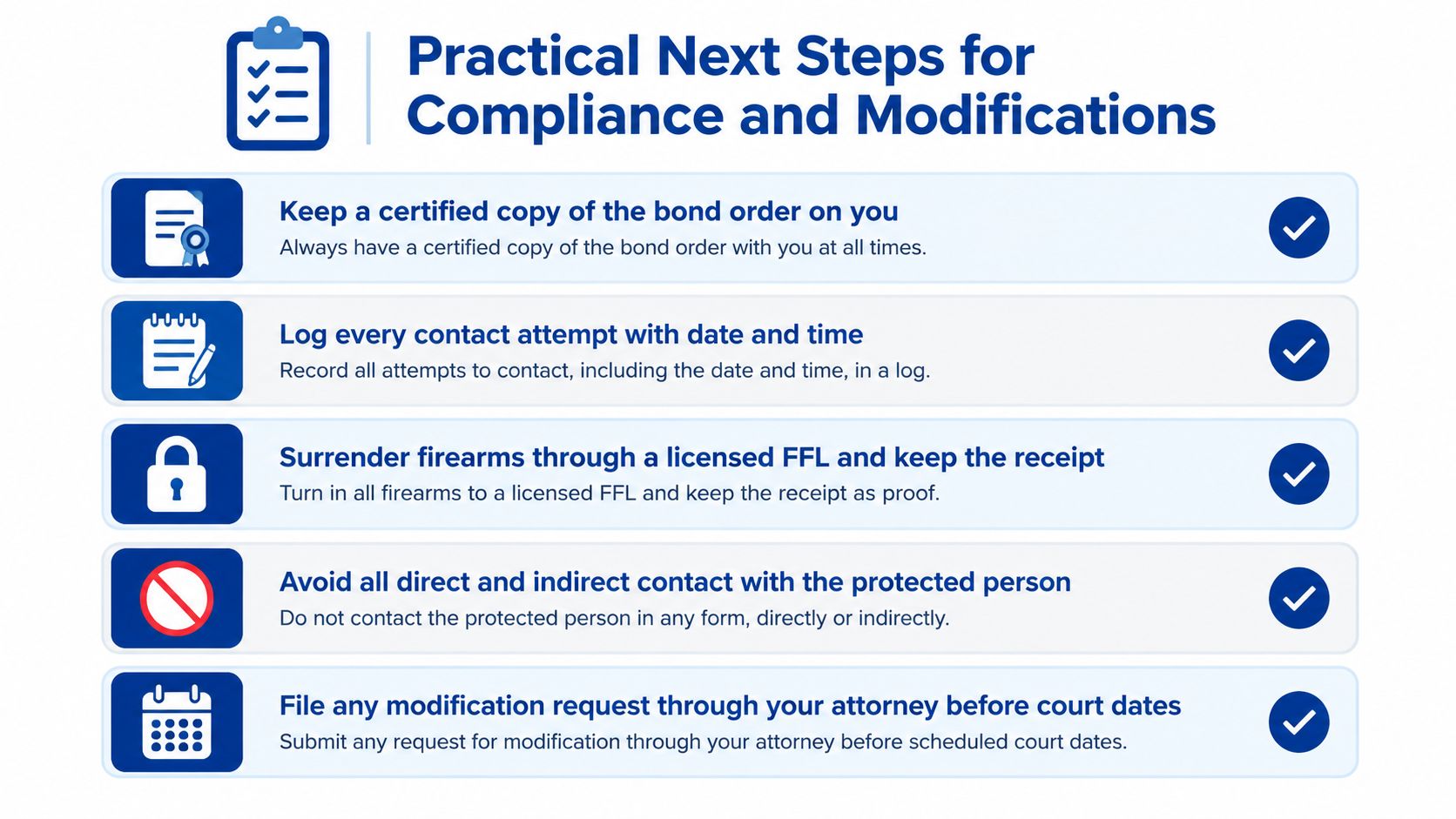
Start with the paperwork. Keep a certified or otherwise official copy of the bond order available, and save a digital copy where you can access it without contacting the alleged victim. Mark every prohibited person, address, workplace, school, communication channel, monitoring requirement, and firearm instruction.
Then create a written compliance plan:
- Record every attempted contact. Save call logs, messages, emails, and third-party communications. Don't respond just because the alleged victim initiated contact.
- Map restricted locations. Identify the residence, workplace, school, children's school, and other listed areas. Ask counsel how to avoid them safely and how to handle unavoidable legal or parenting events.
- Complete monitoring requirements. Install and maintain GPS or electronic monitoring as ordered. Follow charging, check-in, and equipment rules exactly.
- Handle firearms lawfully. If surrender is required, use a lawful process advised by counsel and keep the receipt or other documentation.
- Protect the custody case. Don't exercise possession, attend exchanges, or enter the home when doing so could conflict with release terms. Ask for a coordinated solution instead.
A modification request belongs in the criminal case when the problem is a bond condition. The request should identify the specific term, explain the practical conflict, and propose a safer alternative. For example, a parent may seek a structured child-related communication method, a neutral exchange arrangement, or a narrowly defined location exception. The court's decision depends on the order, allegations, safety concerns, and facts presented. No attorney can promise that a requested change will be granted.
A family-law protective-order proceeding may provide another avenue for addressing related safety and custody issues. These proceedings don't automatically change the criminal bond order. The criminal and family courts must be handled as connected but separate matters.
Call counsel the same day if there are new allegations, missed monitoring check-ins, positive drug or alcohol tests, attempted contact through a third party, or an accidental encounter near a restricted location. Bring the bond papers, custody orders, protective orders, monitoring instructions, and any relevant messages to the consultation.
A Fort Worth family law attorney can coordinate the criminal bond file with the SAPCR, divorce, or protective-order case so that a proposed parenting arrangement doesn't accidentally violate release terms. If you're dealing with Tarrant County bond conditions in a family violence case, schedule a consultation before making contact, returning to the home, or attempting to resume a possession schedule.
The Law Office of Bryan Fagan PLLC can help you understand how a Tarrant County bond order affects custody, possession, protective orders, and related family-law proceedings. Visit the firm to learn about the Start Here process and schedule a consultation focused on your immediate compliance and modification needs.
