 Skip to content

A Mansfield resident's divorce is not handled by a Mansfield court, and the specific Tarrant County family district court that hears the case is assigned after filing based on the cause number, not chosen up front. For a Tarrant County filing, the family courts are located at the Family Law Center in Fort Worth, where the assigned court is identified by the first three digits of the cause number.
You may be sitting at your kitchen table in Mansfield with a petition, a list of questions, and no clear idea whether you should drive to a Mansfield courthouse, a justice-of-the-peace location, or downtown Fort Worth. The answer depends on more than your mailing address. Mansfield spans Tarrant, Johnson, and Ellis counties, and the correct filing county depends on residency and venue requirements before the court assignment issue even begins.
Once a proper Tarrant County case is filed, the courthouse, filing office, cause number, assigned district court, and hearing notice each serve a different purpose. Understanding those differences can help you avoid paying the wrong filing fee, appearing at the wrong courtroom, or assuming that an associate court is handling the underlying divorce.
Table of Contents
- Where Mansfield Divorce Cases Are Actually Heard
- Texas Residency and Venue Rules for Mansfield Filers
- The Tarrant County Family District Courts Explained
- Where to File and How to Find Your Courtroom in Fort Worth
- Filing Fees and the With-Children Versus Without-Children Path
- Uncontested Divorce Timelines and the Local Order Process
- Common Mistakes Mansfield Residents Make at Filing
- Practical Next Steps and When to Talk With an Attorney
Where Mansfield Divorce Cases Are Actually Heard
Suppose a Mansfield resident searches online for “Mansfield TX which Tarrant County court hears divorce.” The person may expect to find one courthouse or one judge assigned to every Mansfield divorce. That isn't how the system works.
Mansfield divorce cases proceed through Tarrant County's district-level family-court system, not through a separate Mansfield divorce court. Tarrant County district courts have original jurisdiction over divorce and other family-related cases. The county's family courts are located at the Family Law Center in Fort Worth, and the assigned court is determined after filing. Tarrant County's court contact information explains how the county's district-level court system operates.
The cause number identifies the court
After the petition is filed, the clerk assigns a cause number. The first three digits identify the assigned district court. For example, a cause number beginning with 324, such as 324-100000-14, indicates the 324th District Court.
That number is more reliable than a general internet search or an assumption based on where you live. You don't choose the 231st, 233rd, 322nd, 324th, 325th, or 360th District Court yourself. The case record tells you which court received the filing.
Practical rule: Treat the cause number and hearing notice as your court map. Your Mansfield address tells you where you live, but it doesn't select the courtroom.
Temporary orders can create another layer of confusion. A temporary-orders hearing may occur in an associate court carrying the same three-digit designation. For example, a case assigned to the 324th District Court may have a temporary-orders hearing in the 324th Associate Court. The underlying divorce remains a district-court case.
A justice-of-the-peace location also shouldn't be confused with the family district courts. Tarrant County has separate civil, criminal, family, juvenile, probate, and justice-of-the-peace courts. A nearby JP office doesn't become the divorce courthouse merely because it is convenient for a Mansfield resident.
For more detail about the role of one local family court, see what the Tarrant County 324th District Court hears. The key point is simple: a Mansfield divorce filed in Tarrant County is assigned within the county's family district-court system, and the assignment appears on the case file.
Texas Residency and Venue Rules for Mansfield Filers
Before asking which Tarrant County court hears your divorce, confirm that Tarrant County is the proper filing county. This is the step many people skip because they associate a Mansfield address with Tarrant County automatically. Mansfield extends across Tarrant, Johnson, and Ellis counties, so the correct county depends on the filing spouse's actual county residency and the facts surrounding the move.
Texas Family Code § 6.301 provides two separate requirements. Either the petitioner or respondent must have been domiciled in Texas for the six months immediately preceding filing, and the spouse filing the case must have been a resident of the filing county for the preceding 90 days. You can review the statutory language in Texas Family Code § 6.301.
Separate the state requirement from the county requirement
Think of the rules as two gates:
- Texas domicile: Either spouse must satisfy the six-month Texas domicile requirement.
- County residence: The filing spouse must have lived in the county where the case is filed for the preceding 90 days.
For example, imagine that both spouses moved from another state to a Mansfield address only recently. Even though they now live in Mansfield, they may not yet satisfy the six-month Texas domicile requirement. If one spouse has lived in Texas long enough but recently moved from another Texas county to Mansfield, that spouse may still need to satisfy the 90-day residence requirement in the county where the petition will be filed.
The answer can change when spouses live in different counties. One spouse may satisfy the Texas domicile requirement while the filing spouse must separately satisfy the county-residency requirement. A recent move, a residence that sits near a county boundary, or uncertainty about the legal county can justify getting venue reviewed before filing.
Before paying the clerk: Confirm the county tied to the filing spouse's residence, not merely the city name printed on a mailing address.
A filing in the wrong county can create delay and additional expense. It can also lead you to the wrong courthouse even if the address says Mansfield. The Fort Worth divorce venue guide for people living in neighboring counties provides additional local context, but case-specific venue questions should be reviewed with a qualified Texas family law attorney.
The county question comes first. Only after the proper county is identified does it make sense to determine which family district court will receive the case.
The Tarrant County Family District Courts Explained
Tarrant County identifies six family district courts: the 231st, 233rd, 322nd, 324th, 325th, and 360th District Courts. These courts handle family matters such as divorce, custody, support, and other domestic-relations issues. The county's family courts page lists the courts and explains the county's family-court structure.
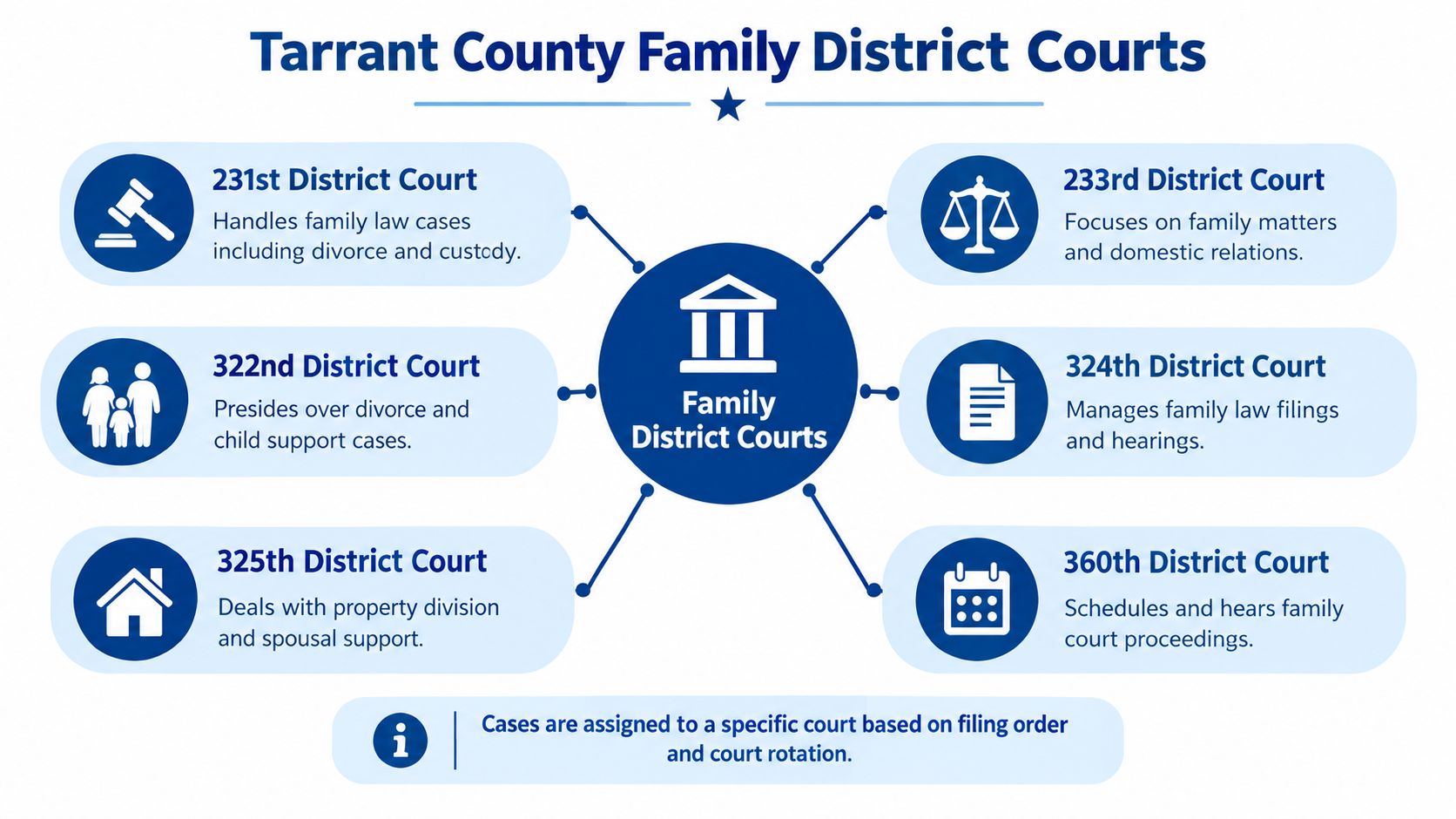
The important distinction isn't that one court is automatically the Mansfield court. The important distinction is that the cause number shows which court was assigned.
Reading the first three digits
| Cause-number beginning | Assigned district court |
|---|---|
| 231 | 231st District Court |
| 233 | 233rd District Court |
| 322 | 322nd District Court |
| 324 | 324th District Court |
| 325 | 325th District Court |
| 360 | 360th District Court |
This table helps you decode the paperwork, but it doesn't mean that a filer can select a preferred court. Assignment occurs after filing under the county's process. The city where you live doesn't identify a particular judge, courtroom, or hearing date.
If the paperwork identifies the 324th District Court, read the hearing notice carefully. A temporary matter may be scheduled in the 324th Associate Court, while the divorce file itself remains assigned to the 324th District Court. That distinction matters when you search for orders, ask about the case status, or request a copy of the final decree.
The district-court record also differs from later child-support enforcement or modification proceedings. A divorce decree is maintained as a district-court record by the District Clerk. A later proceeding may have its own filing path and assigned court, so don't assume every future family-law issue will appear under the same hearing arrangement.
Where to File and How to Find Your Courtroom in Fort Worth
For a Tarrant County divorce, the practical filing location is the Family Law Center, 200 East Weatherford Street, Fort Worth, Texas 76196. The Family Law Division of the Tarrant County District Clerk is on the third floor. The county lists the building as open Monday through Friday from 8 a.m. to 5 p.m. Tarrant County's Family Law Division information provides the location and clerk details.
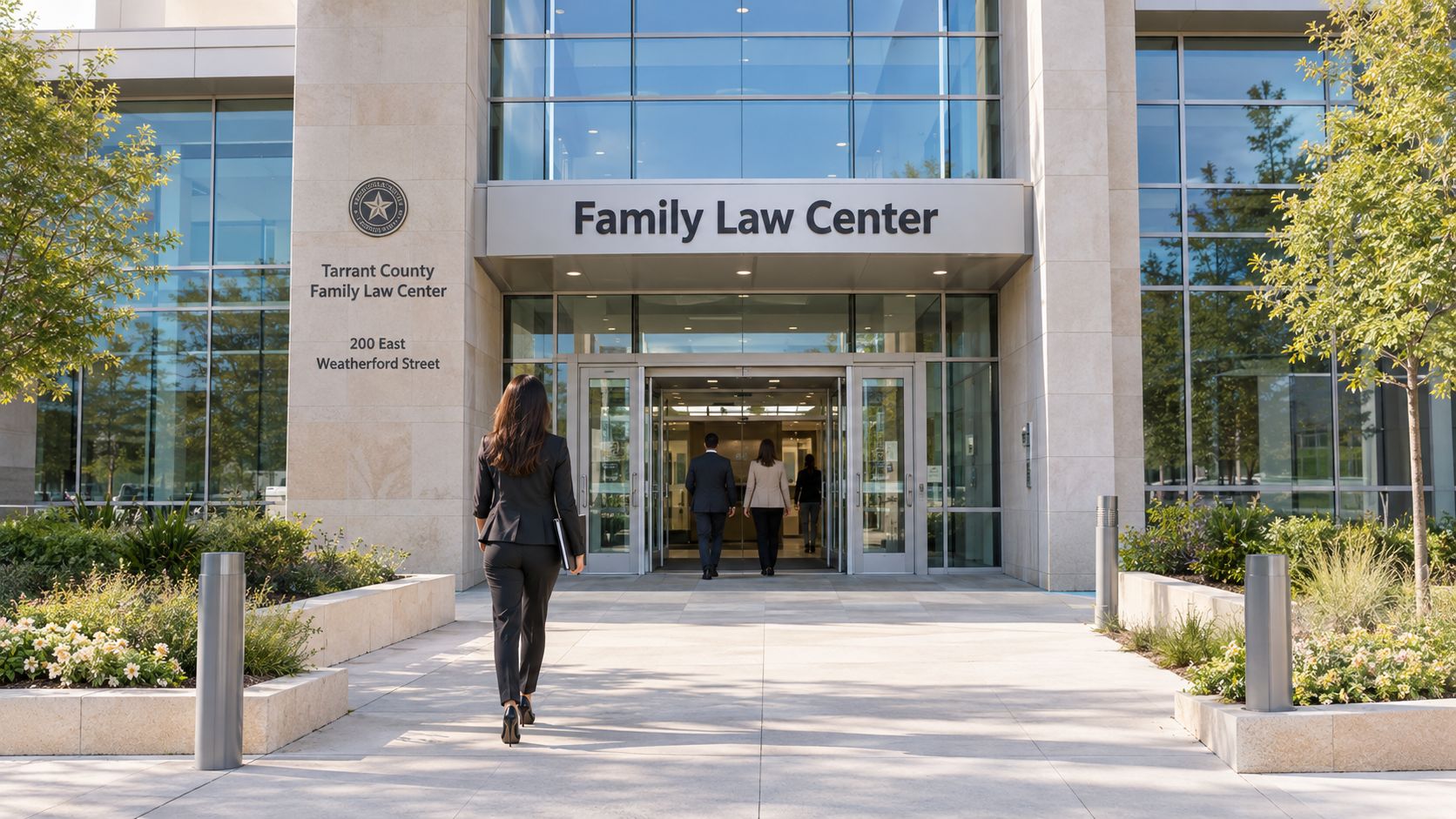
Filing office and hearing room are different places
The clerk's office accepts and maintains filings. It doesn't mean every hearing occurs at the filing counter. After the case is filed, the assigned district court and the hearing notice determine where and when you need to appear.
Before traveling from Mansfield to Fort Worth, gather:
- Your cause number: Use the first three digits to identify the assigned district court.
- Your hearing notice: Confirm the hearing type, date, time, court designation, and courtroom.
- Your filing information: Keep copies of the petition, any orders, and clerk correspondence together.
The county's published Family Law Division telephone number is 817-884-1265. Call the District Clerk when you need to verify filing information, case records, or instructions about the assigned case. You can also review what floor the Tarrant County Family Law Center's family-law offices use.
A temporary-orders notice may direct you to an associate court with the same three-digit designation as the district court. That doesn't mean the original filing was misplaced. It usually means the hearing type is being handled through the corresponding associate court.
Before appearing in Fort Worth: Confirm the cause number, assigned court, and hearing type. Reaching the right building isn't enough if the notice identifies a different courtroom.
If you have already received a notice, follow the notice first and verify any uncertainty with the clerk or assigned court. Don't rely solely on an old online search result, a verbal assumption, or the fact that another Mansfield resident had a different court assignment.
Filing Fees and the With-Children Versus Without-Children Path
The filing fee depends in part on whether the new family suit involves children. Tarrant County's fee schedule, effective January 1, 2026, lists a total filing fee of $350 for a new family suit without children and $401 when children are involved. The schedule is available through the county's Family Filing Fees document.
The difference is $51, and the larger amount reflects additional family-protection and initial child-support-service charges. This is not just a different price for the same paperwork. A case involving children can require child-related services and filings that don't apply to a divorce without children.
What the fee categories tell you
| Case type | Total filing fee effective January 1, 2026 |
|---|---|
| New family suit without children | $350 |
| New family suit involving children | $401 |
A parent shouldn't assume that the lower amount applies merely because the parents agree on every issue. The relevant question is whether the new family suit involves children, not whether the case is contested. Likewise, a divorce without children still requires the correct petition and procedural documents.
If paying the filing fee creates a serious financial problem, ask the District Clerk about available fee-waiver or indigency procedures. The clerk can provide the applicable process, but the clerk doesn't decide whether your facts make legal venue proper. Those are separate questions.
Keep the filing receipt and cause number with your case papers. When the divorce is completed, the final decree is a district-court record maintained by the District Clerk. That record function is separate from later child-support enforcement or modification matters.
Fees can change, so verify the current schedule before filing. Planning for the correct amount helps avoid a rejected filing or an unexpected trip back to the Family Law Center.
Uncontested Divorce Timelines and the Local Order Process
A Mansfield couple may agree on every issue, file the required papers, and still need to wait before the divorce can become final. Texas generally requires at least 61 days after the petition is filed before finalization, subject to statutory exceptions. Confirm the current waiting-period guidance through the applicable court or clerk resources.
Agreement simplifies the case, but it does not replace the legal steps. The file still needs the correct pleadings, proper service or a valid waiver, and a proposed final decree. The judge must receive paperwork that supports the requested divorce, property division, and any orders involving children.
When Domestic Relations Office review may be available
A Tarrant County local order for the 325th District Court allows self-represented parties in qualifying uncontested divorces filed after March 1, 2020 to request Domestic Relations Office review of final-divorce documents. The listed conditions include:
- The petition was filed in Tarrant County.
- The divorce is uncontested by agreement or default.
- The final-decree form comes from a Texas Supreme Court-promulgated form or TexasLawHelp.
- Neither party is represented by an attorney.
Review is not automatic approval. It does not decide disagreements about property, custody, support, or procedure, and satisfying the listed conditions does not guarantee that the documents are ready for finalization.
For example, a Mansfield filer with cause number 325-xxxxx whose decree uses a Texas Supreme Court form may submit the proposed decree to the Domestic Relations Office for review before the final hearing. The filer should still confirm the submission method and any required documents.
A similar local order addresses qualifying matters assigned to the 324th District Court. The assigned court controls which procedure applies, so check the local order connected to your cause number. A temporary-orders notice may identify an associate court, but that does not change who selected the district-court assignment.
Agreement is not the same as completion. The petition, service or waiver, waiting period, final decree, and court presentation still matter.
Ask the District Clerk or assigned court whether review is available and whether your paperwork meets every condition. If the spouses disagree about children, property, debts, support, or decree language, attorney review may prevent a simple filing from becoming a larger procedural problem.
Common Mistakes Mansfield Residents Make at Filing
A Mansfield resident can prepare the correct divorce papers and still create a problem at the courthouse. The risk often comes from treating a city address, a filing counter, a cause number, and a hearing notice as if they identify the same place.
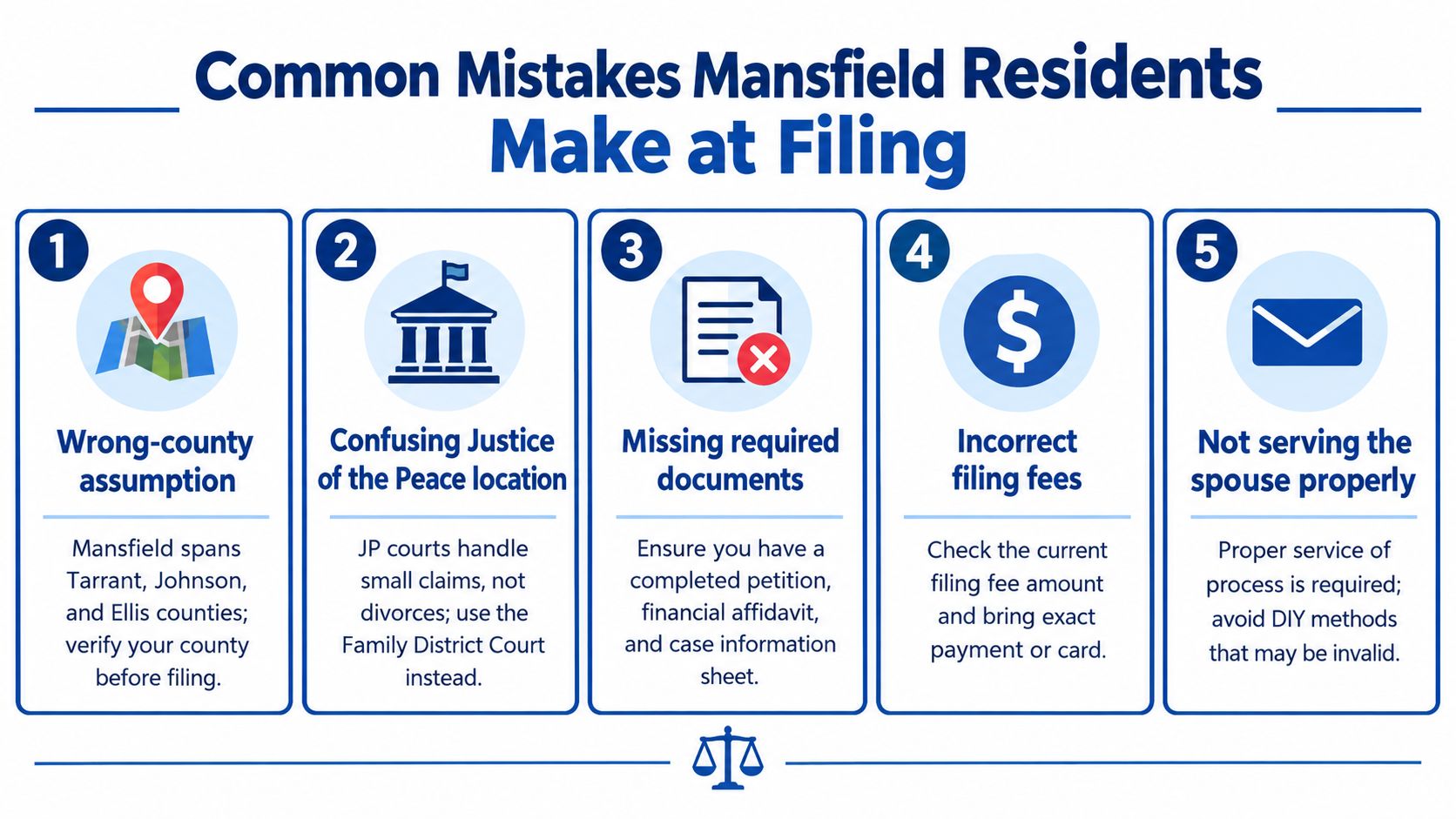
Avoid these less obvious filing errors:
- Checking only the city name: Mansfield reaches into Tarrant, Johnson, and Ellis counties. A Johnson County resident who files in Tarrant may face a venue challenge under Texas Family Code § 6.301. Confirm the county and precinct before paying the filing fee.
- Budgeting for the wrong case path: The filing fee differs depending on whether the divorce involves children. Check the current fee with the clerk before submitting payment, rather than assuming every Mansfield case costs the same.
- Reading the cause number as a hearing address: The first three digits can identify an assigned court, but they do not replace the courtroom, date, or appearance instructions on the notice.
- Bringing the wrong paperwork to court: A petition, waiver, proposed decree, and hearing notice serve different purposes. Keep the filed copies and any signed orders together so the judge can review the correct version.
- Assuming an agreement removes every deadline: Spouses may agree on the result and still need proper service or waiver, required waiting periods, and an acceptable decree. A missing procedural step can delay an otherwise agreed divorce.
The courthouse process works like a chain. Venue starts it, the clerk records the case, the assignment directs it, and the hearing notice tells you where to appear. A break at any point can send you back to an earlier step.
Before driving to Fort Worth, call the Family District Clerk at 817-884-1265 and compare the answer with your notice. Keep a complete copy of every filing and order, including anything submitted electronically or received by mail.
Practical Next Steps and When to Talk With an Attorney
Start with venue. Confirm whether your residence falls in Tarrant County, whether the Texas six-month and county 90-day requirements are satisfied, and which filing fee applies. Then gather the facts a family-law review will need, including the marriage and separation history, children's information, property and debt overview, prior orders, and any paperwork already received.
If your case has been filed, put the cause number and hearing notice in the same folder. Check the first three digits, identify whether the notice concerns the district or associate court, and verify the courtroom before appearing.
A consultation may be especially useful after a recent move, when children or disputed property are involved, when prior orders exist, or when you're uncertain about venue, service, or the proposed final decree. The Law Office of Bryan Fagan PLLC provides family-law representation and procedural guidance for matters filed in Tarrant County family district courts.
If you need help determining whether Tarrant County is the proper venue or understanding the court listed on your Mansfield divorce paperwork, visit the Law Office of Bryan Fagan PLLC. You can review the firm's Fort Worth family-law resources and request a consultation focused on your filing, hearing notice, children, property, and next procedural step.
