 Skip to content

You may be the parent who gets a child ready for school, handles appointments, and covers everyday expenses, while the other parent contributes only now and then. Or you may be a father raising your child who isn't sure whether child support is available to him. In Fort Worth and across Tarrant County, being the day-to-day caregiver doesn't by itself establish who is entitled to receive support or what the other parent must pay. The court order, if there is one, matters.
Texas law connects child support to the legal arrangements for the child and the parents' financial responsibilities. Understanding those arrangements can help you see what a support order covers, how support is calculated, and where Tarrant County families may turn when payments don't arrive. This is general information, not advice for your individual case.
Table of Contents
- A Fort Worth Morning That Changes the Legal Question
- What Custodial Parent Means Under Texas Family Law
- How Texas Calculates Child Support
- Rights and Responsibilities in a Texas Support Order
- Collecting Support and Using Tarrant County Enforcement Tools
- When a Custodial Parent Hesitates to Pursue Formal Support
- Practical Next Steps for Fort Worth and Tarrant County Families
- Common Questions Fort Worth Parents Ask About Child Support
A Fort Worth Morning That Changes the Legal Question
A parent in Arlington has been caring for a child most of the time for years. They pack lunches, manage school pickups, and pay the bills. One morning, after another missed contribution from the other parent, they wonder: “Doesn't the fact that I'm the custodial parent mean support is already owed?”
That question mixes up two things that can feel like one: the everyday work of caring for a child and the legal terms of a support order. Being the primary caregiver is an important part of the family's circumstances. But the fact that one parent handles school mornings doesn't, by itself, establish an enforceable payment amount or a method to collect it.
A parent in Keller might have a court order that names one parent to determine the child's primary residence and sets child support. Another family might have no order, only a history of occasional transfers and informal promises. Those situations call for different next steps, even if the children live with one parent in both families.
For Fort Worth and Tarrant County parents, the practical questions are usually specific: What does the order say? How did the court calculate support? Does it address health insurance and unpaid medical bills? If payments stopped, which agency or court can help?
The answers depend on Texas family-law rules and the actual documents in your case. The sections below explain the basic framework, the guideline calculation, common order terms, and local enforcement options. They also address a less-discussed question: what if you're a custodial father or you're hesitant to pursue formal support because you're worried about co-parenting or safety?
What Custodial Parent Means Under Texas Family Law
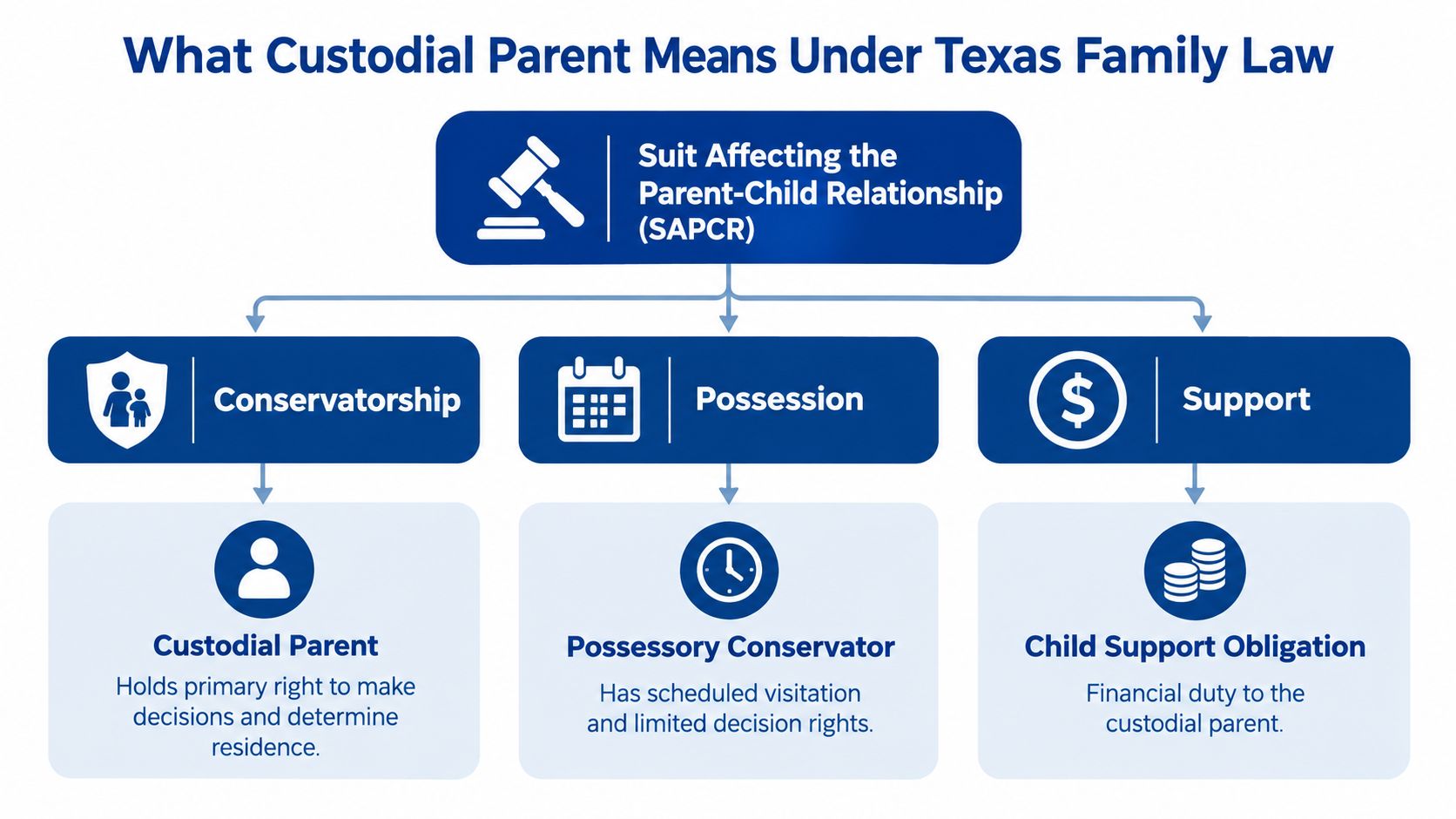
In Texas, parents often establish custody, visitation, and support through a Suit Affecting the Parent-Child Relationship, commonly called a SAPCR. A SAPCR is the legal case used to establish rights and duties concerning a child. The resulting order, not a parent's informal label for themselves, sets the legal arrangements.
The order can address conservatorship, including who has the right to designate the child's primary residence; possession, meaning when each parent has the child; and child support. These issues relate to one another, but they're not interchangeable. A parent can have the child most of the time without every legal detail being resolved.
Texas courts generally start with a presumption that parents should be appointed joint managing conservators. That doesn't necessarily mean equal time or identical decision-making rights. The specific order assigns rights and responsibilities.
Read the order, not just the label
Chapter 154 of the Texas Family Code provides the framework for court-ordered child support. The parent named in the order to receive payments is commonly called the obligee or payee. The parent required to pay is the obligor. These terms describe the roles assigned by the order, not a parent's gender or who usually buys groceries.
Suppose a Fort Worth parent moves out with the child after a separation. That parent may be the child's main caregiver in practice, but the right to receive support still depends on the existing order or a support determination made through the proper legal process. If no order exists, a SAPCR may be needed to establish the legal arrangements.
The Texas State Law Library explains how Texas courts address child custody and support. For your family, start by locating the most recent signed order and checking who is named to receive support, what amount is due, and how possession is set.
How Texas Calculates Child Support
Texas guideline support is generally based on the paying parent's net resources, rather than the custodial parent's income alone. The guideline percentage depends on the number of children covered by the order. These percentages come from the Texas Attorney General's child-support handbook.
| Number of Children | Percentage of Net Resources |
|---|---|
| One | 20% |
| Two | 25% |
| Three | 30% |
| Four | 35% |
| Five or more | 40% |
“Net resources” is a legal calculation, not the number left in someone's bank account after personal bills. The court applies Texas rules to income and permitted deductions. Other support orders can also matter. Because the available verified information here doesn't provide the current income cap or a full deduction formula, don't rely on an online percentage alone to estimate an exact obligation.
A percentage is a starting point, not the entire order
For a family with two children, the guideline percentage listed above is 25% of the paying parent's net resources. For a simplified illustration, if the court has determined that a parent's net resources are $4,000 per month, applying 25% gives $1,000 before considering other support terms or any reason the court may depart from the guideline. This is an example, not a prediction of what a court would order in a particular case.
A parent's unemployment doesn't automatically prevent a support order. At the same time, a parent's primary caregiving role doesn't automatically mean that parent owes nothing. Texas treats physical care and financial responsibility as related but separate questions.
Medical and dental support can also be addressed in the order. Courts may consider the children's insurance coverage and who must pay toward it, so don't assume the monthly guideline amount tells the whole story.
Before estimating support: Gather pay records, tax returns, information about health-insurance costs, childcare expenses, and any other support orders. Those records can help explain the financial picture and may matter if someone asks the court to consider a different amount.
Rights and Responsibilities in a Texas Support Order
A custodial father in Mansfield receives school supplies and cash from the other parent, then wonders whether those contributions satisfy the support order. The answer starts with the order's terms. Helpful contributions don't automatically receive credit toward court-ordered support; how they were paid and recorded can matter.
Read the order as a set of instructions
A support order works like a household instruction sheet: the monthly amount is only one entry. It also explains payment arrangements and responsibilities for medical or dental support. The Texas State Law Library's child-support guide outlines that Texas framework.
Whether you're a custodial mother or father, review these terms:
- Payment details: Identify the amount due, due date, and designated payment method.
- Income withholding: Check whether payments will come through deductions from wages or other qualifying income.
- Health coverage: Find which parent must provide available health or dental insurance.
- Uninsured costs: Read how parents must share medical and dental expenses insurance doesn't cover.
- Possession terms: Check the schedule stating when each parent has the child.
The receiving parent may expect payment as ordered and keep records to check that payments were credited. Parents relying on informal contributions should compare those arrangements with the written payment requirements before assuming the obligation has been met.
Gifts and support aren't automatically the same
In the Mansfield example, clothing, cash, and school supplies may benefit the child. Keep records of those contributions, but don't treat them as substitutes for the required payments without checking the order and how credit is handled.
Support and possession are separate obligations.
A missed payment alone doesn't authorize cancellation of scheduled possession. Withholding parenting time in retaliation can create another legal dispute while leaving the support problem unresolved.
For Tarrant County parents considering changes to existing custody terms, the guide to Tarrant County custody modifications explains why the current order matters. Follow the appropriate legal process to seek a schedule change rather than using payment as bargaining power.
Collecting Support and Using Tarrant County Enforcement Tools
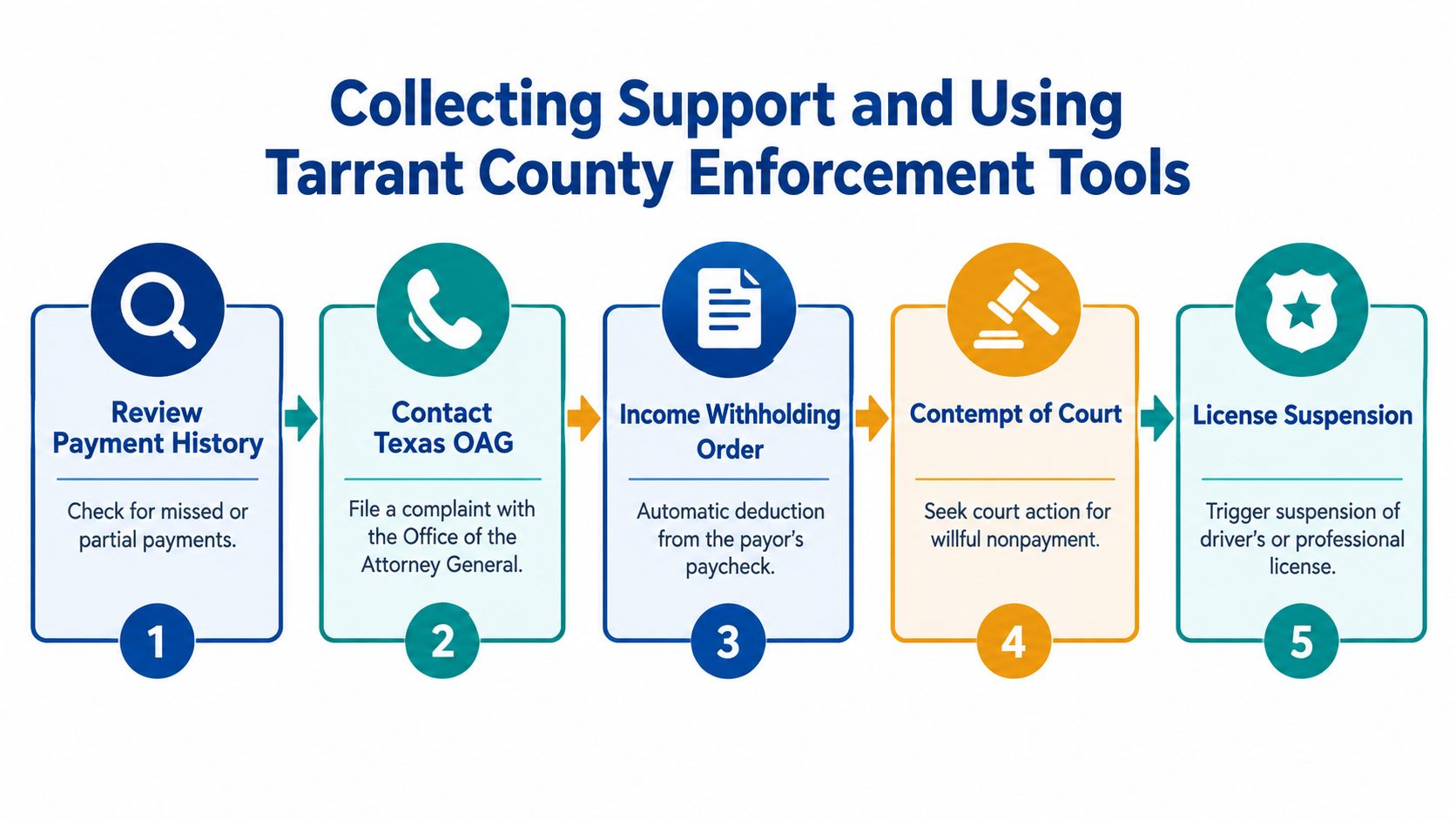
When a payment is missed, begin with the order and your records. The Texas Office of the Attorney General (OAG) is the state's official child-support enforcement agency and may assist with services such as locating a parent, establishing parentage, processing payments, and enforcing an order. The Texas State Law Library describes the OAG's enforcement role and available child-support enforcement mechanisms.
Income withholding can make payments more predictable by deducting support from wages or other qualifying income. It's not the only possible enforcement route, but it can reduce dependence on voluntary payments. Keep the order, account history, wage-withholding information, returned checks, and messages about missed or partial payments together.
Where a Tarrant County case may be heard
Tarrant County has dedicated Title IV-D child-support courts for qualifying cases receiving services through the OAG or the county Domestic Relations Office. The county says these courts handle matters involving parent location, parentage, establishment, modification, and enforcement of child-support or medical-support obligations, as well as paternity cases. It identifies two IV-D courts and says they use expedited processes required by Texas Family Code Chapter 201.110. Check the Tarrant County IV-D Courts information to understand whether your case is connected to those services.
Not every family-law dispute belongs in a Title IV-D court. Confirm your assigned court, hearing date, case number, and required documents with the county or agency handling your matter. If enforcement involves disputed credits, arrears, or possible contempt, a parent may need court action rather than relying only on collection assistance.
Texas law also allows a court to request suspension of a driver's license when a parent is more than three months overdue on child support. A request isn't an automatic result. For example, a Fort Worth parent might first check the official payment record, ask about collection through the OAG, and then seek legal advice about court enforcement if the record shows continued nonpayment. A Tarrant County child-support enforcement and contempt docket resource may help you learn about that local process.
When a Custodial Parent Hesitates to Pursue Formal Support
Not every parent who needs help wants to pursue formal support immediately. Some worry that requesting enforcement will worsen conflict, affect co-parenting, or provoke retaliation. Others rely on gifts, direct purchases, or informal cash because those contributions feel less confrontational. These concerns can arise for mothers and fathers alike.
The risk is practical as well as legal: informal help can be difficult to document, unpredictable, and hard to connect to a court-ordered obligation. If a support order already exists, a parent shouldn't assume that clothing or occasional cash satisfies it. The order's terms and the record of payments matter.
On the other hand, asking for formal support doesn't automatically mean a parent wants to damage the child's relationship with the other parent. Financial support and possession are distinct issues. Parents can raise concerns about communication, safety, or the child's relationship with the other parent while seeking advice about financial arrangements.
Fathers can be the parent receiving support
The framework isn't based on whether the custodial parent is a mother or father. A father raising a child may seek support if the legal and financial circumstances support that request. The same practical questions apply: Is there an order? Who does it name as the payee? Are payments being made as directed?
If no formal order exists, voluntary contributions may continue for a time, but a change in income, relationship, or willingness to help can leave the caregiving parent exposed. If safety concerns, coercion, or retaliation are part of the situation, don't treat enforcement as a routine paperwork problem. Speak with a qualified family-law attorney about an approach that accounts for both financial needs and safety.
Practical Next Steps for Fort Worth and Tarrant County Families
Start with the paperwork, not a confrontation. The current order tells you what the court requires and which parent is named to receive support. If you can't find it, identify where the case was filed and contact the appropriate court or agency about obtaining a copy.
Build a clear record of what has happened. Keep payment statements, wage-withholding details, bank records, returned checks, and messages about missed payments together. Separate court-ordered payments from gifts or direct purchases, and avoid claiming that informal contributions were credited unless the records support that conclusion.
Prepare for the next conversation
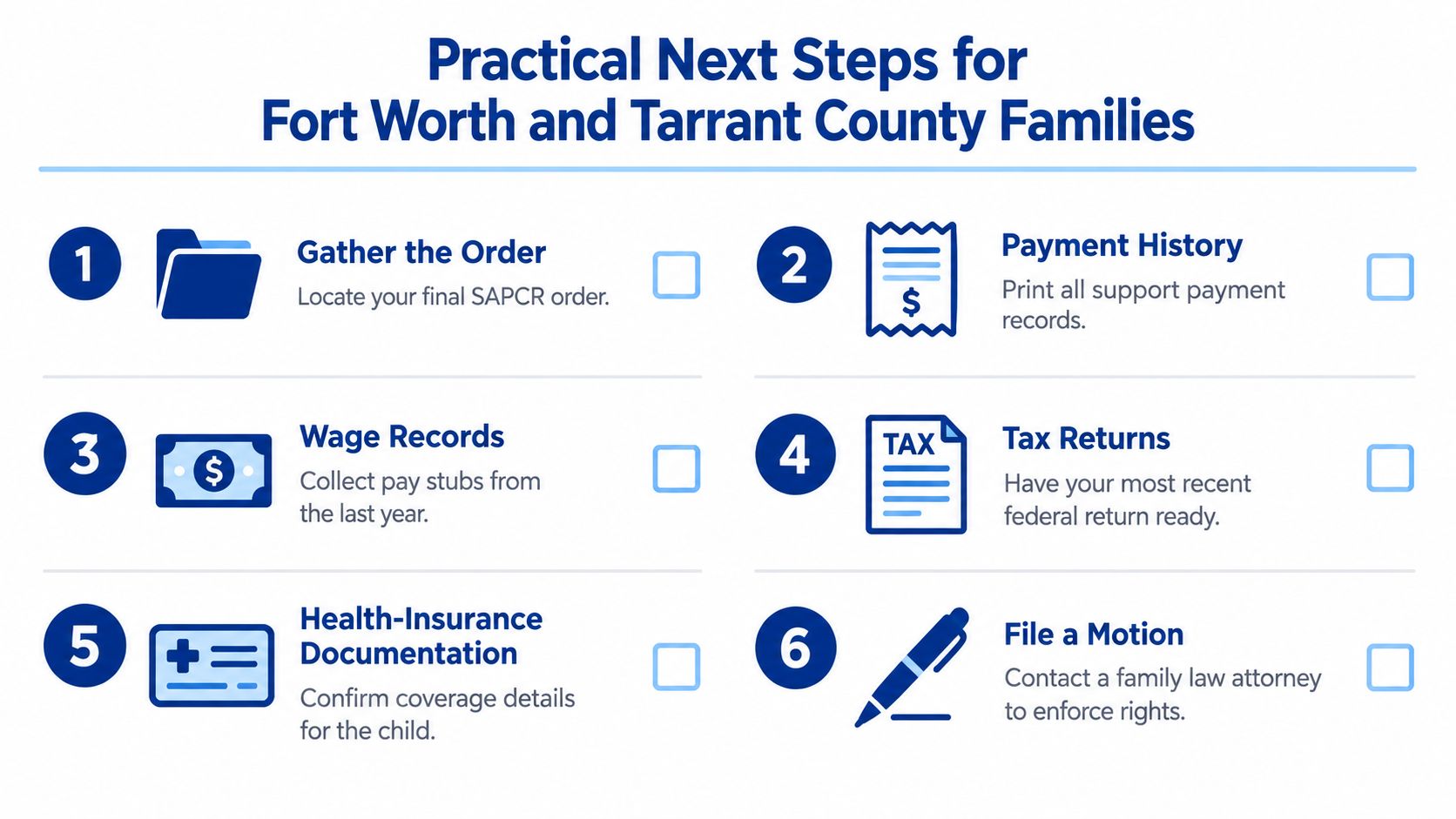
Before contacting an agency or a lawyer, gather documents that help show the order and the financial circumstances:
- The signed SAPCR order: Note the payment terms, payee, medical-support provisions, and possession schedule.
- Payment records: Collect statements showing payments received, missed payments, or partial payments.
- Income documents: Bring available wage records and tax returns if support may need to be established or changed.
- Insurance and childcare information: Keep records of the child's coverage and relevant costs.
- Communication history: Save messages about payments, missed obligations, and any safety or co-parenting concerns.
The OAG may be the right contact when you need child-support services through the state. The Tarrant County Domestic Relations Office may be involved in qualifying matters. A private family-law attorney can help assess a case involving disputed order terms, modification, enforcement, or safety concerns. If you're unsure where to direct a payment question, this Tarrant County child-support payment resource may help identify the relevant office.
Don't assume every family-law matter belongs at the same courthouse. Tarrant County cases may be assigned to different courts or venues depending on the case and services involved. Confirm the location from official case information before appearing, and don't change possession or stop following an order because a payment is late.
Common Questions Fort Worth Parents Ask About Child Support
Can a custodial father receive child support?
Yes. If a Fort Worth father is raising the child in his home, he may be entitled to receive support under the same Texas framework that applies to a custodial mother. The order, the child's primary residence, and the parents' financial responsibilities determine the obligation. Gender doesn't decide who receives support.
What if the other parent pays inconsistently?
Keep a payment history that distinguishes missed payments, partial payments, and direct contributions. Informal help with expenses can leave parents disagreeing about what counts toward court-ordered support. Ask the OAG about services if it handles your case. If payment credits are disputed or enforcement is needed, a family-law attorney can assess the issue.
What happens when a child turns eighteen or graduates?
In Texas, court-ordered support generally continues until the child turns eighteen or graduates from high school, whichever occurs later. For example, an eighteenth birthday during high school generally doesn't end support that day. Check your order's termination terms and consult an attorney before changing payments, especially if an exception may apply.
Can support be changed after income or possession changes?
A court order works like a standing instruction: it remains in effect until the court changes it. A different income or parenting schedule may justify requesting modification, but neither automatically changes support. For related parenting questions, see the guide to custody modifications in Tarrant County.
The Law Office of Bryan Fagan PLLC provides guidance on establishing, modifying, and enforcing child-support orders in Tarrant County.
Parents facing unpaid support, unclear terms, or concerns about formal enforcement can contact Law Office of Bryan Fagan PLLC to discuss available family-law options and whether a consultation fits their needs.
