 Skip to content

The Texas baseline is a written jury demand filed no later than 30 days before the final trial date, along with the $10 district court jury fee, or a qualifying inability-to-pay filing instead. Before filing in Tarrant County, verify the current local amount and court-specific requirements because published county materials can differ by court and case type.
You may be in Fort Worth, Arlington, Keller, or another Tarrant County community, looking at a divorce, custody, or modification trial setting and realizing that you want a jury to decide some issues. The request isn't automatic. A jury demand is a formal procedural step, and the written filing and payment, or approved substitute, must be handled on time.
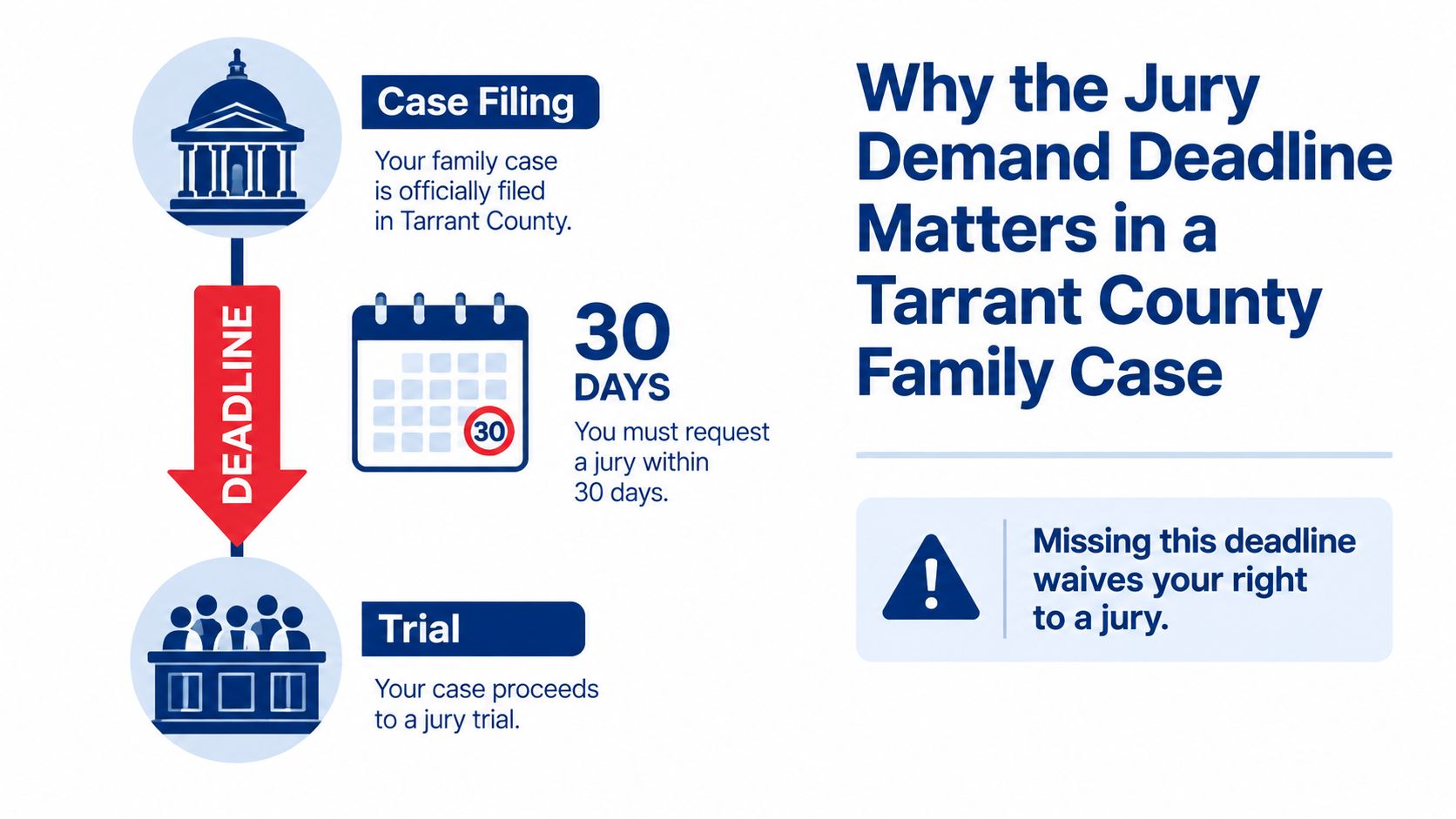
For most Texas family-law cases in district court, count backward from the final trial date. Don't count from the date you filed for divorce or from the day you first discussed a jury with your attorney. A missed deadline can waive the jury request, leaving the judge to decide the case unless the court grants relief.
Table of Contents
- Why the Jury Demand Deadline Matters in a Tarrant County Family Case
- Where and How to File the Written Jury Demand in Tarrant County
- Jury Fees and When the Statement of Inability Substitute Applies
- Counting Backward From the Final Trial Date
- What Happens If the Demand or Fee Lands Late
- After You File the Demand, Setting the Case Up for Trial
- Practical Next Steps and When to Bring in a Family Law Attorney
Why the Jury Demand Deadline Matters in a Tarrant County Family Case
A jury demand can affect how the court decides disputed issues in a divorce, Suit Affecting the Parent-Child Relationship, or modification case. It isn't a note to the clerk saying that you prefer a jury. It is the written procedural act that preserves the request under the Texas rules.
Texas family matters are civil cases, and the general Texas framework requires a written jury demand at least 30 days before trial. The standard district court jury fee is $10, while the county court fee is $5, as described in Texas Rule of Civil Procedure 216 materials. In a Tarrant County family district court case, the district-court baseline is the relevant starting point, but you should still confirm the current amount with the clerk before tendering payment.
You have two separate tasks:
- File a written jury demand in the existing cause number.
- Pay the applicable fee or file a qualifying inability-to-pay document.
TexasLawHelp explains that, in family cases, the demand must be filed no later than 30 days before the final trial date, and that both the demand and fee matter when preserving the jury right. If you can't afford the fee, a Statement of Inability to Afford Payment of Court Costs may be filed instead.
Practical rule: Treat the demand and the payment or inability-to-pay filing as one deadline project. Completing only one side can leave the jury request vulnerable.
The danger is greatest in custody cases, where the issues involve your children and the trial may determine conservatorship, possession, or other parent-child questions. Texas authorities recognize that custody litigants can demand a jury when they comply with the applicable demand and fee requirements, including an approved inability-to-pay filing, as reflected in this Texas Attorney General opinion on jury trials in custody matters.
Where and How to File the Written Jury Demand in Tarrant County
File the demand in the underlying family case and cause number. The safest approach is a separate document titled something like “Jury Demand” or “Demand for Jury Trial,” rather than burying the request inside a motion, response, or discovery filing.
You can submit the filing through the applicable eFileTexas process or ask about in-person filing through the Tarrant County district clerk's family-law filing operations. A practical starting point is the Tarrant County district clerk e-filing requirements for family cases. Confirm the current filing location and accepted submission method before appearing at a clerk window, because local operations and filing instructions can change.
What the document should contain
Your written demand should make the request unmistakable. Use the case caption from the existing petition, include the cause number, identify the requesting party, and state that the party demands a jury trial on the issues permitted to be tried to a jury.
A basic filing should include:
- Correct caption: Match the names of the parties and the court shown in the case.
- Cause number: Use the number assigned to the family case.
- Clear request: State that the filing party demands a jury trial.
- Signature: Sign as the party or through counsel, as applicable.
- Service: Serve the opposing party or opposing counsel as required.
Keep the file-stamped or electronically conformed copy. That record can matter if the opposing party later disputes when the demand was filed.
Tarrant County's local materials don't eliminate the written-demand requirement under the Texas rule. Filing a separate demand also helps prevent a practical problem: a clerk, opposing lawyer, or judge shouldn't have to search through another pleading to determine whether you requested a jury.
Jury Fees and When the Statement of Inability Substitute Applies
The statewide district court baseline is a $10 jury fee, and Texas Government Code section 51.604 addresses when the jury fee must be paid. The statutory fee provision also refers to the Rule 216 amount and other jury fees allowed by law or rule.
Tarrant County's published materials show why you shouldn't rely on a statewide number without checking the specific case. County civil materials identify a $22 jury fee and a 14-day-before-trial deadline in certain lower-court settings, while the family fee schedule separately identifies family filing and jury-fund components. The Tarrant County district clerk fee structure should be checked for the current venue and case type.
You generally face three practical paths:
| Path | What You File | Key Risk |
|---|---|---|
| Pay the fee | Written jury demand and applicable fee | Paying the fee doesn't fix a late written demand |
| Use inability-to-pay relief | Written demand plus a sworn Statement of Inability to Afford Payment of Court Costs | An incomplete or rejected filing may leave the fee unpaid |
| File only the demand | Written demand without payment or substitute | The jury request may be treated as defective or waived |
If money is tight because you're paying rent, supporting children, or carrying litigation expenses, don't omit the fee. Ask about filing the required sworn statement. The Tarrant County divorce filing-fee schedule can help you identify local charges, but verify the current amount and filing instructions with the clerk.
A timely demand with no fee or substitute can create the same problem as a timely fee with no demand. Preserve both parts together.
Counting Backward From the Final Trial Date
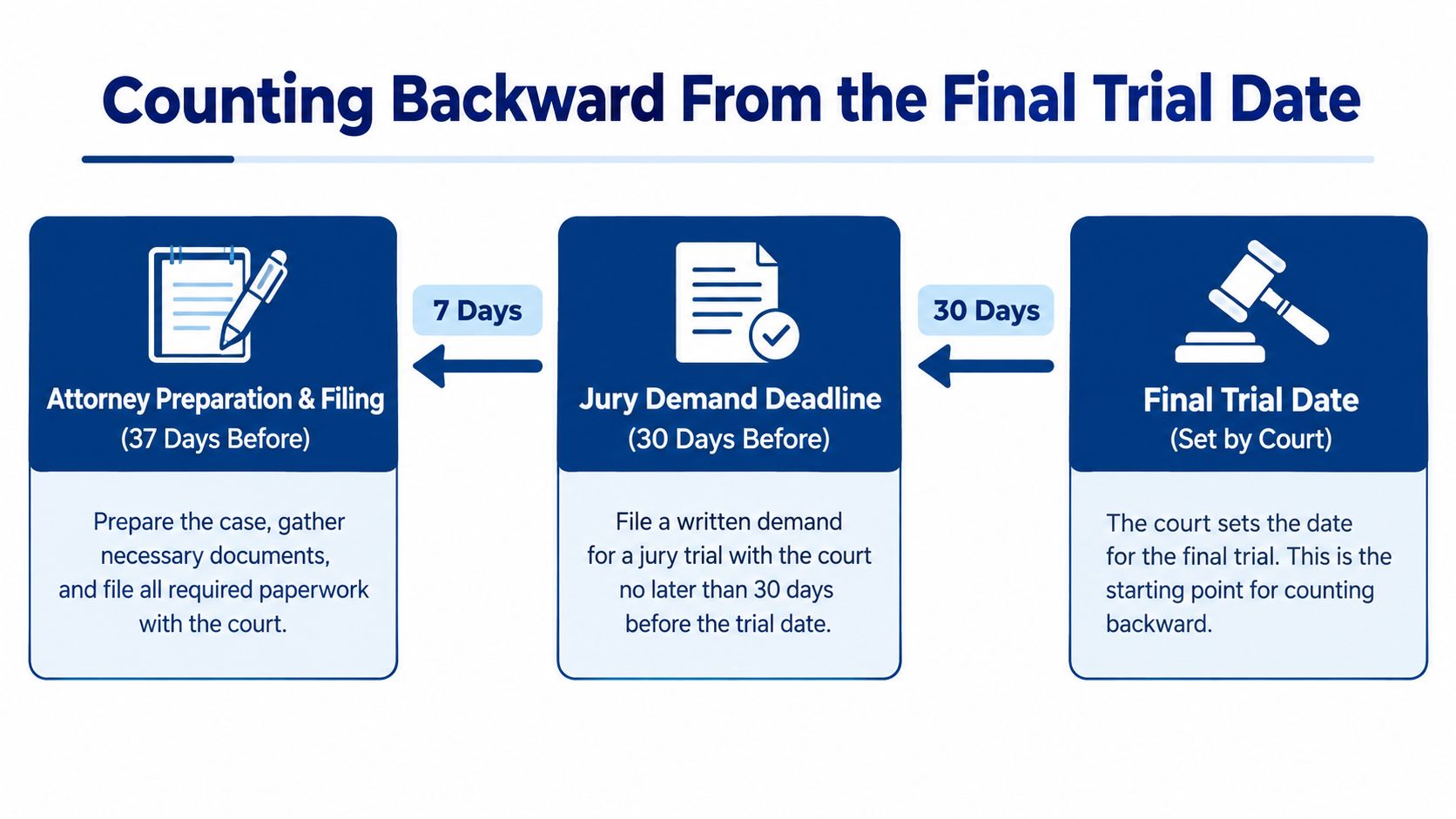
Start with the date shown for the final trial setting on the official docket. Then count backward to identify the deadline for the written demand and the fee or inability-to-pay filing.
For a Texas family district court case, the working benchmark is 30 days before final trial, based on the Texas family-law guidance linked above. Government Code section 51.604 also provides a separate payment deadline in some contexts, stating that the fee must be paid no later than the 10th day before the jury trial begins. Because these rules can operate together, waiting for the later payment date is a poor strategy.
Some Tarrant County civil forms use language requiring a demand no later than 14 days before trial in certain lower-court settings. That isn't a reason to use the shorter period in a family district court case. It is a warning to identify the court, docket, and proceeding before counting.
A calendar example
Assume the final trial is set for March 17. The 30-day family-case deadline falls on February 15. The written demand and the fee or qualifying inability-to-pay filing should reach the clerk on or before that date. If the date falls on a weekend or courthouse closure, plan for the prior business day rather than gambling on access.
Build in a personal buffer before the legal deadline. Check the docket again, confirm whether the setting is final or interlocutory, and review any amended pleadings or new claims. If you need context about other steps before a final setting, review the information on Tarrant County local rules and mediation before final trial.
What Happens If the Demand or Fee Lands Late
Consider a parent in a Fort Worth divorce who asks for a jury two weeks before final trial. The parent files a document, but the 30-day deadline has already passed. The opposing party objects, and the judge must decide whether the late request can proceed or whether the jury right was waived.
The ordinary risk is serious. Under the Texas framework, an untimely demand can be treated as a waiver, and the case may remain on the judge's trial docket. Paying a fee after the deadline doesn't automatically revive a missing or late written demand. Likewise, a written demand filed late can't be rescued because the party intended to pay earlier.
A court may excuse lateness for good cause, but that is relief you must request and support. Don't assume a judge will grant it because the case involves custody or because you didn't understand the rule. The result depends on the facts, the explanation for the delay, the opposing party's position, and the court's application of the governing rules.
When the deadline slips: Ask counsel to evaluate a motion for leave or other available relief immediately. Waiting for the next hearing can make the problem harder to address.
A late fee can also create a dispute even when the opposing party had some awareness that a jury was being considered. Actual notice, informal discussions, or a reference in another filing aren't safe substitutes for a timely written demand and proper payment or inability-to-pay filing.
The common mistake is waiting until trial feels close. Use the date on the docket, not your sense of urgency, as the trigger.
After You File the Demand, Setting the Case Up for Trial
A filed demand changes the preparation required. The parties must prepare for a jury presentation rather than assuming the judge will decide every disputed issue. That affects evidence organization, questioning, proposed instructions, and how counsel presents the case.
The preparation file should become more structured
Start by preserving the clerk's conformed copy and proof of payment or the inability-to-pay filing. Then organize the issues that may reach the jury, the witnesses who can address them, and the documents or records supporting your position.
Counsel may need to address:
- Jury questions and charge work: Proposed questions and instructions must match the issues properly submitted.
- Exhibit preparation: Documents should be organized, identified, and prepared for admission.
- Witness coordination: Necessary witnesses may require subpoenas and timely notice.
- Pretrial motions: Motions in limine and evidentiary issues should be identified before trial.
A jury demand doesn't automatically resolve scheduling. The trial court, court coordinator, associate-judge settings, and pretrial requirements still control the case's movement. A bench pretrial setting isn't the same event as the final jury trial, and the docket should be reviewed carefully.
Settlement obligations continue
A jury request doesn't pause mediation, settlement discussions, discovery, or other obligations already imposed by the court. Tarrant County family cases may still involve pretrial deadlines and hearings before the final trial setting.
If the case includes contested custody evaluations, relocation allegations, complex property, or serious evidentiary disputes, jury preparation should begin well before the final setting. You don't want to preserve the jury right and then discover that witness availability, exhibits, or expert issues weren't addressed.
Subpoena requirements, exhibit procedures, and hearing practices should be confirmed from current court instructions rather than assumed from another Tarrant County case. A lawyer can coordinate those details while keeping the focus on the issues that matter to your children, property, or requested orders.
Practical Next Steps and When to Bring in a Family Law Attorney
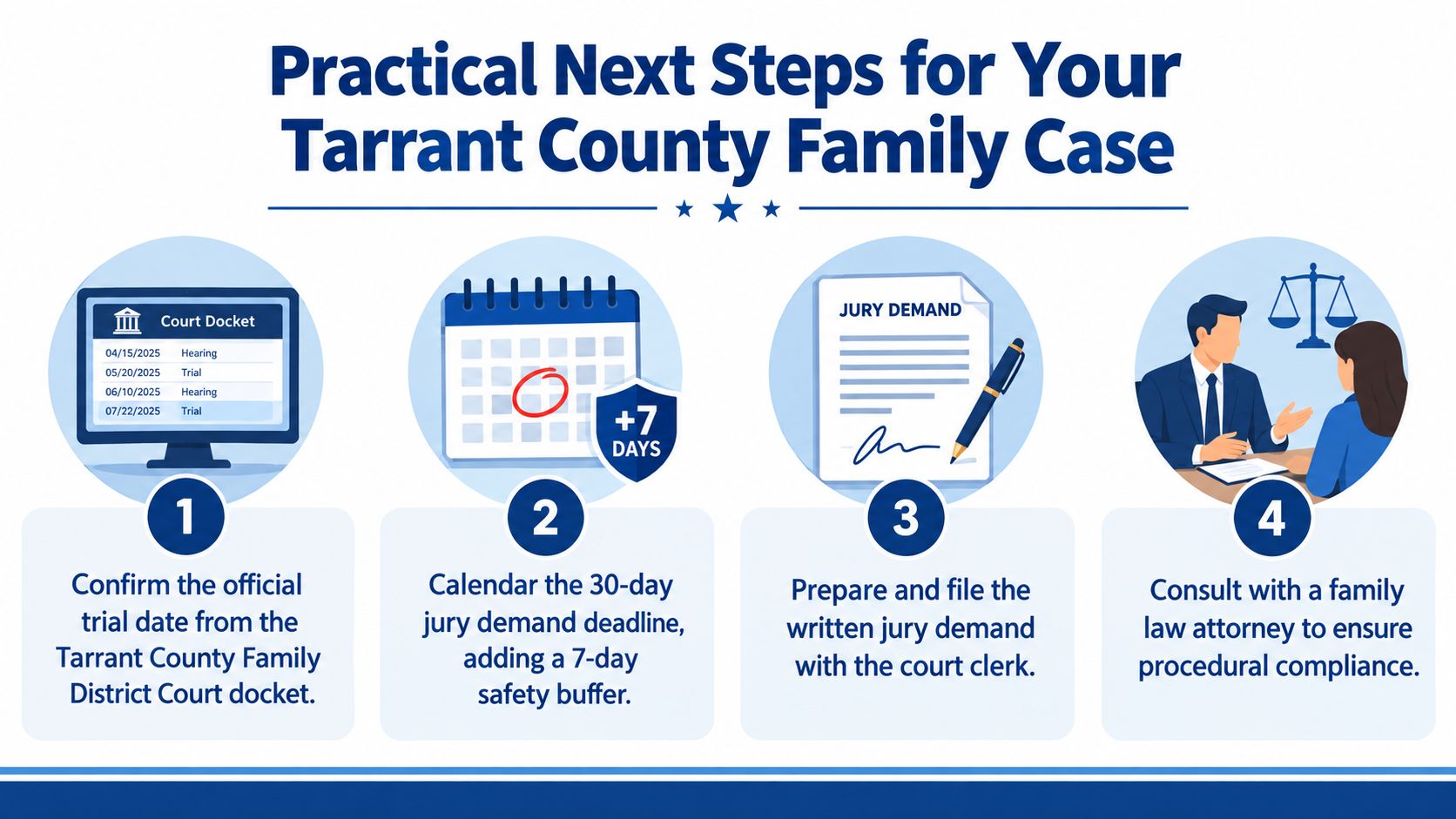
Begin with the official docket, not an old notice or a calendar entry copied from an email. Confirm the final trial date, court, cause number, and current filing instructions before preparing the demand.
Use this checklist
- Confirm the setting: Review the Tarrant County Family District Court docket and identify the final trial date.
- Calendar backward: Mark the 30-day deadline and add a 7-day safety buffer for preparation and filing.
- Prepare the document: Use the correct caption, cause number, clear jury request, and signature.
- Handle the fee: Confirm the current local amount, or prepare a Statement of Inability to Afford Payment of Court Costs.
- File and serve: Submit through the appropriate eFileTexas process or clerk filing channel, then serve the opposing party or counsel.
- Preserve proof: Keep the stamped or conformed demand, payment record, and service confirmation.
If new claims are added, the timing analysis may change. Texas Rule of Civil Procedure 66 can matter when amended pleadings introduce new issues, so don't assume the original demand automatically covers every later claim.
Bring in a family-law attorney promptly if you have a missed deadline, a contested custody evaluation, a relocation dispute, complicated property, or a post-demand motion to withdraw or strike the jury request. Professional help is also sensible when the fee issue is unclear or the opposing party is challenging the filing.
Call the Tarrant County District Clerk's office to confirm current filing procedures and fees, and consider the Tarrant County Bar Association lawyer referral service if you need help locating counsel. Verification isn't panic. It's how you protect a procedural right before the deadline closes.
The Law Office of Bryan Fagan PLLC can help Fort Worth and Tarrant County families evaluate jury-demand timing, fee options, and preparation for divorce, custody, or modification proceedings. Visit the firm to learn about its family-law services and request a consultation before your filing deadline passes.
