 Skip to content

A court-ordered social study can feel intimidating, especially if you're a parent in Fort Worth who has just received paperwork mentioning an evaluator, interviews, home visits, or records. You may be wondering whether the process is a conversation, whether your child will be asked to choose sides, and what the evaluator will tell the court.
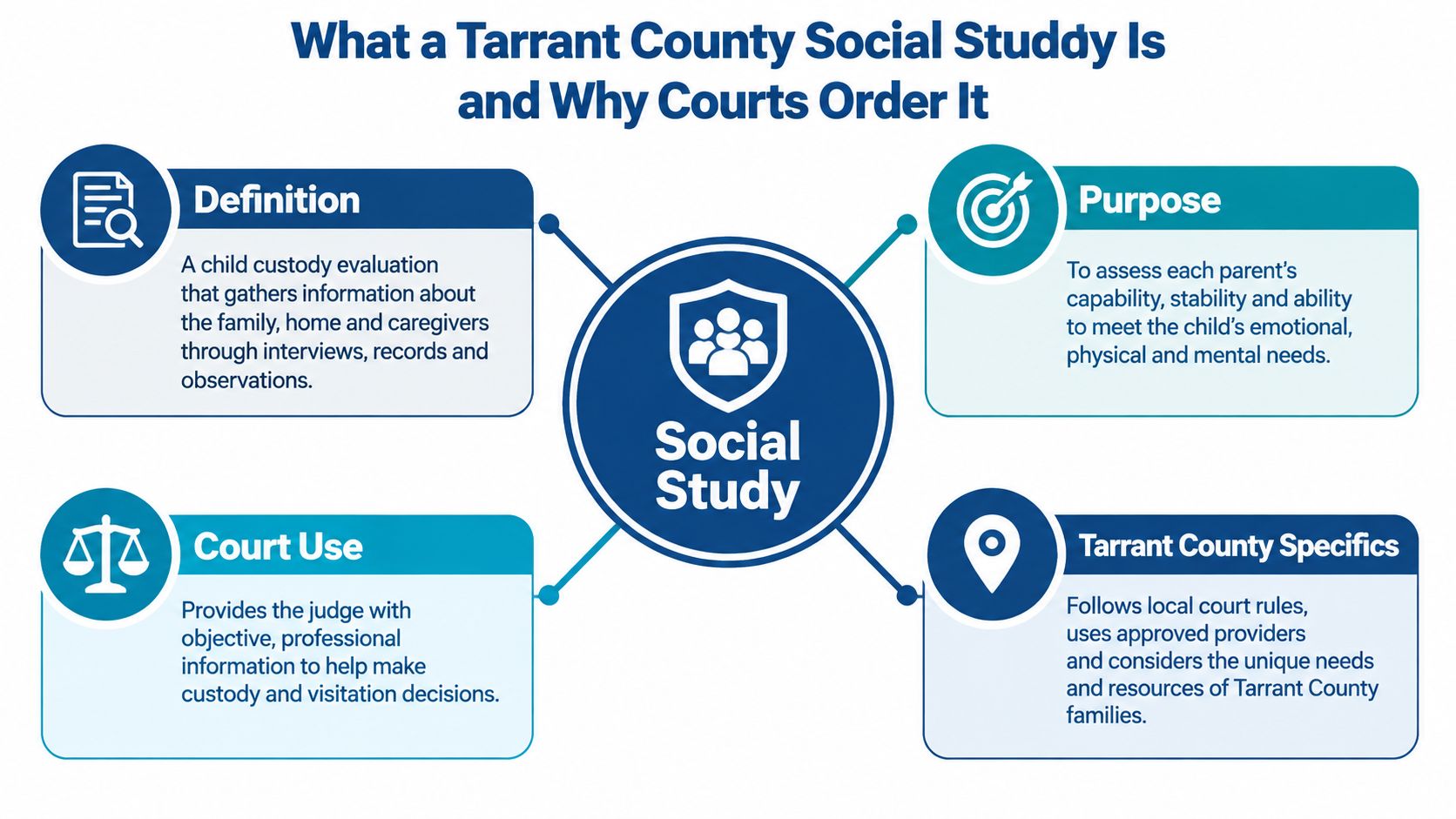
In Tarrant County, a social study is generally the local term for a child custody evaluation. It's an intensive, multi-source investigation conducted under Texas Family Code Section 107.101, not a single interview or informal opinion. The evaluator gathers information about the child, both parents, the homes, household members, third parties, and relevant records before preparing a written report for the court. Tarrant County Family Court Services describes the social study process
Table of Contents
- What a Tarrant County Social Study Is and Why Courts Order It
- How a Social Study Gets Ordered in Tarrant County Courts
- Inside the Evaluation From Referral to Final Report
- How to Prepare for Your Social Study and Avoid Common Mistakes
- Timelines Fees and How Tarrant County Courts Use the Report
- Next Steps When a Social Study Is Part of Your Custody Case
What a Tarrant County Social Study Is and Why Courts Order It
A court-ordered social study can change how a custody dispute is prepared. Instead of relying only on each parent's testimony, the court receives an investigation of the child's circumstances, the adults involved, and information from other relevant sources. The evaluator then prepares findings, opinions, and recommendations that may assist the court when deciding conservatorship and possession issues.
In Tarrant County, the process is not mediation. A mediator helps parents negotiate an agreement. A social study evaluator independently gathers and compares information for the court. The evaluation also involves more than one conversation. Depending on the written assignment, it may include interviews with both parties, the children, household members, and other people with relevant firsthand information. The evaluator may also conduct home or school observations and review relevant records. Tarrant County Family Court Services explains the multi-source nature of social studies
What the evaluator is examining
The evaluator compares each parent's account with information from other sources. A parent may describe a stable routine, while school records, household interviews, or an observation add context. A difference does not automatically prove dishonesty. The purpose is to build a broader factual record instead of relying on one person's version.
The court is looking for organized information about the child's living situation and the adults who affect the child's care. The study may address parenting circumstances, household relationships, the child's needs, and concerns raised by either party. The Texas Family Code requirements, the local Family Court Services checklist, and the court's written order work together like a map. The statute supplies the legal framework, the local process identifies information the evaluator may gather, and the order defines the assignment in that case.
What a social study is not
A social study does not guarantee either parent a preferred custody arrangement. The evaluator's report becomes part of the court record, but the judge remains responsible for the legal decisions. Treating the evaluation as a chance to list every past disagreement can distract from the child-focused questions the court must resolve.
Approach the process as a litigation record audit. Prepare relevant documents, identify people with firsthand knowledge, answer questions truthfully, and expect the evaluator to compare your statements with observations and supporting information.
Tarrant County parents may encounter social studies in family district court litigation, including cases assigned to the 231st, 233rd, or 322nd District Courts. The scope depends on the written order and the issues in that case, so read the order carefully rather than assuming another family's process will be identical.
How a Social Study Gets Ordered in Tarrant County Courts
A social study begins with a legal decision, not an informal request from one parent. In a suit affecting the parent-child relationship, Texas permits the court to order a child custody evaluation after notice and a hearing. The parents may also agree to an evaluation. Texas Family Code Section 107.103 explains how a child custody evaluation is ordered
The written order functions like a case map. It must identify the evaluator, explain the evaluation's purpose, list the basic elements to be covered, include any additional elements required by the court, and state the issues or questions the evaluator must answer. Those details set the assignment's boundaries and show the parents what information may be relevant.
Why the wording of the order matters
Family information can be broad, but the evaluator's work should connect to the questions in the order. A stated concern about parenting, household conditions, or another issue may shape the interviews, records review, observations, and contacts with people who have firsthand information.
Get the complete order and read it closely after the appointment. Look for the evaluator's name, the stated purpose, required subjects, and specific questions. If a provision is unclear, ask a qualified Texas family law attorney before making assumptions or responding informally. For background on how authority may be divided between local judicial officers, review this explanation of Tarrant County associate judges and district judges.
Family Court Services and private evaluators
The appointment may involve Tarrant County Family Court Services or a private evaluator. Those arrangements can affect scheduling, forms, and communication, while the statutory requirements still provide the legal framework. The order remains the bridge between the law and the evaluator's day-to-day work.
A special rule applies when a nonparent seeks conservatorship. The court may appoint an evaluator only after making a specific good-cause finding following notice and a hearing, unless the parties agree. This issue can arise in cases involving grandparents, relatives, or other adults seeking custody-related rights.
Evaluations ordered through the Tarrant County family district courts, many of which sit in the George Allen Courts Building, still follow the written order's scope. The location may help identify where proceedings occur, but it does not determine what the evaluator investigates. Start with the order to confirm who was appointed, what subjects are included, and which questions require answers.
Inside the Evaluation From Referral to Final Report
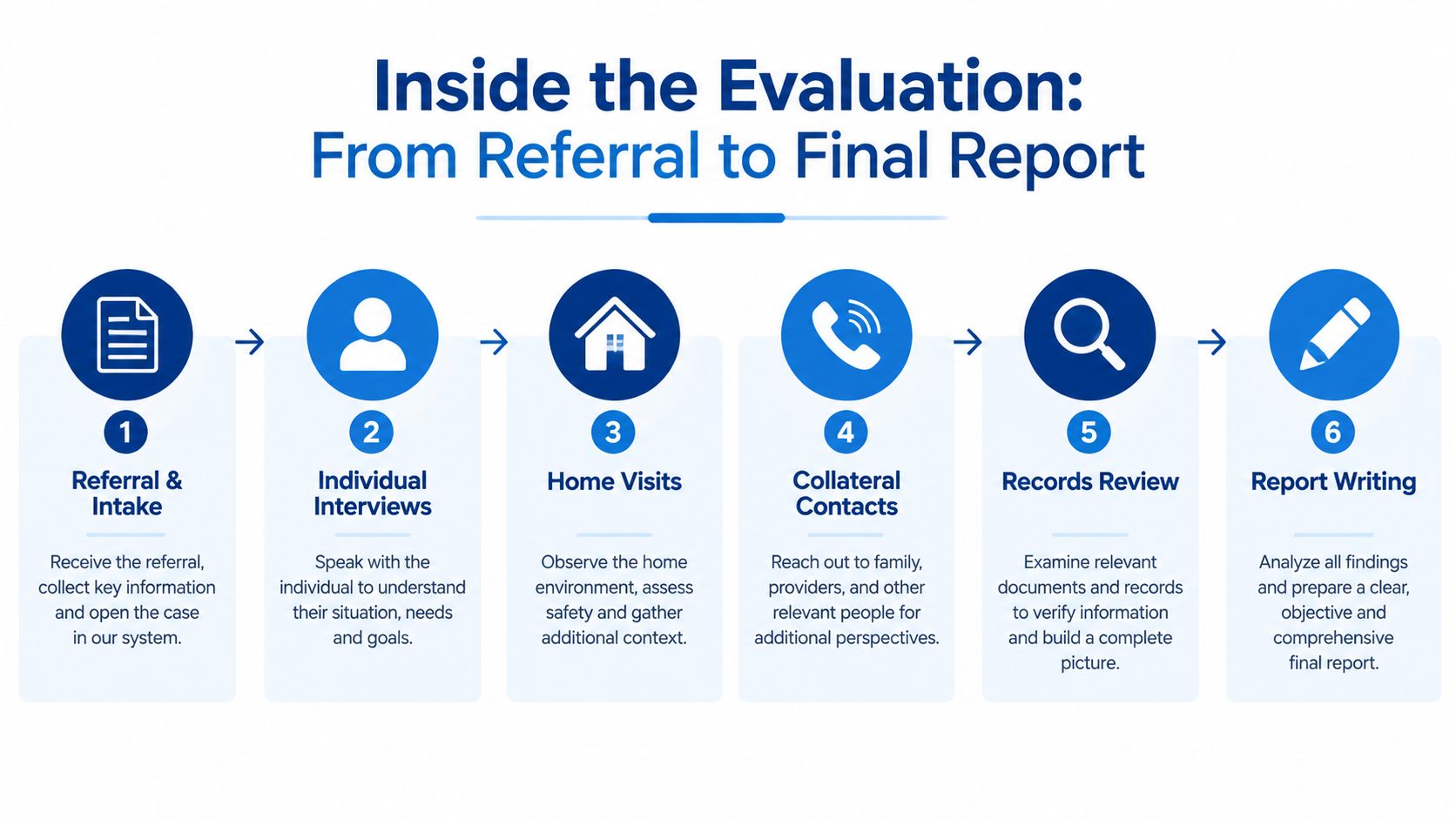
The Tarrant County social study custody evaluation process usually unfolds as a sequence of information-gathering steps. The exact scheduling and scope depend on the order, the evaluator, the family's circumstances, and the information the evaluator believes is necessary.
Referral and intake
After appointment, the evaluator receives the referral and reviews the court order. Intake may involve collecting contact information, scheduling appointments, explaining required forms, and identifying the issues that need investigation.
Read every instruction from the evaluator. If the evaluator requests releases, questionnaires, records, or contact information for other people, respond promptly and keep copies of what you provide. Your attorney can help you understand whether a requested item raises a legal concern.
Individual parent interviews
The evaluator generally interviews each party separately. These interviews may cover parenting history, the child's routine, school and medical matters, communication between the parents, household relationships, and concerns about safety or adjustment.
Answer the question asked. A long list of accusations can make it harder to identify the facts that matter. If you're discussing a serious concern, explain what happened, when it happened, who observed it, and what records or witnesses may help verify it.
Child interviews
Texas custody-evaluation materials identify an interview of each involved child who is at least four years old as a basic element, conducted in a developmentally appropriate manner. Texas Family Code Chapter 107 lists the basic elements of a custody evaluation
A developmentally appropriate interview doesn't mean the child is responsible for deciding custody. Parents shouldn't rehearse answers, tell a child what to say, or ask the child to report back about the evaluator's questions. Children often feel pressure when adults discuss litigation around them, so keep adult legal conversations away from the child as much as possible.
Home visits and household interviews
The statutory basic elements include a home visit in each home visited. The evaluator may assess the child's living environment, sleeping arrangements, safety considerations, routines, and interactions within the home.
Texas law also identifies interviews with people who live in or frequently visit the child's home, as well as any other person the evaluator believes is necessary. That could include household members, relatives, caregivers, or other adults with meaningful firsthand information.
Collateral contacts and records review
The evaluator may seek information from third parties. Depending on the issues in the case, collateral sources may include teachers, medical professionals, counselors, childcare providers, relatives, or other people with direct knowledge. A person who has only heard one parent's version may offer less useful information than someone who has regularly observed the child or parenting environment.
Records can provide another way to compare accounts. Relevant materials may include school, medical, counseling, childcare, communication, or court records, depending on the order and the evaluator's request. Don't hide unfavorable information or assume the evaluator won't discover it through another source.
Observations and the written report
Tarrant County Family Court Services identifies home and/or school observations as part of the process. An evaluator may observe parent-child interactions or the child's circumstances in a setting connected to the assignment.
The process ends with a written report containing findings, opinions, and recommendations. The report is designed to answer the court's questions based on the information gathered. It's not an automatic custody order, and it doesn't eliminate the parties' opportunity to address the case through their attorneys and the court process.
How to Prepare for Your Social Study and Avoid Common Mistakes
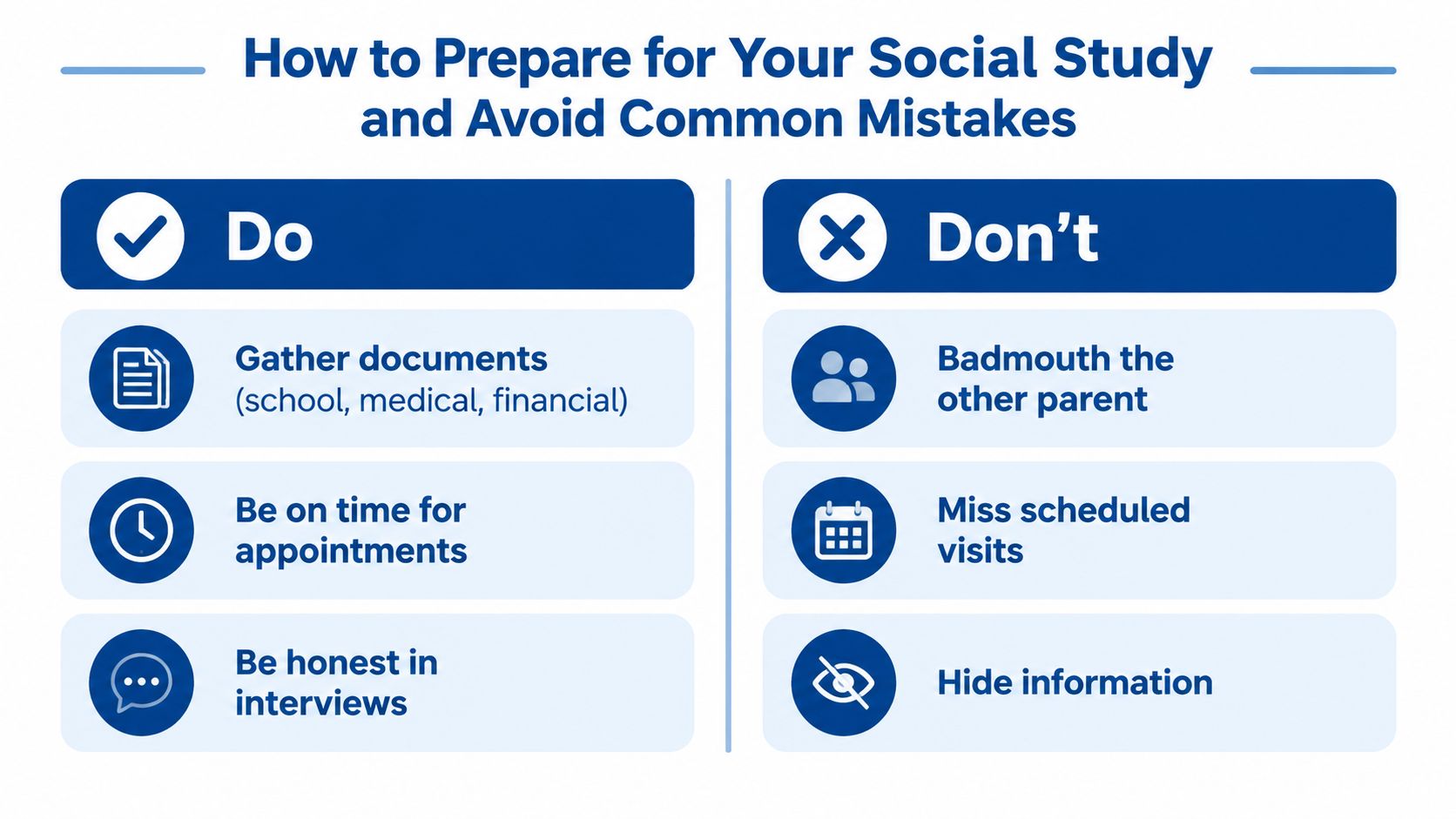
A parent may arrive prepared to discuss the other parent's conduct, then discover that the evaluator is also checking records, household conditions, and the child's daily experience. Preparation works best when it is organized, truthful, and practical. Treat the social study like a record audit rather than a performance. The evaluator may compare your statements with documents, home conditions, collateral information, and your interactions with the child.
Organize documents before the first appointment
Create one clearly labeled paper or electronic folder for records related to the child and the issues identified in the court order. A focused file helps the evaluator find relevant information without sorting through unrelated material.
- School information: Group attendance, grades, teacher communications, and other school records that relate to the evaluation.
- Medical information: Gather records concerning care, appointments, medications, or treatment when those matters are relevant.
- Parenting communications: Preserve messages about schedules, exchanges, decisions, and specific concerns.
- Court materials: Include current orders and any documents your attorney recommends providing to the evaluator.
Keep messages intact. Do not delete inconvenient records or prepare a version of events that removes important context. For a sensitive legal document, ask your attorney how it should be submitted. Confirm the evaluation fee and payment deadline with the evaluator's office early, using the court order to determine who is responsible.
Identify credible collateral witnesses
A useful collateral witness has firsthand knowledge. A teacher who has observed the child's school adjustment may provide more relevant information than a friend who has only heard complaints about the other parent.
Make a factual list of people who know the child, parenting arrangements, or home environment. Do not pressure anyone to choose a side or suggest what a witness should say. The evaluator decides which contacts are needed, so provide accurate names and contact information without coaching the process.
Prepare the home without staging it
The home should be safe, functional, and suitable for the child. Address ordinary hazards, provide an appropriate place to sleep, and allow the evaluator to observe the home without unnecessary disruption.
A staged home can create credibility concerns if it does not reflect daily life. Consistent routines and genuine care matter more than a temporary display. The same principle applies if the visit occurs at another location named in the order.
Help your child without coaching
Tell your child that adults may ask questions and that truthful answers are appropriate. Do not suggest particular answers, criticize the other parent during preparation, or ask the child to report what was discussed afterward.
Practical rule: Prepare your child to be truthful, not to produce a result.
Avoid preventable credibility problems
A parent may say the other parent blocks school involvement, while the records show that the parent missed scheduled meetings or withheld school information. The evaluator may examine both accounts instead of accepting either statement automatically. Consistency between what you say, what the records show, and how you act is easier to explain than a polished but incomplete story.
Common problems include:
- Badmouthing the other parent: Keep adult grievances out of the child's conversations and avoid hostile statements during interviews.
- Missing appointments: If an emergency affects attendance, communicate promptly and keep the evaluator informed.
- Withholding records: Provide relevant information rather than assuming it cannot be obtained elsewhere.
- Missing the fee requirement: Confirm the amount, responsibility, and deadline with the evaluator's office and review the order promptly.
- Providing incomplete disclosures: Check every requested form and attachment before submitting the materials.
For practical logistics, review the Tarrant County Family Law Center location and floor information before attending an appointment or court-related meeting. Knowing where to go reduces avoidable stress and leaves more attention for the evaluation itself.
Timelines Fees and How Tarrant County Courts Use the Report
A social study can feel like a finish line, but the schedule works more like a chain. Interviews, home visits, records, collateral contacts, releases, and the questions in the court order must all connect. A missing link, such as incomplete paperwork, an unavailable witness, a late payment, or a delayed release, can hold up the final report.
The court order and the Tarrant County checklist work together. The order tells the parties what the evaluator must address and who is responsible for each task. The checklist supplies practical requirements for completing the evaluation. Payment timing matters: the checklist sets $500 per party unless the court orders otherwise, and an unpaid fee can stall the work. The legislative materials identify the Tarrant County checklist reference. The cited Texas legislative materials contain the Tarrant County checklist reference Review the order early, confirm the deadline with the evaluator's office, and ask your attorney to explain any unclear division of responsibility.

Report disclosure rules
Texas law sets disclosure deadlines based on the evaluator's arrangement. A private child custody evaluator must provide the report to the parties' attorneys, any unrepresented party, and other court-appointed persons by the earlier of the third day after the report is completed or the 30th day before trial. For an evaluator working for, or under contract with, a domestic relations office, the deadline is the earlier of the seventh day after completion or the fifth day before trial. Texas Family Code Section 107.114 addresses disclosure of the evaluation report
These deadlines govern when the completed report must be shared. They do not promise that the investigation will finish by a particular date. The order, trial setting, evaluator's workload, cooperation from the family, and access to records still shape the working schedule.
Evaluator qualifications
Texas law also establishes minimum qualifications for child custody evaluators. A qualified evaluator generally has a master's degree in a human-services field and Texas licensure as a social worker, professional counselor, marriage and family therapist, or psychologist. A Texas-licensed physician with board certification in psychiatry may also qualify.
The statute requires relevant supervised experience, supervised custody-evaluation work, and training concerning family-violence dynamics. The requirements include two years of relevant supervised experience, 10 court-ordered child custody evaluations under supervision or supervised practice to complete those evaluations, and at least eight hours of family-violence dynamics training from a family-violence service provider. Texas Family Code Section 107.104 sets evaluator qualifications
How the court considers the report
The report organizes the evaluator's investigation for the judge. It does not decide conservatorship, possession, or other custody issues by itself. The court may consider it alongside testimony, documents, pleadings, and other admissible information, so a recommendation is one part of the case rather than an automatic result.
After receiving the report, an attorney can help identify factual errors, prepare questions, and place the findings beside the evidence already before the court. That review matters when the report omits information, relies on an inaccurate account, or makes a recommendation that needs a careful response.
Next Steps When a Social Study Is Part of Your Custody Case
Start by locating the signed order, the evaluator's contact information, every request for records or forms, and any stated payment instructions. Keep a calendar for interviews, home visits, deadlines, and court settings. If the case includes allegations of family violence, substance use, mental health concerns, relocation, or a dispute over a child's safety, get legal guidance before responding informally.
A qualified Fort Worth family law attorney can help you understand the scope of the order, organize relevant evidence, communicate with the evaluator through the proper channel, and prepare for how the report may be addressed in court. If the issue involves a nonparent seeking conservatorship, review the specific good-cause requirement and consider whether a resource about amicus attorney appointments and costs in Tarrant County custody cases applies to your situation.
Bring the court order, relevant pleadings, recent custody records, a clear timeline of major events, and your questions to a consultation. This article provides general information, not individualized legal advice, and the right preparation depends on the facts and orders in your case.
The Law Office of Bryan Fagan PLLC offers family law guidance for parents dealing with custody evaluations, social studies, possession disputes, and related Tarrant County proceedings. Visit Law Office of Bryan Fagan PLLC to learn about the Start Here process and request a consultation about the next step in your case.
