 Skip to content

Agreed resets of non-final family hearings can usually be handled informally before the associate judge, but resetting a final trial generally requires a written motion, notice, and a hearing. For most Tarrant County trial settings, a continuance motion generally must be filed by the Wednesday before trial and heard at 2:00 p.m. on the Thursday before trial, unless the court sets a different schedule.
Your custody hearing is on the calendar, childcare is arranged, and then a problem appears. Perhaps your lawyer becomes ill, a witness can't attend, or you discover a medical issue that makes the scheduled date unworkable. In Fort Worth and the surrounding Tarrant County communities, the answer depends first on what kind of setting you need to move.
People often use “reset” and “continuance” as if they mean the same thing. They overlap, but the local family rules treat them differently, especially when the setting is a final trial rather than a temporary hearing. The practical decision is simple to state: identify the hearing, determine whether everyone agrees, and then find out whether the court requires a written motion and hearing.
Table of Contents
- When a Tarrant County Family Hearing Gets Rescheduled
- How the Local Rules Separate Final Trials From Other Settings
- Deadlines That Control a Continuance Motion
- Agreed Resets Versus Contested Motions in Tarrant County
- A Realistic Walkthrough of a Final Trial Reset
- Emergency Resets and Child Protection Settings
- Practical Next Steps for Fort Worth and Tarrant County Families
When a Tarrant County Family Hearing Gets Rescheduled
Maya, a Fort Worth mother, has a Monday temporary-orders hearing about possession of her child. Her attorney comes down with the flu over the weekend. Maya and the other parent agree that neither side wants to proceed without counsel, so they ask the court to move the setting.
That request is usually described as a reset because it concerns a non-final proceeding. A reset moves a hearing to another date without deciding the ultimate divorce or custody issues. Temporary custody requests, protective-order settings, status conferences, and other interim matters can fall into this category. A continuance generally refers to postponing a final trial or another setting that requires more formal treatment, although people and courts sometimes use the terms interchangeably.
Tarrant County family local rules draw the key line at the final trial. For proceedings other than final trials, agreed motions for continuances and resets may be presented to the associate judge without a written motion. A final trial generally can't be continued or reset without a written motion, notice, and hearing, unless all parties sign a written agreement and the court consents. The Tarrant County family-law local rules contain that distinction.
What happens after the court agrees
A rescheduled setting isn't merely a private agreement between parents. The court must accept the change, and the new setting needs to be reflected in the court's records.
The process may involve:
- The clerk records the new date. The docket should show that the original setting changed.
- The associate judge confirms the action. If the matter is presented in court or by an approved court process, the judge may announce the result on the record.
- The parties receive a new setting. Keep the new notice and verify the date, time, courtroom, and type of hearing.
- The old date no longer controls only after court approval. Until the court grants the reset, you should assume the existing setting remains active.
Practical rule: “We both agree” doesn't automatically change a court date. The court's consent is still required.
The courthouse location, assigned court, and filing process matter. A useful starting point for checking a Fort Worth family docket is this Tarrant County 325th District Court family docket resource, but you should also confirm information with the clerk or court coordinator handling your case.
The next question is whether your setting is an interim hearing or a final trial. That distinction controls how much paperwork and notice the court expects.
How the Local Rules Separate Final Trials From Other Settings
A temporary hearing usually addresses an immediate issue while the case continues. A final trial decides the merits, such as the final conservatorship arrangement, possession schedule, child support issues, or property questions in a divorce. Because a final trial can resolve the central disputes, the court uses more formal procedures before moving it.
For non-final proceedings, the local family rules allow an agreed reset to be presented to the associate judge without a written motion. That flexibility helps the court manage temporary-orders settings and other interim matters without requiring a full motion practice process every time both sides need a different date.
A final-trial reset is different. The local rule generally requires a written motion, notice, and hearing, unless every party signs a written agreement. Even then, the court must consent. This protects the other side from being surprised by a change that affects preparation, witnesses, discovery, settlement discussions, and the time needed to present evidence.
Texas statewide procedure still matters. Tarrant County's trial procedures direct parties to comply with the applicable Texas Rules of Civil Procedure, including Rules 251, 252, 253, and 254, as reflected in the county's trial-procedure guidance for motions for continuance. Local rules supplement those statewide requirements. They don't erase them.
The decision tree in plain English
Ask these questions in order:
- Is this a final trial? If yes, expect formal written motion practice unless all parties sign a written agreement and the court accepts it.
- Is it another kind of family proceeding? An agreed reset may be presented to the associate judge without a written motion under the local family rules.
- Does the other side object? If yes, treat the request as contested and prepare for a hearing.
- Is the matter in a child-protection court? Chapter 262 of the Texas Family Code may affect the timing and urgency.
- Does the assigned court have additional procedures? Check the applicable court's instructions because Tarrant County courts can differ on signatures, deadlines, and hearings.
| Factor | Non-Final Hearing | Final Trial |
|---|---|---|
| Common examples | Temporary orders, status settings, protective-order matters | Trial deciding the merits of custody or divorce issues |
| Agreed request | May be presented to the associate judge without a written motion under the family local rules | Generally requires written motion, notice, and hearing unless all parties agree in writing |
| Court approval | Still required | Still required |
| Main concern | Keeping an interim issue moving efficiently | Protecting preparation, notice, witnesses, and trial fairness |
| If opposed | The court may require formal motion practice and a hearing | Written motion, notice, and hearing are generally central to the request |
A final trial setting deserves special care because moving it can disrupt every preparation task connected to the trial. Parents seeking help with related preparation may also benefit from reviewing Tarrant County mediation requirements before a final trial, since a new trial date can affect how the remaining pretrial work is organized.
Deadlines That Control a Continuance Motion
Tarrant County county-court local rules generally require a continuance motion to be filed no later than the Wednesday before the trial date and heard at 2:00 p.m. on the Thursday before trial, unless the court sets another schedule. The same county materials state that a trial date can't be postponed or changed without the court's consent. An agreement between parents doesn't make the reset automatic. See the Tarrant County local rules on continuance timing.
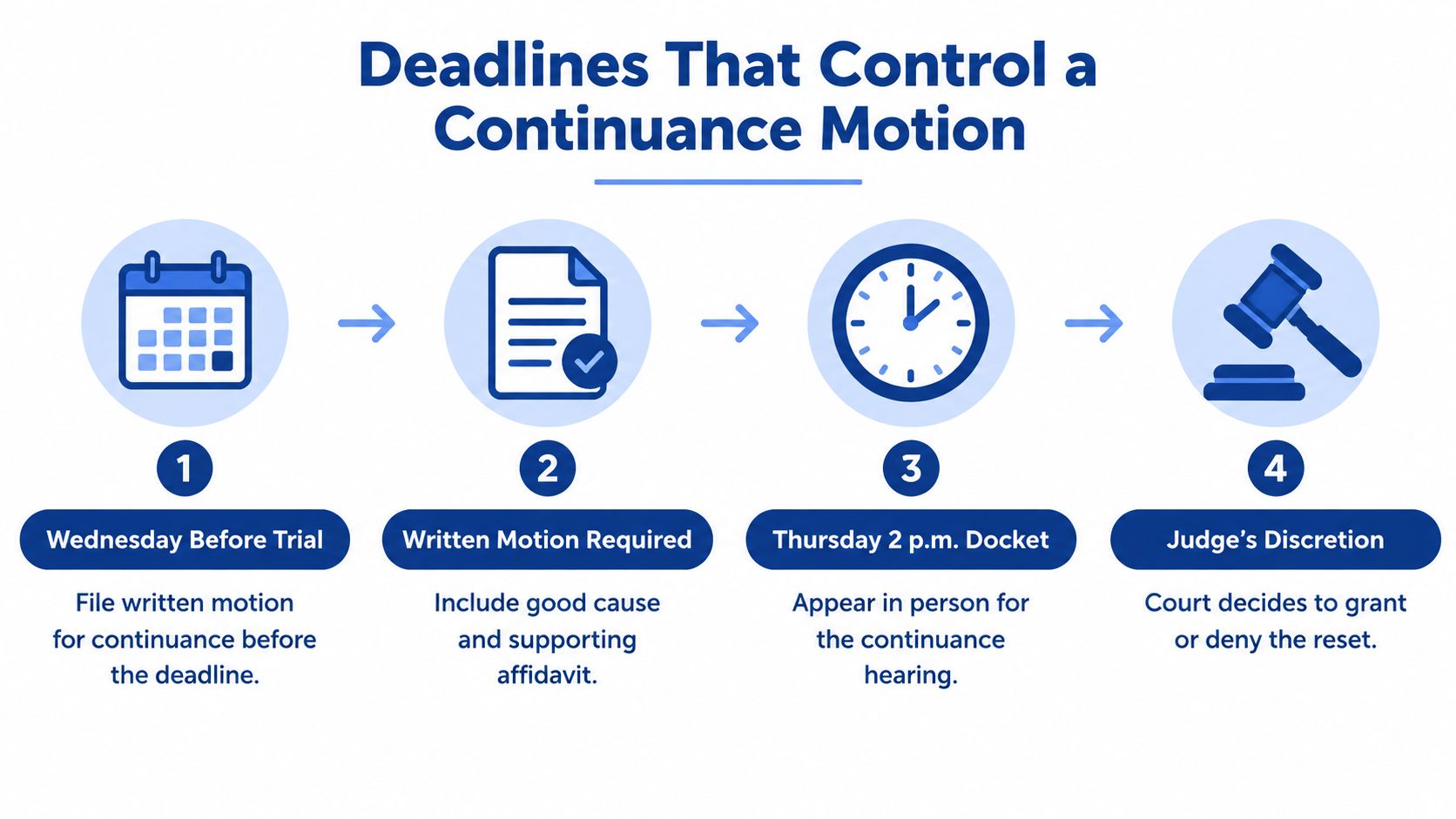
A calendar example
Suppose your family trial is set for the following week. You learn on Tuesday that an important witness can't attend. Filing the motion on Tuesday may satisfy the Wednesday-before-trial deadline, but filing it isn't the end of the process. You still need to address the hearing, notice, service, supporting facts, and any court-specific filing requirements.
A careful filing packet may include:
- A written motion. Explain the reason for the continuance and identify the setting involved.
- Supporting proof. Later-arising facts should be presented promptly, with documents that help the judge evaluate the problem.
- A certificate of conference. State whether you contacted the other side and whether the request is agreed or opposed.
- Notice of hearing. Make sure the other parties receive the information required for the hearing.
- A proposed order. Use the court's required format if one applies.
The Texas Rules of Civil Procedure govern the supporting requirements. Rule 251 addresses good cause and related requirements, Rule 252 addresses supporting affidavits, and Rule 253 concerns additional motions and trial-related matters. A motion that arrives late, lacks required support, or doesn't give the other side a fair opportunity to respond may be denied.
If the problem arises after the ordinary deadline, file as soon as possible rather than waiting. An emergency medical event or sudden witness problem isn't treated the same way as a scheduling conflict known well in advance, but the court still decides whether the facts justify moving the setting.
For a visual explanation of the filing sequence, review the following:
Agreed Resets Versus Contested Motions in Tarrant County
An agreed reset starts with cooperation. Both sides communicate, identify a replacement date or scheduling need, and present the request through the process accepted by the assigned court. For a non-final proceeding, the family local rules allow an agreed motion for a reset or continuance to be presented to the associate judge without a written motion.
That doesn't mean every court handles the paperwork identically. County materials describe differences among courts, including situations where an agreed continuance for a case less than one year old may be granted without a hearing, while an older case may require signatures from all counsel. An opposed continuance may require a hearing. Those variations are why a parent shouldn't assume that a procedure used in one Tarrant County courtroom will work in another.
What changes when the request is contested
A contested motion means the other side objects, doesn't agree to the new date, or can't be reached in a way that allows the court to treat the request as agreed. The judge then needs enough information to decide whether the reason is legally sufficient and whether moving the case would unfairly harm the other side.
A contested final-trial continuance commonly requires the formal path:
- Prepare the written motion.
- State the reason and explain why the problem couldn't be handled earlier.
- Attach appropriate supporting material.
- Contact the other side and document the result.
- Provide notice of the hearing.
- Appear when the court sets the matter for consideration.
- Wait for the court's ruling and new setting, if granted.
| Element | Agreed Reset | Contested Motion for Continuance |
|---|---|---|
| Agreement | All parties consent, when required by the court | One party objects or agreement can't be obtained |
| Written motion | May not be required for an agreed non-final setting | Usually required, especially for a final trial |
| Hearing | The associate judge may accept the presentation without a formal hearing for a qualifying non-final setting | A hearing is generally needed so both sides can be heard |
| Signatures | The assigned court may require signatures from all counsel or parties | Signatures show service or agreement, but they don't replace the court's ruling |
| Court authority | The court must still consent | The judge decides whether the legal reason supports a continuance |
| Risk | Assuming agreement changes the date without approval | Filing late or offering a vague reason without proof |
The presiding judge and associate judge also aren't interchangeable for every purpose. Tarrant County family rules provide that the presiding judge generally can't grant a continuance or reset without a written motion, notice, and hearing unless all parties agree and the court consents. The Texas Supreme Court administrative order addressing this distinction reinforces why the identity of the judicial officer matters.
A Realistic Walkthrough of a Final Trial Reset
Consider a hypothetical custody case in Tarrant County. Jordan and Casey are scheduled for a final trial, and Jordan learns that a necessary witness has an unexpected medical issue. The trial is close enough that Jordan can't ask the clerk to move it.
Jordan first confirms that the setting is a final trial, not a temporary-orders hearing or a status docket. That classification determines the formal path. Jordan contacts Casey's attorney, explains the problem, and asks whether Casey agrees. Casey objects because the witness issue affects Jordan's preparation, not Casey's ability to proceed.
The filing and hearing
Jordan prepares a written Motion for Continuance. The motion identifies the trial setting, explains when the witness problem arose, describes why the testimony matters, and attaches appropriate supporting information. Jordan also includes a certificate of conference showing that the parties discussed the request and that Casey opposes it.
Because the ordinary local timing rule generally places the filing deadline on the Wednesday before trial and the hearing on the Thursday before trial at 2:00 p.m., Jordan files by the applicable Wednesday deadline and prepares to attend the Thursday docket. The motion must also provide proper notice to Casey, because Casey has the right to respond.
At the hearing, Jordan explains the facts. Casey explains the prejudice caused by moving the trial and may argue that the witness's absence doesn't justify delaying the case. The associate judge then decides whether the stated reason and supporting proof satisfy the governing requirements.
What a ruling changes
If the court grants the motion, the original trial date is replaced with the new date selected or approved by the court. Jordan should confirm the ruling in the docket, obtain the written order if one is entered, and review every deadline tied to the new trial date.
If the court denies the request, the original trial setting remains in place unless the court orders something different. A parent shouldn't assume that filing a motion puts the trial on hold.
The public docket may show the continuance, the new trial date, or another event reflecting the court's action. Check the docket and court communications directly. A private email between the parties isn't a substitute for a court order.
Emergency Resets and Child Protection Settings
A last-minute problem can arise after the ordinary filing deadline. A serious medical event, an unexpected witness issue, or newly discovered facts may justify asking the court for immediate relief, but the party requesting the change still needs to explain what happened, when it happened, and why the court should act despite the timing.
The county materials distinguish between an ordinary continuance request and a motion based on later-arising facts. When a new problem develops, the safer approach is to file or present the request as soon as possible, rather than waiting for the next routine docket. Include supporting records when appropriate, while protecting confidential medical and child information from unnecessary public filing.
Child-protection cases need separate attention
Tarrant County family rules connect continuance practice in child-protection matters to Chapter 262 of the Texas Family Code. That matters in CPS cases because emergency removal proceedings and related settings can operate under different statutory timelines and priorities than an ordinary divorce or custody hearing.
A parent facing a CPS removal setting shouldn't treat it like a routine temporary-orders reset. Missing the setting, delaying action, or signing an agreement without understanding its effect can affect the child's placement and the parent's ability to respond. The Tarrant County CPS removal resource can help explain the local subject area, but case-specific advice should come from a qualified Texas family lawyer.
The judicial officer also matters. A request directed to the associate judge may follow a different path from one presented to the presiding judge. Emergency facts don't guarantee a reset, and they don't eliminate notice or court-consent requirements unless a valid legal procedure allows the court to act without ordinary notice.
When the setting involves child safety, act first and explain clearly. Preserve the notice, gather proof, contact the court through the approved channel, and get legal help promptly.
Practical Next Steps for Fort Worth and Tarrant County Families
The morning you realize a hearing may need to move, slow down long enough to identify the setting. A parent who calls a request a “reset” may be describing a final trial, while a parent who asks for a “continuance” may be dealing with a non-final hearing. The label matters less than the actual purpose of the setting.
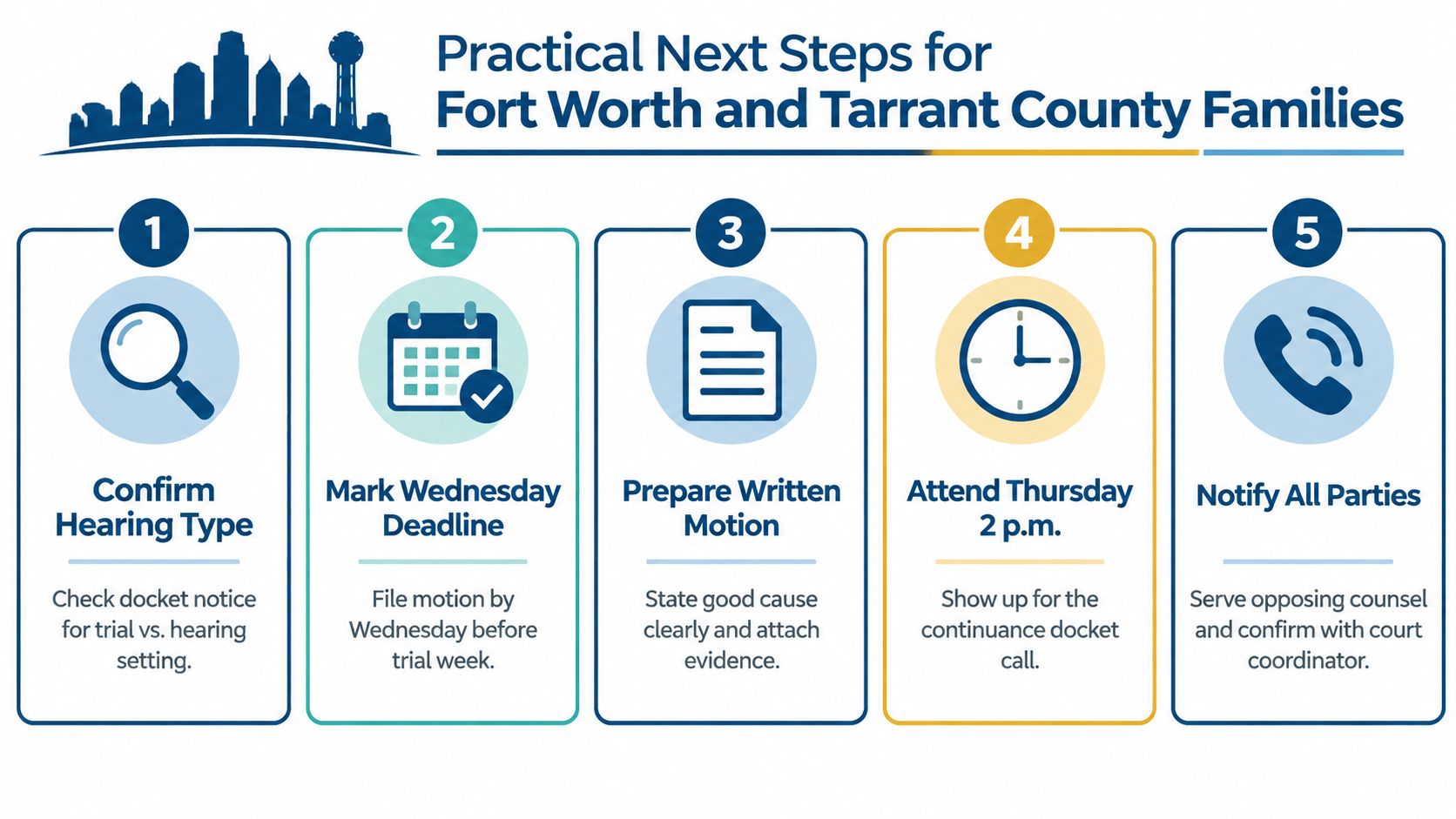
A working checklist
- Read the docket notice: Confirm whether the matter is a final trial, temporary hearing, status setting, protective-order matter, or child-protection proceeding.
- Mark the filing deadline: For a trial continuance, place the Wednesday-before-trial deadline on your calendar and verify whether the assigned court uses a different schedule.
- Contact the other side: Ask whether the request is agreed, and keep a written record of the response.
- Prepare the packet: Gather the motion, supporting affidavit or exhibits, certificate of conference, certificate of service, and proposed order when appropriate.
- Plan for the hearing: If the request is contested, prepare to appear at the Thursday 2:00 p.m. continuance setting unless the court gives different instructions.
A proposed order isn't a guarantee of approval. It gives the judge a document to sign if the request is granted. File through the method accepted by the assigned court and verify that the clerk received the documents. The Family Law Center on East Belknap may be relevant to your case, but confirm the correct filing location, clerk, and courtroom before traveling.
Don't overlook work, transportation, childcare, or remote-appearance instructions. A parent who assumes the court will call them may miss the hearing if the court requires in-person attendance. The court's coordinator or clerk can provide procedural information, but they can't advise you whether your facts legally justify a continuance.
Self-help materials may not be enough when a final trial is only days away, the other side objects, or the request concerns a CPS removal under Chapter 262. Get advice before signing an agreed reset if it could affect your preparation, statutory timing, or another right. The Tarrant County Law Library self-help desk and local bar pro se resources may help with general forms and procedure, while a confidential consultation can address the facts of your case.
The Law Office of Bryan Fagan PLLC can help you evaluate whether your Tarrant County family setting is an informal agreed reset or a formal continuance request requiring motion practice. Visit Law Office of Bryan Fagan PLLC to learn about family-law guidance in Fort Worth and arrange a consultation before you sign an agreement or miss a court deadline.
