 Skip to content

Tarrant County's current probate fee schedule lists a $500 attorney ad litem deposit, but the final fee is reasonable compensation set by the court and taxed as costs payable from the estate, a party, or registry funds. The deposit is a starting payment, not necessarily a guarantee that the appointment will end at that amount.
You may be looking at an heirship application after a family member's death, or preparing a guardianship filing for someone who needs protection. At the clerk's window in Fort Worth, the immediate question is often simple: How much must be paid for the attorney ad litem appointment? The practical answer becomes more complicated because Texas law gives the probate court control over the final compensation.
Tarrant County's probate courts are located at the Tarrant County Old Courthouse in Fort Worth, and the county's published materials provide local fee benchmarks. Those benchmarks help families budget, but they don't replace the court's authority to approve reasonable compensation in the particular case. A straightforward appointment may remain close to the deposit, while an unusual matter may require additional work and a request for extra compensation.
Table of Contents
- What You Will Pay for an Attorney Ad Litem in Tarrant County Probate Court
- Understanding What an Attorney Ad Litem Does in a Texas Probate Case
- How and When Tarrant County Probate Courts Appoint an Attorney Ad Litem
- How Much an Attorney Ad Litem Costs and How Courts Set the Fee
- Who Pays the Attorney Ad Litem and When the Deposit Is Not the Final Cost
- Practical Steps to Address Appointment and Manage Costs in Tarrant County
- Local Resources and Next Steps for Fort Worth and Tarrant County Families
What You Will Pay for an Attorney Ad Litem in Tarrant County Probate Court
Suppose a Fort Worth family files an application to determine heirship after a relative dies. The family believes it knows every heir, but one branch of the family is difficult to locate. The probate court appoints an attorney ad litem to investigate and protect the interests of unknown or missing heirs. Before the appointment moves forward, the county's current probate fee schedule lists an attorney ad litem deposit of $500 in probate matters (Tarrant County Probate Fee Schedule).
That $500 deposit is the current local baseline for the appointment, not necessarily the final amount. Texas law provides that an attorney ad litem appointed in probate is entitled to reasonable compensation set by the court. The approved compensation is taxed as costs in the probate proceeding and may be paid from the estate, by a party, or from registry funds in certain circumstances.
Practical rule: Treat the deposit as the amount needed to get the appointment administered, not as a promise that no additional compensation can ever be approved.
The difference matters to families in Fort Worth, Arlington, Keller, Southlake, Grapevine, Mansfield, and nearby communities. A person filing the case may need to provide the initial funds, but the probate court can later determine how the expense belongs in the overall cost structure of the proceeding.
Tarrant County materials also show older benchmarks. A prior heirship-related fee reference used a $400 attorney ad litem fee, while a guardianship filing requirement used a $500 fee under an administrative order. The county's more recent probate schedule lists the $500 probate deposit, showing why older forms and online discussions can give applicants conflicting answers.
The safest budgeting approach is to ask three separate questions:
- What deposit does the clerk require? The current probate schedule identifies the local starting amount.
- What work will the appointment involve? A simple review may differ from an investigation involving missing family members or incomplete records.
- How will the court handle the final fee? The judge approves compensation and determines how it is taxed as a probate cost.
Understanding those distinctions before filing can prevent an unpleasant surprise and help you ask focused questions about the appointment order, payment process, and possible additional compensation.
Understanding What an Attorney Ad Litem Does in a Texas Probate Case
An attorney ad litem serves a different purpose from the probate lawyer hired by the applicant or the estate. The retained attorney helps a client pursue the case. The attorney ad litem is appointed by the court to protect people whose interests may otherwise be overlooked, such as unknown heirs, missing heirs, incapacitated persons, or people with a property interest that needs independent protection.
Think of the appointment as an independent checkpoint. The applicant presents the family history and supporting documents. The ad litem examines that information from the perspective of someone who isn't present to speak for themselves.
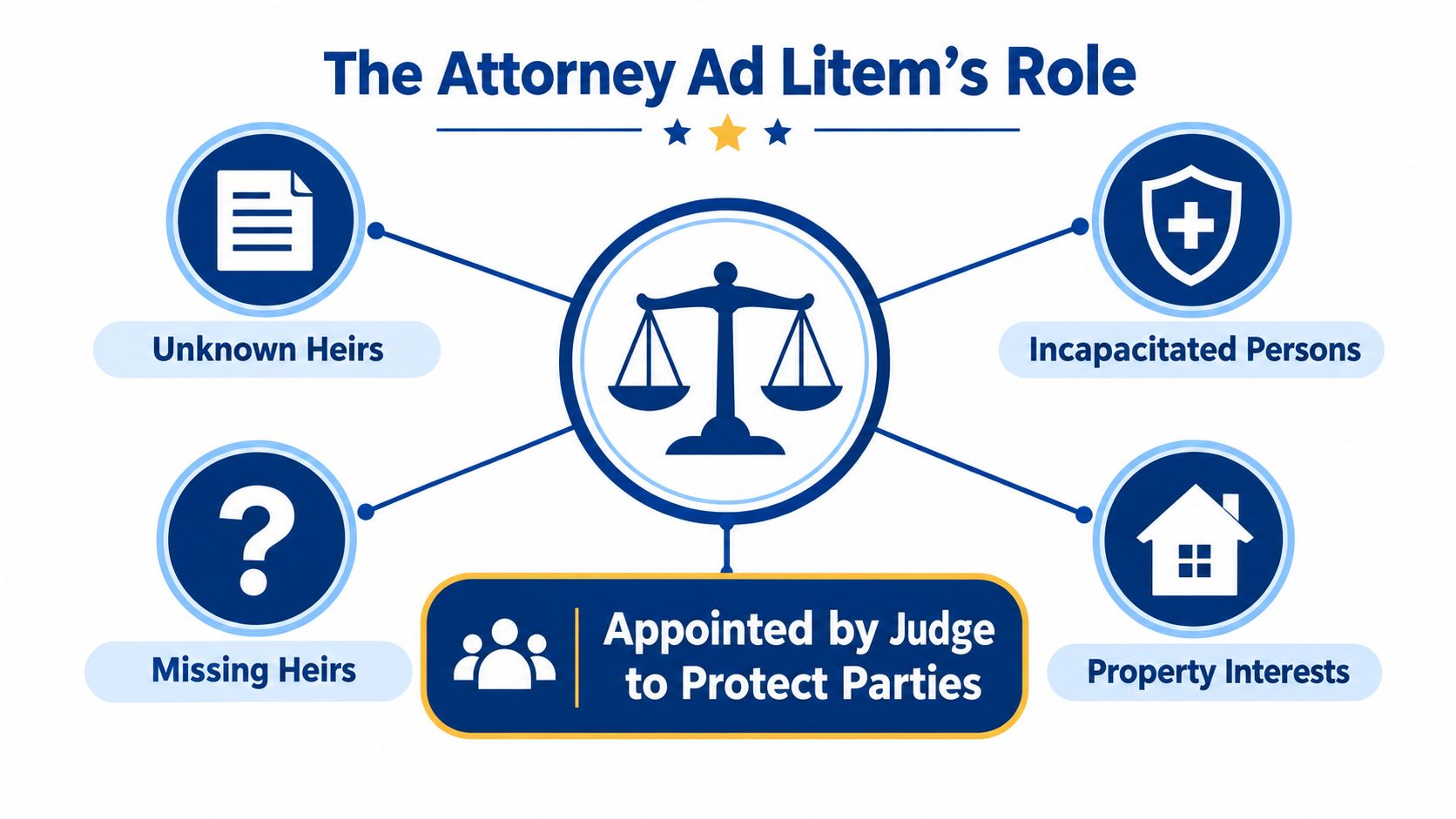
The independent review
Consider an heirship case involving a decedent who had more than one marriage and children from different relationships. The applicant may believe the listed heirs are complete. The attorney ad litem still has an independent responsibility to examine whether an unknown or missing heir could exist.
The work can include reviewing the application, examining available records, speaking with family members or witnesses, researching the family history, and reporting findings to the court. The ad litem doesn't adopt the applicant's conclusions because the appointment exists to test whether the proposed determination protects absent parties.
The attorney may agree with the applicant's evidence, identify missing information, or raise an issue the court should address. That report gives the judge an independent perspective before entering an order affecting inheritance or another protected interest.
How the role differs from other lawyers
An applicant's probate attorney may prepare filings, communicate with the clerk, organize evidence, and present the client's position. An attorney ad litem doesn't represent the applicant merely because the applicant paid the initial deposit. The appointment is tied to the court's protective function.
That distinction also separates an attorney ad litem from a guardian ad litem. The names sound similar, but the appointment and protected interests depend on the proceeding. Ask the court or a qualified Texas attorney to identify the type of appointment in your case rather than assuming every “ad litem” role has the same duties.
The more complicated the family history or protected interest, the more important it becomes to provide complete information promptly. Missing records and delayed answers can require additional investigation, which may affect the final compensation approved by the court.
How and When Tarrant County Probate Courts Appoint an Attorney Ad Litem
A probate filing can look complete while leaving one person's interest unprotected. For example, an heir may be unknown, unavailable, or unable to participate. In that situation, the court may appoint an attorney ad litem to investigate that interest and report back before the judge decides the matter.
The filing begins the process
A family may file an application to determine heirship when the court must establish who inherits. A guardianship applicant may encounter the same type of appointment process when the court needs independent protection for the proposed ward or another affected interest. Other probate matters may require an appointment if a party is missing, unknown, incapacitated, or otherwise needs representation.
The application should identify the relevant people, family relationships, property, and circumstances accurately. Complete information gives the judge a clearer basis for deciding whether an appointment is needed. It also gives the appointed attorney a reliable starting point, which can reduce unnecessary follow-up.
The judge determines whether an appointment is needed
After filing, the judge reviews the pleadings and related materials. If the circumstances show that an absent or protected interest needs separate representation, the judge signs an order appointing a qualified attorney ad litem.
Because Tarrant County has two probate courts, review which probate court hears your case before filing. Choosing the correct court helps direct the application, case number, and later payment records to the proper location.
The appointment order defines the attorney's authority and ties the work to the specific probate case. It also explains why the applicant generally cannot select a preferred lawyer for this role. The judge, rather than the applicant, controls the appointment.
The clerk administers the payment
After the appointment, the clerk connects the required deposit with the case number and the decedent's or ward's name. Tarrant County's probate court resources describe local court information and case administration.
The deposit starts the payment process, but it does not necessarily define the attorney's final compensation. If the assignment requires more investigation, communications, document review, or court appearances, the judge may later review additional compensation. The amount approved becomes part of the probate costs rather than remaining only a private payment arrangement.
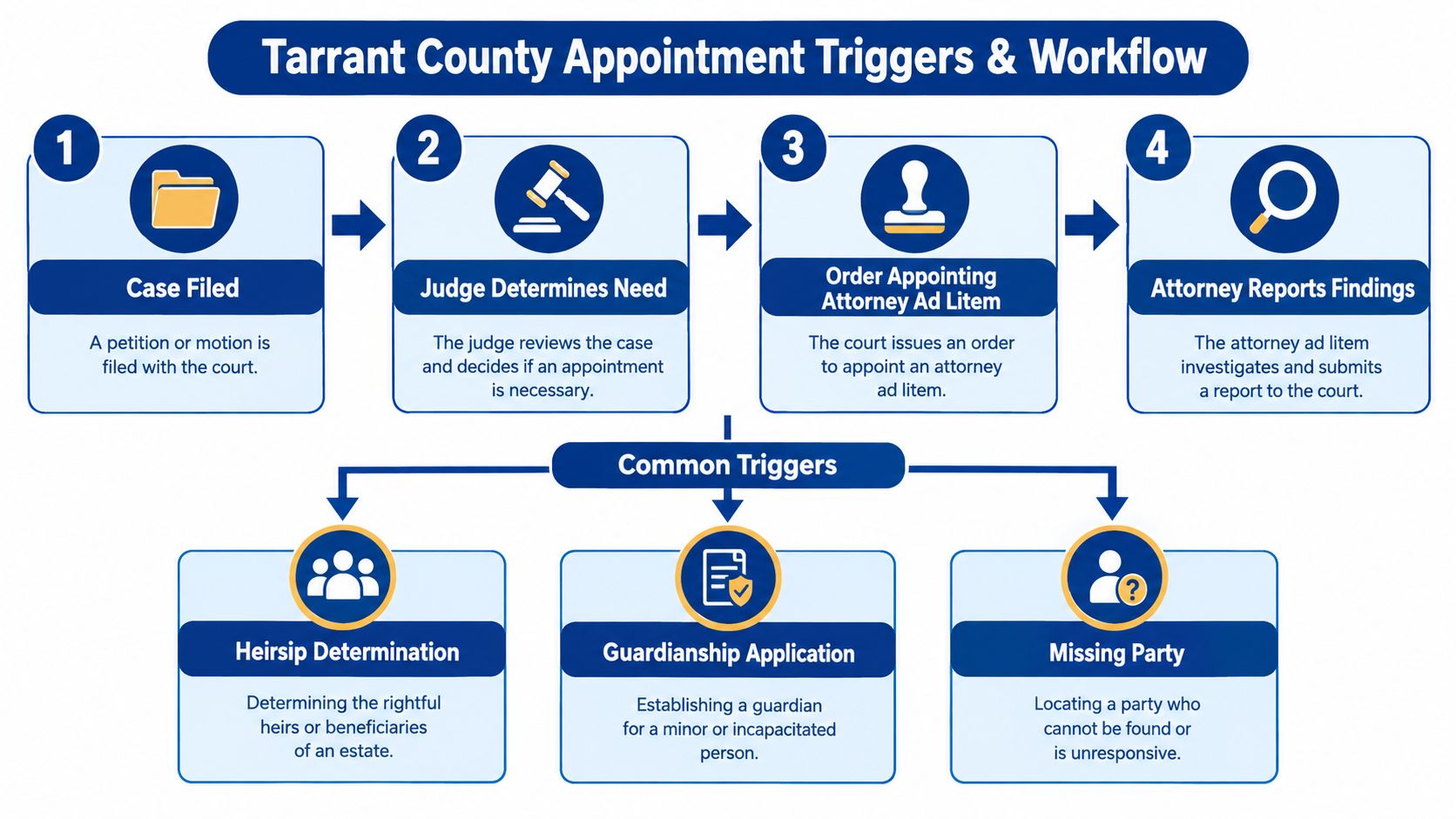
Notice and court review follow
Known parties and other required recipients must receive notice under the applicable procedure. The attorney ad litem then investigates the protected interest and presents findings to the court. The judge considers that report and the evidence before deciding the underlying probate issue.
For filing-location information, review where to file an application in Tarrant County probate court. Filing requirements can vary by case type, so confirm current instructions with the county clerk or a qualified Texas probate attorney.
How Much an Attorney Ad Litem Costs and How Courts Set the Fee
A clerk may ask for a $500 attorney ad litem deposit for a Tarrant County probate matter when the appointment is opened. A separate county schedule lists a $600 guardianship deposit. Older county materials also show a $400 heirship amount and a flat-fee approach for certain appointments (Tarrant County Probate Appointments and Fees).
These figures answer the first payment question. They do not, by themselves, establish the lawyer's final compensation.
Deposit and final compensation are different
Texas law treats final payment as reasonable compensation set by the court. Once approved, the amount can be taxed as a cost of the probate proceeding instead of remaining only a private retainer between the applicant and the appointed attorney.
Tarrant County's older guidance described a flat-fee arrangement for ad litem work in heirship matters. It listed $400 for attorneys ad litem and explained that unusual matters could require a motion for hourly compensation. In some cases, the attorney might also need help from a genealogist before the hearing (Tarrant County probate fee schedule effective September 1, 2017).
The payment process has two stages:
- The applicant or another responsible payer provides the deposit required to administer the appointment.
- The court reviews the work and approves the compensation that should ultimately be charged as a probate cost.
An unusual case can require more work than a standard appointment. The attorney may investigate additional records, communicate with more interested parties, or address issues that do not fit the ordinary flat-fee service. The lawyer must seek court approval for additional compensation rather than treating the deposit as an open-ended authorization to bill. The judge controls the amount approved, which protects the estate and the people whose interests are being examined.
County benchmarks over time
| Period and source | Case type | County-published amount |
|---|---|---|
| Administrative order dated January 1, 2008, reflected in older county materials | Applications to declare heirship | $400 |
| Administrative order dated April 16, 2014, reflected in county materials | Applications for guardianship | $500 |
| Current Tarrant County probate fee schedule | Probate attorney ad litem deposit | $500 |
| Current Tarrant County probate fee schedule | Guardianship deposit | $600 |
Different amounts in older checklists, forms, and articles may reflect changes in county schedules rather than a mistake in the current filing materials. The published schedules keep the initial appointment payment anchored around a set deposit, while the court retains authority to approve a different final amount when the work requires it.
For a practical explanation of appointment duties, deposits, and court-approved compensation, review Tarrant County amicus and attorney ad litem appointment information.
Who Pays the Attorney Ad Litem and When the Deposit Is Not the Final Cost
The person who pays the initial deposit isn't always the person who bears the final cost. Texas probate law allows the court-approved compensation to be taxed as costs and paid from the estate, by a party, or from registry funds in certain circumstances.
That framework reflects the purpose of the appointment. The ad litem performs court-authorized work to protect an interest in the proceeding. The fee therefore becomes part of the formal probate accounting rather than remaining only a private expense of the person who filed the case.
A practical decision matrix
| Situation | Initial payment issue | Possible final treatment |
|---|---|---|
| Heirship application | The applicant may need to provide the required deposit | The court may tax the approved compensation as a probate cost payable from the estate or otherwise allocated by the court |
| Guardianship matter | The filing process may identify a separate guardianship deposit | The court determines reasonable compensation and how the cost is handled in the proceeding |
| Missing or unknown party | The deposit supports the court-appointed investigation | Additional compensation may require court approval if the work becomes unusual |
| Funds held in registry | The clerk's payment process remains tied to the case | Registry funds may be used in circumstances authorized by the court |
The matrix gives a budgeting framework, not a prediction about a particular case. The appointment order, the facts, and the judge's fee determination control.
When extra compensation may arise
Tarrant County's older checklist describes a flat-fee approach unless the matter is unusual and the attorney seeks hourly payment by motion. An investigation can become more involved when family information is incomplete, potential heirs cannot be located, records conflict, or a protected interest requires substantial attention.
The important point is procedural. The ad litem generally can't turn a standard deposit into an unrestricted bill without court involvement. If additional compensation is requested, the court may review the request and determine what amount qualifies as reasonable compensation under the circumstances.
A family should also distinguish between a request for extra compensation and automatic liability for the requested amount. A request is not the same as an approved fee. Ask for the order approving compensation and determine whether the court has taxed the amount as a probate cost.
A deposit answers what must be paid at the beginning. A fee order answers what the court ultimately approved.
If the final approved fee exceeds the initial deposit, the difference may need to be addressed through the probate case's payment or cost procedures. If the estate has assets, the expense may be paid from estate funds. If the estate lacks available funds or the court finds another allocation appropriate, the order may address payment by a party or from registry funds.
Practical Steps to Address Appointment and Manage Costs in Tarrant County
Preparation won't eliminate every cost, but it can reduce avoidable confusion and help the appointed attorney work efficiently. Start by gathering the records that explain the family relationship or the protected person's circumstances.
Before the appointment
Use this checklist when preparing for filing or responding to an appointment:
- File complete documents: Include the information required for the probate application and identify known heirs, interested persons, and relevant property as accurately as possible.
- Prepare deposit funds: Confirm the current amount with the Tarrant County clerk because older materials may show a different benchmark.
- Organize family records: Gather death records, marriage and divorce records, birth records, deeds, contact information, and any documents that clarify the family tree.
- Respond promptly: Answer reasonable requests from the attorney ad litem and tell the attorney when a person is missing, deceased, or difficult to locate.
- Review fee orders: Keep copies of the appointment order, payment receipt, any motion for additional compensation, and the final order approving the fee.
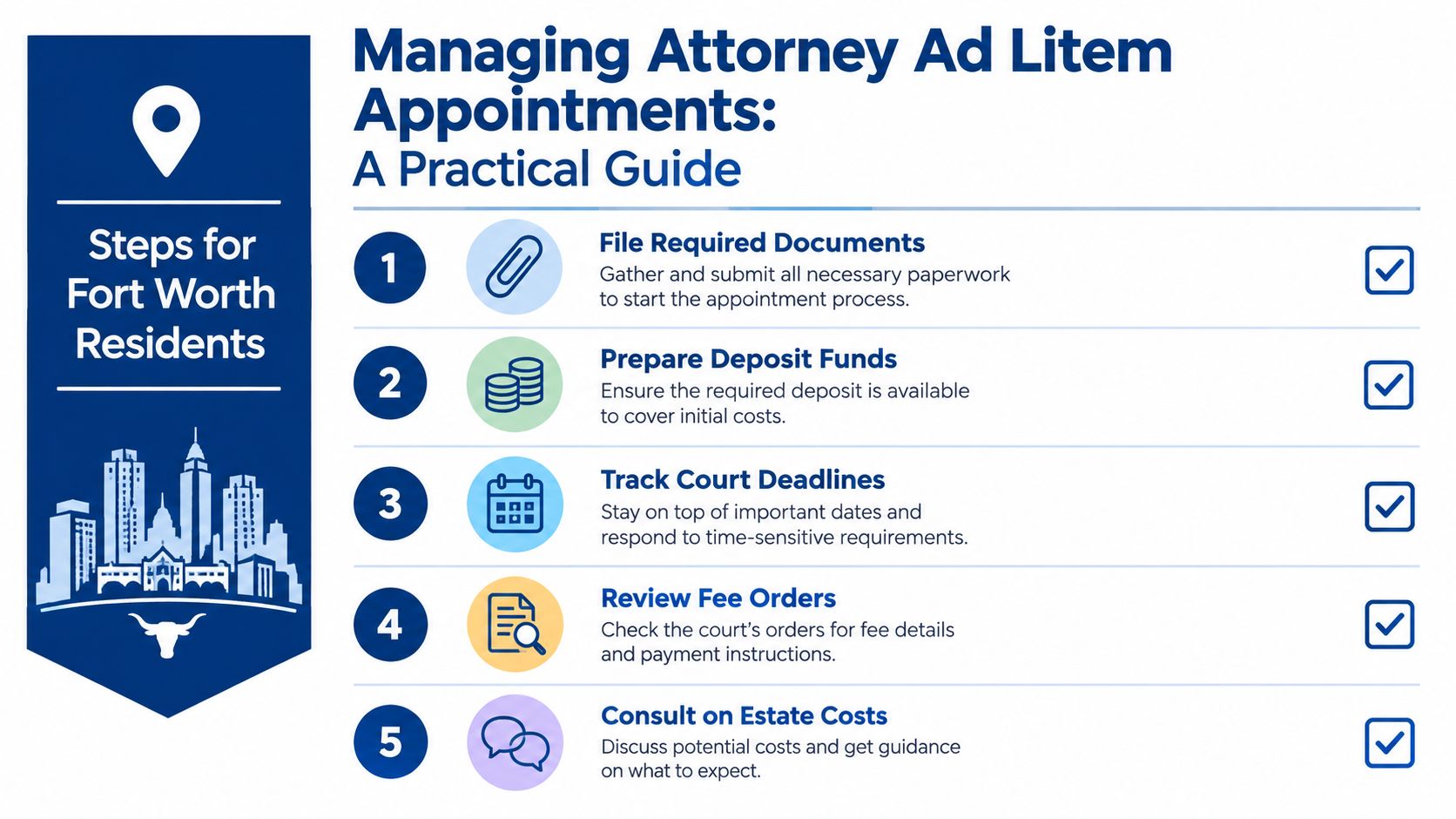
An incomplete family tree can cause repeated follow-up, new record searches, and delays. That doesn't mean every added task creates an extra fee, but it does make it harder to predict the work required.
Two examples
In an heirship matter, a family may know the decedent's children but lack information about an earlier marriage. Providing names, locations, and available records at the outset gives the attorney ad litem a clearer path for checking the possible heirship issue.
In a guardianship matter, the applicant may have medical, family, and contact information that helps identify the people whose interests the court must consider. Organizing those materials before the appointment can make communications more focused.
The applicant should not direct the ad litem's conclusions. The proper role is to provide accurate information, answer questions, and let the appointed attorney independently evaluate the facts.
For local filing guidance, review where to file an application in Tarrant County and confirm current clerk requirements. If you believe a requested fee is unclear or excessive, don't ignore the issue. Ask a qualified Texas probate attorney whether the appropriate response is a written objection, a request for a hearing, or another procedure allowed in the case.
Local Resources and Next Steps for Fort Worth and Tarrant County Families
The Tarrant County Probate Courts at the Old Courthouse are the starting point for local filing and payment information. Use the county clerk's current probate fee schedule and case-specific payment resources rather than relying on an older checklist, especially when the materials show different deposit amounts.
Texas probate questions may also require review of the applicable Estates Code provisions, the appointment order, and any local court instructions. A general article can't determine who should pay in your case, whether an appointment is required, or whether additional compensation should be approved.
Legal guidance may be appropriate if heirs are missing, the family history is disputed, the estate has limited funds, a guardianship appointment is involved, or the attorney ad litem requests compensation beyond the initial deposit. The Law Office of Bryan Fagan PLLC's Start Here process can help North Texas families identify the right next step and understand whether probate or guardianship representation fits their circumstances.
The Law Office of Bryan Fagan PLLC offers guidance with Texas probate and guardianship matters, including questions about attorney ad litem appointments, deposits, court-approved compensation, and estate costs. Visit the firm's website to review local resources and request a consultation about the facts affecting your Fort Worth or Tarrant County case.
