 Skip to content

A BNSF engineer in his late fifties has spent most of his career working in and around Tarrant County. After a 22-year marriage, divorce is now on the table. His spouse isn't focused only on the house, vehicles, or bank accounts. Two questions keep coming up: what part of the railroad retirement package can be divided, and what income will still arrive after the divorce decree is signed?
Railroad retirement division in a Fort Worth divorce doesn't work like dividing an ordinary 401(k). Federal law controls important parts of the benefit, while Texas law determines the spouses' property rights. The answer usually turns on three issues: Tier I generally can't be divided as community property, certain Tier II and supplemental annuity benefits may be partitioned, and a former spouse may have an independent divorced-spouse annuity claim.
Table of Contents
- A Railroad Spouse's First Questions About Divorce
- How Railroad Retirement Benefits Are Structured
- Texas Community Property Meets Federal Railroad Rules
- Property Partition Versus Divorced-Spouse Annuity
- Working the Case in Tarrant County Courts
- Mistakes That Undermine a Railroad Retirement Settlement
- Practical Next Steps for a Fort Worth Spouse
A Railroad Spouse's First Questions About Divorce
The non-employee spouse in this example may have helped support the household, moved for railroad assignments, or managed family responsibilities while the employee built service credits. It can feel unfair to hear that the total retirement check isn't just a marital asset that gets divided in half. The confusion is understandable because many retirement accounts are analyzed by tracing contributions during the marriage and then issuing a domestic-relations order.
Railroad retirement requires a different first step. The employee's projected check is made up of legally distinct components. Some are protected from a state-court property division, while others can be treated as marital property and paid to a former spouse under a qualifying order.
The practical answer: A Fort Worth court generally can't award a former spouse a share of the employee's entire projected railroad annuity. The order must identify the divisible component and comply with federal Railroad Retirement Act requirements.
The first question is therefore not, “What is half of the retirement check?” It is, “Which part of the benefit was earned during the marriage and can federal law permit the Railroad Retirement Board, or RRB, to partition?”
The second question concerns income after divorce. A former spouse may receive payments through a property partition, or may qualify separately for a statutory divorced-spouse annuity based on the railroad employee's record. Those routes aren't interchangeable. They have different eligibility rules, payment timing, and consequences for the employee's benefit.
The RRB reported that the average divorced-spouse annuity being paid in June 2025 was $890.38 per month. That figure describes a statutory divorced-spouse annuity, not necessarily a payment created by a property-partition order. The Railroad Retirement Board's June 2025 benefit data also shows why the benefit type must be identified before anyone evaluates a proposed settlement.
For a Tarrant County case, the rest of the analysis follows those three answers. Tier I is generally outside a Texas property order. Tier II and certain supplemental benefits may be divided. A former spouse may also have an independent federal benefit that deserves separate evaluation.
How Railroad Retirement Benefits Are Structured
Before applying Texas community-property rules, separate the railroad package into its federal components. The RRB administers the program, but the components don't all serve the same purpose or follow the same legal rules.
Tier I
Tier I is the Social Security-equivalent portion of railroad retirement. It is designed to provide the basic federal retirement layer for qualifying railroad workers. Although the RRB pays the benefit and coordinates certain matters with the Social Security system, Tier I isn't treated like a private pension account that a Texas court can freely divide.
Under 45 U.S.C. § 231m, the Tier I portion generally can't be characterized as community property or assigned through a divorce decree. That federal protection applies even when the employee earned credits during the marriage. The issue isn't whether the marriage contributed to the employee's career. The issue is whether federal law permits a state court to assign that component.
Tier II
Tier II is the railroad pension layer most likely to matter in a Texas property division. It is tied to railroad employment and is closer to the private-industry pension component than to Social Security. Federal rules permit qualifying Tier II benefits to be characterized as marital or community property and divided through a court decree.
The order still has to be precise. It should identify the benefit being divided, the former spouse who will receive payment, and the formula or amount that applies. The RRB, rather than the employee alone, must be directed to make payments.
Supplemental annuity
A supplemental annuity may provide an additional benefit for qualifying railroad employees. When applicable, it generally belongs in the same federal analysis as Tier II for property-partition purposes. It shouldn't be lumped into Tier I merely because all components appear on one benefit statement.
Lump-sum benefits
Railroad retirement materials may also refer to lump-sum benefits connected to retirement or death. Those payments aren't automatically the same as a monthly Tier II partition. Counsel must identify the particular payment, determine whether it is payable, and review whether the proposed decree can reach it under federal law.
Divorced-spouse annuity
A divorced-spouse annuity is different from a property division. It is an independent statutory benefit that a former spouse may claim on the employee's record if federal eligibility requirements are satisfied. The RRB explains that eligibility generally includes a marriage lasting at least 10 consecutive years immediately before the divorce became final, the former spouse reaching age 62 for a full month, and the former spouse not being currently married. The RRB's divorced-spouse FAQ identifies additional conditions that may apply in situations where the employee isn't yet receiving an annuity.
| Component | What It Is | Who Pays It | Divisible in Divorce? |
|---|---|---|---|
| Tier I | Social Security-equivalent federal retirement component | Railroad Retirement Board | Generally no, because federal law protects it from state-court property assignment |
| Tier II | Railroad pension component tied to railroad service | Railroad Retirement Board under the federal program | Certain amounts may be partitioned as marital or community property |
| Supplemental annuity | Additional railroad retirement benefit when applicable | Railroad Retirement Board | Certain amounts may be partitioned when federal requirements are satisfied |
| Lump-sum benefits | Statutory payments connected to retirement or death | Railroad Retirement Board | Requires separate analysis and shouldn't be assumed divisible |
| Divorced-spouse annuity | Independent benefit based on the employee's record | Railroad Retirement Board | Not property awarded by a Texas decree |
The table's key distinction is simple. A property partition divides an eligible portion of the employee's benefit. A divorced-spouse annuity is a separate federal entitlement. Treating those rights as one asset can distort both settlement negotiations and the language of the final order.
Texas Community Property Meets Federal Railroad Rules
Texas law and federal railroad law operate at different levels. Texas Family Code Chapter 7 requires a divorce decree to determine each spouse's rights in pensions, retirement plans, annuities, and similar compensation or savings plans. In a Texas divorce, benefits earned during the marriage generally require characterization and division, while benefits connected to other periods may require separate-property analysis.
The Texas court decides the spouses' property rights. Federal law then determines which railroad components the RRB may pay to a former spouse. The Texas statute requiring the decree to address retirement interests is available through the Texas Family Code's retirement-benefit provisions.
The community-property question
For an ordinary retirement account, the marital period often provides the starting point for determining the community portion. With railroad retirement, that state-law analysis still matters, but it can't override federal limits.
A Tier I benefit earned during the marriage doesn't become divisible because the marriage lasted through the employee's railroad career. Federal law prevents a state court from characterizing or assigning that component as community property.
Tier II is different. To the extent the benefit accrued during the marriage, Texas law may support a community-property claim. Federal law permits a qualifying partition of eligible non-Tier I benefits, principally Tier II and, when applicable, the supplemental annuity. The order must stay within the federal payment authority.
A working characterization chart
| Benefit Component | Texas Characterization | Federal Preemption? | Result in Fort Worth Divorce |
|---|---|---|---|
| Tier I | Not available for ordinary state-court property assignment | Federal law controls and protects the component | Don't award it as community property in the decree |
| Tier II earned during marriage | Potential community-property interest | Federal law permits compliant partition | Identify the marital share and draft an RRB-compliant order |
| Tier II earned outside the marriage | Potential separate-property or nonmarital portion | Federal rules still limit payment mechanics | Trace the applicable service and benefit period |
| Supplemental annuity | May contain a marital component when applicable | Federal requirements govern partition | Address it expressly if it is part of the employee's benefits |
| Divorced-spouse annuity | Not a community asset awarded by the court | Governed solely by federal law | Evaluate eligibility separately from property division |
The practical effect is that a proposed “half of the railroad retirement” clause may be defective even if both spouses intended an equal division. The order must identify the permitted benefit, use a workable formula or amount, and direct the RRB to make the payment.
The RRB states that there is no statutory limit on the amount of Tier II and supplemental annuity amounts that may be divided in a divorce proceeding, but the order must meet federal requirements and precisely identify the benefits subject to partition. The RRB's legal-partition guidance explains why a state court's property ruling and the agency's payment authority must be addressed separately.
Property Partition Versus Divorced-Spouse Annuity
A former spouse may be looking at two different paths. The first is a property partition, which assigns an eligible portion of the employee's non-Tier I benefit as part of the Texas property division. The second is a statutory divorced-spouse annuity, which may be available independently under federal law.
What a property partition does
A partition order treats qualifying Tier II or supplemental annuity benefits as marital property. It may use a percentage, a fixed amount, or another calculation that the RRB can administer. The order must identify the parties, state that it divides benefits under the Railroad Retirement Act, describe the amount or formula, and direct the RRB to make payments.
This route is tied to the property settlement. It can affect the amount of the employee's payable non-Tier I benefits because the RRB is paying the former spouse from the partitioned interest. A qualifying partition payment may begin even before the employee is receiving an annuity, but federal eligibility conditions apply. The employee generally must have at least 10 years of railroad service, or 5 years of service earned after December 31, 1995, and both the employee and former spouse must reach age 62. Those requirements come from the federal framework described in 45 U.S.C. § 231m.
What a divorced-spouse annuity does
A divorced-spouse annuity isn't awarded as property in the divorce decree. The former spouse applies under federal law and must satisfy the applicable conditions, including the marriage-duration, age, and current-marital-status requirements described by the RRB.
The RRB's average payment of $890.38 per month in June 2025 is an average for statutory divorced-spouse annuities. It shouldn't be used as a promise about an individual claim or confused with the value of a Tier II property partition. The former spouse's record, eligibility pathway, and timing all matter.
| Feature | Tier II Property Partition | Divorced-Spouse Annuity |
|---|---|---|
| Legal source | Texas property division subject to federal Railroad Retirement Act limits | Federal statutory eligibility |
| Benefit involved | Selected non-Tier I components, principally Tier II and applicable supplemental annuity | Independent former-spouse annuity based on the employee's record |
| Role of divorce decree | Must contain compliant partition language | Can't create or eliminate the federal entitlement |
| Effect on employee's benefit | A partition may reduce payable non-Tier I benefits by the divided amount | Generally does not reduce the employee's annuity |
| Timing | Depends on the order and federal eligibility conditions | Depends on federal eligibility and application requirements |
| Remarriage | Must be reviewed under the applicable benefit and order terms | Current remarriage can affect eligibility |
| Payment authority | RRB must be directed to make the payment | RRB administers the statutory claim |
A former spouse shouldn't assume that choosing both routes produces two payments from the same Tier II record. The rights are distinct, and the same benefit can't be counted twice. Before agreeing to a settlement, compare the value of the marital Tier II interest with the potential independent annuity, while recognizing that eligibility isn't guaranteed.
Working the Case in Tarrant County Courts
The retirement issue should be developed before the parties sign a mediated settlement or present an agreed decree. A clean process begins with records, not estimates based on the employee's projected monthly check.
Start with benefit identification
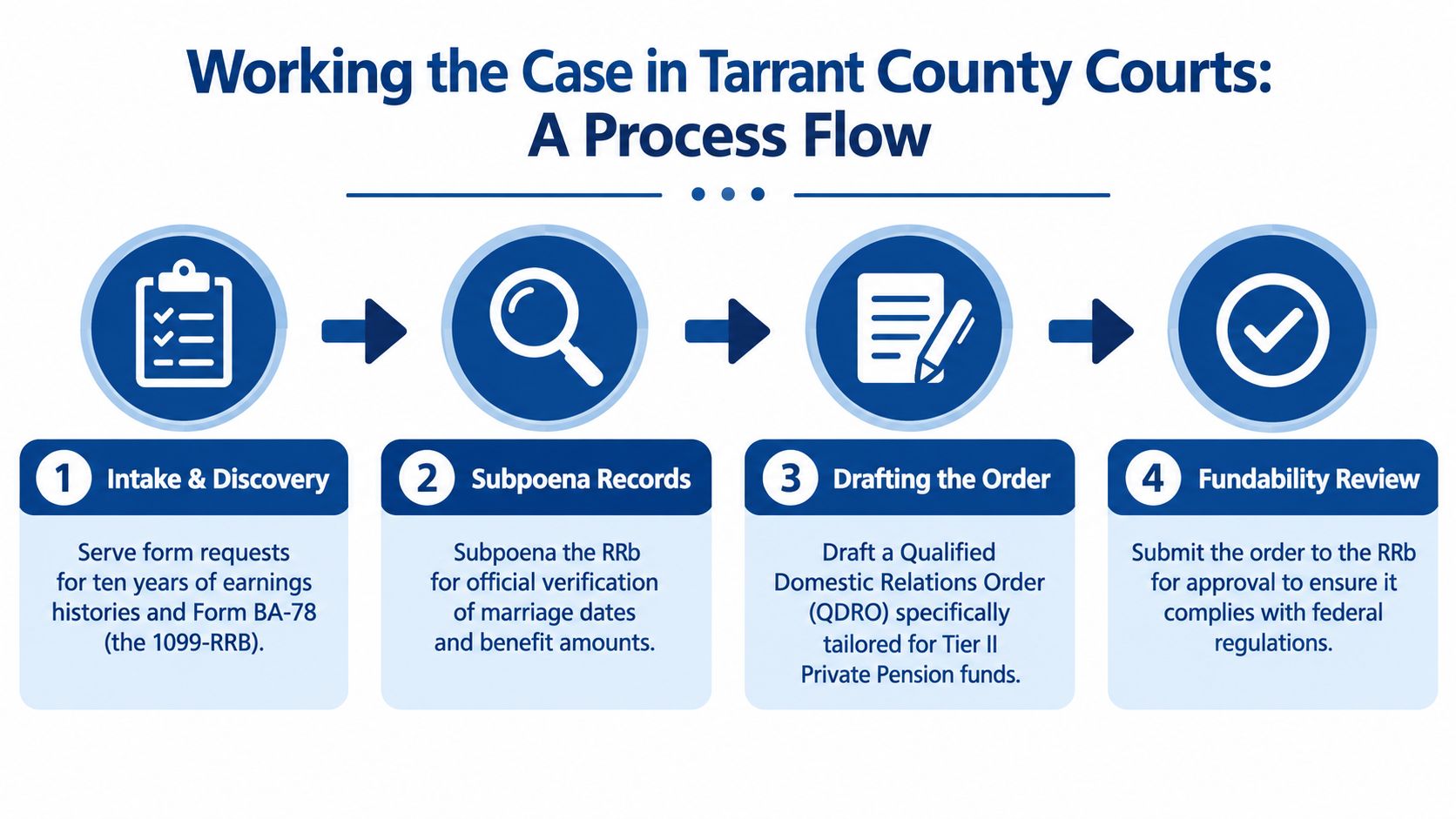
Request the employee's railroad service and benefit information during discovery. The goal is to identify the marital-service period and separate the Tier I, Tier II, and supplemental portions. A current RRB statement may provide a useful starting point, but counsel should verify what the agency will recognize for payment purposes.
Records can also help determine whether a partition is already pending, whether the employee has reached a relevant eligibility point, and whether the former spouse may have an independent federal claim. Don't rely on a general retirement summary that combines every component into one total.
Value the divisible interest
Tier II is a future stream of payments, not necessarily an account with a simple balance. An actuary or retirement-benefits specialist may be needed to evaluate the marital portion, payment timing, life expectancy assumptions, and other valuation questions. The parties should also consider whether an offset with other marital property is more practical than dividing the benefit itself.
The valuation exercise doesn't turn Tier I into divisible property. It helps identify the value of the interests that Texas law and federal law may permit the court to address.
Draft for agency administration
A proposed decree should use a separate paragraph for the railroad partition. It should identify the former spouse as the alternate payee, state the permissible benefit component, provide the percentage or calculation formula, and direct the RRB rather than only the employee to make payments.
A generic QDRO for a 401(k) isn't automatically suitable for railroad retirement. A 401(k) plan administrator and the RRB operate under different rules, so the order must be written to fit the specific benefit being divided.
For local procedural information, review the Tarrant County 360th District Court divorce procedures, while remembering that local court materials don't replace the federal requirements governing RRB payment.
Submit the final order correctly
After the divorce decree is signed, the certified order must be sent to the RRB Office of General Counsel through the agency's required process. The RRB reviews whether the order satisfies federal requirements. A settlement agreement may establish what the spouses intended, but the agency still needs a compliant order before it can implement the partition.
Tarrant County residents should also review applicable local standing-order requirements with counsel. Those requirements can affect how a case is prepared, but they don't expand the benefits a state court can divide under federal railroad law.
Mistakes That Undermine a Railroad Retirement Settlement
The most dangerous mistake is treating the employee's projected retirement check as one divisible asset. A decree that awards a former spouse “half of all railroad retirement” may fail because it doesn't distinguish protected Tier I from eligible non-Tier I benefits.
Common drafting failures
Using a blanket division: A state court generally can't divide Tier I. The order should identify the Tier II or supplemental annuity interest that federal law permits the RRB to partition.
Calling the award a lump sum: A property partition isn't automatically a lump-sum award. Mislabeling the benefit can make the order difficult or impossible for the RRB to administer.
Leaving out the benefit tier: The RRB needs to know whether the order addresses Tier II, a supplemental annuity, or another benefit. A clause that refers only to a railroad “account” may not identify a legally divisible employee annuity.
Directing only the employee to pay: A qualifying order must direct the RRB to make payments. A private promise between former spouses doesn't give the agency authority to redirect benefits.
Skipping agency submission: A signed decree may establish the parties' rights, but failing to submit the certified final order through the RRB process can prevent the partition from becoming operative.
Ignoring an independent annuity claim: A former spouse may have a statutory divorced-spouse annuity option. That possibility should be evaluated separately rather than automatically treating every potential payment as property.
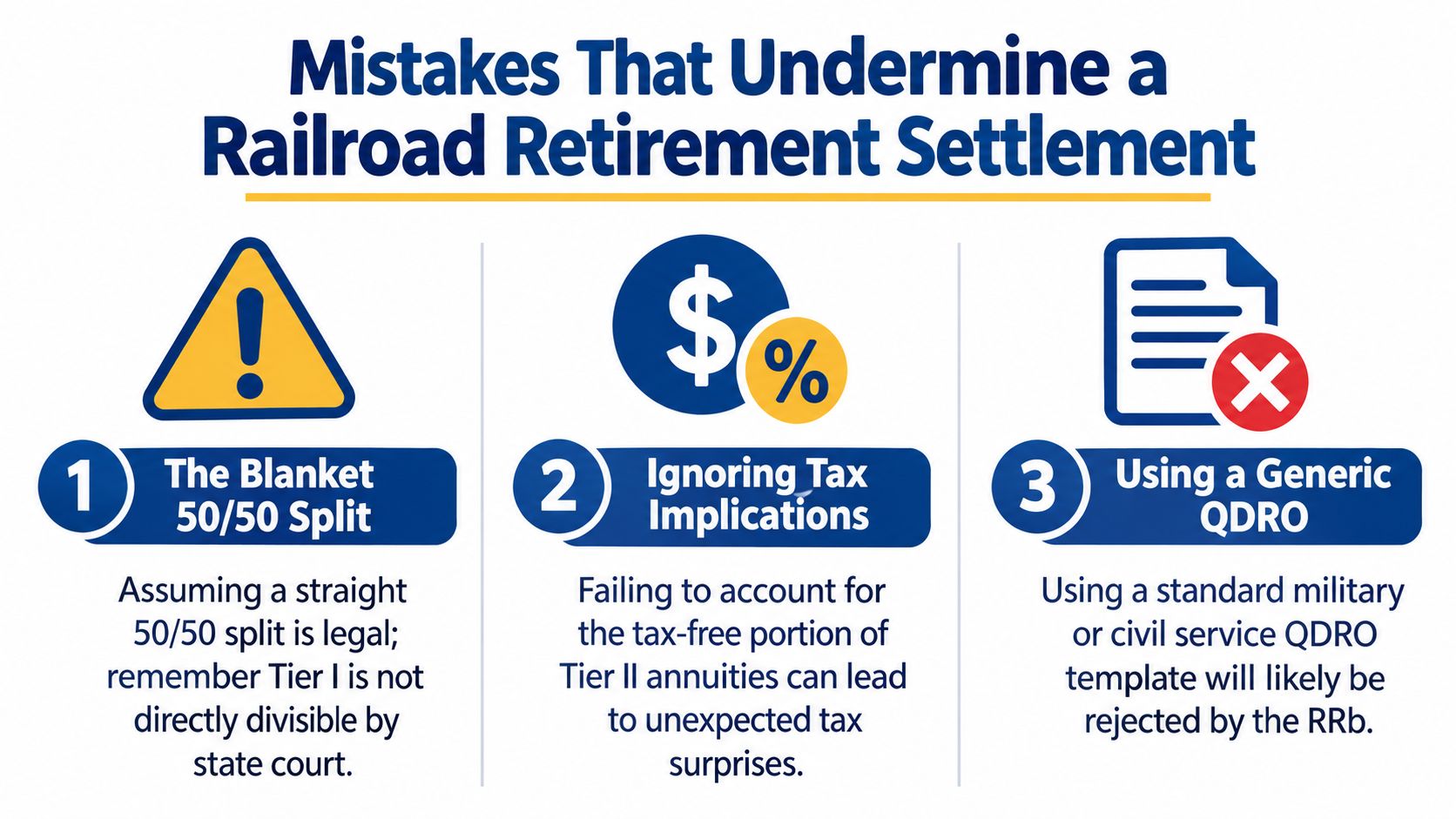
Tax treatment and survivor-related issues also deserve careful review. The effect can depend on the specific benefit, the payment arrangement, and what the final order says. A party reviewing local restrictions can consult the Tarrant County standing-order information, but that resource can't answer whether a particular railroad order is federally fundable.
A short decree review before signing may prevent a much longer dispute later. The review should compare the settlement language with the RRB's federal requirements, confirm the identified tier, and check that the payment formula can be administered.
Practical Next Steps for a Fort Worth Spouse
If railroad retirement is part of a Fort Worth or Tarrant County divorce, take these steps before negotiating the final property division.
Obtain current RRB information. Request a current earnings and service statement and identify the Tier I, Tier II, and supplemental portions. Preserve records showing the marriage dates and the period during which the benefit accrued.
Separate property value from federal eligibility. Calculate the potential community-property share of eligible Tier II benefits using the marital service period. Then evaluate whether the non-employee spouse may qualify for an independent divorced-spouse annuity. Those calculations answer different legal questions.
Review the settlement before it is signed. A Fort Worth family lawyer familiar with railroad benefits can check whether the proposed language identifies the correct component and gives the RRB the authority it needs. A general retirement-account form may not work for this benefit.
Address related coverage and finances. Ask about available insurance-continuation rights and review the applicable Railroad Employees National Health and Welfare Plan materials before coverage lapses. Confirm the details directly with the plan or its administrator.
Bring organized records to the first meeting. The guide to preparing for a first meeting with a Fort Worth divorce attorney can help you gather benefit statements, marriage and separation information, prior orders, and other financial documents.
The central decision isn't whether the employee's retirement should be split. It is whether the former spouse should receive a compliant partition of eligible non-Tier I benefits, pursue a separate federal annuity, or negotiate another property offset after both values have been evaluated.
The Law Office of Bryan Fagan PLLC helps Fort Worth and Tarrant County families analyze complex property divisions, including railroad retirement benefits and federal payment requirements. Visit Law Office of Bryan Fagan PLLC to learn about the firm's Start Here process and schedule a consultation about your divorce and retirement concerns.
