 Skip to content

A parent in Arlington says the child should enroll at an Arlington ISD campus. The other parent lives in Fort Worth, wants the child to remain at the current Fort Worth ISD school, and points to the existing possession schedule. The child may be caught between two addresses, two enrollment systems, and two parents who each believe the court order supports them.
That situation is commonly described as an Arlington ISD vs Fort Worth ISD custody school dispute. But the districts usually aren't the legal opponents. The central questions are what the signed custody order permits, who has educational decision-making authority, which residence controls enrollment, and whether the proposed campus is available under district rules.
The practical framework is straightforward. A known court order controls the parents' rights, while each school district controls its own enrollment and transfer requirements. If the order doesn't clearly resolve the dispute, a parent may need clarification, temporary orders, modification, or enforcement in a Tarrant County family court rather than trying to solve the disagreement through enrollment alone.
Table of Contents
- Why This Custody School Dispute Often Starts With a Misunderstanding
- How To Read Your Tarrant County Custody Order Before Filing Anything
- Arlington ISD Versus Fort Worth ISD Enrollment And Transfer Rules
- What Texas Law Actually Controls When Parents Disagree About School
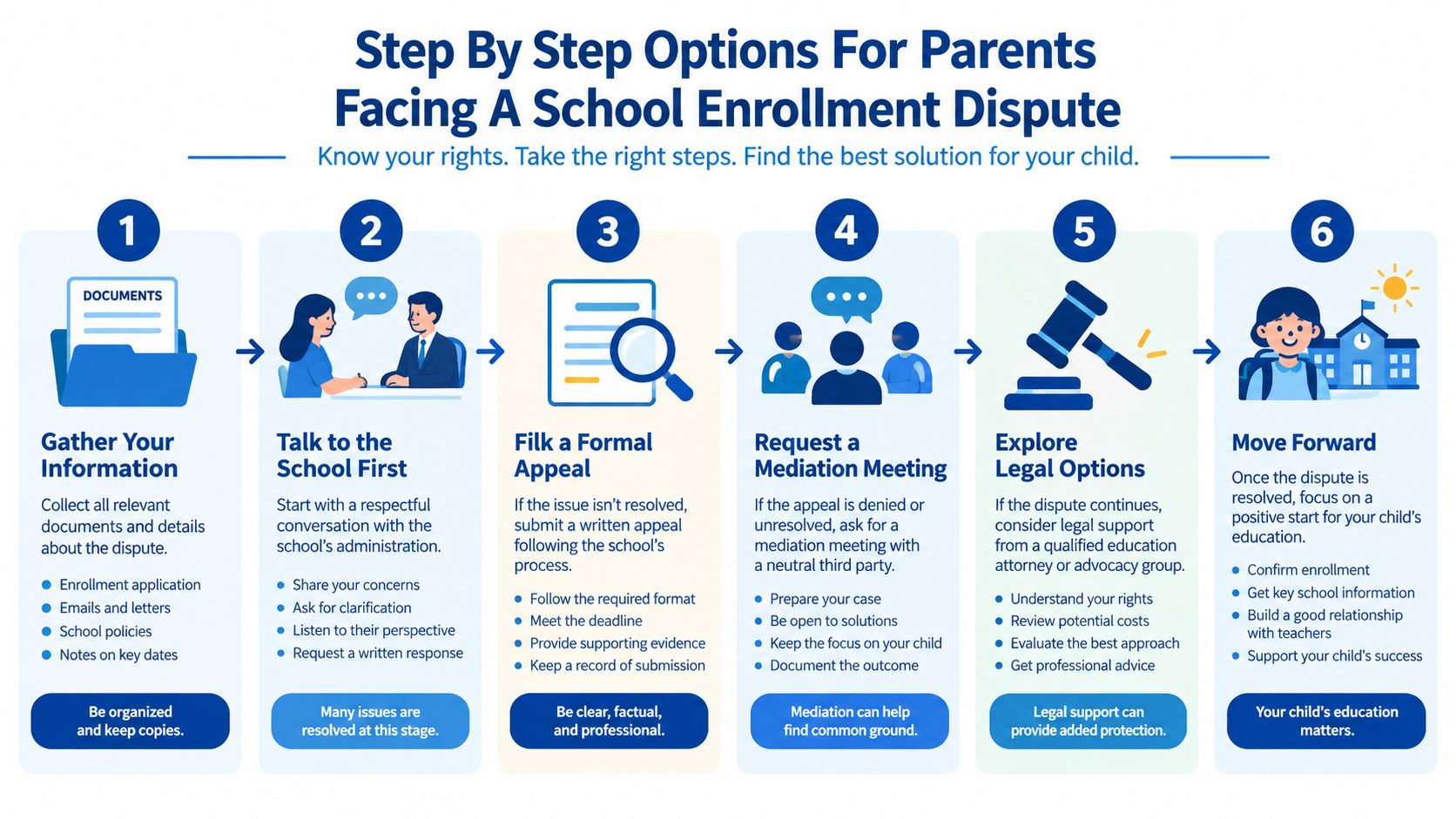
- Step By Step Options For Parents Facing A School Enrollment Dispute
- When To Modify Custody Or Enforce The Existing Order
- Practical Next Steps For Fort Worth And Tarrant County Parents
Why This Custody School Dispute Often Starts With a Misunderstanding
A parent may believe that living in Arlington automatically gives the child a right to attend Arlington ISD. The other parent may assume that the child can stay in a Fort Worth ISD school because the child has attended there before. Neither assumption answers the custody question by itself.
Arlington and Fort Worth are geographically adjacent, but they remain separate public-school systems. A move across a nearby boundary can change the assigned campus, create a transfer issue, alter transportation obligations, and make an existing possession schedule difficult to follow.

The district names can hide the real dispute
The identifiable Arlington ISD appellate dispute, S.W., as next friend of A.W. v. Arlington Independent School District, wasn't a custody contest between Arlington ISD and Fort Worth ISD. The Texas appellate court issued its opinion on June 12, 2014, affirmed the trial court's order, and left the jurisdictional dismissal in place. The appellate opinion matters because it helps distinguish a dispute involving a school district from the custody rights created by an order between parents.
Fort Worth ISD's custody guidance states that parents generally retain full and equal parental rights unless a court order changes those rights. It also explains that the district follows a known order concerning parental rights, duties, and possession periods, but isn't a party to the parents' order and can't enforce or modify it. Fort Worth ISD's custody guidance reflects the practical rule parents need to understand.
The key question isn't which district wins. It's what the custody order allows and whether the proposed campus accepts the child under its enrollment rules.
For a family in Fort Worth, Arlington, Mansfield, Grand Prairie, or another surrounding North Texas community, the first task is to identify the order's language about residence, education, and possession. Only then can the parent evaluate whether an Arlington campus, a Fort Worth campus, or a transfer is legally and practically workable.
How To Read Your Tarrant County Custody Order Before Filing Anything
Before contacting a registrar, changing an address, or filing a motion, obtain the complete signed order. A mediated settlement, temporary order, final order, or agreed parenting plan may contain language that isn't obvious from the parents' informal understanding.
Find the provisions that answer four questions
Start with the conservatorship designations. Identify which parent has the exclusive right to designate the child's primary residence. That provision may determine which address the school uses, but it doesn't necessarily answer every educational decision question.
Next, look for a separate allocation of educational authority. The order may give one parent an exclusive right, require joint agreement, or leave the authority subject to other restrictions. Don't assume that the parent who handles enrollment has authority to make every educational decision.
Then locate any geographic restriction. A restriction may limit where the child's primary residence can be established. A move from Fort Worth to Arlington, or the reverse, can have school and transportation consequences even when both homes are relatively close.
Finally, read the possession schedule alongside the school provisions. A proposed campus must work with weekday exchanges, school-day transitions, activities, and transportation. A school change that makes the written schedule impractical may require a court-approved adjustment.
Use the Tarrant County standing order information as a separate procedural reference, but don't confuse a standing order with the individualized language in your own custody order.
Don't confuse information rights with school-choice authority
Parents may have rights to receive school records, communicate with school personnel, attend activities, and remain emergency contacts. Those rights don't automatically authorize a unilateral campus change, address change, or alteration of the other parent's possession.
If the order is silent or unclear, preserve the uncertainty rather than guessing. Prepare the exact language for the district, identify the proposed campus, document both addresses, and write down who will provide transportation and how the schedule will operate. A parent who files in Tarrant County court should bring the order and concrete facts, not just a statement that Arlington ISD is better than Fort Worth ISD.
Arlington ISD Versus Fort Worth ISD Enrollment And Transfer Rules
The districts apply different administrative rules, so parents must investigate the specific campus rather than rely on a general reputation. The legal order may authorize a decision between parents, but the district still determines whether the child qualifies for neighborhood enrollment or a transfer.
Arlington ISD defines a transfer as attendance at a school other than the school assigned by address, including intradistrict and interdistrict placements. Its published process requires an application, a district seat determination, and acceptance within 48 hours after an offer. Arlington also identifies an annual regular transfer window and may open special windows when space remains, with priority governed by Board Policy FDB for intradistrict transfers and FDA for interdistrict transfers. Arlington ISD's transfer information should be checked for the current campus and application cycle.
Fort Worth ISD uses a separate boundary and capacity framework. The district publishes campus-specific boundary maps, and its Better Spaces program explains that students at a consolidating traditional campus under an approved transfer may be reassigned to the home campus based on address while remaining eligible to apply through the transfer process. District materials reported that approximately 105 students would move from Clifford Davis Elementary to Carter Park Elementary to address capacity, while about 120 students were expected to shift from West Handley to Sagamore Hill Elementary for the 2025–26 school year. Those figures come from FWISD boundary and Better Spaces materials.
| Feature | Arlington ISD | Fort Worth ISD |
|---|---|---|
| Address and assignment | The assigned school generally depends on the residence, while a transfer covers attendance elsewhere. | Campus-specific boundary maps and residence determine the neighborhood assignment. |
| Transfer process | Application, seat determination, and acceptance within 48 hours after an offer. | Transfer availability and continued eligibility depend on district rules, space, and the student's circumstances. |
| Capacity concerns | Regular and special transfer windows may be available when space remains. | Consolidation, construction, and enrollment balancing can change campus assignments. |
| Custody relevance | The parent should document the proposed address, application, offer or denial, and priority category. | The parent should verify the effective school year, boundary, transportation, and whether a transfer survives a residence change. |
The useful comparison isn't “Which district is better?” It's whether the specific child can attend the proposed campus, whether the placement remains available, and whether both parents can follow the possession schedule.
What Texas Law Actually Controls When Parents Disagree About School
Texas family courts decide custody matters under the child's best interests and the language of the governing order. A school district doesn't decide legal custody merely because one parent completes enrollment first, and enrollment doesn't rewrite a geographic restriction or possession schedule.
When Fort Worth ISD knows about a controlling order, it follows the order concerning parental rights, duties, and possession. When parents provide conflicting educational instructions and no controlling order is available, the campus will generally maintain the student's status quo temporarily while the parents seek agreement or court intervention. That approach avoids forcing school staff to choose between competing parents.

The legal order and the school file serve different purposes
Texas Education Code Chapter 26 gives parents specific rights involving their child's education. Those rights can include access to records and communications, but access isn't the same as authority to change the school. Arlington ISD identifies the principal as the custodian of records for currently enrolled students under Board Policy FL(LOCAL), while Fort Worth ISD publishes information about parental rights and educational records through its family resources.
A parent who can obtain grades, attendance information, special-education records, or school communications may still lack authority to enroll the child in another district. Conversely, a parent with decision-making authority may still need to satisfy proof-of-residence, capacity, and transfer requirements.
Read the Tarrant County custody modification process with this distinction in mind. A court can decide the parents' rights, but it doesn't guarantee that a district will approve a campus that fails its own enrollment requirements.
School records show what is happening at school. They don't, by themselves, show who may override the custody order.
The strongest filings connect the order to the requested relief. They identify the specific residence provision, educational-decision provision, geographic restriction, school, transportation plan, and effect on each parent's time with the child.
Step By Step Options For Parents Facing A School Enrollment Dispute
Parents usually have several possible paths, but the right path depends on whether the issue is administrative, legal, or both. Start by separating what the district must decide from what the family court must decide.
First verify whether the proposed placement is workable
Obtain written information from the proposed district and campus. Ask about the exact address, assigned campus, transfer category, available space, application status, effective school year, transportation, and any specialized-program requirements.
Then confirm how the child currently attends school. The placement may be based on a neighborhood assignment, an approved transfer, or a specialized program. Fort Worth ISD states that some students may attend even when they don't live within the boundary, but space can limit enrollment and proof of residence may be required for neighborhood priority. Its transfer information also states that transportation is the family's responsibility for general transfers and that an approved transfer remains effective while the student stays at the same school. FWISD enrollment and transfer information should be reviewed with the child's specific circumstances.
Match the evidence to the legal request
Create a written file containing:
- The order: Highlight residence, education, geographic restriction, possession, and transportation language.
- The school facts: Save boundary information, transfer applications, offers, denials, capacity statements, and program requirements.
- The logistics: Map the commute between homes, school, exchanges, activities, and work obligations.
- The child's continuity: Record attendance, academic services, special-education needs, activities, and the practical effect of changing campuses.
- The communications: Keep written objections, district responses, and proposed solutions in one place.
If the order clearly authorizes the decision and the campus accepts the child, the dispute may be resolved through coordinated enrollment and a written parenting plan. If the district denies the placement, the parent may need to pursue another eligible campus or request court relief that accounts for the denial.
Choose the court remedy carefully
A temporary order may be appropriate when a school change or threatened move could disrupt the child before a final decision. A modification may be necessary when the existing order no longer works because of changed residence, school boundaries, or transportation. Enforcement may fit when a parent violates clear order language by withholding school information, blocking possession, or refusing required cooperation.
An appeal is a separate legal process and isn't a substitute for gathering the record or requesting appropriate relief in the trial court. Parents should speak with counsel about the available procedure and the specific order before filing.
When To Modify Custody Or Enforce The Existing Order
The distinction between modification and enforcement prevents parents from asking the court for the wrong solution. Modification changes the arrangement. Enforcement requires compliance with an arrangement that already exists.
Suppose an order gives one parent the right to designate the child's primary residence, but the other parent blocks school communications or refuses to follow the possession schedule. That may present an enforcement issue if the order clearly protects the disputed right. The parent should identify the exact violation and preserve records showing what happened.
A different situation arises when neither parent can follow the order without changing the school. The proposed Arlington campus may fall outside the practical reach of the current schedule, or a Fort Worth boundary may have changed because of consolidation or enrollment balancing. In that situation, a parent may need modification or clarification rather than an accusation that the other parent violated the order.

Record access may require enforcement
Give each district a complete, current copy of the custody order and provide later orders promptly. If a parent blocks access to grades, attendance, special-education information, or school communications, document the request and response before deciding whether court enforcement is necessary.
The claim should be specific. “The other parent won't tell me anything” is less useful than identifying the missed report, denied communication, or withheld school notice and connecting it to the order's language.
A school-choice request needs a concrete plan
A parent seeking court relief about which district the child should attend should present the proposed campus, eligibility status, transportation plan, academic reasons, and effect on each parent's time. General statements that one district is preferable won't answer whether the child can attend the campus or whether the arrangement serves the child's needs.
The court can address the parents' rights, but the district still applies its enrollment rules. A successful legal argument therefore needs both parts: authority under the order and a workable school plan.
Practical Next Steps For Fort Worth And Tarrant County Parents
For parents in Fort Worth, Arlington, Keller, Mansfield, and nearby Tarrant County communities, the decision framework is narrow enough to use immediately:
- Read the signed order. Mark residence, educational authority, geographic restriction, possession, and transportation provisions.
- Confirm the district facts. Ask Arlington ISD or Fort Worth ISD about the assigned campus, transfer category, capacity, proof of residence, and effective school year.
- Build the logistics record. Document commute times, school-day exchanges, transportation responsibility, activities, attendance, and educational services.
- Communicate in writing. State the proposed school, order language, objections, and workable alternatives without threatening unilateral action.
- Select the legal remedy. Seek clarification, temporary relief, modification, or enforcement based on the actual problem.
- Protect the child's stability. Don't use enrollment to override a possession schedule or geographic restriction, and don't assume enrollment first creates legal authority.
The central rule remains the same: the custody order governs the parents' rights, and district rules determine whether the proposed school is accessible. Parents who skip either half may create a placement that is legally disputed, administratively unavailable, or impossible to operate day to day.
For information about reaching a Fort Worth family-law resource, review the Tarrant County family law center information. A consultation is especially appropriate when the dispute involves competing district enrollments, a possible violation of the order, a change in residence, or transportation demands that make the current schedule unworkable.
The Law Office of Bryan Fagan PLLC provides legal guidance on Texas custody disputes involving school enrollment, educational decision-making, modifications, enforcement, and possession schedules. If you're facing an Arlington ISD and Fort Worth ISD conflict, visit Law Office of Bryan Fagan PLLC to learn about the firm's family-law services and request a consultation about your situation.
