 Skip to content

In Tarrant County, you file a probate application with the County Clerk's Probate Division at the Tarrant County Old Courthouse, Room 233, 100 West Weatherford Street, Fort Worth, Texas 76196, not directly with a probate judge. The clerk receives the filing, dockets it, and assigns the case before it goes to the appropriate probate court.
If you're handling a parent's or spouse's estate right now, that distinction matters more than many expect. Many families in Fort Worth and nearby communities assume they should go straight to “probate court,” meaning the judge's courtroom. In practice, the first stop is the clerk.
That simple clerk-first rule prevents a lot of confusion. It can save you a wasted trip, help you prepare the right payment and paperwork, and make the filing process feel much less intimidating when you're already dealing with a loss.
Table of Contents
- Where to File a Probate Application in Tarrant County
- How Texas Law Assigns Your Filing to the Right Court
- How to File Your Application by eFiling or In Person
- Required Documents Fees and Payment Details to Avoid Delays
- What Happens After You File and How to Prepare for Your Hearing
- Practical Next Steps and Local Resources for Fort Worth Families
Where to File a Probate Application in Tarrant County
For Tarrant County probate court where to file an application, the answer is concrete. Tarrant County directs probate filings to the County Clerk's Probate Division at the Tarrant County Old Courthouse, Room 233, 100 West Weatherford Street, Fort Worth, Texas 76196. The office lists probate filing help at 817-884-1770, and the county page says the office is open Monday through Friday from 7:30 a.m. to 5:00 p.m., while the probate courts themselves may follow separate schedules, including Probate Court No. 2 from 8:00 a.m. to 4:30 p.m. according to the Tarrant County probate courts page.
The first stop is the clerk, not the courtroom
That surprises people.
A Fort Worth family may think, “We need to open probate, so we should go to the judge's court.” But the intake point is the clerk's probate division. The clerk handles the filing side of the case before the court handles the hearing side.
Practical rule: If you are opening the case, start with the probate clerk's office, not a judge's chambers.
That clerk-first process matters whether you live in Fort Worth, Arlington, Keller, Grapevine, Mansfield, or another nearby North Texas community. If Tarrant County is the proper county for the estate, the filing intake happens through that probate division.
Why this prevents wasted time
Knowing the right office helps with three common problems:
- Wrong destination: People go looking for a courtroom when they really need the filing counter or e-filing path.
- Wrong hours: The clerk's office and the courts don't always operate on the same schedule.
- Wrong questions: Filing questions usually belong with the clerk's probate division, not directly with the judge.
If you're also trying to get oriented in downtown Fort Worth court buildings, this Tarrant County courthouse floor guide can help you understand local courthouse logistics.
A probate case often begins during a week when a family is making funeral arrangements, locating a will, and fielding calls from relatives. Having one clear answer about where to file can reduce some of that pressure right away.
How Texas Law Assigns Your Filing to the Right Court
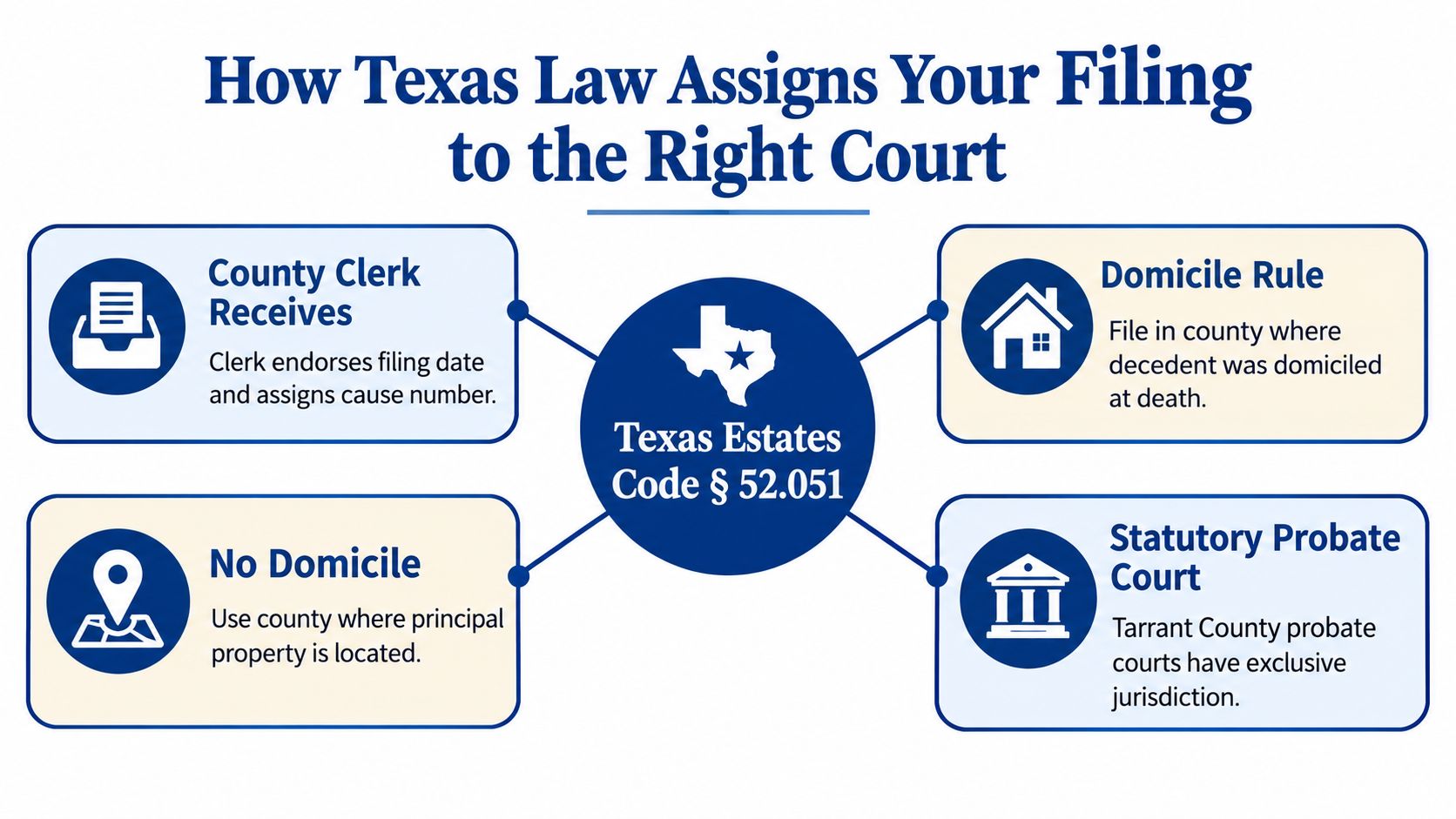
Texas law explains why the process starts with the clerk. Under Texas Estates Code § 52.051, an application for a probate proceeding or other paper filed in a probate matter must be filed with the county clerk of the proper county, and the clerk must assign it to the estate docket number and endorse the filing date, docket number, and official signature on receipt, as described in Texas Estates Code Section 52.051.
What that means in plain English
The law creates a simple flow:
- You file with the county clerk: That's the formal entry point.
- The clerk creates the official case record: The filing date and docket number become part of the record.
- The case is then assigned within the court system: You don't start by personally choosing a judge and handing papers to the bench.
This is why “go straight to the judge” is the wrong mental model for probate intake.
The common misunderstanding
People often treat probate like a hearing-first process. It isn't. It starts as a filing process, and that filing has to be properly received and docketed before the court can act on it.
The judge doesn't open the case for you. The clerk opens the case record so the court can act on it.
If you're trying to understand which probate court may handle the matter after filing, this overview of Tarrant County Probate Court No. 1 and No. 2 can help frame the court side of the process.
For families, the practical takeaway is straightforward. If you're asking where to begin, begin where Texas law says probate papers are received. That is the county clerk.
How to File Your Application by eFiling or In Person
A lot of online guides stop too early. They say “file online” and leave out what happens immediately after that. In Tarrant County, that missing piece can create avoidable problems.
If you eFile, the process is not over when you hit submit
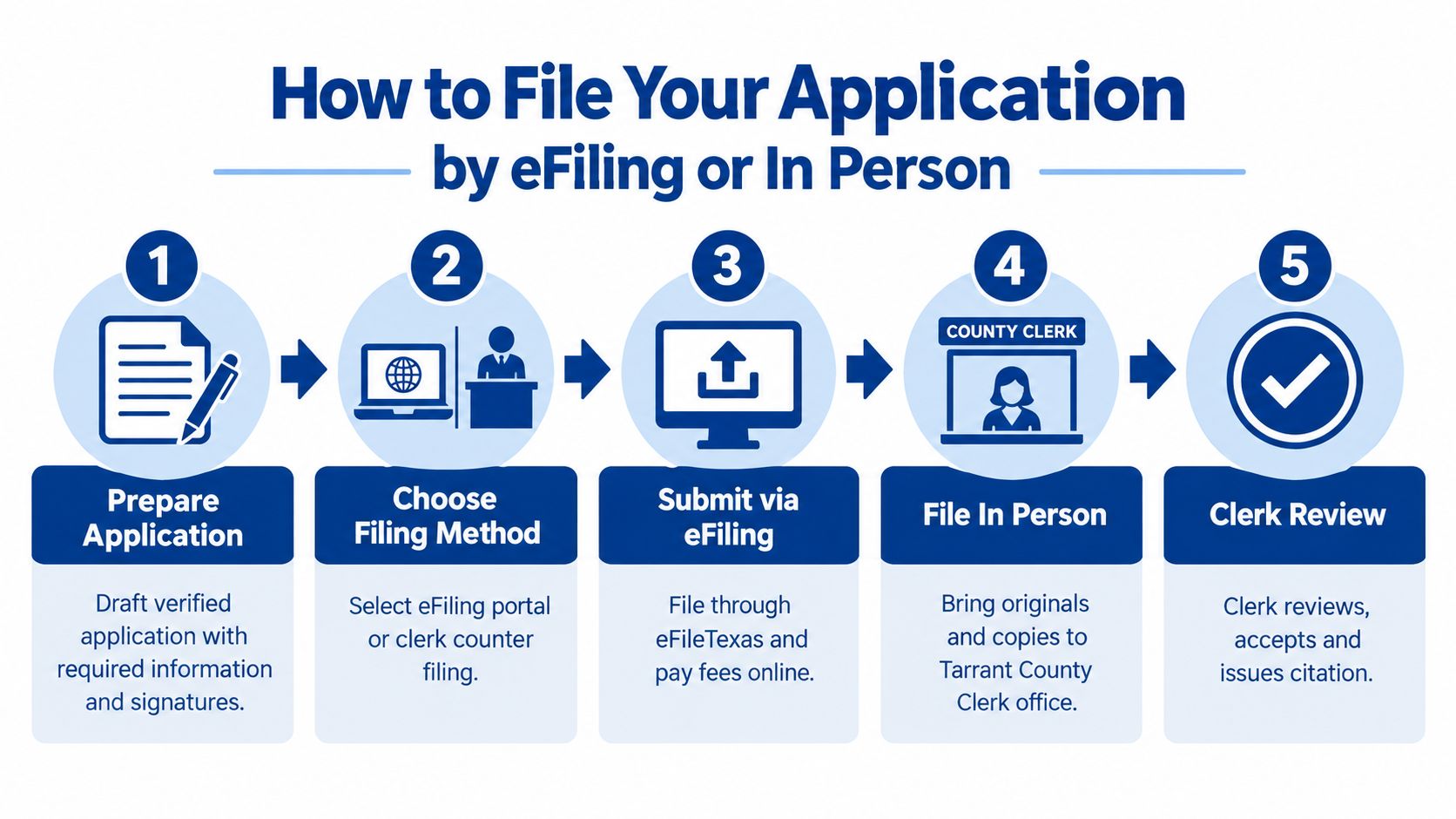
A practical Tarrant County filing workflow is to prepare the probate application, submit it through the county's probate filing process, deliver any original will promptly to the clerk, and then monitor for the court hearing and notice requirements. County guidance and local reference materials also indicate that wills that are part of a probate case must be filed with the probate office in Room 233, and the county's e-filing reference guide says the original will still has to be delivered to the clerk within three business days after e-filing. Some matters also need follow-up on citation, a return-date hearing, and coordination with the court coordinator, as explained in the Tarrant County probate e-file reference guide.
That's the step many first-time filers miss.
If you e-file an application to probate a will and then leave the original will sitting in a folder at home, the filing may not move the way you expected. The online submission and the physical original will are connected parts of one process.
If you file in person, come prepared for intake questions
Some families still prefer to handle filing at the clerk's office. That can make sense when you want immediate confirmation that you're at the right office and have the right documents in hand.
If you plan to file in person, bring:
- Your prepared application: Make sure it's complete and signed as required for your filing.
- The original will if there is one: Don't assume a copy will solve the problem if the original must be delivered.
- Payment in an accepted form: The clerk's office rules on payment are strict.
- Any supporting paperwork you know is needed: It's easier to sort that out before you stand at the counter.
Here is a short video that can help you think through the filing path before you go:
A realistic local example
Suppose two siblings live outside Texas, but their mother lived in Fort Worth. One sibling e-files the probate application from another state and assumes that finishes the opening step. A few days later, they learn the original will still needed to be delivered to the clerk promptly.
That kind of issue is common because families often divide tasks. One person handles paperwork, another holds the original will, and nobody realizes Tarrant County expects both pieces to come together on a tight timeline.
Filing online starts the case. It doesn't erase the need to complete the county's follow-up requirements.
After filing, keep watching for acceptance, citation-related steps, and hearing information. Probate is rarely “one click and done.”
Required Documents Fees and Payment Details to Avoid Delays
A lot of probate slowdowns start at the clerk's desk, not in the courtroom. In Tarrant County, a case can stall because the filing packet is incomplete, the original will does not reach the clerk, or the payment does not match the county's rules.
The safest approach is to treat your filing like an airport check-in. The judge decides the case later. The clerk first checks whether your paperwork, delivery steps, and payment are in order.
What to have ready before you submit
Start with the filing packet that fits your probate matter. Then match it with anything the clerk must receive at the opening stage.
If your case involves a will, make sure the original will gets to the probate office. That point causes confusion for families who e-file the application and assume the case is fully opened.
It also helps to bring or keep close any practical backup materials that answer basic questions about the estate, the decedent, or the person filing. The clerk is not deciding the merits, but missing details can still create avoidable back-and-forth.
Tarrant County Probate Filing Costs at a Glance
| Filing Item | Amount and Payment Note |
|---|---|
| New probate filing fee | $360.00 |
| Application for Small Estate Affidavit | $120.00 |
| Posted citation | $28.00 |
| Personal citation | $83.00 |
| Citation by publication | $83.00 |
| Accepted payment methods | Cash, cashier's check, money order, or attorney's check |
| Required payee on checks and money orders | Make payable to Mary Louise Nicholson, County Clerk |
Tarrant County lists probate filing questions and citation amounts in its probate FAQs, and it lists filing categories and accepted payment methods in the county probate fee schedule.
Fee mistakes that commonly delay acceptance
The fee problem is often simple. A family pays the base filing fee but misses a citation charge that applies to the case. Or someone brings a personal check when the clerk only accepts the listed payment forms.
Those are clerk-side problems, which means they can stop progress before the file ever reaches the assigned court.
Clerk-first reality: In Tarrant County, acceptance starts with the county clerk. Correct fee category, correct payment method, and delivery of any required original documents all matter at that first step.
Before you submit, confirm three things: the exact filing type, whether citation costs apply, and whether your payment is prepared exactly as the county requires. That short review can save a return trip to downtown Fort Worth.
What Happens After You File and How to Prepare for Your Hearing
Once the clerk accepts the filing, many families expect a hearing notice to appear automatically and immediately. The process usually feels more layered than that.

What to watch for after acceptance
After filing, keep your attention on the parts that happen between submission and hearing:
- Citation and notice steps: Some matters require additional notice-related action after the initial filing.
- Hearing assignment: The case may need a return-date hearing or other scheduling follow-up.
- Coordinator contact: Some situations require coordination with the court coordinator rather than passive waiting.
- Document tracking: Keep copies of what you filed and proof of what you delivered.
If you want a broader sense of how families think about the pace of an estate case after filing, this guide on probate timelines in Tarrant County can help.
Two short examples
One family files an application to probate a will. Their biggest early issue is making sure the original will gets where it needs to go and watching for hearing and notice requirements tied to that filing.
Another family has no will and files an application related to administration of the estate. Their questions may focus more on notice, hearing preparation, and making sure the court has what it needs to move the matter forward.
The details differ, but the lesson is the same. Don't assume filing alone completes the opening stage.
How to stay organized before the hearing
Use a simple system that you can maintain even while grieving.
- Keep one probate folder: Put confirmations, copies, payment records, and hearing information in one place.
- Write down dates immediately: If someone tells you about a delivery requirement, hearing setting, or follow-up task, log it that day.
- Check who holds the original documents: In many families, one relative has paperwork that another relative assumes was already filed.
- Ask focused questions: When you contact the clerk or coordinator, ask about status, missing items, and next required actions.
A smooth probate opening usually comes from organization, not speed.
The hearing itself generally addresses the application that was filed and whether the matter is ready to proceed. The court will look for a complete and properly presented case record. That's why the filing stage matters so much.
Practical Next Steps and Local Resources for Fort Worth Families
A common Fort Worth mistake happens at the very start. A family has the will in hand, knows a hearing will be needed, and assumes the next stop is the judge's courtroom. In Tarrant County, the first stop is the clerk filing path. That means making sure the application goes to the county clerk, confirming the estate belongs in Tarrant County, and getting the original will to the right place if the filing requires it.
That clerk-first path works like checking in at the front desk before you can see the doctor. The court cannot act on a case that has not been opened correctly.
If your situation is simple, self-filing may be realistic. If the original will cannot be found, family members disagree, heirs are scattered across different states, or you are not sure whether the case calls for probate of a will, administration, or another estate filing, legal advice can prevent delays that are hard to undo later.
For local help, start with the Tarrant County probate clerk's office, the county fee schedule, and the Texas Estates Code sections that control probate procedure. Keep the county's contact information, your filing confirmation, receipt, and any hearing notice in one folder so nothing gets lost between eFiling, document delivery, and the court setting.
If you want legal guidance specific to your facts, the Law Office of Bryan Fagan PLLC provides probate and estate information for Fort Worth families at https://www.fort-worth-attorneys.com.
Grief makes paperwork feel heavier than it looks on paper. The clearest next step is usually the right one. Start with the clerk, verify the documents and fees before you submit anything, and treat the original will, payment receipt, and hearing information as three separate items you need to track carefully.
