 Skip to content

In Tarrant County, the listed family filing fee is $350 without children and $401 with children. On the clerk's own example, the total court cost reaches $499 after adding $8 for citation issuance and $90 for service.
If you're in Fort Worth, Arlington, Mansfield, Keller, or another Tarrant County community, the petition fee may be the first number you see, but it isn't always the amount you'll spend to get the case started. The difference matters most when children are involved, when your spouse must be formally served, or when the case requires additional filings.
The safest approach is to treat the Tarrant County District Clerk divorce filing fee schedule as a line-item budget, not a single flat price. The official schedule tells you what the clerk charges for filing, citation, service, and other court actions. Your total depends on which of those actions your divorce requires.
Table of Contents
- What the Tarrant County District Clerk Divorce Filing Fee Schedule Shows
- Reading the Fee Schedule Without Children vs With Children
- Other Family Filing Fees on the Tarrant County Schedule Worth Knowing
- Service of Citation and Why It Pushes the Total Higher
- Certified Copies and Records Costs You May Need Later
- How Fees Break Down by Statutory Authority in Tarrant County
- Filing Fee Waiver and Deferral Options in Tarrant County
- Related Divorce Costs Beyond the Filing Schedule
- Where to Confirm the Current Schedule and Hours
- Practical Next Steps for Fort Worth and Tarrant County Residents
What the Tarrant County District Clerk Divorce Filing Fee Schedule Shows
The Tarrant County District Clerk's schedule is best read as a menu of charges. It identifies fees connected with family cases, including the initial divorce filing, citation issuance, service, and other actions that may arise after the petition is filed. The clerk's official family fee schedule is the reference point to check before submitting paperwork.
A divorce petition starts the case, but the petition isn't the only document or service the clerk may process. A spouse may need to be served with citation. Later, a party may request certified copies, file another pleading, or ask the court to consider a motion. Each action should be evaluated separately.
The schedule is a starting point
For budgeting purposes, begin with three questions:
- Are children involved? The family filing amount changes depending on whether the divorce involves children.
- Will formal service be required? Citation issuance and service are separate from the initial pleading fee.
- Will you need additional court records or filings? Copies, motions, and later pleadings can create additional charges.
The clerk's published schedule is the most reliable place to verify the current amounts. Fee amounts can change, and the clerk's materials also recognize that amounts may vary because of legislative or commissioners-court actions. Don't rely on an old online article or a figure quoted by someone who filed a different kind of case.
| Filing Action | Statutory Fee | When It Applies |
|---|---|---|
| New family suit without children | $350 | Initial divorce filing when children aren't involved |
| New family suit with children | $401 | Initial divorce filing when children are involved |
| Citation issuance | $8 in the clerk's example | When formal citation must be issued |
| Service of citation | $90 in the clerk's example | When the citation is formally served |
The practical point is simple. The petition fee gets the case filed, but it may not finish the first payment calculation. Build the filing budget around the entire opening process, not just the first line on the schedule.
Reading the Fee Schedule Without Children vs With Children
The headline comparison is straightforward. Tarrant County's current family filing schedule lists $350 for a new suit without children and $401 for a new suit with children, as shown on the official Tarrant County family filing fee PDF.
That $51 difference reflects child-related charges included in the with-children filing. The county's fee information identifies components such as the State Consolidated Filing Fee of $137, the Local Consolidated Filing Fee of $213, the Family Protection Fee, and the DRO initial child support service fee. The schedule identifies those components under the applicable statutory fee structure.
A divorce without children generally begins with an Original Petition for Divorce and the filing charge associated with a family suit without children. A divorce involving children enters a different fee category because child support and family-protection administration create additional filing components. That doesn't mean the filing fee pays for every service the family may need. It means the clerk collects child-related charges at the opening of the case.
The comparison in plain English
| Scenario | Filing Fee | What the Fee Covers |
|---|---|---|
| Divorce without children | $350 | New family suit filing in the no-children category |
| Divorce with children | $401 | New family suit filing with listed child-related components |
The clerk's example shows why the with-children amount shouldn't be treated as the final court cost. It lists $401 for the divorce filing, $8 for citation issuance, and $90 for service, for a $499 total court cost example. You may have a different service arrangement or additional filing needs, but the example demonstrates the point clearly: service costs sit outside the pleading fee.
Budgeting rule: Decide whether children are involved first, then price citation and service separately. Those two steps prevent most opening-cost surprises.
Before filing in Fort Worth or elsewhere in Tarrant County, recheck the official schedule. Use the amount applicable on the day you file, not an estimate copied from an older divorce guide.
Other Family Filing Fees on the Tarrant County Schedule Worth Knowing
A divorce case can generate more than the original petition and citation. The District Clerk schedule includes other family-case charges that may appear if the respondent files a pleading, a party asks for court action, or someone needs an official record.
A counterclaim fee of $46 may apply when the responding spouse files a counterclaim raising affirmative requests of their own. That filing changes the case from a simple response into a pleading that asks the court for relief. If your spouse files a counterclaim, review it carefully rather than assuming it's only an administrative response.
Motion-related charges also vary by the type of filing. The schedule includes motion fees in the range of $15 to $46, depending on the motion. A separate $25 occupational driver's license and similar fixed-cost family item may also appear when that type of matter is filed through the clerk's office. Confirm the precise entry before paying because the applicable fee depends on the document being submitted.
Why ancillary charges matter
Even an agreed divorce can require additional paperwork. A party might need to file a motion connected with obtaining relief, presenting an agreed order, or addressing an issue that wasn't resolved in the original petition. A contested case can generate more filings as the spouses address temporary orders, discovery, property, support, or conservatorship.
| Filing or Motion | Listed Fee | When It Typically Appears |
|---|---|---|
| Counterclaim | $46 | When the respondent asks the court for relief in a counterclaim |
| Motion filing | $15 to $46 | Depending on the motion type listed by the clerk |
| Occupational driver's license and similar family item | $25 | When that specific matter is filed |
The clerk's schedule should control your calculation. The amounts are subject to updates under applicable law, including the fee authority identified in the schedule. Don't assume that a prior divorce in Tarrant County had identical charges.
If money is tight, ask about inability-to-pay procedures before submitting ancillary filings. A waiver or deferral question is easier to address before a payment is rejected than after a filing is returned.
Service of Citation and Why It Pushes the Total Higher
Filing the Original Petition for Divorce starts the case, but it doesn't automatically place the paperwork in your spouse's hands. If formal service is required, the clerk issues citation and an authorized person delivers it according to the applicable service rules.
The initial filing fee doesn't include every service step. Tarrant County's own example separates the charges, listing the pleading fee, citation issuance, and service as distinct amounts. That separation is why someone who budgets only for the petition can come up short at filing.
Common service paths
Your options depend on the circumstances and the location of the spouse. Possible approaches include:
- Tarrant County constable or sheriff service: An authorized officer may attempt personal service.
- Private process server: A licensed or authorized process server may handle delivery, subject to applicable requirements.
- Certified mail: Service by certified mail may be available in circumstances permitted by Texas procedure.
- Out-of-state service: A spouse outside Texas may require a different process, and the correct method depends on the facts.
The clerk's example provides the concrete budget marker. It lists $8 for citation issuance and $90 for service, in addition to the $401 with-children filing fee, producing a $499 total court cost example. The exact amount can differ when the service method or circumstances differ.
If your spouse is difficult to locate, additional attempts or a request for an alternative service method may create further expense and procedural work. Don't choose a service method based only on price. Defective service can delay the case and create avoidable complications.
Certified Copies and Records Costs You May Need Later
The filing fee doesn't automatically give you certified copies of the final divorce decree. After the judge signs the decree, you may need official copies for a bank, employer, retirement administrator, insurance carrier, government agency, or another institution.
The District Clerk's record charges are separate from the opening petition fee. The amount can depend on the number of pages, the certification requested, and any authentication or related service. Because those charges aren't included in the initial divorce filing amount, ask the clerk what your completed packet will cost before requesting multiple copies.
Plan for the documents that matter
Make a list of organizations that may need proof of the divorce. For example:
- Financial institutions: A bank or lender may request a certified decree before changing ownership or account information.
- Retirement administrators: A plan administrator may need the decree and separate qualified-order paperwork.
- Insurance carriers: A carrier may require official documentation before changing beneficiaries or coverage.
- Government agencies: An agency may require a certified record rather than an informal photocopy.
A finalized divorce packet can require several certified pages and more than one copy. The cost grows with the number of pages and institutions involved, so don't wait until a deadline to discover that you need additional records.
Ask for the exact copy and certification charge before ordering. A plain copy and a certified copy serve different purposes, and the receiving organization decides which one it will accept.
Keep the original decree in a secure location. Order certified copies only where an institution specifically requires them, and confirm whether a digital copy will be accepted before paying for paper records.
How Fees Break Down by Statutory Authority in Tarrant County
The fee schedule isn't an arbitrary price list created by a clerk at the filing window. Many charges come from laws that direct courts and clerks to collect particular amounts for filing, records, child-related services, and court administration.
The official Tarrant County materials identify parts of the with-children fee as the State Consolidated Filing Fee of $137 under Local Government Code § 133.151(a)(1) and the Local Consolidated Filing Fee of $213 under Local Government Code § 135.101(a)(1). The same materials identify additional family-law charges, including the Family Protection Fee and the DRO initial child support service fee.
Why the categories matter
Think of the fee as a bundle assembled from separate legal components:
- General filing charges support the filing of the new family case.
- Local and state consolidated fees are collected under the statutory authority identified by the clerk.
- Family-related charges apply when the case involves children and related support services.
- Citation and service charges arise from the act of issuing and delivering process.
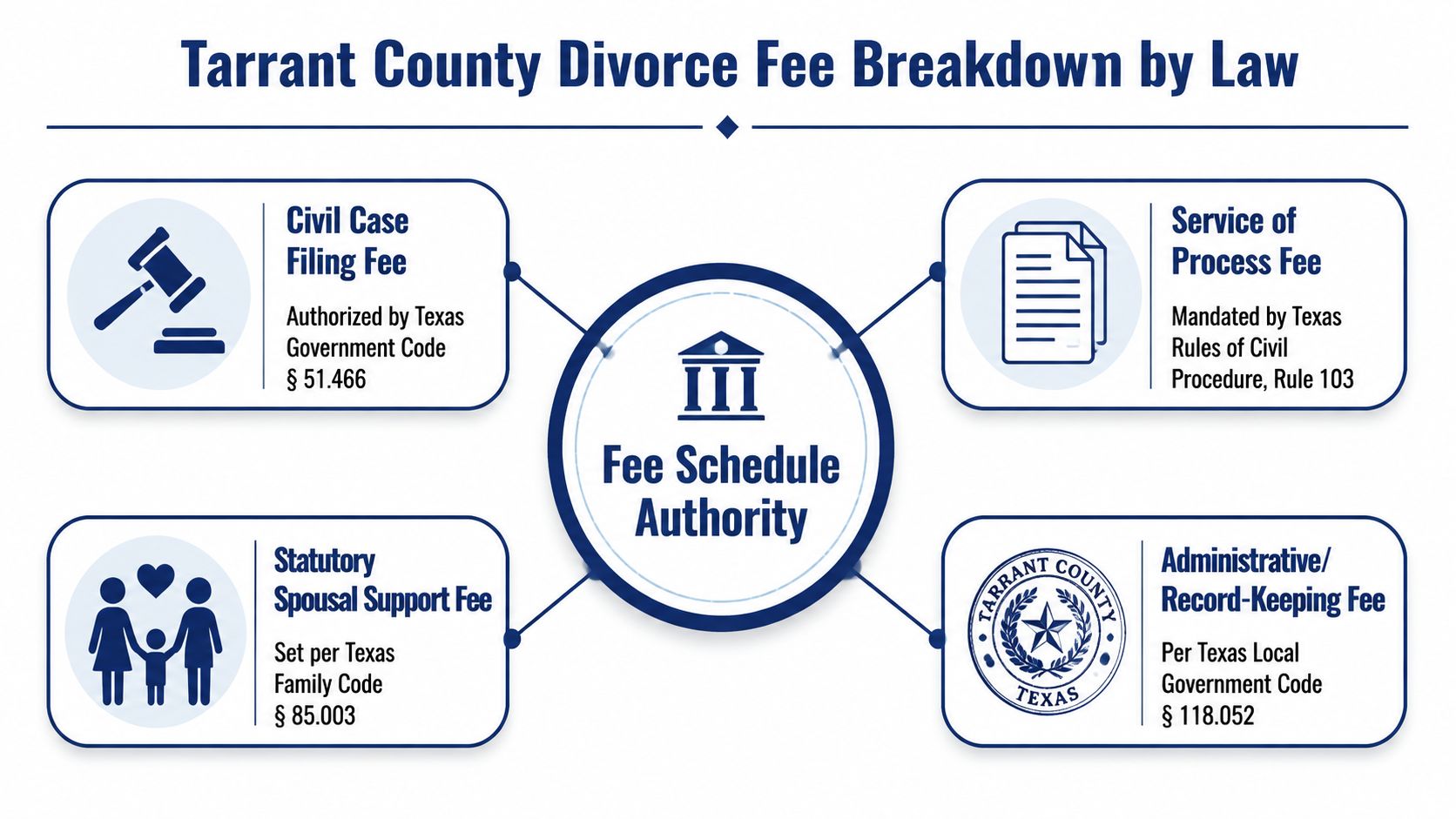
That structure explains why the filing amount changes when children are involved. The clerk collects the charges required for the applicable case category. The additional amount isn't an optional convenience fee that a filer can remove from the petition.
The law can change, and the county's schedule can be updated to reflect those changes or local actions. For that reason, check the current schedule before filing rather than treating an older fee sheet as permanent.
Filing Fee Waiver and Deferral Options in Tarrant County
If you can't afford court costs, Texas provides a process for asking the court to waive or defer payment. The form commonly used is the Statement of Inability to Afford Payment of Court Costs. Tarrant County filers should obtain the current form and follow the clerk's filing instructions.
The form asks for financial information, including income, expenses, property, dependents, and other facts relevant to your ability to pay. The clerk or judge may review that information to determine whether you qualify. Don't guess or leave out information that makes your financial position look less difficult. Accuracy matters.
What can happen after filing
A declaration may result in different payment treatment depending on the circumstances:
- Full waiver: Qualifying court costs may be waived under the court's order.
- Deferral: Payment may be postponed rather than eliminated.
- Installments: The court may allow payment over time when appropriate.
A granted waiver generally addresses court charges covered by the order, including applicable filing, citation, or service costs. It doesn't necessarily cover a private process server's separate charges if you independently choose that service. Ask before hiring a private provider.
A declaration can also be challenged during the period allowed by the applicable procedure. A person who knowingly provides false information may face legal consequences. The practical recommendation is direct: complete the form carefully, attach or provide requested information, and keep a copy of everything submitted.
If the court denies the request, ask the clerk what payment must be made and by when to keep the case moving. A waiver request is not a reason to ignore a filing notice or assume the case will proceed without further action.
Related Divorce Costs Beyond the Filing Schedule
The filing schedule answers the court-cost question, but a divorce budget may include expenses paid to people or providers outside the District Clerk. Those expenses depend on the facts, the level of conflict, the service method, and whether the spouses can resolve the case without hearings or professional assistance.
A private process server may charge $75 to $150 per attempt, while mediation may cost $100 per party for court-ordered sliding-scale sessions or $250 or more per hour for private mediators, based on the planning figures identified for this topic. Those are not amounts you should assume will apply to every case. Confirm the actual price directly with the provider.
Build a working budget
| Cost Item | Typical Range | Paid To |
|---|---|---|
| Private process server attempt | $75 to $150 | Private process server |
| Mediation, sliding-scale session | $100 per party | Mediation provider |
| Private mediation | $250 or more per hour | Private mediator |
| Certified copies | Varies by record request | District Clerk |
| E-filing convenience charge | Varies by provider | E-filing service provider |
The clerk's own service example remains the most useful court-cost reference for the opening filing, while private-provider charges must be quoted separately. E-filing convenience charges also aren't the same as statutory court fees, even though they may appear during the submission process.
If you're preparing for a consultation, use this guide to what to bring to your first meeting with a Fort Worth divorce attorney to organize the documents and questions that can affect your overall budget. A complete financial picture helps identify property, support, service, and records issues before they become expensive surprises.
Where to Confirm the Current Schedule and Hours
Before paying a filing fee, check the Tarrant County District Clerk's official website and the current family filing fee PDF maintained by the clerk's office. Those sources should control over a general divorce article, a social media post, or an old form saved on your computer.
Filings may be handled through the District Clerk's family-law operations serving the Fort Worth area and other Tarrant County locations. Confirm the correct courthouse, filing window, accepted payment method, and current operating hours before traveling from Arlington, Mansfield, Northeast Tarrant County, or another surrounding community.
For location guidance, review this Tarrant County Family Law Center resource before you go. It can help you identify the building and floor information associated with family-law services, but you should still confirm details with the clerk because local operations can change.
Don't rely on an assumed processing time for either paper or electronic filing. The clerk must review a submission, and a rejected e-file may require correction and resubmission. Ask the clerk's family-law desk about current hours, payment procedures, filing acceptance, and processing expectations on the day you plan to submit.
The Texas Legislature can amend statutory fees, and local actions can affect the published schedule. Verify the amount immediately before filing, especially if you prepared your petition weeks earlier.
Practical Next Steps for Fort Worth and Tarrant County Residents
Start with your case facts, not the payment screen. Gather identification, Social Security numbers, your marriage certificate, and information about any children. Also collect records that may affect property, debt, income, insurance, retirement, or support issues.
Then decide how you'll submit the petition. Some Fort Worth residents may file in person through the appropriate downtown family-law facility, while others may use the statewide electronic filing system. Confirm the current location and filing method with the District Clerk before making the trip or uploading documents.
Use this filing checklist
- Confirm the county and case category. Make sure Tarrant County is the correct place to file and determine whether the case involves children.
- Price the opening process. Include the applicable petition fee, citation issuance, service, and any expected certified records.
- Ask about inability to pay. If you can't afford the costs, complete the current Statement of Inability to Afford Payment of Court Costs instead of assuming you must pay the full amount.
- Confirm the clerk's figures. Call the District Clerk at (817) 884-1550 before paying to verify the current amount and accepted payment process.
- Choose a service plan. Decide whether your spouse will be formally served or whether another legally permitted approach applies to your circumstances.
- Get support for complicated issues. Consider a child support clinic, family-law mediator, or self-help resource listed through the Tarrant County Law Library if you're handling the case without counsel.
A divorce filing also begins important procedural timing under Texas law, including residency and waiting-period requirements. Don't file casually because a mistake in the petition, service, or supporting documents can create delay.
For a broader procedural overview, review the Tarrant County divorce procedures guide and compare it with current clerk instructions. If your case involves children, significant property, safety concerns, disputed support, or a spouse who won't cooperate, get legal advice before filing rather than trying to repair a strategic mistake later.
The Law Office of Bryan Fagan PLLC can help Fort Worth and Tarrant County residents evaluate filing costs, service options, child-related issues, and the documents needed to begin a divorce. Visit Law Office of Bryan Fagan PLLC to learn about the firm's family-law services and schedule a consultation about your situation.
